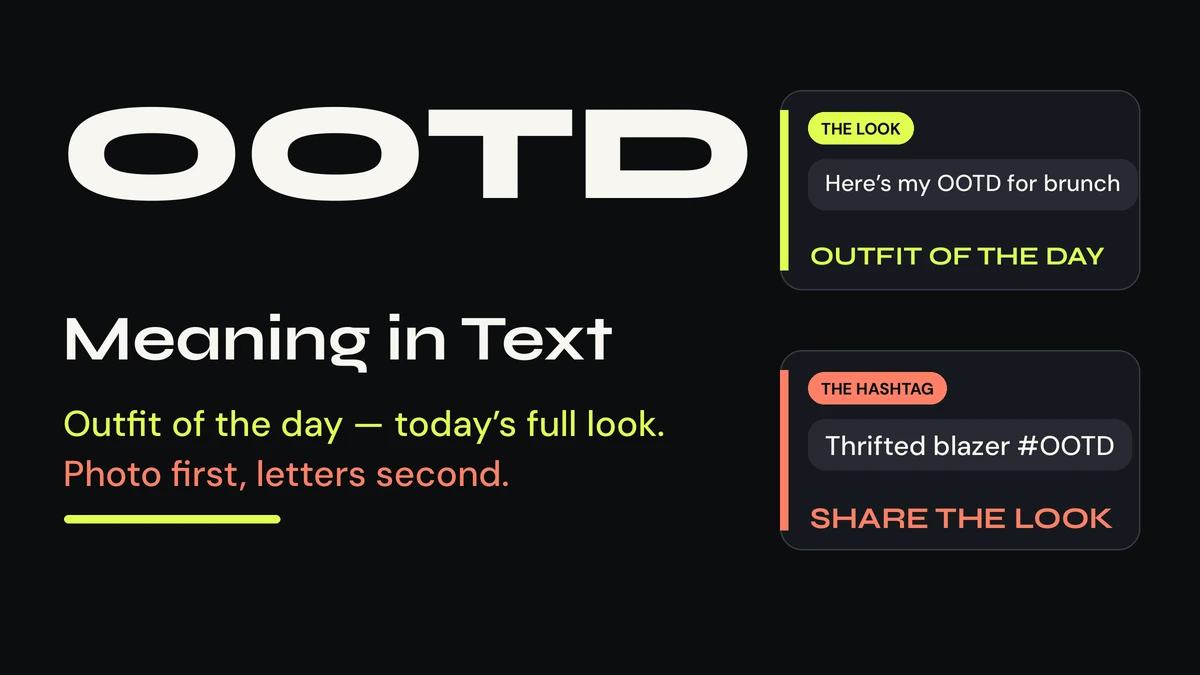
What does ootd mean in text? OOTD means “outfit of the day” — the clothes, shoes, and accessories someone is wearing today, usually shared as a photo or video. This guide to ootd meaning in text gives you the OOTD Three-Photo Test, so you can tell in seconds whether the OOTD you just got is a proud reveal, an honest opinion request, or a compliment.
This guide covers the one dictionary-backed meaning, the three-check test, seven tones, OOTD on TikTok, Snapchat, Instagram, and in texts, how it lands by sender, when it crosses a line at work, school, and home, graded claims, cousins, a dated history from fashion blogs to RushTok, and a reply bank keyed to the ask you just identified.
What “OOTD” Means in Text
OOTD is an initialism: take the first letters of the phrase “outfit of the day” and squeeze out the spaces, and you get O, O, T, D. Say it letter by letter — “oh-oh-tee-dee” — because nobody pronounces it as a single word. Strictly it names one thing, the outfit itself, but in practice it names three: the outfit (“love your OOTD”), the photo of it (“we took OOTD pics”), or the post (“my OOTD is up”). The letters are a label for a look, and the look is the point — an OOTD without a photo is a promise, not a post.
The dictionary record is unusually strong for a slang term, and this guide leans on all of it. Wiktionary, read directly for this article, lists OOTD as fashion and internet slang, an initialism of “outfit of the day,” and backs it with press citations: The Atlantic in February 2021, on shoppers who wanted their hashtagged OOTD to be “colorful and weird and stand out on social media”; The Guardian in May 2023, on sorority recruits sharing daily OOTDs during rush; and the Los Angeles Times in August 2023, in its guide to RushTok, on recruits describing their OOTD for each sorority event. Dictionary.com, also read directly, calls it an internet abbreviation for outfit of the day that “refers to what someone’s wearing on a particular day, usually in the context of fashion blogging,” and adds that it can also mean a particularly fashionable outfit, or the photoshoot involved in taking an OOTD photo for a social network; its page is dated 1 March 2018 and describes itself as an informal word summary, not a formal definition, and this guide grades it accordingly. Cambridge Dictionary goes further and gives OOTD a real entry: an abbreviation for “outfit of the day,” a set of clothes worn on a day or occasion, with examples including “Kendall Jenner’s OOTD might inspire you to wear a minidress over trousers, too,” and the note that “OOTD remains one of the most popular and enduring types of social media content.” No dedicated Merriam-Webster entry for OOTD exists — a search surfaces only a rhymes and related-words page for “outfit” — so the abbreviation’s dictionary record rests on Wiktionary, Dictionary.com, and Cambridge, and this guide says so rather than pretending otherwise.
Two small spelling facts finish the definition. The hashtag form, #OOTD, files the post into one of the most-used fashion hashtags on the internet, which is why the tag does real work: it is a genre label, not just a caption. And the lowercase form, ootd, means exactly the same thing as the capitals — case changes nothing here, only the volume. One more thing the dictionaries agree on, and ProWritingAid states it plainly: you probably would not call your current outfit an OOTD if it is just something you threw on at random. The term implies you are proud of the outfit you chose. An OOTD is a look worth showing, and the showing is half the meaning.
The OOTD Three-Photo Test
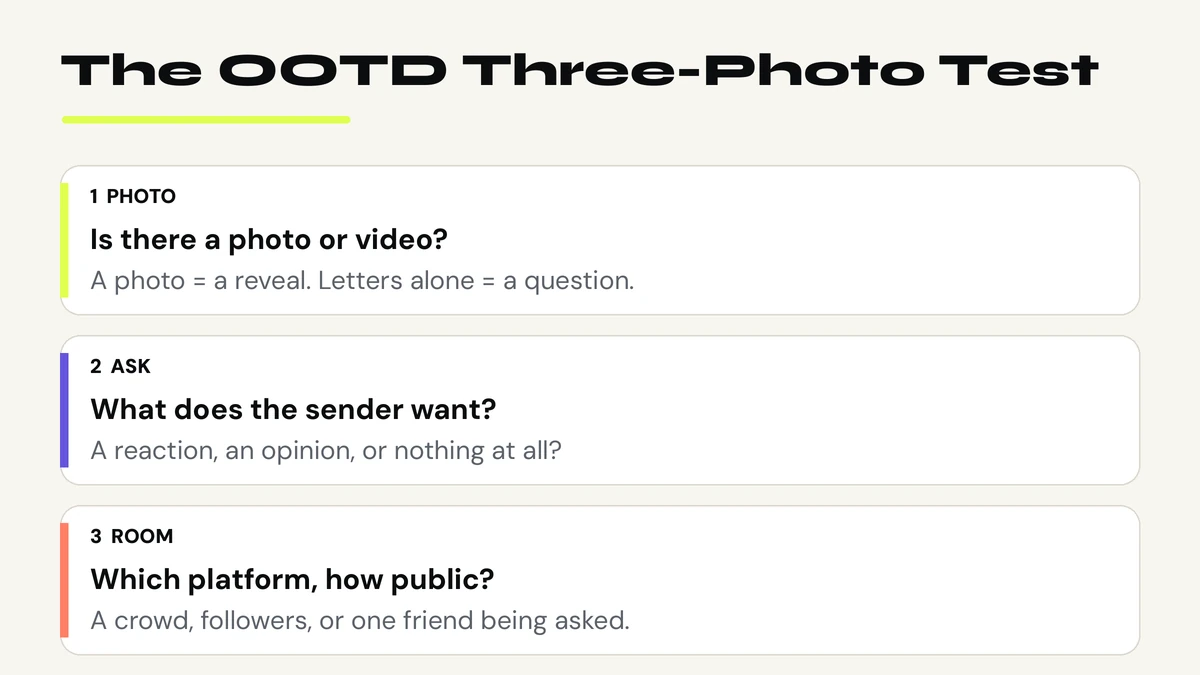
Before you answer an OOTD — or post one — run three checks. They take about five seconds, and they beat every shortcut the competitors offer, because the competitors all list five uses or six mistakes without giving you a procedure for reading a single message:
- Check 1 — The Photo Check. Is there a photo or a video, or just the letters? A photo means a reveal: the look is the message, and your job is to react to it. Letters alone usually mean a question or a reference to a look you already saw — “what was your OOTD?” is asking about a memory, not showing you one. No photo, no reveal; the check tells you which half of the conversation you are in.
- Check 2 — The Ask Check. What is the sender asking for? A reaction, an opinion, or nothing at all? “Thoughts?” or “rate it 1-10” is an opinion request, and it deserves a real answer, not a like. A fire emoji or “today’s OOTD” with no question is a hype request: the sender wants applause, not advice. No question and no hype is just sharing — the sender is filing the look away, and a save or a short compliment ends it cleanly.
- Check 3 — The Room Check. Which platform, and how public is it? A TikTok video is a performance for strangers, and the comments are a crowd. An Instagram caption is a post for followers, and the hashtag files it for anyone searching. A private text or DM is a question for you alone, and the answer is expected to be honest. The same four letters mean a different job in each room, and the room is what tells you whether you are an audience, a follower, or a friend being asked.
Worked trio. “Here’s my OOTD for brunch today” plus a mirror selfie in a group chat: photo yes, ask a reaction, room friends. A proud reveal — compliment the look, not the letters. “Rate my OOTD 1-10, be honest” in a DM: photo yes, ask an opinion, room private. An opinion request — be specific and kind, because honesty was invited. “Thrifted blazer, vintage jeans #OOTD” under a public post: photo yes, ask nothing, room the whole internet. A filed inspiration — save it, ask where the blazer is from, or scroll on. Three messages, one abbreviation, three jobs — and the test, not the spelling, sorted them.
“OOTD” in Real Chats
Illustrative examples written for this guide, not real transcripts:
- The brunch reveal. “Here’s my OOTD for brunch today.” A photo follows, full-length mirror, decent light. The letters are the caption; the photo is the message. Reply to the look, not the abbreviation.
- The pre-party opinion request. “Sending my OOTD — be honest, are the boots too much?” The letters arrive as a question, and the question is the whole point. A vague “cute!” wastes the ask; a specific answer repays it.
- The thrift flex. “Today’s OOTD is entirely thrifted, total cost $14.” The price is part of the look. The sender is not just showing clothes; they are showing what fourteen dollars can do.
- The group chat rating. “Rate my OOTD 1-10, be honest.” A game with scores, and the group plays along: “solid 8, the sneakers are doing the work.” The rating is the fun; the outfit is the excuse.
- The compliment. “Okay OOTD!! You understood the assignment.” Nobody is showing their own outfit here. OOTD has become praise — a title handed to someone else’s look, the way you would call a meal a feast.
- The saved inspiration. “Saving this OOTD for a wedding guest look.” The letters are a filing label. The sender is not talking to the poster at all; they are talking to their future self, and the save button is the reply.
- The airport mirror selfie. “Airport ootd.” The classic format: a full-length mirror, a suitcase in the corner, the outfit defended by daylight. No question, no rating, just the look — and a thousand strangers will file it under the hashtag.
The OOTD Tone List

OOTD’s meaning never changes; its feeling slides across seven readings, proudest to quietest. The first three are the ones you will see every day; the last two are the ones that reward a closer look:
- Proud reveal: “Here’s my OOTD for the concert!” The sender is happy with the look and wants you to see it. The exclamation mark is the pride, and the photo is the proof.
- Playful rating ask: “Rate my OOTD 1-10, be honest.” A game, not a verdict. The sender is inviting judgment on purpose, and a number with one specific note is the correct score.
- Warm compliment: “Okay OOTD!! You understood the assignment.” The letters praise someone else’s look. The warmth is the point; the outfit is only the occasion.
- Casual everyday share: “Today’s ootd, nothing fancy.” Lowercase, unhurried, unbothered. The sender is documenting the day, not auditioning for it, and the look is allowed to be ordinary.
- Ironic joke look: “My OOTD is pajamas and a blazer for the video call.” The joke is the gap between the word “outfit” and the reality. The sender knows it is funny, and the laugh is the reply the post was built for.
- Thrift flex: “Thrifted OOTD, total cost $14.” The flex is the price, not the label. The sender is proud of the hunt, and the number is the headline.
- Quiet inspiration save: “Saving this OOTD for later.” No audience, no performance. The sender is filing someone else’s look for a day they have not dressed for yet, and the save is silent by design.
What moves a reading between these tones is never the letters alone: it is the photo (is there one, and does it show a look worth the label?), the ask (a reaction, an opinion, or nothing?), and the room (a crowd, followers, or one friend?). The same “ootd” that is a proud reveal on Saturday can be an ironic joke on Monday — and the test, not the spelling, tells you which day you are on.
“OOTD” on TikTok
On TikTok, OOTD is a content genre, not just a caption: outfit videos, mirror transitions, fit checks, and styling series — office OOTDs, vacation OOTDs, concert OOTDs — under the #OOTD hashtag. The main competitor reports billions of views under the tag, a figure this guide repeats as competitor-reported, not as an independently checked statistic. The video format changes the job: a photo shows a look, but a transition shows it being built, and the comments become a crowd rating the reveal in real time. A fashion video that lands on the For You page reaches strangers who never asked for it, and our FYP guide covers that page in full, because the For You page is where an OOTD stops being a post for friends and becomes a post for everyone.
TikTok is also where OOTD met its biggest stage, RushTok. In 2023, sorority recruits at Southern universities filmed daily OOTDs for each rush event, and The Guardian and the Los Angeles Times both documented the wave — the Guardian on daily OOTDs and rush recap videos, the Times on recruits describing their OOTD for each of the main events. The format is the same as any OOTD, only the stakes are higher: the look is being judged as part of a week of being judged. And TikTok is where the niche-aesthetic OOTD lives — a look only a small corner of the internet will recognise — which is exactly the kind of inside joke our IYKYK guide covers, because an OOTD that only insiders get is a wink, not a broadcast.
“OOTD” on Snapchat
On Snapchat, OOTD gets the casual version: a quick mirror snap captioned “ootd” sent to close friends for a vibe check. The disappearing format suits the opinion request best — “does this work?” is a question for one friend, not a crowd, and the snap is gone before anyone else can weigh in. The private room makes the honesty easier: a close friend will tell you the boots are too much, and a crowd never gets the chance.
Snapchat is also where the photo does half the work and disappearance takes the other half away. A snap of the outfit plus “ootd” needs no explanation: the image names the look, and the letters only file it. But disappearance also removes your evidence: if a friend’s reaction stung, you cannot re-read the snap, so judge from memory what rode with it — a fire emoji, a question mark, or nothing at all. And because streaks run on speed, ootd is a streak-saver: a look in four letters keeps the conversation alive when a full sentence would slow the whole exchange down.
“OOTD” on Instagram
On Instagram, OOTD lives in captions, carousel posts, and story try-ons, and the mirror selfie with the outfit tagged piece by piece is the classic format. The hashtag does the filing: it puts the photo into one of the most-used fashion hashtags on the internet, where strangers looking for outfit ideas will find it, save it, and ask where a piece is from. Dictionary.com notes that OOTD posts often identify brands and purchase sources for individual pieces — the caption is a shopping list as well as a look — and the scale is large: one social-media guide reports over 400 million posts under #OOTD on Instagram alone, a figure this guide repeats as competitor-reported, not as an independently checked count.
Instagram is also where OOTD meets its closest platform trap: reading a public comment as a private verdict. A stranger’s “love this OOTD” under your post is a reaction to a photo, not a judgment of you, and answering it with a long explanation embarrasses both sides. A thank-you, a matching compliment, or a save all end it cleanly; the comment was never asking for more. The exception is a DM that keeps asking for styling advice across several messages — that is a conversation, not a comment, and the reply section below covers it. For a business, OOTD is one of the safer slang terms to use in a casual reply — a boutique answering “OOTD goals!” under a customer’s photo feels warm — but avoid it when the customer is asking a real question about sizing or stock, because a fashion label is not an answer.
“OOTD” in Text Messages
Plain texts are OOTD’s home ground for the opinion request, and the one-to-one setting makes the distinction sharpest. A proud text wants a witness: “Here’s my OOTD for tonight, I feel amazing.” An opinion text wants a verdict from you: “Be honest, are the boots too much?” The reply each one deserves is completely different, which is why the Ask Check comes before the reply — answering an opinion request with a bare like, or a proud share with a long critique, is the classic OOTD misfire. Lowercase ootd is common here, because texts are typed fast and lowercase reads softer; capitals in a text are a choice, and a choice is information.
Texts are also where an OOTD opinion turns into a longer conversation, and the conversation usually moves somewhere private. A friend who replies with a real opinion often follows up with the details themselves — the link, the store, the swap — and our DM guide covers that move in full, because the channel changes what the next message can say. And texts are OOTD’s work limit in miniature: never send an OOTD in a professional message. A client, a manager, or a first contact deserves plain language, not four letters that presume a casualness you do not have — and never one that could be read as showing off.
Who Is Sending It: How “OOTD” Lands by Sender
No source documents a different meaning of OOTD per sender — the outfit stays fixed; what changes is which tone you should expect, and therefore what you owe back:
- Friend: the default. A friend’s OOTD is usually an opinion request or a proud share at face value; run the test and answer that, not the letters.
- Crush: overread territory. A crush’s OOTD feels bigger than it is — usually “look at my outfit,” not a confession about you. Answer the look, not a romance you invented.
- Partner: pattern rules. A partner’s OOTD is usually a routine share before heading out; the opinion is the gift, so give a real one, not a reflex “looks great.”
- Sibling: brutal honesty expected. A sibling’s OOTD is an invitation to be blunt, and a sibling who asked for honesty and got flattery will ask again louder.
- Parent: usually literal and plain. A parent who sends an OOTD has usually learned it from you and means the share plainly; do not read a parent’s OOTD as a performance unless the caption is clearly showing off.
- Coworker: context decides. In a friendly team chat an office OOTD is a normal share; in any formal thread it is out of place, and never send one upward to a manager or client.
- Stranger or creator: the inspiration habitat. A stranger’s OOTD under a hashtag, or a creator’s OOTD in a styling series, is a public post, not a message to you personally. A thank-you, a save, or a question about one piece is enough; never answer a public post with a private confession about your own wardrobe.
When “OOTD” Is Too Much: Work, School, and Family
OOTD’s risk is not rudeness — the word is clean, and there is no vulgar reading to dodge — but the flex: it can make a normal day sound like a performance, and a person who cannot afford the look feel small. Four rooms, four rules. At work: never send an OOTD in a professional message, a client thread, or a formal channel. A yes among close peers in a casual chat is one thing; the same letters answering a client’s genuine question read as showing off, and a client who feels shown up does not come back. If the room would want the information, give it in full words: “Here is what I am wearing today.”
At school: the same rule, with a younger audience, and the same edge in miniature. Teachers, school groups, and class chats are not OOTD rooms, and a student who posts a designer-tagged OOTD in a class chat has sent a small flex whether they meant to or not. In family chats, read the room person by person: a sibling group may love the shortcut, a grandparent group may not know the letters, and a parent who dislikes being made to feel out of touch will dislike the abbreviation exactly as much as the full phrase, once they learn what it stands for. Abbreviation is not permission. The general rule covers every room at once: if someone tells you OOTD bothers them, simply stop. Switching words is easy, and it shows respect. The swap menu is free and it loses nothing: “Here is my outfit today” for a share, “What do you think of this look?” for an opinion request. And one boundary worth stating plainly: never use an OOTD to dress up showing off at somebody who had every right to dress plainly, because you cannot control who reads it or how it lands.
Checked Claims: Expansions That Do Not Hold Up
Four letters attract folklore, and a word this popular attracts more than most. Each claim below was graded against the dictionaries read in full and the competitors read in full; nothing is repeated here as fact on a single blog’s say-so:
- “OOTD means ‘out of the door’” — rejected. The misread circulates on low-quality guides, but no dictionary supports it, and no source in this build documents it as a live meaning. It is a guess built from the first letters, not a sense of the term.
- “OOTD means ‘offer of the day’” — rejected. One shopping guide lists it as a meaning, but no dictionary supports it, and no source in this build documents it as a live texting meaning. A sale is not an outfit, and a discount code is not a look.
- “OOTD is just for girls” — rejected. Men’s fashion OOTDs are a thriving niche on TikTok and Instagram — the main competitor says so plainly, and the second competitor devotes a whole section to men’s OOTDs. The acronym describes any outfit share.
- “OOTD is a romantic or flirty code” — rejected. One competitor states it plainly: OOTD is typically casual and not flirtatious by default, and the tone depends on context, not the word itself. A look is not a love letter.
- “OOTD was invented on TikTok” — rejected. TikTok spread the word; it did not invent it. The term was born in fashion blogging in the late 2000s, the hashtag first appeared on Twitter in 2009, and it took off on Instagram in 2011. TikTok is the stage, not the author.
- “OOTD is the same as OOTN or GRWM” — rejected as an equation. The words overlap only in the fashion family. OOTN is the night look, and GRWM is the getting-ready process, not the result. A daytime outfit is not a night outfit, and a video of getting dressed is not the outfit itself.
- “Lowercase ootd and uppercase OOTD mean different things” — rejected. Every source in this build agrees: case changes nothing here. Lowercase reads softer and faster, capitals read louder, but both mean “outfit of the day.” What changes the reading is the photo, the ask, and the room — never the case alone.
- “Any outfit counts as an OOTD” — qualified, not rejected outright. ProWritingAid argues the term implies pride in the outfit you chose, and you would not usually call something thrown on at random an OOTD. But the line is social, not dictionary: no dictionary draws it, and a lazy-day OOTD posted as a joke is still an OOTD. Treat it as a norm, not a rule.
What SURVIVES: OOTD means “outfit of the day,” the clothes, shoes, and accessories someone is wearing today, with the seven tones above as feelings of the same share — not different meanings; the word names the outfit, the photo, or the post, and the hashtag files it; the timeline is dated, not guessed — fashion blogs in the late 2000s, Twitter in 2009, Instagram in 2011, RushTok in 2023; and the Photo, Ask, and Room checks are the one procedure every claim in this build agrees on.
“OOTD” vs Its Closest Cousins
OOTD belongs to the fashion-and-social-media family — words that show a look, a process, or a reaction to one. Its closest cousins split by what part of the look they cover:
- OOTN (night cousin). Outfit of the night, the evening look. OOTD is the day’s outfit; OOTN is the one for going out. Same format, different hour — and the two together are the most common day-and-night pair in the family.
- GRWM (process cousin). Get ready with me, the video of assembling the look on camera. GRWM is the process, OOTD is the result: one shows the getting dressed, the other shows the dressed.
- WIWT (past-tense cousin). What I wore today, the look you already wore. WIWT looks backward at a finished day; OOTD usually shows a look that is still being worn.
- FR (co-sign cousin). Our FR guide covers the sincerity stamp that certifies a claim. A comment that reads “fr, that fit is fire” uses FR to swear the OOTD is real: one word shows the look, the other certifies the feeling behind it.
- IKR (agreement cousin). Our IKR guide covers the echo that agrees with a feeling. A reply of “ikr, the boots” agrees with the taste and confirms the look; IKR shares the judgment, OOTD shows what was judged.
- GNG (going-out cousin). Our GNG guide covers the going word that states a plan. “OOTD for where I’m gng” pairs the look with the movement: OOTD says what, GNG says where — and the two together are the most common going-out pair in the series.
Where “OOTD” Came From
The phrase came first, by decades. “Outfit of the day” is ordinary English for the clothes you are wearing today, and it was a complete, ordinary phrase long before anyone typed it. The abbreviation is the new part, and it was born the way most fashion abbreviations were: out of a label. In the late 2000s, fashion bloggers needed a quick tag for daily outfit posts, and OOTD was the label they chose. When Instagram and Pinterest took over fashion discovery in the 2010s, #OOTD became one of the most-used fashion hashtags on the internet, and the tag did what tags do: it filed millions of photos into one searchable pile.
The dates are unusually well documented for a slang term, and this guide reports them as the dictionaries report them. Dictionary.com, as read by the main competitor’s research, puts the hashtag’s first appearance on Twitter in 2009, its take-off on Instagram in 2011, and its trending moment by 2012. The second competitor traces the same path through Tumblr and the street style blogs of the early 2010s, then Instagram, then video on YouTube and TikTok. The video era gave the term its biggest stage: in 2023, RushTok turned the daily OOTD into a recruitment ritual, documented by The Guardian and the Los Angeles Times in the same season, and the format — a mirror, decent daylight, an outfit you would defend — has not changed since the first blog post.
The family grew around it. ProWritingAid lists the siblings: OOTW for outfit of the week, MUOTD for makeup of the day, and NOTD for nails of the day — the same “of the day” frame, pointed at a different part of the look. The phrase stuck because it names something people genuinely want to share, as the second competitor puts it: the small daily act of getting dressed with intention. It flatters the poster, feeds the scroller ideas, hands brands free marketing, and anyone can join with one photo. As long as people get dressed and phones have cameras, the outfit of the day is not going anywhere — and Cambridge Dictionary agrees, calling it one of the most popular and enduring types of social media content.
How to Reply When Someone Sends “OOTD”
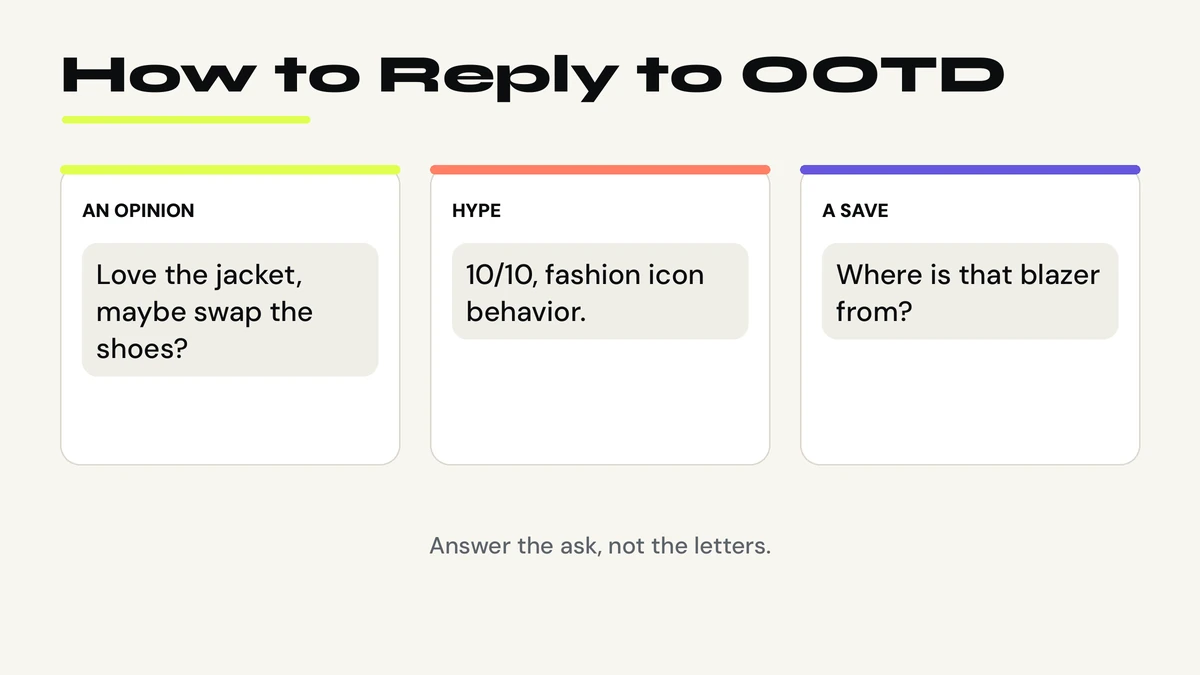
Golden rule: answer the ask the test found, not the letters. A reply bank keyed to the ask:
- Opinion request — be specific and kind: “Love the jacket, maybe swap the shoes?” beats “cute.” The sender invited honesty, so honesty with one concrete note is the reply the question was built for.
- Hype request — hype back: “10/10, fashion icon behavior.” The sender wants applause, not advice, and a matching cheer is the whole reply. Do not answer hype with a critique nobody asked for.
- Caption — engage the content: Ask where a piece is from, or save it for inspiration. “Where is that blazer from?” is a better reply than a bare like, because the caption was filed for people looking for ideas.
- Not into fashion — keep it simple: “You look great!” is always correct. No styling vocabulary is required, and nobody ever got hurt by a plain compliment.
- The daily flood — a like counts: If it is the forty-seventh OOTD this week, a like or a reaction emoji is enough. You do not have to reply to every one, and the sender knows the format is daily.
- Turn it into an opinion — say what you think: A look deserves a verdict, and our IMO guide covers the opinion word in full, because “imo the boots make the whole look” turns a bare reaction into a real answer, and a real answer is what an opinion request was asking for all along.
Frequently Asked Questions
What does OOTD mean in a text message?
OOTD means “outfit of the day” in a text message — the clothes, shoes, and accessories someone is wearing today, usually shared with a photo. It often arrives as an opinion request (“here’s my OOTD — thoughts?”). Run the Three-Photo Test before you decide which job you just got.
What does OOTD stand for?
OOTD stands for “Outfit Of The Day.” It is an initialism, pronounced letter by letter as “oh-oh-tee-dee,” and it names the outfit itself, the photo of it, or the post showing it.
What does OOTD mean on TikTok?
On TikTok, OOTD is a content genre: outfit videos, mirror transitions, fit checks, and styling series under #OOTD. It also carries the RushTok history — sorority recruits filming daily OOTDs in 2023 — and the niche-aesthetic OOTD that only insiders recognise.
What does OOTD mean on Instagram?
On Instagram, OOTD is a caption and hashtag on a photo of what someone is wearing that day — usually a mirror selfie with the outfit tagged piece by piece. The hashtag files the post for strangers looking for outfit ideas, and the post often names brands and purchase sources.
Is OOTD just for girls?
Not at all. Men’s fashion OOTDs are a thriving niche on TikTok and Instagram, and the second competitor in this build devotes a whole section to men’s OOTDs. The acronym describes any outfit share.
Is OOTD flirty?
Usually not. OOTD is typically casual and not flirtatious by default; the tone depends on context, not the word itself. A look is not a love letter — though a crush’s OOTD can feel bigger than it is, and the sender section above covers that trap.
Can I use OOTD at work or school?
Generally, no. OOTD belongs in casual digital conversations. In work messages, formal chats, or school messages it can sound unprofessional, and a designer-tagged OOTD in a class chat reads as a flex. In a casual peer chat about a look, it is fine; anywhere formal, spell it out instead.
What is the difference between OOTD and OOTN?
OOTD is the day’s outfit; OOTN (outfit of the night) is the evening look. Use OOTD for daytime shares and OOTN when the outfit is specifically for a night out. GRWM is different again — the getting-ready video, the process, not the result.
The Takeaway
OOTD means “outfit of the day”: today’s full look, shared as a photo or video. The meaning never changes; the job does — a proud reveal, an opinion request, a compliment, or a quiet save. When an OOTD lands, run the Three-Photo Test: check the photo, check the ask, check the room. And when you post one, remember the only rule that matters: the photo is the message and the letters are only the label — so if the look is worth showing, show it properly, in daylight, full-length, and let the outfit do the talking, because four letters can file a photo, but only the photo can wear it.