
What does GTS mean in text? In a late-night DM, GTS usually means “go to sleep” — a sign-off with an action attached. But the same three letters in a comment thread usually mean something else entirely, and under an old photo they mean a third thing. Context, not the letters, decides which GTS you just received. The Direction Test below tells you which one it is before you reply to the wrong one.
This guide to GTS meaning in text covers the three readings, the three-check Direction Test, a six-reading tone spectrum, GTS on TikTok, Snapchat, Instagram, and in plain texts, how it lands by sender, when it turns sharp, the claims that do not hold up, the cousins it gets confused with, its history from late-1990s messaging to comment culture, and exactly how to reply to each version.
What “GTS” Means in Text
GTS has three texting readings, and the honest first fact about them is this: the primary dictionary source does not attest any of them. Wiktionary‘s GTS entry lists technical and institutional senses — a global weather-data network, a seminary, a medical syndrome, a survey, a wrestling move — plus a separate adult-community abbreviation, but no texting sense at all. The texting readings below rest on broad agreement across independent secondary guides plus reported Urban Dictionary dates, and this article grades them that way instead of pretending a dictionary backs them.
Reading one: “go to sleep.” In private, late-night, one-to-one texting, this is the dominant reading — “It’s past midnight, you should gts,” or “I’m exhausted — gts, talk tomorrow.” The variant form “going to sleep” is the same reading with the verb changed, not a different meaning. Reading two: “Google that shit.” In public threads — Reddit, TikTok comments, Discord, replies on X — GTS is a sarcastic dismissal aimed at a question anyone could search: “How do I reset my AirPods?” / “Bro… gts.” (From here on, this guide writes it asterisked as “Google that sh*t,” except for that one plain statement above.) Reading three: “good times.” On Snapchat and Instagram, GTS captions a fun memory: an old road-trip photo with “GTS with these lot” underneath.
Three readings, three jobs. Go-to-sleep GTS ends a conversation with an instruction. Google-dismissal GTS ends a question with a shrug. Good-times GTS does not end anything — it celebrates something already over. Confuse them and the reply goes wrong in public: answer a dismissal with “good night” and you look lost; answer a sleep wish with “on it” and you look cold.
The GTS Direction Test
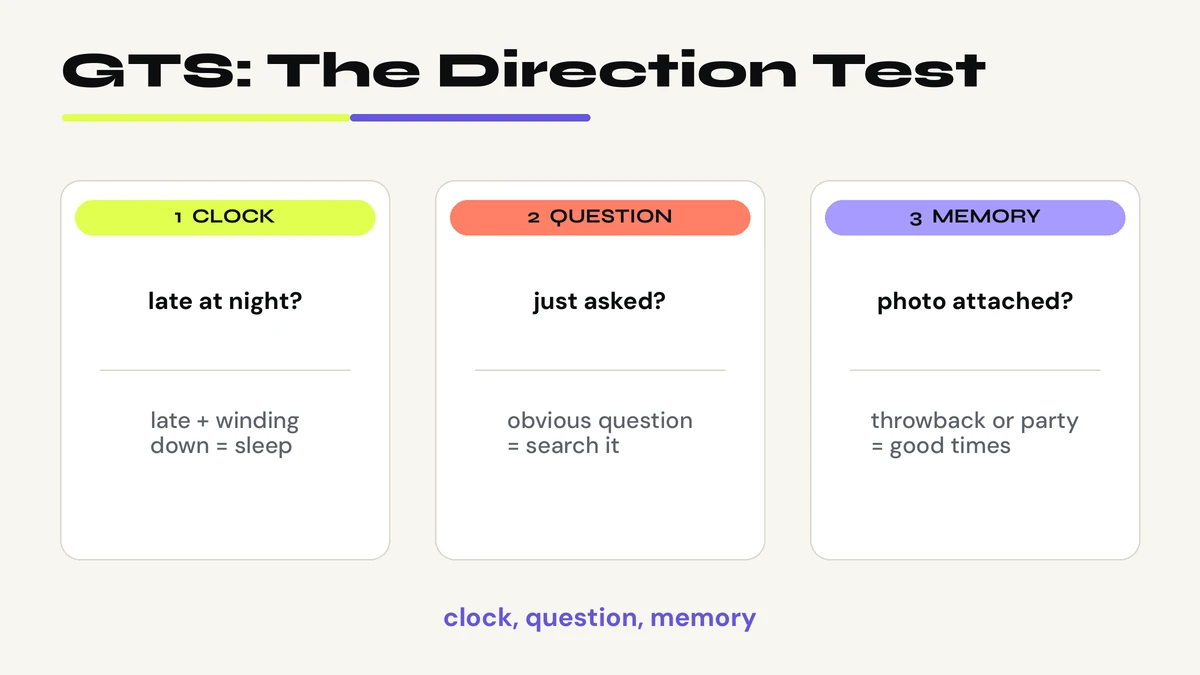
GTS has one real ambiguity, and it is not about tone: which meaning is this? Three checks settle it, plus one direction rule:
- Check 1 — The Clock Check. Is it late at night and is the conversation winding down? Late-night plus winding down points to “go to sleep.” A GTS at noon points anywhere but bedtime.
- Check 2 — The Question Check. Did someone just ask a question — especially an obvious one — in a public thread, comment section, or group? A question just asked points to “Google that sh*t.” No question, no dismissal.
- Check 3 — The Memory Check. Is the GTS attached to a photo, a throwback, a party, or a celebration? A memory attached points to “good times.” Memories do not need sleep or search.
The direction rule: who is the sentence aimed at? Self-directed GTS (“I need to gts,” “gts now”) is always go-to-sleep. Other-directed late at night (“you should gts”) is a sleep nudge. Other-directed after a question or a hot take in public is the Google dismissal — or the put-down, covered below. Worked trio: “It’s past midnight, you should gts” at 1 a.m. after a slowing DM — go to sleep. “How do I reset my AirPods?” / “Bro… gts” in a comment thread — Google that sh*t. An old road-trip photo captioned “GTS with these lot” — good times. Same letters, three different messages, and the checks never disagree once you run all three.
“GTS” in Real Chats
Illustrative examples written for this guide — not presented as real transcripts:
- The self sign-off. “I’m beat, gts now” — tired, neutral, the default late-night reading.
- The nudge. “It’s past midnight, you should gts” — care disguised as a command.
- The playful nudge. “Bro, gts already lol” — teasing, affectionate, from someone who knows you are still awake.
- The dismissal. “How do I reset my AirPods?” / “Bro… gts” — not about sleep at all; about search.
- The put-down. “You’re delusional lol, gts” — a hot take answered with a bedtime, not an argument.
- The caption. “GTS with these lot” under an old photo — warmth aimed backward, at a memory.
The GTS Tone Spectrum

GTS’s meaning changes with context; its tone slides within each meaning. Six readings, lightest to heaviest:
- Warm sleep wish: “GTS, sleep well, talk tomorrow” — care plus a promise of return; the closest GTS gets to a good-night.
- Playful nudge: “Bro, gts already lol” — teasing and affectionate; the friend who knows you are still scrolling.
- Plain self sign-off: “I’m beat, gts now” — tired, neutral, no extra meaning. The default late-night reading.
- Nostalgic good times: “GTS with these lot” — warmth aimed at a memory, not at bedtime.
- Sarcastic dismissal: “Bro… gts” after an obvious question — blunt and funny among friends, cold from a stranger.
- Put-down: “You’re delusional lol, gts” — not about sleep at all; a shut-up wrapped in a go-to-bed blanket.
The tone lives in the clock, the question, and the memory attached — not in GTS alone. When in doubt, assume the plain sign-off in a DM and the dismissal in a comment thread; the venue is the loudest clue you have.
“GTS” on TikTok
On TikTok, GTS is overwhelmingly the Google reading. Comment sections run on it: a creator asks something basic, a commenter answers “gts,” and the thread moves on. The dismissal is the platform’s house style — fast, public, and a little ruthless — and a GTS here is almost never a sleep wish, because nobody on TikTok is tucking you in.
The good-times reading shows up too, but only as a caption: a throwback clip or a night-out montage tagged GTS. The Direction Test still works — a GTS in the comments answers a question; a GTS on the video itself celebrates a memory.
“GTS” on Snapchat
On Snapchat, GTS splits two ways, and the clock decides. Late at night, a snap or DM saying “gts” ends the day: “Night fam, gts” as the streak closes. Attached to a throwback snap or a party story, the same letters mean good times: “GTS out here” at a pool party is a celebration, not a bedtime.
Snapchat is where the good-times reading is strongest, because the platform is built on moments rather than threads. A GTS without a question and without a late hour, sitting on a photo, is good times until proven otherwise.
“GTS” on Instagram
On Instagram, GTS lives mostly in captions and story text. A throwback post captioned GTS means good times; a late-night DM saying “gts” means go to sleep. The comment-section dismissal appears here too, but less fiercely than on TikTok — Instagram comments lean warmer, so a GTS dismissal here usually comes with a laughing emoji to soften it.
Instagram is also where misreading costs most: a good-times caption answered with “sleep well!” confuses everyone, because the poster was not going anywhere. Run the Memory Check first on any captioned GTS.
“GTS” in Text Messages
Plain texts are go-to-sleep GTS’s home ground. It pairs naturally with its sleep-family cousin GN — but the two are not twins. GN (“good night”) is a warm wish; GTS go-to-sleep is a command, a nudge, or a self-announcement with an action attached. “GN, sweet dreams” wishes you rest; “gts already” tells you to get it. It also travels with the reassurance cluster: “GTS, dw, we’ll sort it tomorrow” lets a worried friend sleep instead of spiraling — the nudge plus the reassurance, in one line.
Texts are also where GTS’s group life lives: “Night fam, gts” closes a group chat the way a door closes a room. And in a work Slack, none of the three readings belong — go-to-sleep is too casual, the Google reading is too blunt, and good times is too nostalgic for a channel. Spell the words out at work.
Who’s Sending It: How “GTS” Lands by Sender
No source documents a different meaning of GTS per sender — the meaning still comes from context; what changes is how each reading lands:
- Friend: the default for all three readings. A friend’s late-night “gts” is a nudge; a friend’s comment-thread “gts” is a joke; a friend’s captioned GTS is a memory. Read the venue, not the person.
- Crush: overread territory. A crush’s “gts, talk tomorrow” feels bigger than it is — it is a sign-off with a promise of return, not a confession. A crush’s dismissal “gts” stings more than a stranger’s; judge it by the question that came before it.
- Partner: the nudge habitat. A partner’s “you should gts” is care, plain and simple — the person who knows your morning alarm. A partner’s good-times GTS under a photo of the two of you is affection aimed backward.
- Parent: almost always the nudge. A parent’s “gts already” is the modern “lights out” — take it at face value and go to bed.
- Group chat / gaming squad: the sign-off habitat. A squad’s “night fam, gts” after a long session is a collective exit, not a message to one person — and nobody is owed a reply.
- Stranger in a comment thread: the dismissal habitat. A stranger’s “gts” is almost never about your sleep; it is about your question. Do not take it personally — and do not answer it with a good-night.
When “GTS” Turns Sharp
Two sharp edges, graded. First, the Google dismissal: “Google that sh*t” is sarcastic by design. Among friends it lands as a joke; from a stranger it lands as impatience. If you received it, the question was probably answerable in one search — that is the whole point of the jab, and answering it with anger proves the sender’s point. If you send it, know that the bluntness is the message: a softer cousin like FWIW (“for what it’s worth”) hedges an opinion before it is delivered, while a GTS dismissal sharpens one after it is asked. FWIW says “take it or leave it”; GTS dismissal says “you should already know.”
Second, the put-down: “You’re delusional lol, gts” after a hot take is not a sleep wish and not a search suggestion — it is a mild insult wearing a bedtime as a costume. The reply rule for both edges is the same: do not answer the sharpness. Answer the question (by searching it), answer the topic later, or let it go. And a warning for senders: a go-to-sleep GTS dropped mid-topic, mid-question, or mid-argument reads as a dismissal even when you meant tiredness. If the chat was not winding down, your GTS did ending work you did not say out loud — a follow-up tomorrow (“Sorry, I crashed — what were you saying?”) repairs it.
Checked Claims: Expansions That Don’t Hold Up
Three letters attract folklore. The claims that fail evidence:
- “GTS has only one meaning in text” — rejected. Three readings are attested across independent guides in different contexts; collapsing them misleads the reader.
- “Wiktionary proves GTS means ‘go to sleep’” — rejected. The Wiktionary GTS entry contains no texting sense at all; the texting readings are secondary-consensus, stated as such.
- “GTS means ‘getting too serious’” — graded unverified. It appears in one listicle only, with no corroboration, and is not taught here as a meaning.
- “GTS means ‘great to see’” — graded unverified. Same single-listicle status, no corroboration, not taught as a meaning.
- “GTS means ‘going through sh*t’ as a standard meaning” — graded weak. One competitor lists it as a lowercase rough-time aside; it is a possible informal aside, never a headline meaning.
- “GTS means ‘giantess’ in a text” — rejected as a texting meaning. Wiktionary attests it as a separate adult-community abbreviation, not a chat meaning; it is mentioned here only so readers do not mistake it for one.
- “GTS means a game, a transport service, or a medical term in a text” — rejected as texting meanings. Gran Turismo Sport, Ground Transportation Services, and the medical senses are community- and profession-bound; they never occur in a casual chat.
- “A GTS is always friendly” — rejected. The Google dismissal is sarcastic by design and the put-down is a mild insult; friendliness depends on the reading.
What SURVIVES: “go to sleep” (strong in private late-night texting), “Google that sh*t” (strong in public threads and comments), and “good times” (moderate, caption-bound) — three readings, chosen by the Direction Test, not by the letters. Everything else failed evidence.
“GTS” vs Its Closest Cousins
GTS belongs to two families at once — the endings and the dismissals — which is why it gets confused so often:
- GN (“good night”) — the sleep cousin. GN is a warm wish; GTS go-to-sleep is a command or nudge. GN says “sleep well”; GTS says “go to sleep.”
- GTG (“got to go”) — the departure cousin. GTG leaves for any reason at any hour; GTS go-to-sleep is night- and sleep-bound. GTG says “I have to leave”; GTS says “it is bedtime.”
- CYA (“see you”) — the goodbye cousin. CYA closes with a promise to return; GTS go-to-sleep closes with sleep. CYA says “until next time”; GTS says “good night, now go.”
- BRB (“be right back”) — the pause cousin. BRB promises a return in minutes; GTS ends the night. BRB says “hold on”; GTS says “we’re done.”
- GM (“good morning”) — the day-pair cousin. GM opens the day; GTS go-to-sleep closes it. GM says “I’m here”; GTS says “I’m done.”
- BTW (“by the way”) — the side-note cousin. BTW adds something extra mid-conversation; GTS ends it or dismisses it. BTW says “oh, also”; GTS says “go to sleep” or “go search it.”
GTS often travels with a promise — “talk tomorrow” — the cheapest way to soften any ending, and the difference between a warm close and a final one.
Where “GTS” Came From
Go-to-sleep GTS dates to late-1990s AOL Instant Messenger culture, where teenagers needed fast ways to enter and exit chats — the same AIM cradle that produced GN, whose first Urban Dictionary entry dates to 2004, the same year reported for GTS go-to-sleep. The pair are AIM-era contemporaries: one wished you a good night, the other told you to go and get one.
The Google reading followed in 2006 on Urban Dictionary, two years later, and grew with forums, Reddit, and comment culture into the dominant public-thread reading — a dismissal born when search engines made “just look it up” a complete answer. Good times is the youngest reading, tied to Snapchat and Instagram caption culture, with no attested first-use date claimed here. The wrestling “Go 2 Sleep” — the finishing move Wiktionary attests — is a separate branch, not the origin of the texting readings. No inventor or precise first-use date earlier than the AIM-era account is claimed; the 1990s origin is reported by secondary sources, not attested by a primary dictionary.
How to Reply When Someone Sends “GTS”
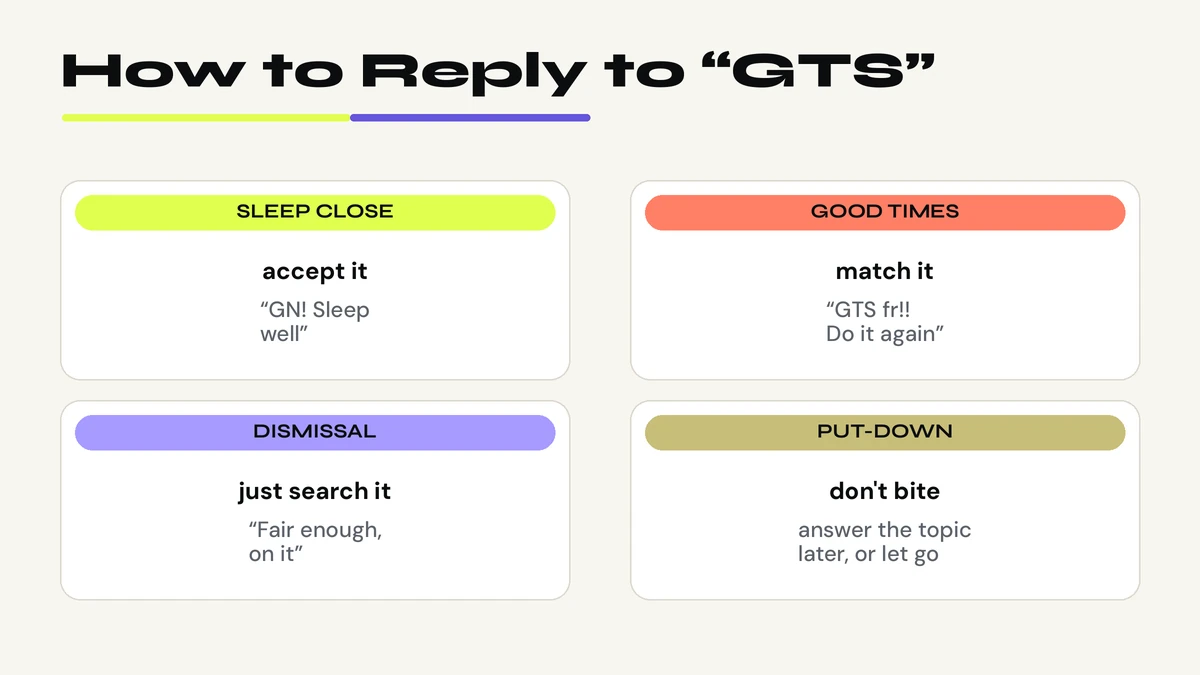
Five replies, matched to the meaning:
- Go-to-sleep, self-directed — accept the close: “GN! Sleep well”, “Talk tomorrow”. A sign-off deserves a sign-off.
- Go-to-sleep, you are the one told — deflect or negotiate: “You first”, “Lowkey yeah probably should”, or “Five more minutes, then I promise”.
- Good times — match the energy: “GTS fr!!”, “We need to do that again asap”, or add a specific memory: “Especially when [thing happened].”
- Google dismissal — just search it: “Fair enough”, “On it”. If the question was reasonable, say so once: “I tried, couldn’t find it” — then move on.
- Put-down — don’t answer the insult: answer the topic later, or let it go. Never answer a put-down GTS with a longer hot take; that is the argument the sender wanted.
What never works: answering a go-to-sleep GTS with a new question that needs an answer tonight, or answering a dismissal with a good-night. The golden rule: answer the meaning, not the letters.
Frequently Asked Questions
What does “GTS” mean in a text message?
Usually “go to sleep” — a late-night sign-off, nudge, or self-announcement. “I’m beat, gts now” is a farewell with an action attached, not a question.
What does “GTS” mean on TikTok, Snapchat, and Instagram?
It depends on the venue. On TikTok comments it usually means “Google that sh*t”; on Snapchat and Instagram captions it often means “good times”; in a late-night DM on any platform it means “go to sleep.” Run the Direction Test: clock, question, memory.
Is “GTS” rude?
It depends on the reading. Go-to-sleep GTS is generally friendly; good-times GTS is warm; the Google dismissal is sarcastic by design and the put-down is a mild insult. Read the venue and the question that came before it.
What’s the difference between “GTS” and “GN”?
GN is a warm wish (“good night”); GTS go-to-sleep is a command, nudge, or self-announcement. GN says “sleep well”; GTS says “go to sleep.”
What’s the difference between “GTS” and “GTG”?
GTG means “got to go” and leaves for any reason at any hour; GTS go-to-sleep is night- and sleep-bound. GTG says “I have to leave”; GTS says “it is bedtime.”
Can I use “GTS” at work?
No — none of the three readings belongs at work. Go-to-sleep is too casual, the Google reading is too blunt, and good times is too nostalgic for a work channel. Spell the words out instead.
Someone just sent me “GTS”. What do I say?
Answer the meaning, not the letters: accept a sleep close, match a good-times memory, or just search it after a dismissal. If it was a put-down, do not answer the insult — answer the topic later, or let it go.
The Takeaway
“GTS” is three messages wearing one set of letters — a bedtime, a search suggestion, and a celebration. When the letters arrive, run the Direction Test: clock, question, memory. And when you send one, remember the only rule that matters: a GTS that lands in the wrong context is not a message — it is a misunderstanding wearing your name.