What “TYSM” Means in Text
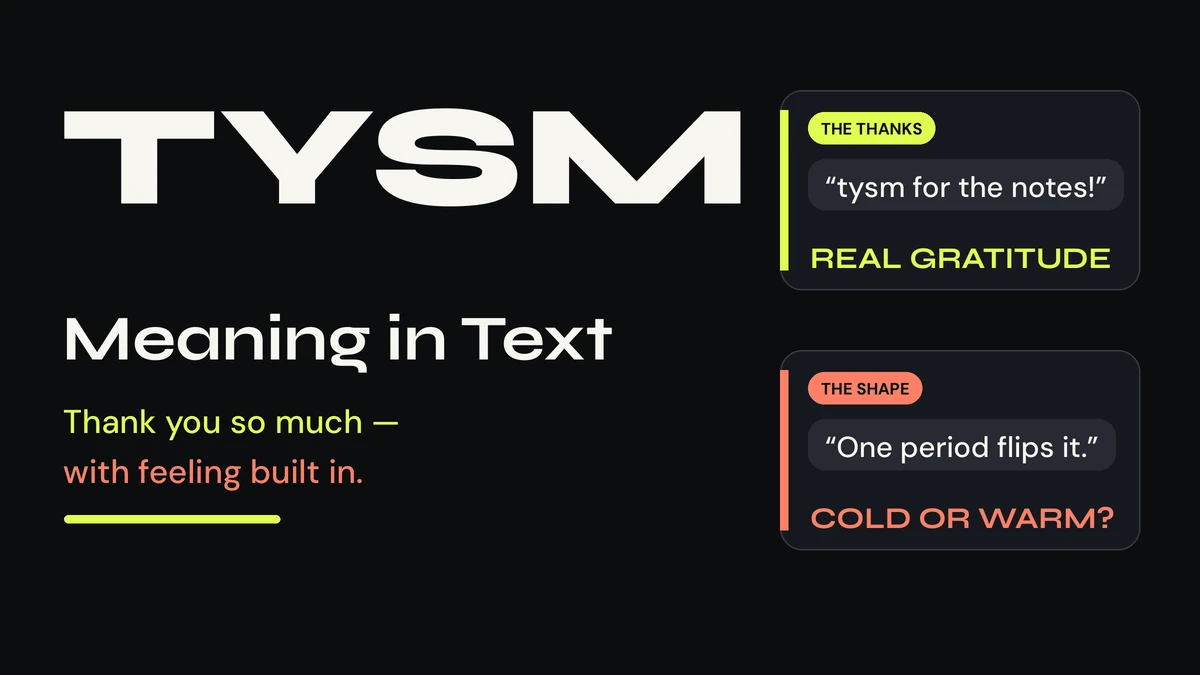
TYSM means “thank you so much” in text. When a friend sends you the notes you needed and you reply “tysm, you are a lifesaver,” you are saying one thing: I noticed what you did, and I am genuinely grateful — and that is the tysm meaning in text in one sentence: four letters that carry real warmth at the speed of typing. TYSM is an initialism, four letters standing in for four words, and it is one of the most useful abbreviations in texting, because it does a job almost no other abbreviation does: it turns a plain “thanks” into thanks with feeling, without making you type a whole sentence.
The dictionaries are thinner on TYSM than they were on TTYL, and the gap itself is worth knowing. Wiktionary has a page for “tysm,” and it lists the reading directly: “(Internet slang, text messaging) Initialism of thank you so much,” with TYVM and YMTS named beside it as related terms. That is the whole dictionary record: no major dictionary read for this build lists TYSM as a headword the way they list TTYL. Merriam-Webster has no TYSM entry at all — it has “thank-you,” a polite expression of gratitude, first known use 1792, which is the history of the phrase, not the abbreviation. No Oxford or Cambridge entry for TYSM turned up in this build either. The abbreviation is younger than the dictionaries’ patience for it, and the guides carry the meaning instead: every competitor read for this build agrees TYSM means “thank you so much,” and MeansToday states the honest truth plainly — TYSM has no widely used alternate meaning anywhere.
What TYSM does in a sentence is different from what most abbreviations in this series do. It is not a sign-off, like TTYL, and it is not a label on the sentence itself, like an honesty marker. It is gratitude with a volume knob. “Thank you” on its own is polite. Adding “so much” turns politeness into feeling, and typing TYSM instead of the full phrase keeps the feeling while cutting the typing to four letters. The word “so” is doing the work: it is an intensifier, and in informal English it adds an emotional, slightly breathless quality, which is why TYSM shows up after real favors, thoughtful gifts, kind compliments, and support during hard times — and much less often after tiny everyday courtesies, where “ty” or “thx” is enough.
That volume knob is why TYSM survives. A “ty” is a nod; a “tysm” is a hug, and the reader can feel the difference in four letters. The reader’s real question is almost never “what do the letters stand for” — that takes four seconds to learn — it is “do they actually mean it, or is this the sarcastic one?” This guide answers the second question, not just the first, and the tool for it is the Sincerity Test in the next section.
The TYSM Sincerity Test
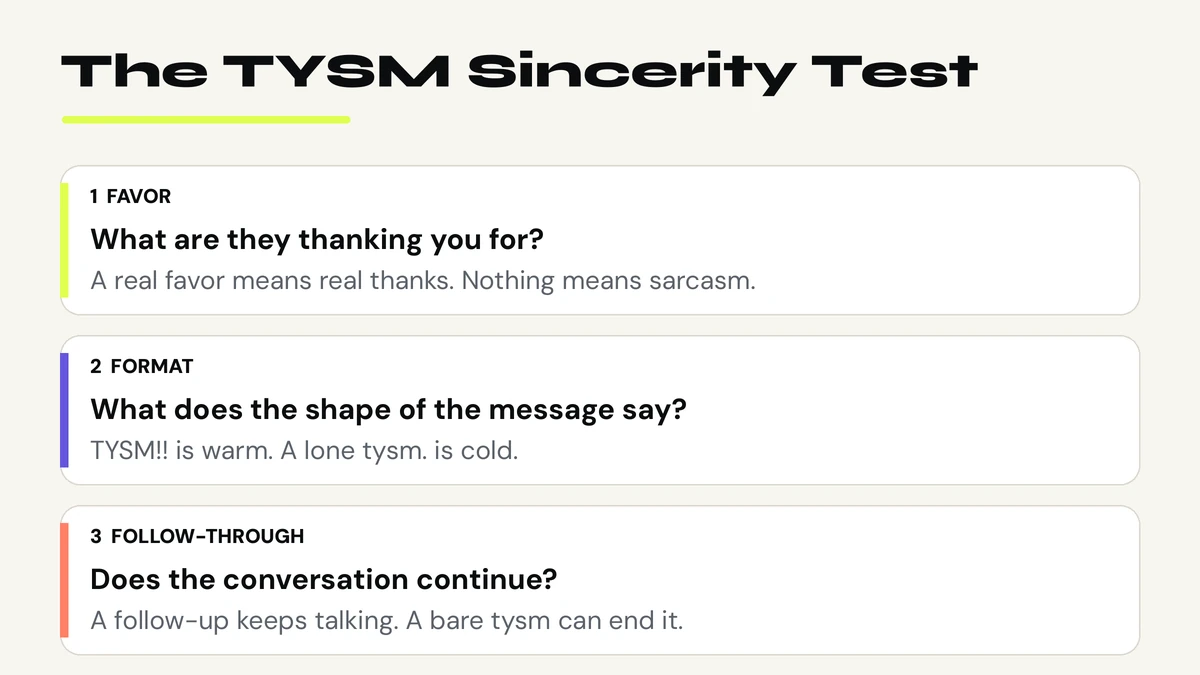
TYSM is easy to decode and hard to read. The letters always mean “thank you so much,” but the thanks can be heartfelt, flat, sarcastic, or a polite way of ending the conversation — and the difference between those four is the difference between warmth and a brush-off. The TYSM Sincerity Test pins the thanks down with three questions, asked in order, stopping at the first clear answer. If two questions disagree, trust Question 2, because the shape of the message beats the favor behind it: a real favor thanked with a cold “tysm.” is still a cold message.
- Question 1 — FAVOR: what are they thanking you for? Look for the thing. A real favor, gift, or kind word behind the TYSM means the thanks has something to stand on: “tysm for driving me to the airport at 5am” is gratitude with a receipt. A TYSM with nothing behind it — no favor, no gift, no help, just “tysm” after something went wrong — is the shape sarcasm takes. If there is nothing to be grateful for, the thanks is not gratitude.
- Question 2 — FORMAT: what does the shape of the message say? This is the one abbreviation where capitalization and punctuation genuinely matter. “TYSM!!” is enthusiastic. “tysm” in lowercase is casual and relaxed. “tysm.” with a lone period can read as dry or flat, and after an argument it reads colder still. “tysm 🙄” with an eye-roll is sarcasm, the opposite of thanks. A stretched “tysmmm” is extra excitement, and an emoji like 🙏 or 💛 locks the warmth in. Read the shape before you read the letters.
- Question 3 — FOLLOW-THROUGH: does the conversation continue, or does it end here? A TYSM that comes with a follow-up — “tysm! so what did you think of the movie?” — is warmth that keeps talking. A bare “tysm” with nothing after it can be a closer: “Yeah okay. tysm.” reads as “we are done here.” The thanks is the same either way; the conversation around it tells you whether it was a hello or a goodbye.
Worked case one: “tysm for sending the notes, you are a lifesaver 🙏” All three questions agree. The favor is real (the notes), the format is warm (lowercase, a reason, a prayer-hands emoji), and the conversation stays open. That is sincere gratitude, and the honest reply is warmth back: “of course, anytime!”
Worked case two: “tysm for the spoiler 🙄” Question 1 overrules the letters. There is nothing to be grateful for — a spoiler is not a favor — and the eye-roll in Question 2 confirms it. This is the sarcastic TYSM, and the reply is not “you are welcome” but a joke back, or nothing at all: “oops, my bad 😅” if you are friends, silence if you are not.
Worked case three: a bare “tysm.” alone, after an argument, with a period and nothing else. Question 1 finds no favor. Question 2 finds the coldest shape in the guide. Question 3 finds a conversation ending, not continuing. The test can narrow it to a flat or dismissive thanks, but it cannot tell you whether the sender is annoyed or simply done talking, because there is nothing to run the questions on. That is a thanks with the warmth taken out, and the honest reading is the cautious one: do not answer it like a warm TYSM, and do not chase it with three more messages. The hardest case in this guide is also the most common trap, and the test is honest about what it cannot do: it sorts the sincere thanks from the sarcastic one, but it cannot invent a feeling the sender never put in the message.
“TYSM” in Real Chats
The examples below are written for this guide, in the shape of real messages, so you can see how TYSM actually lands in a thread. Each one shows a different job the abbreviation does — a real thanks, a warm close, a sarcastic jab, a reflex, a brush-off — and the reply each one earns. Read them as a set, and the pattern appears: TYSM almost always arrives with a reason, a shape, or a follow-up, and whichever of the three it carries is the part that decides the reply.
- The favor repaid: “tysm for driving me to the airport at 5am” — The classic TYSM. A real favor, a named reason, warmth in the letters. Reply: “anytime, have the best time!”
- The gift received: “tysm for the birthday hamper, I have already eaten half the chocolate” — The thanks names the thing, which proves the sender noticed it. Reply: “haha of course, happy birthday!”
- The compliment answered: “your speech at the wedding was amazing” — “tysmmm, I was shaking the whole time” — The stretched letters carry the feeling: excitement, relief, and gratitude at once. Reply: “you crushed it!”
- The practical help: “tysm for proofreading my personal statement” — A serious favor thanked seriously, with the full four letters instead of a quick “ty.” Reply: “no worries, it is really good.”
- The group-chat heads-up: “Reminder: party moved to Saturday” — “tysm for the heads up” — A quick thanks that keeps the group chat positive without cluttering it. Reply: none needed; the thanks is the whole message.
- The gaming save: (teammate drops a health pack) — “tysm!!” — A reflex thanks in a fast game, where four letters is all anyone has time for. Reply: none; the next round is the reply.
- The sarcastic spoiler: “tysm for the spoiler 🙄” — No favor, an eye-roll, and a situation where thanks would be absurd. The opposite of gratitude. Reply: “oops, my bad 😅” — or nothing.
The TYSM Warmth Scale
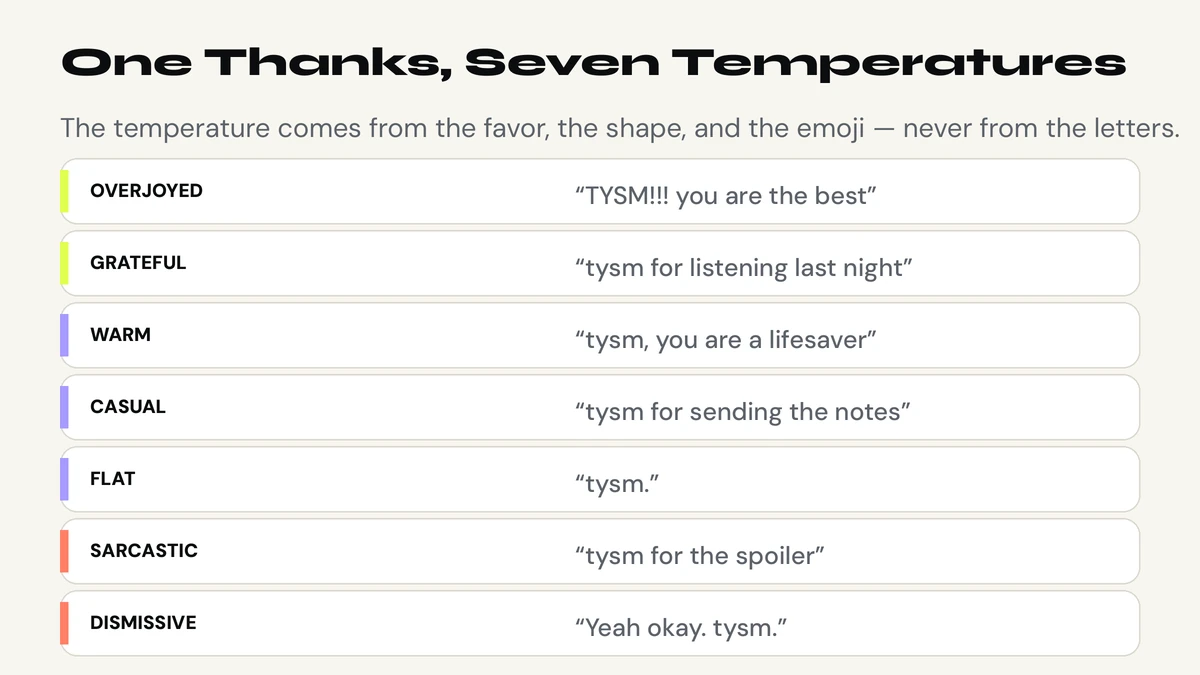
TYSM has one meaning and seven temperatures, and the temperature never comes from the letters. It comes from the favor behind the thanks, the shape of the message, and the emoji attached to it — the same three signals the Sincerity Test reads, turned into a scale. The temperatures below are ordered by how warm the thanks feels, from the warmest to the coldest, and the punctuation is a temperature signal all by itself: an exclamation mark warms a TYSM up, and a lone period cools it down.
- Overjoyed: “TYSM!!! you are the best” — A thanks with the volume all the way up. Capitals, exclamation marks, and a superlative. The favor was big, and the sender wants you to know it.
- Grateful: “tysm for listening last night, I really needed it” — A thanks with a reason and a feeling attached. The warmest shape that is not shouting, and the one that lands best after a hard conversation.
- Warm: “tysm 🙏” — A thanks with a prayer-hands emoji doing the warming. Short, sincere, and complete on its own. The standalone TYSM at its best.
- Casual: “tysm for sending the notes” — The default. A thanks with no edge, the way most TYSMs are sent and most are received.
- Flat: “tysm.” — A thanks with a period and nothing else. Shortness alone proves neither coldness nor warmth, but a lone period after thanks is the one shape that reads colder than the letters do.
- Sarcastic: “tysm for the spoiler 🙄” — A thanks that means the opposite. The favor is not a favor, the eye-roll is the tell, and the gratitude is a joke.
- Dismissive: “Yeah okay. tysm.” — A cooling thanks. Short words, a period, no reason, and the reader is left to guess whether the thanks was real at all — usually, it was the end of the conversation.
The temperatures overlap by design. A real TYSM can be grateful and overjoyed at the same time (“TYSM!! tysm for the concert tickets!!”), and the scale gives you vocabulary for the in-between cases the three-question test sorts more coarsely. The one rule that holds across the whole scale is the shape rule: the warmer the shape — exclamation marks, emojis, a named reason — the warmer the thanks reads, because a thanks with a reason in it is a thanks somebody actually thought about, and a bare “tysm.” is a thanks somebody typed on the way out.
When “TYSM” Does Not Mean “Thank You So Much”
TYSM has one dictionary meaning, but it does more than one job, and three of its jobs are not the dictionary meaning at all. The first is the sarcastic TYSM: a thanks sent after something bad happened, where the gratitude is the joke — “tysm for eating my fries” is not gratitude, and everyone in the thread knows it. The second is the dismissive closer: a bare “tysm” used to end a conversation rather than express real thanks, where the letters are the politeness and the period is the door closing. The third is the reflex: in a live-stream chat, “tysm for the follow!” is a friendly habit, closer to a wave than to a considered thanks. The letters are the same in all three; the gratitude is not.
- The sarcastic TYSM: “tysm for the flat tire” or “tysm for telling everyone” — the opposite of thanks, always signaled by context or an emoji. The Sincerity Test catches this one in Question 1: there is nothing to be grateful for.
- The dismissive closer: a bare “tysm.” that ends a conversation the sender does not want to continue. The thanks is the politeness, not the feeling — and the period is the tell.
- The “aw tysm” meme misread: on TikTok, “aw tysm” — “aw, thank you so much” — sounds like “autism” when read aloud, and a viral joke pretends the sender has just diagnosed the other person. The meme is a phonetic gag, not a second meaning, and it is graded REJECTED as a meaning in the checked-claims section.
- The stretched TYSM: “tysmmm” or “TYSM!!!” is not a different meaning — it is the same thanks with extra feeling. Stretching the letters turns the volume up; it never changes what the letters stand for.
- The streaming reflex: in a live-stream chat, “tysm for the follow!” or “tysm for the sub!” is a friendly habit, sent dozens of times a night. It is real gratitude, but it is lighter than a personal TYSM, because it is a reflex, not a considered message.
- The habit TYSM: some friends use TYSM for everything, and when every message gets a “tysm,” each one means a little less. The abbreviation is still sincere — it is just worn thin by overuse, the way any favorite word gets worn thin.
- The misplaced TYSM: after a serious or sensitive moment — a bereavement, an illness, a hard conversation — an acronym can feel too light. “tysm for coming to the funeral” is not wrong in its letters, but the setting wants the full sentence, and the abbreviation reads as careless there.
The rule across all seven is simple: TYSM always stands for “thank you so much,” but it does not always carry thanks. The letters are fixed; the feeling is not. That is the one thing the dictionaries cannot tell you, because no dictionary grades a feeling. The Sincerity Test exists for exactly this gap — it reads the favor, the format, and the follow-through, and tells you which of the seven jobs this particular TYSM is doing.
Who Is Sending It: How “TYSM” Lands by Sender
The meaning stays “thank you so much” for every sender. What changes is how much warmth the thanks is allowed to carry, and how much it is allowed to ask for in return. A close friend gets the warmest TYSM of anyone, because the friendship already carries the feeling. A stranger gets the lightest, because there is no history to hold it up. The list below is about the landing, not the definition — no sender changes what the letters stand for.
- Close friend: the warmest TYSM. Usually grateful and specific, a real thanks for a real thing, and the one most likely to come with an emoji or a stretched “tysmmm.”
- Crush: the most over-read TYSM. A thanks that can feel loaded with meaning it may not actually have, because every warm word gets weighed — and because “aw tysm” is where the TikTok meme lives. The Sincerity Test is worth running here more than anywhere else.
- Partner: usually comfortable shorthand built on shared history. Often paired with affection — “tysm ily” — and the “so much” is understood without being spelled out. Read the ILY guide for the phrase TYSM is most often paired with.
- Parent or family: plain and practical, and rarer, so warmer. Usually “thank you so much for the help” spelled out in part, because family thanks tends to name the thing that was done.
- Coworker: friendly but bounded, because work threads keep receipts. A lowercase “tysm” in a casual Slack DM with a friendly coworker is fine; the same four letters in a work email read as careless, because the setting wants the full sentence.
- Stranger or creator: the lightest TYSM. A creator thanking followers, or a follower thanking a creator, in a comment thread where the thanks is real but the relationship is not. The easiest TYSM to leave unanswered, and the one most likely to be a reflex.
- Group chat: the hardest TYSM to place. It can be aimed at one person in the room or at the whole room, and a “tysm everyone” after a birthday lands differently from a “tysm” aimed at the one person who helped.
Gender does not change the meaning. The guides that address it agree in substance — the same letters from a girl and from a guy, with the warmth coming from the relationship and the rest of the message, not from who typed it. What changes the reading is the history between the two people, and the history is the one thing the abbreviation never carries. That is why the sender section and the Sincerity Test belong together: the test reads the message, and the sender list reads the relationship, and the honest answer needs both.
“TYSM” on TikTok
On TikTok, TYSM lives in the comments, and the comments are the most public place the abbreviation ever appears. Followers thank creators, creators thank followers, and friends react to helpful or funny content — “TYSM for the recipe!” under a cooking video, “tysm, this helped so much” under a tutorial — and the thanks is performed for strangers as much as for the person it is aimed at. That publicity lightens the thanks: a TYSM in a TikTok comment is the likeliest home of the lightest TYSM in this guide, a bare “tysm!” with no reason and no history, sent where hundreds of people can see it and nobody can tell who it was for. The FYP guide covers the feed whose comments collect these thanks, and the pattern there is the same one this guide describes everywhere: the core meaning stays “thank you so much,” and only the weight changes.
TikTok is also where TYSM picked up its one famous misreading. In June 2021, TikToker @Jax.mp4 posted a comedy sketch where he texts his crush telling her she is cute, and she replies “aw TYSM” — “aw, thank you so much” — and the joke is that, said aloud, “aw TYSM” sounds like “autism,” as if the crush has just diagnosed him. The video spread, the joke became a meme, and the phrase “aw tysm” now carries a second life as a punchline: “Told this girl she looked pretty this morning. She replied back with ‘aw tysm.’ How does she know I have that?” The meme is a phonetic gag, not a second meaning, and this guide grades it that way in the checked-claims section. No source supports a distinct TikTok meaning for TYSM, and this guide claims none: the platform changes the publicity, not the definition.
“TYSM” on Snapchat
Snapchat is a natural home for TYSM. The chats are fast and disappearing, the rhythm is send-reply-send-reply, and a quick thanks fits that rhythm exactly. A “tysm” on a snap reply is standard etiquette when someone sends something funny or useful — a meme, a photo, a piece of news — and the thanks is usually the whole message: “tysm, I needed that laugh.” The disappearing messages change the stakes, not the meaning. Because the chat vanishes, a TYSM on Snapchat carries no receipt to check later — nobody can scroll back and count how many thanks were sent — which makes the abbreviation lighter here than in text messages, where the thread keeps score.
The tone on Snapchat is usually the casual or warm one from the warmth scale, and the warmest Snapchat TYSMs are the ones with a reason attached: “tysm for the heads up” is a thanks somebody actually thought about, and a bare “tysm” after a snap is a reflex. The opened-read receipt makes a repeated TYSM sharper here than anywhere else: a TYSM you have already read, followed by another TYSM the next day, reads as a pattern, and patterns are how readers decide whether the warmth is real. No source supports a distinct Snapchat meaning, and none is claimed here.
“TYSM” on Instagram
Instagram splits TYSM by place, and the place decides how much the thanks weighs. In DMs, TYSM carries the real gratitude — a one-to-one thanks at the end of a private exchange, with a history behind it and a warm reply expected. In comments, TYSM is the friendly wave: a follower thanking a creator, or a creator thanking followers, where “tysm!” means “I saw this and I liked it” as much as it means “thank you.” The IG guide covers the app where both the DM thanks and the comment wave live, and the split there is the same one this guide draws for every platform: same letters, different weight.
TYSM also appears in Instagram stories and reels, usually as a caption sign-off — “10k followers! TYSM for all your love and support!” — where it is thanking a crowd rather than a person. The job is the same, the audience is a crowd, and the warmth is spread thin across thousands of readers, which is exactly why creators pair it with an emoji or an exclamation mark: the shape has to carry the feeling the crowd cannot. No source supports a distinct Instagram meaning, and none is claimed here. What Instagram adds is the clearest version of the platform rule in this guide: the more private the place, the heavier the thanks; the more public the place, the lighter it gets.
“TYSM” in Text Messages
Private texting is where TYSM is at its fullest, because the thread keeps score. A text message thread remembers every thanks that was sent and every favor that was never repaid, and that memory is what makes a texted TYSM heavier than a commented one. In text messages, TYSM carries the widest range in this guide: classic thanks (“tysm for helping me move!”), thanks with a reason (“tysm for driving me home”), warm closes (“tysm, I really needed it”), overnight thanks (“tysm for listening last night”), and the stretched, excited kind (“tysmmm, I was shaking the whole time”). The DM guide covers the one-to-one thread where TYSM lives most of its life, and the pattern there matches the one in this guide: the abbreviation is gratitude with a volume knob, and the thread is the record of whether the gratitude was real.
Texting is also where the flat TYSM is coldest. In a private thread, a bare “tysm.” after a long message is not a casual thanks — it is a door closing, and the reader knows it, because the thread shows exactly how much was left unanswered. The same bare “tysm” in a TikTok comment means almost nothing; in a text thread, it means the conversation is over for now, and the next message, if there is one, will come from the sender. That difference is not a difference in meaning. It is a difference in evidence, and the evidence is the thread itself.
“TYSM” vs Its Closest Cousins
TYSM belongs to a family of thank-you abbreviations, and the family differs by warmth, not by the job. Every cousin below is a way of saying thanks; what changes is how much feeling each one carries. TY is a nod. THX is a quick thanks. TYSM is a hug. TYVM is a hug in a slightly more formal coat. That is the whole family tree, and the Sincerity Test is built on it: Question 2, the format question, is the question that sorts the cousins from each other, because the shape of the thanks is the warmth of the thanks.
- TY (“thank you”): the parent and the closest cousin. TY is the quick, neutral acknowledgment; TYSM is TY with the feeling turned up. A meme gets a “ty”; someone driving you to the airport gets a “TYSM!!” Named, not linked — no TextsMeaning article exists yet.
- TYVM (“thank you very much”): the cousin that sounds a touch more formal. TYVM feels slightly more polished and old-school, and it can occasionally be used sarcastically; TYSM feels warmer and more modern. Named, not linked — no TextsMeaning article exists yet.
- THX (“thanks”): the cousin that is shorter and lighter. THX is the everyday quick thanks between friends; TYSM is what you reach for when a plain thanks does not feel like enough. Named, not linked — no TextsMeaning article exists yet.
- TYSFM (“thank you so freaking much”): the cousin that turns the volume past TYSM. Playful and casual, for close friends only — the extra word is the joke, and the thanks is real underneath it. Named, not linked — no TextsMeaning article exists yet.
- YMTS: the term Wiktionary names beside TYSM as a related term. No expansion for it appears in the sources read for this build, and this guide invents none — it is listed here only because the dictionary record names it. Named, not linked — no TextsMeaning article exists yet.
- TYTY (“thank you, thank you”): the cousin that says it twice. Playful, common in gaming and streaming chat, where repeating the thanks is faster than finding a warmer word. Named, not linked — no TextsMeaning article exists yet.
- TTYL (“talk to you later”): the cousin that closes a conversation the way TYSM sometimes does. TYSM closes with thanks; TTYL closes with a promise. Read the TTYL guide for the sign-off that promises a next conversation.
- GN (“good night”): the cousin that often follows a TYSM at the end of the day — “tysm, gn!” — a thanks and a sign-off in one breath. Read the GN guide for the sign-off that names the night.
Checked Claims: Expansions That Do Not Hold Up
Eight claims about TYSM, graded against Wiktionary, the Merriam-Webster record, and the two full competitor reads. A claim is graded REJECTED when the sources contradict it, UNVERIFIED when no source supports it and none contradicts it, and CONFIRMED when the sources agree. The grading is the point of this section: TYSM is so familiar that people repeat things about it that nobody has ever checked.
- “TYSM means thank you so much” — CONFIRMED. Wiktionary lists it directly, and every competitor read agrees. This is the strongest grading in the section, and the only one that is unanimous — even though the dictionary record behind it is thinner than TTYL’s, with Wiktionary carrying the meaning alone among the major dictionaries.
- “TYSM has no widely used alternate meaning” — CONFIRMED. MeansToday states it plainly, and the dictionaries agree by silence: no dictionary read lists a second reading, no competitor read names one, and the only “alternate readings” in the guides are tone-based — sarcasm and dismissal — which are jobs, not meanings.
- “‘Aw tysm’ means the sender thinks you have autism” — REJECTED as a meaning. Know Your Meme documents the joke exactly: in June 2021, TikToker @Jax.mp4 posted a sketch where a crush replies “aw TYSM” to a compliment, and the punchline is that, said aloud, “aw TYSM” sounds like “autism.” The text means “aw, thank you so much.” The meme is a phonetic gag that pretends otherwise, and the guides that explain it all say the same thing: the sender is thanking, not diagnosing.
- “TYSM began trending in 2008” — UNVERIFIED. One guide gives 2008 as the year TYSM began trending, with no source behind the number. No dictionary dates the abbreviation, PulsarPass says there is no known first use and the origin cannot be pinned to a single platform, and the documented history is a range — early-2000s IM and SMS culture, mainstream by the 2010s — not a year. The 2008 claim is presented here as a claim, not a fact.
- “TYSM is only for teenagers” — REJECTED as a generational claim. Cyber Definitions lists the typical users of TYSM as adults and teenagers, MeansToday calls it understood across generations, platforms, and countries, and the guides that describe its users describe parents, coworkers, creators, and gamers. No first-use date ties it to a generation, and no study does either.
- “TYSM works in professional settings” — REJECTED. The guides agree on the split, and the split is the whole answer: never in a work email, a cover letter, or a message to a client — “TYSM for the interview opportunity” reads as careless, not efficient. In a casual Slack or Teams DM with a friendly coworker, a lowercase “tysm” is fine. The first half of the claim is wrong and the second half is right, and the abbreviation does not decide which half applies — the setting does.
- “Capitalization and punctuation do not matter” — REJECTED. MeansToday’s formatting table proves the opposite: lowercase “tysm” is casual, uppercase “TYSM” is enthusiastic, “tysm!!” is extra warm, “tysm.” with a period can read as dry or flat, and “tysm 🙄” with an eye-roll is sarcasm. This is the one abbreviation in the series where the shape of the message is the meaning of the message, and the Sincerity Test is built on exactly that.
- “TYSM is brand-new internet slang with no history” — REJECTED. The abbreviation grew out of early-2000s instant messaging and SMS culture, when T9 keypads made typing “thank you so much” a thirty-keystroke job and abbreviations were survival, not style. It went mainstream in the 2010s as smartphones and social media took over, spread through comment culture on Instagram, TikTok, and YouTube, and by 2024 it was appearing in a Cosmopolitan article quoted by Wiktionary itself. The phrase “thank you so much” predates the internet by centuries — Merriam-Webster dates “thank-you” to 1792 — and the letters are younger than the words, not younger than the habit.
Where “TYSM” Came From
TYSM came from the same place most of the abbreviations in this series came from: the early internet, where people typed fast, on small keyboards, in rooms full of strangers, and cut phrases down to their first letters to save time. MeansToday traces it to the early 2000s, when the internet ran on instant messengers like AIM and MSN Messenger and mobile phones ran on multi-tap T9 keypads, where typing “thank you so much” meant pressing keys roughly thirty times. Abbreviating gratitude was not just convenient; it was survival. Early chat culture was an abbreviation factory, and alongside LOL, BRB, OMG, and TTYL, gratitude got its own shortcuts: TY for “thank you,” THX for “thanks,” and eventually TYSM for the full-strength version. The logic was simple — the more letters, the warmer the thanks.
The abbreviation went mainstream in the 2010s as smartphones and social media took over. Twitter’s character limit rewarded every saved keystroke, and TYSM became a staple in replies and fan interactions. On Tumblr and Facebook, it showed up in reblogs and comments. By the time Instagram DMs, Snapchat, and TikTok comments became the center of online conversation, TYSM was fully embedded in the language — the default quick-thanks of the internet. PulsarPass adds the honest caveat the other guides skip: there is no known first use, and the origin cannot be pinned to a single platform or community. Its rise probably reflects how often “so much” appears in casual spoken thanks, particularly among younger English speakers, for whom “thank you so much” is a common default.
The paper trail is thinner for TYSM than it was for TTYL, and this guide reports it exactly. Wiktionary lists “tysm” as an Internet slang and text messaging initialism of “thank you so much,” with a 2024 Cosmopolitan citation showing the abbreviation in current use, and TYVM and YMTS named as related terms. The Word Counter traces it to chat speak and SMS text speak from texting and chatrooms on the early internet. One guide claims it began trending in 2008, but gives no source, and that claim is graded UNVERIFIED in the checked-claims section. No first-use date is claimed beyond those milestones, because no source read for this build can put a year on the very first TYSM — the shift happened gradually, in millions of private chats, and nobody was keeping score.
The “aw tysm” meme deserves its own paragraph, because it is the one pop-culture moment in this guide that could be mistaken for a second meaning. In June 2021, TikToker @Jax.mp4 posted a comedy sketch where he texts his crush telling her she is cute, and she replies “aw TYSM.” The joke is that, said aloud, “aw TYSM” sounds like “autism,” as if the crush is assuming the texter is autistic. The video spread across social media, inspired others to get in on the joke, and saw a fresh boost in popularity in 2026, with the phrasing “Told this girl she looked pretty this morning. She replied back with ‘aw tysm.’ How does she know I have that?” The meme is graded REJECTED as a meaning in the checked-claims section, and it is repeated here only so the reader knows it exists and knows it is a joke. The documented history — T9 keypads, instant messaging, SMS, comment culture, and a Wiktionary entry with a 2024 citation — needs no meme to stand on.
How to Reply When Someone Sends “TYSM”
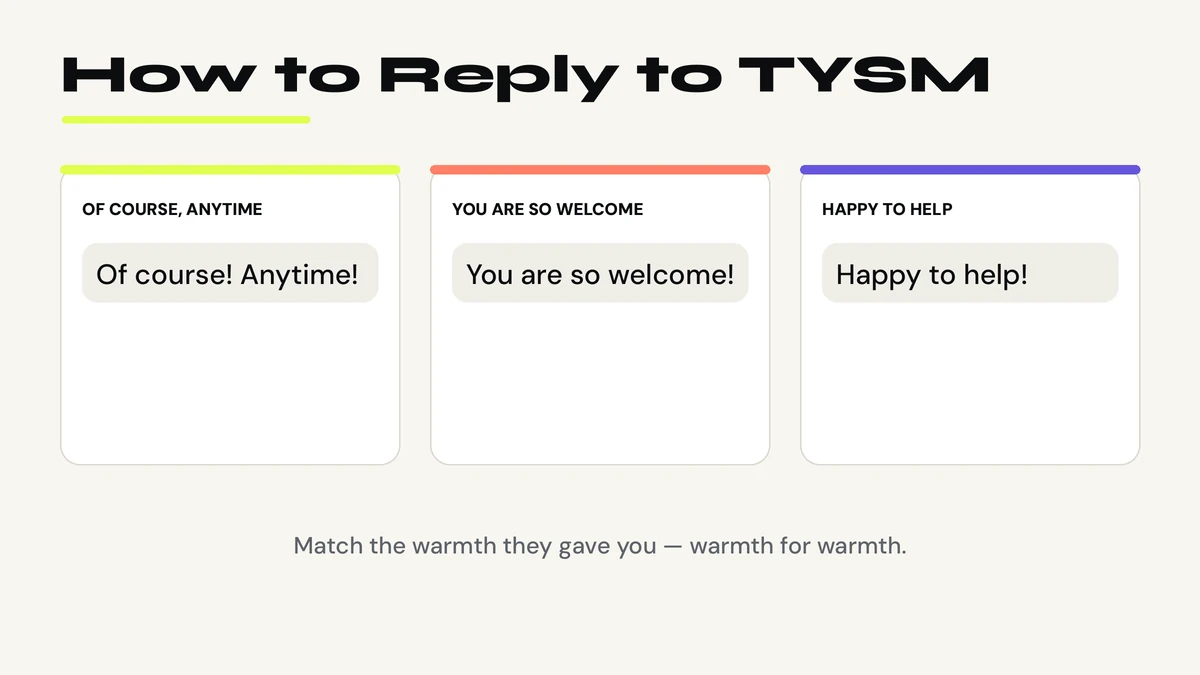
Replying to TYSM is easy once the Sincerity Test has done its work, because the test tells you which job the TYSM is doing, and the job tells you the reply. A sincere thanks gets warmth back. A sarcastic TYSM gets a joke back, or nothing. A flat “tysm.” gets a short wave back, and nothing more. The reply bank below is ordered the same way the warmth scale is ordered — warmest first — and the rule underneath it is the shape rule: match the warmth they gave you, and if they gave you none, give them a little anyway, because a thanks is still a thanks.
- Of course, anytime: “Of course! Anytime!” — For the sincere thanks with a real favor behind it. Warm, simple, and the most common reply in the guides. Read the OFC guide for why “of course” often feels warmer than “you are welcome.”
- You are so welcome: “You are so welcome!” — For the grateful TYSM after a hard conversation or a big favor. Matches the warmth the sender offered, word for word.
- Happy to help: “Happy to help!” — For the practical thanks, the proofreading and the airport runs. Accepts the thanks and closes the exchange cleanly.
- Glad you liked it: “Glad you liked it!” — For the compliment answered and the creator thanked in a comment. Warm, and it invites the conversation to continue.
- No problem: “np!” — For the casual TYSM between close friends, where a short reply is the right size. Read the NP guide for the classic reply to thanks.
- Match the bare thanks: “yw” — For the flat “tysm.” with no reason and no warmth. Short, polite, and nothing more. Named, not linked — no TextsMeaning article exists yet for YW. Do not answer a sarcastic TYSM with a sincere “you are welcome”; answer the joke, or answer nothing.
The one reply that never works is the one that ignores the test. Answering a sarcastic “tysm for the spoiler 🙄” with a sincere “you are welcome!” proves the sender right to joke about you. Answering a warm, grateful TYSM with a bare “k” spends goodwill the sender just offered. And brushing real thanks away with “it was nothing” can make the gratitude feel unwanted, when the sender is clearly moved. Run the three questions — favor, format, follow-through — and the reply writes itself: warmth for warmth, a joke for a joke, and a short wave for a short thanks.
Frequently Asked Questions
What does TYSM mean in a text message?
TYSM means “thank you so much.” It is a warm, casual way of saying thanks in a text, used when someone has done something for you — a favor, a gift, a kind word, a piece of help — and a plain “thanks” does not feel like enough. The “so much” is the point: it turns a polite thanks into a grateful one.
What is the difference between TY and TYSM?
TY means “thank you” and TYSM means “thank you so much.” The difference is the warmth: TY is a quick, neutral acknowledgment, a nod, and TYSM is the same thanks with the feeling turned up, a hug. A meme gets a “ty”; someone driving you to the airport at 5am gets a “TYSM!!” The Sincerity Test in this guide sorts the thanks family by the warmth each one carries.
Is TYSM rude?
No — TYSM is friendly, not rude. The only way it reads badly is through formatting: a bare “tysm.” with a period can look flat or passive-aggressive, and using it in formal settings, like a work email, comes across as careless. Among friends, it is perfectly polite. The sarcastic TYSM is a different matter — “tysm for the spoiler 🙄” is a joke, not gratitude — but the joke is always signaled by context or an emoji.
What does “tysm” mean from a girl?
It means “thank you so much” — the same as from anyone else. The letters do not change with the sender, and the guides that address the question agree in substance: the warmth comes from the relationship and the rest of the message, not from who typed it. From a crush, a TYSM can feel loaded, because every warm word gets weighed, but the honest reading still runs the Sincerity Test on the message itself: the favor, the format, and the follow-through, not the sender.
Can I use TYSM at work?
Not in work email, and carefully in work chats. TYSM is a casual abbreviation that does not belong in resumes, cover letters, formal documents, or customer-facing business communication, and in a work email it reads as careless. In a casual Slack or Teams DM with a friendly coworker, a lowercase “tysm” is fine — the relationship, not the abbreviation, decides. The full phrase “Thank you so much” is warm and professional at the same time, and it costs only a few extra keystrokes.
Can TYSM be sarcastic?
Yes. Like “thanks,” TYSM can be used sarcastically — “tysm for the spoiler 🙄” means the opposite of gratitude. Sarcastic use is almost always signaled by context, because something bad happened, or by an emoji like the eye-roll, so it is rarely confusing once you know to look for it. The Sincerity Test catches it in Question 1: if there is nothing to be grateful for, the thanks is not gratitude.
What does “aw tysm” mean?
“Aw tysm” means “aw, thank you so much” — a warm, soft thanks, usually after a compliment. It became a TikTok meme in June 2021, when TikToker @Jax.mp4 posted a sketch where a crush replies “aw TYSM” to a compliment, and the joke is that, said aloud, “aw TYSM” sounds like “autism.” The meme pretends the sender has just diagnosed the other person; the text itself is just a thanks. The joke is a phonetic gag, not a second meaning.
What does TYSM mean, and how is it different from TYVM?
TYSM means “thank you so much” and TYVM means “thank you very much.” Both express strong thanks, and the difference is small: TYSM feels warmer and more modern, while TYVM feels slightly more formal and old-school, and it can occasionally be used sarcastically. In everyday texting, TYSM is the more common choice. The family differs by warmth, not by the job — every cousin is a way of saying thanks.
The Takeaway
TYSM means “thank you so much,” and that is the easy part. The hard part is the feeling, and the hard part is the whole guide: four warm letters that can be heartfelt, flat, sarcastic, or a polite way of ending the conversation, where the shape of the message decides which one it is. Wiktionary lists the reading directly, the guides agree on the meaning, and MeansToday states the honest truth — TYSM has no widely used alternate meaning anywhere. What none of them can tell you is whether your particular TYSM is sincere, and that is what the Sincerity Test is for: ask what they are thanking you for, ask what the shape of the message says, ask whether the conversation continues, and trust the format over the favor when they disagree.
If you remember one thing from this guide, remember the shape rule. A TYSM with a named reason is a thanks somebody actually thought about. A TYSM with exclamation marks is a thanks with the volume turned up. A TYSM with a lone period is a thanks with the warmth taken out. And a TYSM with an eye-roll is not a thanks at all. Run the test, match the warmth they gave you, and when they gave you none, give them a little anyway: “Of course! Anytime!” That is the whole guide in one reply.