What “WFH” Means in Text
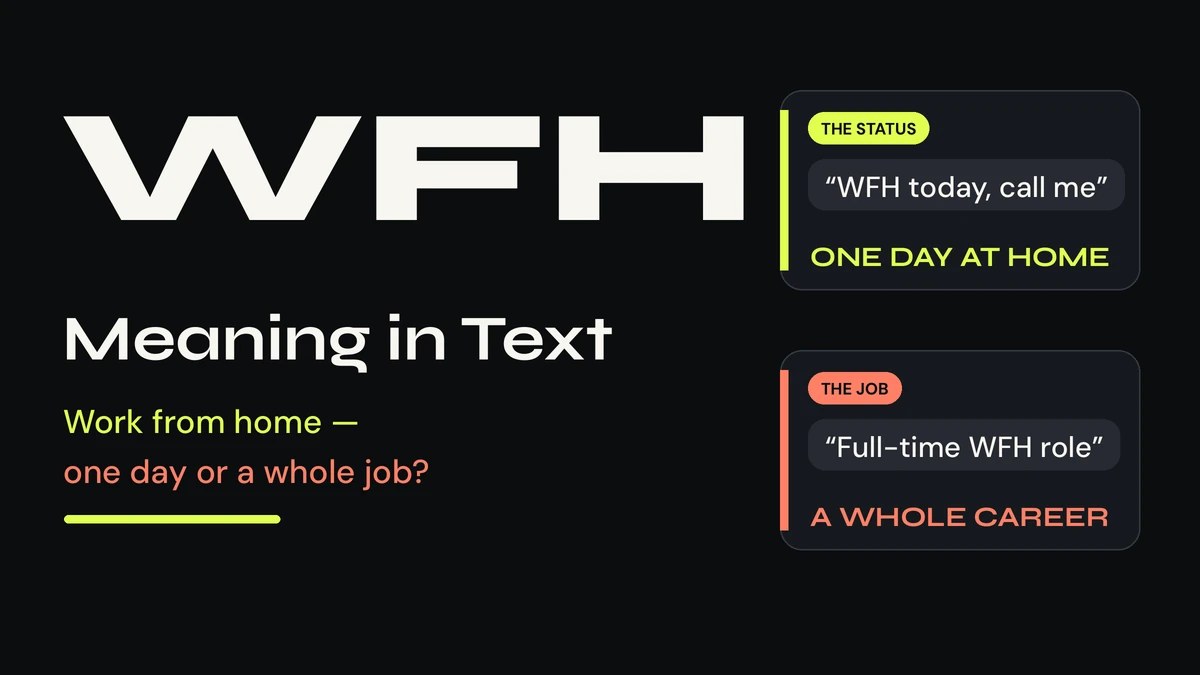
WFH means “work from home” in text. When a coworker texts “WFH today, call me if you need anything,” they are telling you one thing: they are doing their usual job from home today, not from the office — and that is the wfh meaning in text in one sentence: three letters that say where someone works and that they are still on the clock. WFH is an initialism, three letters standing in for three words, and it is one of the most practical abbreviations in texting, because it does a job almost no other abbreviation in this series does: it is a location update, a status line, and a job description all at once, depending on the sentence around it.
The dictionary record for WFH is the strongest in this series. Wiktionary lists it directly: “Initialism of work(ing) from home,” with a 2022 Guardian citation and a 2022 Vice citation showing it in current use, and it even lists the verb form — people write “WFHing” for the act of working from home. Merriam-Webster has a WFH entry of its own: “work from home; working from home.” Cambridge calls it an abbreviation for working from home, “used to refer to a person doing their job in their home rather than traveling to an office.” Oxford Learner’s lists it the same way: “work from home,” with the example “I usually WFH on Fridays.” Four major dictionaries agree, where TYSM had only one — and the agreement matters, because it means the meaning is settled and the real question is never what the letters stand for. It is what the sentence around them is claiming.
What WFH does in a sentence is different from what most abbreviations in this series do. It is not a feeling, like TYSM, and it is not a sign-off, like TTYL. It is a fact about where someone is. “I am WFH today” is a status: home today, office tomorrow. “I WFH five days a week” is a job description: the role itself is home-based. “Our WFH policy allows two home days a week” is a rule: the company sets the terms. The letters never change; the claim changes, and the claim is the whole message. That is why the guides agree on the one rule that matters most: WFH says where someone works, not when they work. A person can be WFH from 9 a.m. to 5 p.m. on exactly the same schedule they would follow in the office, and the abbreviation tells you nothing about their hours.
That split — where, not when — is why WFH survives. “I am working from home today” is a five-word phrase that shows up dozens of times a week in team chats, and three letters replace it without losing the basic meaning. The reader’s real question is almost never “what do the letters stand for” — that takes three seconds to learn — it is “is this one day, a whole job, or something else entirely?” This guide answers the second question, not just the first, and the tool for it is the Day-or-Job Test in the next section.
The WFH Day-or-Job Test
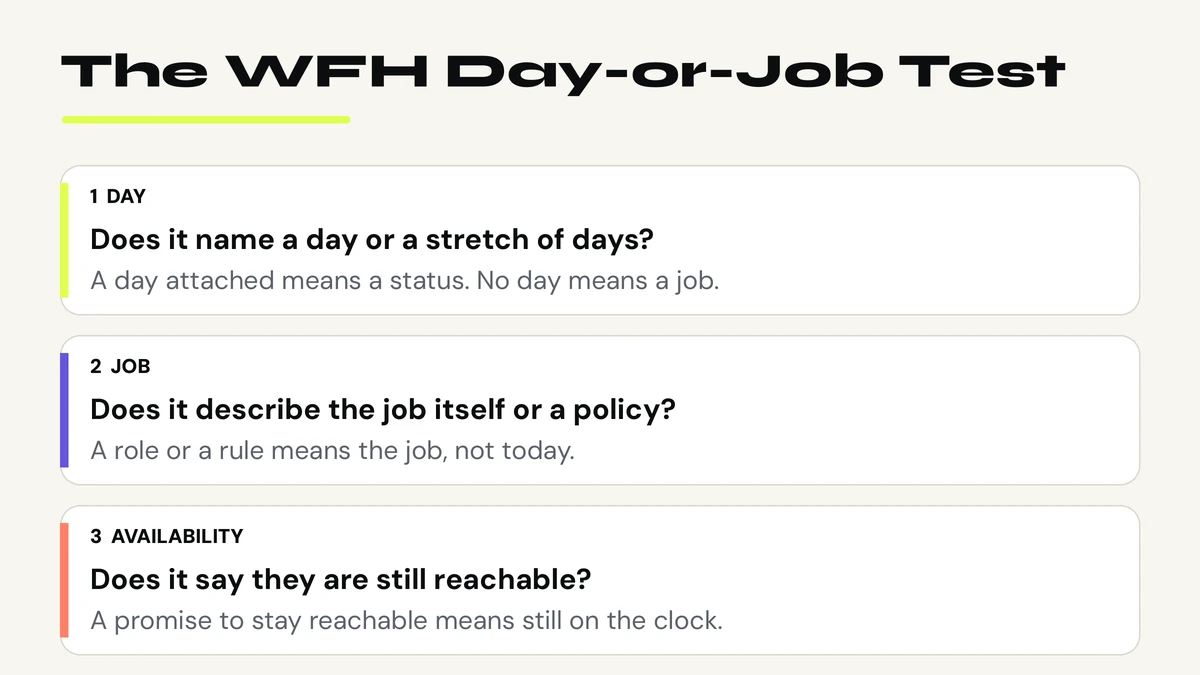
WFH is easy to decode and easy to misread. The letters always mean “work from home,” but the message can be a one-day status, a recurring schedule, a whole job, or a lazy-day joke — and the difference between those four is the difference between expecting someone on Slack all day and expecting them never. The WFH Day-or-Job Test pins the message down with three questions, asked in order, stopping at the first clear answer. If two questions disagree, trust Question 1, because a day attached to the letters beats everything else: a date turns a job description into a status.
- Question 1 — DAY: does it name a day or a stretch of days? Look for the clock. “WFH today,” “WFH tomorrow,” “WFH until Friday,” “WFH Mondays and Fridays” — a day, a date, or a stretch of days means the message is a status, and the status is the whole point. No day attached means the message is about the job or the arrangement, not about today.
- Question 2 — JOB: does it describe the job itself or a policy? Look for the role. “A full-time WFH customer support role,” “our WFH policy allows two home days a week,” “I have been WFH full-time since joining the company” — a role, a policy, or a permanent arrangement means the letters describe how the job works, and the day does not matter. If the sentence is about a job listing or a rule, it is not a status at all.
- Question 3 — AVAILABILITY: does the message say they are still reachable? Look for the promise. “WFH today, on Slack all day,” “WFH, back in the office Tuesday,” “WFH but available on Slack” — a WFH message that names how to reach the person is a working status, and the sender is telling you they are on the clock. A WFH message with no availability attached is still a working status, but it is the one most likely to be misread as a day off, and the honest reply is a question, not an assumption.
Worked case one: “I will be WFH Wednesday. Call me if anything urgent comes up.” All three questions agree. The day is named (Question 1: a status), the job is not the subject (Question 2: not a role), and the availability is promised (Question 3: still working, still reachable). That is a one-day working status, and the honest reply is the short one: “Sounds good.”
Worked case two: “This position offers three WFH days per week.” Question 1 finds days, but Question 2 overrules them: the sentence is a job listing, and the days describe the role, not today. This is not a status — nobody is telling you where they are right now — and the reply is not “sounds good” but a question about the policy: which days, and who decides them.
Worked case three: a bare “WFH” alone, as a Slack status, with no day and no availability attached. Question 1 finds no day. Question 2 finds no role. Question 3 finds no promise. The test can narrow it to a working status — the letters still mean “work from home,” and the person is still on the clock — but it cannot tell you whether they are home for the day or home for good, or how fast they will answer, because there is nothing to run the questions on. That is a status with the detail taken out, and the honest reading is the cautious one: treat it as “working, at home, reachable on chat,” and ask before you assume anything else. The hardest case in this guide is also the most common trap, and the test is honest about what it cannot do: it sorts the status from the job, but it cannot invent a schedule the sender never put in the message.
“WFH” in Real Chats
The examples below are written for this guide, in the shape of real messages, so you can see how WFH actually lands in a thread. Each one shows a different job the abbreviation does — a one-day status, a recurring schedule, a job description, a joke, a brush-off — and the reply each one earns. Read them as a set, and the pattern appears: WFH almost always arrives with a day, a reason, or an availability promise, and whichever of the three it carries is the part that decides the reply.
- The one-day status: “WFH today, so I can do the 3 p.m. school pickup.” — The classic WFH. A day, a reason, and a person still on the clock. Reply: “Sounds good, ping me if you need anything.”
- The recurring schedule: “I WFH every Tuesday and Thursday.” — A schedule, not a status. The days are the point, and the reply is a planning question, not an acknowledgment. Reply: “Got it, so I will book client visits for Mondays.”
- The job description: “This is a full-time WFH customer support role.” — The letters describe the job itself, and nobody is telling you where they are right now. Reply: a question about the policy, not a “sounds good.”
- The hybrid split: “I am hybrid. I am in the office Monday through Wednesday and WFH Thursday and Friday.” — WFH as one half of a bigger schedule, and the sentence only makes sense as a pair. Reply: “So Thursday is the day to catch you on Zoom?”
- The morning routine: “Week three of WFH and the cat has joined every standup.” — A social caption, not a status. The letters set the scene, and the joke does the work. Reply: a laugh, not a work question.
- The appointment dodge: “WFH tomorrow because the plumber is coming.” — A day and a reason, and the reason is the whole message: the person will be home because the house needs them there. Reply: “Good luck with the plumber.”
- The lazy-day wink: “WFH today” with a winking emoji, sent by a friend who has no job to do from home. — The old slang joke, where “working from home” in quotation marks means a day when no work will happen. The letters are the same; the work is not. Reply: the joke back, or nothing.
The WFH Scale: One Day, a Schedule, a Job
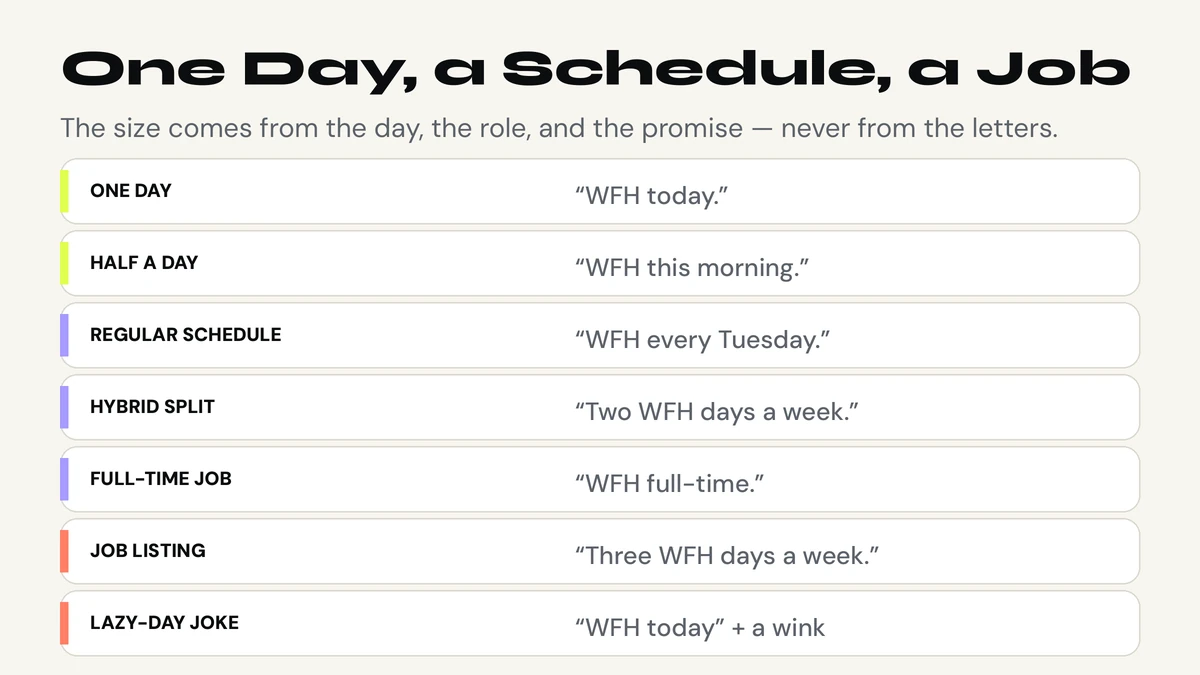
WFH has one meaning and seven sizes, and the size never comes from the letters. It comes from the day attached to them, the role behind them, and the availability promised with them — the same three signals the Day-or-Job Test reads, turned into a scale. The sizes below are ordered by how much of the person’s working life the letters cover, from the smallest to the largest, and the day is a size signal all by itself: a WFH with a day attached covers a day, and a WFH with no day attached can cover a career.
- One day: “WFH today.” — The smallest size. A single day at home, usually with a reason: a delivery, an appointment, bad weather, a sick kid. The person is still working, and tomorrow they are back in the office.
- Half a day: “WFH this morning, office this afternoon.” — A day split in two, and the abbreviation covers only the half it names. The calendar entry “WFH AM” is the same size, written shorter.
- Regular schedule: “I WFH every Tuesday and Thursday.” — A recurring arrangement, and the days are the point. The person is not home today by accident; home is part of the week.
- Hybrid split: “Hybrid role: three office days and two WFH days per week.” — WFH as one half of a bigger schedule. The letters describe the home days only, and the office days are the other half of the same sentence.
- Full-time job: “I have been WFH full-time since joining the company.” — The largest working size. The arrangement is not a day or a schedule; it is how the job operates, and there is no office day to come back to.
- Job listing: “This position offers three WFH days per week.” — The letters describe a role nobody holds yet. The size is the employer’s promise, not the employee’s day, and the details live in the policy, not the abbreviation.
- The lazy-day joke: “WFH today” with a wink, from someone with no work to do. — The size is zero, and the joke is the point. An old slang reading, documented in 2003 and 2019, where “working from home” in quotation marks means a day when no work will happen. It is not the meaning — it is a wink wearing the meaning’s clothes.
The sizes overlap by design. A regular schedule is also a set of one-day statuses (“WFH every Tuesday” is a Tuesday status that repeats), and a full-time job is also a schedule with no office days in it. The one rule that holds across the whole scale is the day rule: the more specific the day, the smaller the claim, because a WFH with “today” attached is a fact about today, and a WFH with nothing attached is a fact about a life. Run the three questions — day, job, availability — and the size sorts itself.
When “WFH” Does Not Mean “Work From Home”
WFH has one everyday meaning, but the letters do more than one job, and four of their jobs are not the everyday meaning at all. The first is the legal one: in US copyright law, WFH also stands for “work for hire,” a work made by an employee or specially ordered, and a contract that says “WFH” is not talking about anybody’s living room. The second is the medical one: WFH also stands for the World Federation of Hemophilia, an international nonprofit for people with hemophilia and other bleeding disorders. The third is the lazy-day wink: an old slang reading where “working from home” in quotation marks means a day when no work will happen. The fourth is the misreading, not a meaning at all: the assumption that WFH means a day off, or flexible hours, or a vacation. The letters are the same in all four; the work is not.
- The legal WFH: “work for hire” in US copyright law — a work created by an employee within the scope of employment, or specially ordered for certain uses. Wiktionary lists it as a second sense, and it is the one WFH that has nothing to do with where anybody sits. If the sentence is a contract, the letters are legal, not locational.
- The medical WFH: the World Federation of Hemophilia — an international nonprofit dedicated to improving the lives of people with hemophilia and other genetic bleeding disorders. Wiktionary lists it too, and it is the one WFH that belongs in a clinic, not a chat. If the sentence is about bleeding disorders, the letters are medical, not locational.
- The lazy-day wink: “working from home” in quotation marks, meaning a day when no work will happen. One slang definition from 2019 says exactly that, and an older one, from November 2003, already used WFH for slacking off at home — seventeen years before the pandemic made it respectable. The wink is documented history, not the current meaning, and it is graded that way in the checked-claims section.
- The day-off misread: WFH does not mean a person has the day off. Working from home is still working: meetings, messages, projects, and a normal schedule, from home. Someone who is off work uses PTO or OOO instead, and the difference is the whole point — a WFH person is on the clock, and an OOO person is not.
- The flexible-hours misread: WFH describes where someone works, not when they work. Someone can work from home from 9 a.m. to 5 p.m. under the same schedule they would follow in the office, and the abbreviation tells you nothing about their hours. Flexible hours are a separate arrangement, and the letters never promise them.
- The permanent misread: “I am WFH today” does not tell you whether the arrangement lasts one day or several years. A message with a day attached is a status; a message about a role is a job; and the same three letters can be either, which is exactly why the Day-or-Job Test asks about the day first.
- The anywhere misread: WFH does not mean working from anywhere. A remote worker can work from a coworking space, a coffee shop, or another approved location, while someone saying “I am WFH” specifically indicates that they are working from home. WFH is one place under the remote-work umbrella, not the umbrella itself.
The rule across all seven is simple: WFH always stands for “work from home” in a text, a chat, or a status — but the letters have other lives in law and medicine, and the abbreviation has old jokes and common misreadings attached to it. The dictionaries list the extra senses openly, and the guides agree on the misreadings, so this guide reports them all instead of hiding them. That is the one thing the dictionaries cannot tell you by themselves, because no dictionary grades a wink. The Day-or-Job Test exists for exactly this gap — it reads the day, the job, and the availability, and tells you which of the seven jobs this particular WFH is doing.
Who Is Sending It: How “WFH” Lands by Sender
The meaning stays “work from home” for every sender. What changes is what the message is allowed to ask for, and how much detail it owes you. A boss gets a WFH with a day and an availability promise, because the team needs to plan around it. A friend gets a WFH with a reason and an invitation, because the friendship is the point. A recruiter gets a WFH as a policy, because the job is the point. The list below is about the landing, not the definition — no sender changes what the letters stand for.
- Close friend: the most flexible WFH. Usually a day and a reason — “WFH today, want to grab coffee at noon?” — and the one most likely to carry the lazy-day wink, because friends are allowed to joke about not working.
- Crush: the most over-read WFH, and the least loaded one in this series. A “WFH today” from a crush is a location update, not a signal, and the honest reading is the plain one: they are home, they are working, and the invitation to meet is the interesting part, not the letters.
- Partner: usually practical shorthand built on shared life. “WFH today, so I can do the school pickup” is a plan, not a status, and the reason is the whole message. The plan is the point, and the letters are just the fastest way to say where the plan happens.
- Boss or manager: the most formal WFH. Usually a day, an availability promise, and a reason the team can plan around: “WFH tomorrow, on Slack all day, camera on for the 11:00.” A bare “WFH” from a boss, with no day and no availability, is the one status that actually needs a follow-up question. Read the GM guide for the morning greeting that usually opens a boss’s WFH status — “gm, WFH today” is the most common shape in this guide.
- Coworker: the most common WFH, and the one the whole guide is built for. A day, a reason, and a promise to stay reachable, because the team needs to know where you are and how to reach you. A coworker who sets their status to DND while WFH is telling you two things at once: home, and do not disturb. Read the DND guide for the status that pairs with WFH when focus matters more than availability.
- Recruiter or job posting: the least personal WFH. A policy, not a status: “This position offers three WFH days per week,” or “WFH available after onboarding.” The letters describe the role, and the details — which days, who decides, what the location limits are — live in the policy, not the abbreviation.
- Group chat: the hardest WFH to place. It can be a status for the whole team (“Reminder: the office is closed Friday, so everyone will be WFH”) or a plan aimed at one person (“WFH today, want to meet near my place?”), and a “WFH” aimed at the room lands differently from a “WFH” aimed at you.
Gender does not change the meaning. No guide read for this build claims a different WFH for a man or a woman, and the letters do not change with the sender — the warmth comes from the relationship and the rest of the message, not from who typed it. What changes the reading is the power between the two people, and the power is the one thing the abbreviation never carries. That is why the sender section and the Day-or-Job Test belong together: the test reads the message, and the sender list reads the relationship, and the honest answer needs both.
“WFH” on TikTok
On TikTok, WFH lives in the lifestyle corners, and the lifestyle is the point. Creators share “WFH morning routines” and joke about WFH struggles like never leaving pajamas — “WFH day 847: forgot what pants feel like,” “POV: You have been WFH for three years and forgot how to make small talk” — and the abbreviation sets the scene for a video about a life, not a status about a day. The FYP guide covers the feed where these routines collect, and the pattern there is the same one this guide describes everywhere: the core meaning stays “work from home,” and only the size changes — on TikTok, the size is usually a life, not a day.
TikTok is also where WFH picks up its most visible joke. The WFH morning routine, the desk setup, the coffee, the cat on the keyboard — the videos are funny because the setup is familiar, and the familiarity is the point: millions of people now work from a kitchen table, and the abbreviation is the shortest way to say so. No source supports a distinct TikTok meaning for WFH, and this guide claims none: the platform changes the audience, not the definition. What TikTok adds is the clearest version of the platform rule in this guide: the more the abbreviation describes a life, the less it describes a day.
“WFH” on Snapchat
Snapchat is a quiet home for WFH. The chats are fast and disappearing, the rhythm is send-reply-send-reply, and a quick status fits that rhythm exactly: “WFH today” on a snap reply tells a friend where you are and why you can meet near your place instead of the office. The disappearing messages change the stakes, not the meaning. Because the chat vanishes, a WFH on Snapchat carries no receipt to check later — nobody can scroll back and count how many home days were taken — which makes the abbreviation lighter here than in a work chat, where the thread keeps score.
The tone on Snapchat is usually the casual one from the scale, and the most common Snapchat WFH is the friend version: a day, a reason, and an invitation, not a status for a team. No source supports a distinct Snapchat meaning, and none is claimed here. What Snapchat adds is the private version of the platform rule: the more private the place, the more the message is a plan between friends, and the less it is a status for a team.
“WFH” on Instagram
Instagram splits WFH by place, and the place decides how much the abbreviation weighs. In stories, WFH is a quick status update for friends — “Monday WFH setup. Coffee is doing all the work today” — a day, a desk, and a joke. In posts and reels, WFH is a lifestyle label: aesthetic desk setups get the hashtag treatment, and “WFH with a view beats my old commute” is a humble-brag about a life, not a status about a day. The IG guide covers the app where both the story status and the lifestyle post live, and the split there is the same one this guide draws for every platform: same letters, different size.
WFH also appears in Instagram DMs, usually as a plan between two people — “WFH today, want to meet near my place?” — where it is doing the same job it does in a text message: a day, a reason, and an invitation. No source supports a distinct Instagram meaning, and none is claimed here. What Instagram adds is the clearest version of the platform rule in this guide: the more public the place, the bigger the claim — a story is a day, and a post is a life.
“WFH” in Text Messages
Private texting is where WFH is at its most practical, because the thread keeps score. A text message thread remembers every home day that was taken and every plan that was made around it, and that memory is what makes a texted WFH heavier than a commented one. In text messages, WFH carries the widest range in this guide: the one-day status (“WFH today”), the question (“Are you WFH tomorrow?”), the stretch (“I will be WFH until Friday”), the preference (“I prefer WFH”), and the plan (“WFH today, want to grab coffee at noon?”). The DM guide covers the one-to-one thread where WFH lives most of its life outside work, and the pattern there matches the one in this guide: the abbreviation is a location update, and the thread is the record of whether the location was real.
Texting is also where the lazy-day wink is most likely to appear. In a private thread between friends, a “WFH today” with a winking emoji is a joke both people understand, because the thread shows exactly how much work is actually happening — which, on a wink day, is none. The same bare “WFH” in a team chat means almost the opposite: a working status, on the clock, reachable on Slack. That difference is not a difference in meaning. It is a difference in evidence, and the evidence is the thread itself.
“WFH” vs Its Closest Cousins
WFH belongs to a family of workplace abbreviations, and the family differs by what each one claims. Every cousin below is a way of saying something about a workday; what changes is whether it claims a place, a time, or an absence. WFH claims a place: home. WFO claims the opposite place: the office. WFA claims no place at all: anywhere with Wi-Fi. That is the whole family tree, and the Day-or-Job Test is built on it: Question 1, the day question, is the question that sorts the cousins from each other, because the day attached to the letters is the size of the claim.
- WFO (“work from office”): the mirror image and the closest cousin. WFO is WFH with the place flipped: “I am WFH Monday and WFO Tuesday” means home on Monday, in the building on Tuesday. Named, not linked — no TextsMeaning article exists yet.
- WFA (“work from anywhere”): the cousin with no address. WFA means working from anywhere with Wi-Fi, even a coffee shop, while WFH specifically means home. Named, not linked — no TextsMeaning article exists yet.
- Remote work: the umbrella, not the cousin. Remote work means working away from the employer’s normal workplace, from home, a coworking space, or another approved location — and WFH is one specific place underneath that umbrella. Named, not linked — it is a policy term, not a TextsMeaning article.
- Hybrid work: the cousin that is a schedule, not a place. Hybrid combines remote work with time at a workplace: office days and home days in the same week, where WFH names only the home days. Named, not linked — it is a policy term, not a TextsMeaning article.
- OOO (“out of office”): the cousin that means the opposite of working. OOO means someone is unavailable or away from normal work duties, while a WFH person is still working and still reachable. Named, not linked — no TextsMeaning article exists yet.
- AFK (“away from keyboard”): the cousin that says you stepped away. AFK means you are not at your desk right now, while WFH means your desk is at home today — a WFH person can still go AFK for lunch. Read the AFK guide for the abbreviation that says you stepped away, where WFH says where you are.
- BRB (“be right back”): the cousin that promises a return in minutes. BRB is a pause, while a WFH day is a whole day — a WFH person who writes “brb” is stepping away from a home desk, not from the office. Read the BRB guide for the pause that fits inside a WFH day.
- GTG (“got to go”): the cousin that ends the day. GTG closes a conversation the way a WFH status opens one — “gtg, WFH tomorrow” is a sign-off and a status in one breath. Read the GTG guide for the sign-off that ends the day WFH started.
Checked Claims: Expansions That Do Not Hold Up
Eight claims about WFH, graded against Wiktionary, the Merriam-Webster record, Cambridge, Oxford Learner’s, and the two full competitor reads. A claim is graded REJECTED when the sources contradict it, UNVERIFIED when no source supports it and none contradicts it, and CONFIRMED when the sources agree. The grading is the point of this section: WFH is so familiar that people repeat things about it that nobody has ever checked.
- “WFH means work from home” — CONFIRMED. Wiktionary lists it directly, Merriam-Webster has an entry, Cambridge and Oxford Learner’s agree, and every competitor read agrees. This is the strongest grading in the section, and the only one that is unanimous — the strongest dictionary record in the series, with four major dictionaries behind one meaning.
- “WFH is the same as remote work” — REJECTED. The guides agree on the split, and the split is the whole answer: WFH specifically means working from home, while remote work can happen from a coworking space, a coffee shop, or another approved location. WFH is a type of remote work, but the terms are not synonyms — remote work is the umbrella, and WFH is one place underneath it.
- “WFH means a day off” — REJECTED. The guides agree, and the agreement is unanimous: working from home is still working. Someone who is off work uses PTO or OOO instead, and the difference is the point — a WFH person attends meetings, answers messages, and follows a normal schedule from home, while an OOO person is not available at all.
- “WFH means flexible hours” — REJECTED. WFH describes where someone works, not when they work. Someone can work from home from 9 a.m. to 5 p.m. under the same schedule they would follow in the office, and the abbreviation tells you nothing about their hours. Flexible hours are a separate arrangement, and the letters never promise them.
- “WFH means a lazy day at home” — REJECTED as the current meaning, DOCUMENTED as history. The wink is real, and it is old: one slang definition from 2019 says “working from home” in quotation marks means a day when no work will happen, and an older one, from November 2003, already used WFH for slacking off at home. But the dictionaries give it no other sense, and every current guide reads WFH as a working status. The lazy day is a joke wearing the meaning’s clothes, not a second meaning.
- “WFH began with the pandemic” — REJECTED. The abbreviation predates the pandemic by years, and the idea predates it by decades: telecommuting was first recorded in 1974, “telecommuting” was coined in 1975, a slang dictionary was already using WFH for slacking off at home in November 2003, and WFH made the dictionary in April 2020 — in the same batch as self-isolate, contactless, and PPE. The pandemic made WFH common, not new.
- “WFH works in professional settings” — CONFIRMED, with limits. The guides agree on the split, and the split is the whole answer: WFH is widely understood in workplace communication, especially in internal chats, emails, calendars, and team updates, and there is no inherent lack of professionalism in using an established workplace abbreviation. For formal documents, public-facing content, or unfamiliar audiences, writing “work from home” in full is clearer — the audience, not the abbreviation, decides.
- “About one in five US workers do some work from home” — CONFIRMED, with the measure stated. Fireflies reports that about one in five US workers — 21.9 percent — did some or all of their paid work from home in September 2026, according to the Bureau of Labor Statistics. A second Bureau of Labor Statistics measure, reported by Corpo Mode, says 35 percent of employed people in the US did some or all of their work at home on the days they worked in 2025. The two numbers measure different things — a month against a day — and both are reported here as reported, not merged into one claim.
Where “WFH” Came From
WFH came from the office, not the internet, and that is the first thing that makes it different from most of the abbreviations in this series. Before WFH, people said telecommuting — a word built around the commute, the one thing it let you skip. “Telecommute” was first recorded in 1974, and “telecommuting” was coined in 1975, said to be by Jack Nilles of the University of Southern California. The idea is fifty years old; only the abbreviation is new. The letters grew out of corporate email culture in the early 2000s, when teams started writing “WFH” instead of “working from home” in status lines and calendar entries, and the abbreviation joined a family of workplace shorthand — OOO for out of office, EOD for end of day, PTO for paid time off — that made a workday scannable at a glance.
The abbreviation had a second, quieter life in slang at the same time. A slang dictionary was already using WFH for slacking off at home in November 2003, and by 2008 a slang dictionary was calling the Friday WFH the three-day weekend technique — a home day on Friday and Monday that looks like a long weekend with a laptop in it. The joke and the status grew up together: the same three letters could mean a real home day or a wink about a day when no work would happen, and the reader had to know which one the sender meant. WFH made the dictionary in April 2020, in the same batch as self-isolate, contactless, and PPE, and the pandemic turned a piece of office shorthand into a word everybody knew — by 2022, Wiktionary was citing a Guardian piece about bosses watching their newly remote workers and a Vice piece about WFH employees living in another country.
The paper trail is the fullest in this series, and this guide reports it exactly. Wiktionary lists “WFH” as an initialism of “work(ing) from home,” with 2022 citations from the Guardian and Vice, a verb form (“WFHing”), and two extra senses — US copyright law’s “work for hire” and medicine’s World Federation of Hemophilia. Merriam-Webster lists WFH as “work from home; working from home,” Cambridge as an abbreviation for working from home, and Oxford Learner’s as “work from home,” with the example “I usually WFH on Fridays.” The first Urban Dictionary definition on the WFH page is dated March 17, 2020, and it calls WFH a concept made popular by COVID-19 quarantines. No first-use date is claimed beyond those milestones, because no source read for this build can put a year on the very first WFH — the shift happened gradually, in millions of office emails, and nobody was keeping score. The return to the office is the newest chapter: by 2025, 72 percent of employers had return-to-office mandates, and most US hybrid workers spent three days a week in the office — which is why the Day-or-Job Test matters more now than it did in 2020, when every day was a home day and nobody had to ask.
How to Reply When Someone Sends “WFH”
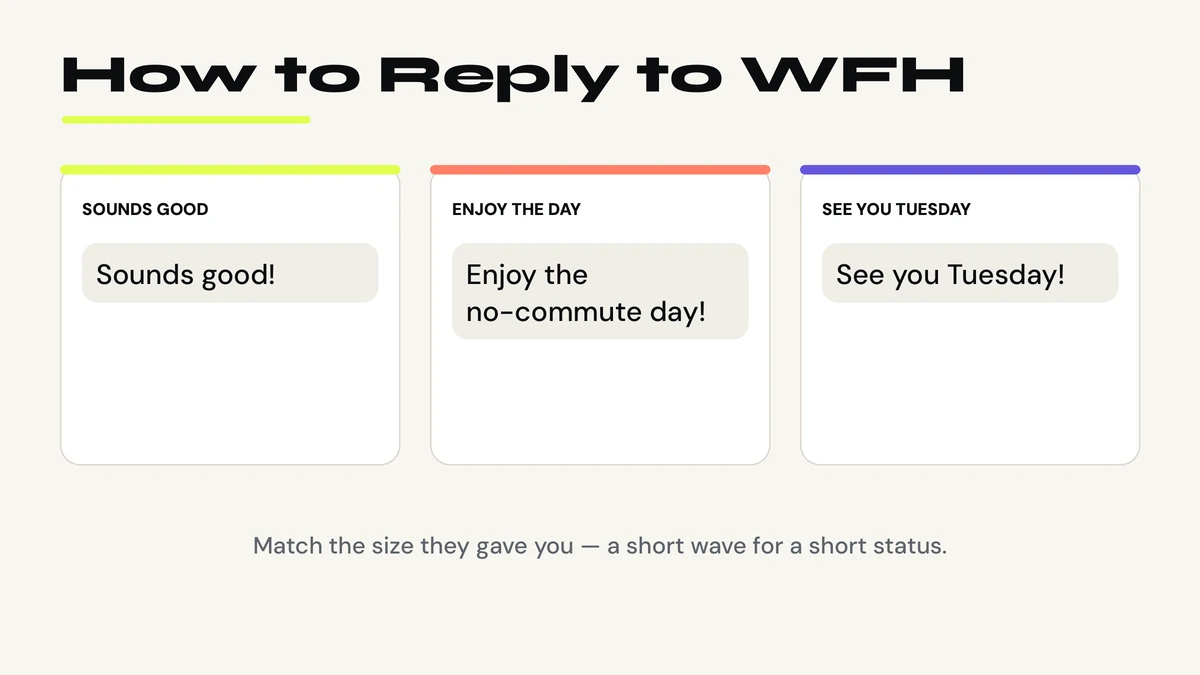
Replying to WFH is easy once the Day-or-Job Test has done its work, because the test tells you which job the WFH is doing, and the job tells you the reply. A one-day status gets a short acknowledgment. A job listing gets a question about the policy. A lazy-day wink gets a joke back. The reply bank below is ordered the same way the scale is ordered — smallest first — and the rule underneath it is the day rule: match the size they gave you, and if they gave you no day, ask for one before you plan around it.
- Sounds good: “Sounds good, ping me if you need anything.” — For the one-day status with a day and an availability promise. Short, warm, and the most common reply in the guides.
- Enjoy the no-commute day: “Enjoy the no-commute day!” — For the one-day status from a friend, where the reply is allowed to be a little jealous. Warm, and it names the best part of the arrangement.
- See you Tuesday: “See you Tuesday!” — For the status that names the return day. Accepts the status and closes the exchange cleanly, because the return is already in the message.
- Want to meet near your place: “Want to grab coffee near your place at noon?” — For the friend’s WFH with a reason and an invitation built in. Accepts the plan the sender offered, and turns a status into a meeting.
- No worries, I will send the files over: “No worries, I will send the files through Teams.” — For the coworker’s status that needs a practical answer, not a warm one. Accepts the status and moves the work forward.
- Same here: “Same here, WFH too!” — For the shared home day, where the reply is a match, not an answer. Short, friendly, and the right size for a status that asked for nothing.
The one reply that never works is the one that ignores the test. Answering a job listing with “sounds good” proves you did not read it. Answering a one-day status with a question about the policy wastes a question the message already answered. And treating a WFH status as a day off — “great, so you are free all day?” — spends goodwill the sender never offered, because a WFH person is on the clock, and the clock is the whole point. Run the three questions — day, job, availability — and the reply writes itself: a short wave for a short status, a question for a job, and a joke for a wink.
Frequently Asked Questions
What does WFH mean in a text message?
WFH means “work from home.” In a text or a chat, it usually means “I am working from home today” — a quick location update that says the person is doing their usual job from home instead of the office, and is still on the clock. The letters say where someone works, not when they work, and the day attached to them is what turns a job description into a status.
What does “I am WFH today” mean?
It means “I am working from home today.” The person is still working but will not be physically present at their normal workplace today. They are usually still reachable on chat, email, and calls during their normal hours, and the message often adds how to reach them — “WFH today, on Slack all day” — so the team knows the person is home, not off.
Is WFH the same as remote work?
Not necessarily. WFH specifically means working from home, while remote work can happen from different locations outside a traditional office, such as a coworking space, a coffee shop, or another approved location. WFH is a type of remote work, but the terms are not synonyms: remote work is the larger umbrella, and WFH is one specific place underneath it.
Is WFH the same as working from anywhere?
No. WFH means working from home, while working from anywhere — WFA — means working from anywhere with Wi-Fi, even a coffee shop. A remote worker can work from anywhere, but someone saying “I am WFH” specifically indicates that they are working from home. The home is the point of the letters, and a coffee shop is not home.
Can I use WFH at work?
Yes, in internal communication. WFH is widely understood in workplace chats, emails, calendars, and team updates, and there is no inherent lack of professionalism in using an established workplace abbreviation. For formal documents, public-facing content, or people unfamiliar with workplace abbreviations, writing “work from home” in full is clearer — the audience, not the abbreviation, decides.
Does WFH mean I am off work?
No. WFH means the person is working from home, not taking time off. Someone who is off work might instead use PTO for paid time off or OOO for out of office, depending on the situation. A WFH person attends meetings, answers messages, and follows a normal schedule from home; an OOO person is not available at all.
What does WFH mean in a job posting?
In a job posting, WFH usually means the role may allow home-based work — for example, “This position offers three WFH days per week.” It does not always mean the same thing: the employer’s actual remote-work policy determines the details, including which days, whether the arrangement is full-time or hybrid, and what the location limits are. A job listing that says “remote” may provide more location flexibility than one that says “hybrid with WFH options.”
What is the difference between WFH and WFO?
WFH means “work from home” and WFO means “work from office.” They are mirror images: “I am WFH Monday and WFO Tuesday” means home on Monday, in the building on Tuesday. The pair is what makes workplace calendars scannable — one abbreviation for the home days, one for the office days, and the week reads at a glance.
The Takeaway
WFH means “work from home,” and that is the easy part. The hard part is the size, and the hard part is the whole guide: three letters that can be a one-day status, a recurring schedule, a whole job, or a lazy-day joke, where the day attached to the letters decides which one it is. Four major dictionaries list the reading directly — Wiktionary, Merriam-Webster, Cambridge, and Oxford Learner’s — the strongest dictionary record in the series, and the guides agree on the meaning. What none of them can tell you is whether your particular WFH is a day or a job, and that is what the Day-or-Job Test is for: ask whether it names a day, ask whether it describes a job, ask whether it promises availability, and trust the day over the job when they disagree.
If you remember one thing from this guide, remember the day rule. A WFH with “today” attached is a fact about today. A WFH with a role attached is a fact about a job. A WFH with no day and no availability attached is a status with the detail taken out, and the honest reply is a question, not an assumption. Run the test, match the size they gave you, and when they gave you a day, answer it short: “Sounds good.” That is the whole guide in one reply.