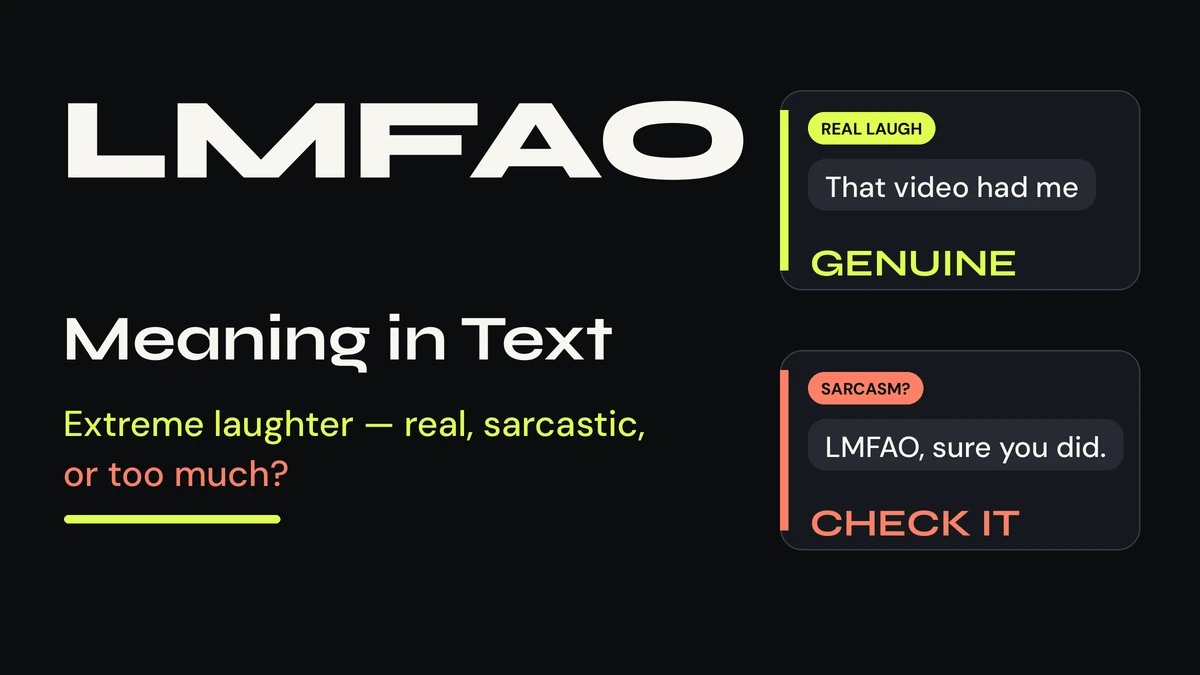
What does lmfao mean in text? LMFAO means extreme, exaggerated laughter — the strongest laugh reaction in everyday texting, sent when something is so funny that a plain “haha” would undersell it. This guide to lmfao meaning in text gives you the LMFAO Laugh-or-Sarcasm Test, so you can tell in seconds whether the laugh you just got is real, sarcastic, or aimed at you.
This guide covers the one dictionary-attested expansion, the three-check test, seven tones, LMFAO on TikTok, Snapchat, Instagram, and in texts, how it lands by sender, when it is too much for work, school, and family, graded claims, cousins, history, and a reply bank keyed to the reading you just identified.
What “LMFAO” Means in Text
LMFAO is an initialism, built from the first letters of a phrase, and it works as a reaction, not a sentence: it tells the reader how hard something landed. The dictionary record is short and decisive. , read directly for this article, lists LMFAO as internet slang and text messaging, marked vulgar, and calls it a more emphatic form of the shorter four-letter laughter term. Its etymology line is just as plain: the shorter term with an additional F. That single letter is the whole upgrade — it turns a strong laugh into an extreme one.
The plain expansion, spelled out here once because the term requires it: laughing my fucking ass off. Everywhere else in this guide it appears only in asterisked form, as “laughing my f***ing a** off,” following the series vulgar-term policy. The “freaking” version you see in family-friendly guides is a clean swap, not a second dictionary meaning: it changes the register, not the meaning, and it is the version to use wherever the room requires it.
Two facts from that record do most of the work. First, LMFAO is not literal: nobody typing it has actually laughed anything off. It is an exaggeration marker, a way of saying “this is far funnier than normal” in five letters. Second, the meaning is fixed but the job is not: the same five letters can be a genuine belly laugh, a sarcastic jab, or a softener for an awkward moment, and the sentence around them decides which. The test in the next section turns that observation into a procedure, because “context matters” is true and useless on its own.
The LMFAO Laugh-or-Sarcasm Test

Before you answer an LMFAO — or send one — run three checks. They take about five seconds, and they beat every shortcut the competitors offer, because the competitors all say “tone depends on context” without giving you a procedure for reading it:
- Check 1 — The Trigger Check. What is being laughed at? A joke, a meme, a fail video, or an embarrassing story points to a real laugh. An absurd claim, a bad plan, or a boast points to sarcasm or disbelief. If there is nothing funny in the message at all, the laugh is doing social work, not reporting laughter — move to Check 2 before deciding what kind.
- Check 2 — The Company Check. What travels with the letters? A laughing emoji, exclamation marks, or a follow-up like “stop, I cannot breathe” confirms a real laugh. A flat period, a “sure,” a “yeah right,” or a quoted claim confirms sarcasm. Stretched spelling (LMFAOOO) turns the volume up; it does not change the reading — a stretched sarcastic laugh is still sarcasm, only louder.
- Check 3 — The Room Check. Would the sender say the full asterisked phrase to this person, in this place? If the phrase would sound wrong — to a boss, in a school group, to someone who dislikes casual swearing — then the abbreviation is wrong too, because abbreviation does not launder meaning: five letters do not make a vulgar phrase polite; they only make it shorter. When the room fails, swap to clean words (“that is hilarious”) or drop the letters entirely.
Worked trio. “That dog video had me LMFAO 😂” — trigger: a funny video; company: a laughing emoji; room: friends, fine. Real laugh. “You think you can finish that in ten minutes? LMFAO, sure.” — trigger: an absurd claim; company: “sure” and a flat period; room: friends, fine. Sarcastic disbelief. “LMFAO, that meeting was chaos” in a work thread — trigger: a shared bad day; company: none; room: fails, because the phrase would sound wrong to a manager. Do not send it there; send “that meeting was chaos” and leave the laugh out.
“LMFAO” in Real Chats
Illustrative examples written for this guide, not real transcripts:
- The meme reaction. “That meme with the dancing cat. LMFAO, I cannot stop watching it.” — the classic: a real laugh at shared content.
- The fail story. “I tripped walking into the meeting room.” — “LMFAO, I would have laughed so hard.” — laughing with the storyteller, not at a stranger.
- The sarcastic disbelief. “You think that plan will work?” — “LMFAO, no chance.” — the laugh is the rejection, dressed as amusement.
- The self-mocking flop. “I tried cooking pasta and somehow burned water.” — “LMFAO, how is that even possible?” — exaggeration as affection: the flop is funny because it is harmless.
- The awkward softener. “I accidentally replied to the boss with a meme.” — “LMFAO, that is awkward.” — laughter as a pressure valve for an uncomfortable moment.
- The group-chat pile-on. “Did everyone see the screenshot?” — “LMFAO, yes.” — a shared laugh that bonds the room; nobody is the joke, the moment is.
- The dry filler. “LMFAO, ok, moving on.” — fast-chat shorthand with almost no feeling left in it. The letters keep the rhythm going; they do not report a real laugh.
The LMFAO Tone List
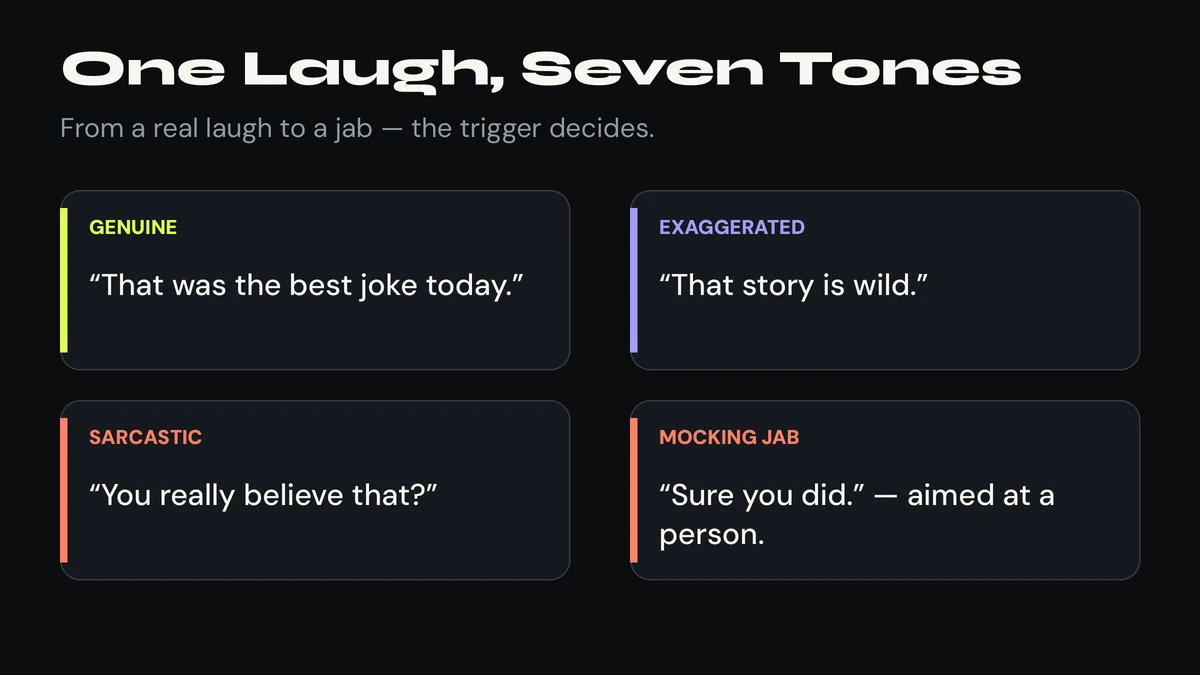
LMFAO’s meaning stays extreme laughter; its job slides across seven readings, lightest to heaviest — and the image above shows where a real laugh ends and a jab begins:
- Genuine belly laugh: “LMFAO, that was the best joke today.” The default among friends. Something truly funny, answered in kind.
- Exaggerated reaction: “LMFAO, that story is wild.” The sender is amused, maybe not literally in tears, and the exaggeration is the point: the reaction is bigger than the moment, on purpose.
- Warm bonding: “LMFAO, you are too funny.” The laugh is a compliment. It says “you made my day funnier,” and it lands best between people who already trust each other.
- Playful teasing: “LMFAO, you are such a dork.” Teasing with a laugh attached. The joke is gentle, the target is in on it, and the laugh proves it.
- Sarcastic disbelief: “LMFAO, you really believe that?” No laugh is being reported. The letters mark a claim as too absurd to take seriously.
- Mocking jab: “LMFAO, sure you did.” The laugh is aimed at someone. The difference from sarcastic disbelief is the target: a claim versus a person, and a person-targeted laugh stings.
- Dry filler: “LMFAO, ok.” The letters are doing rhythm work, not feeling work. In fast chats, a bare LMFAO can mean little more than “noted, moving on.”
What moves a reading between these tones is never the letters alone: it is the trigger (Check 1), the company (Check 2), and the history between sender and reader. The same “LMFAO” that is a warm compliment from a friend is a jab from a stranger — and the test, not the spelling, tells you which room you are in.
“LMFAO” on TikTok
On TikTok, LMFAO is a comment-section reaction more than a private message: “LMFAO, this edit is perfect” under a video, “LMFAO, the last slide got me” under a carousel, or a creator captioning a fail with a bare “LMFAO.” The public stage suits the genuine-laugh and exaggerated-reaction readings best — a comment thread is an audience for a reaction, not a confession booth, and a big public laugh plays well there.
The trap on TikTok is the reverse of the private-chat trap: taking a public LMFAO personally. A creator who captions a video “LMFAO” is reacting to their own content for a crowd, not laughing at you, and a commenter who writes “LMFAO” under a stranger’s video is applauding the video, not judging the viewer. If an LMFAO arrives in a TikTok DM, though, run the test as usual — a DM is private again, and the sarcasm and jab readings return with it.
“LMFAO” on Snapchat
On Snapchat, LMFAO fits the fast, disappearing story reply: “LMFAO, he always does that” under a friend’s snap, or a quick “LMFAO” on a funny photo before it vanishes. The disappearing format suits the genuine and exaggerated readings — a laugh that lands lightly and is gone. But disappearance also removes your evidence: if an LMFAO felt like a jab, you cannot re-read it, so judge from memory what rode with it — an emoji, a “sure,” or nothing at all.
Snapchat is also where the photo does half the work. A picture of a dog stealing a sandwich plus “LMFAO” needs no explanation: the image names the joke, and the letters only turn the volume up. That is the Trigger Check working in real life — remove the LMFAO and the snap is still funny, which is how you know the job was a real laugh, not sarcasm.
“LMFAO” on Instagram
On Instagram, LMFAO shows up in comments, captions, story replies, and DMs, and the stage decides the weight the way it does for every reaction term. Captions lean public and performative: “LMFAO, this one got me” under a meme is a reaction posted for an audience. Comments lean applause: “LMFAO, the last slide” under a carousel is a public laugh the whole thread can join. DMs carry the full range, exactly like texts — a friend’s belly laugh and a stranger’s jab live in the same inbox, and only the test tells them apart.
Instagram is also where LMFAO meets its closest stage trap: a comment laugh that looks personal but is not. A stranger’s “LMFAO” under your post is usually laughing at the post, not at you, and answering it like a personal jab starts a fight nobody was having. Read the trigger first — the post, not your feelings about the post — and the letters second.
“LMFAO” in Text Messages
Plain texts are LMFAO’s home ground, and the one-to-one setting makes the distinction sharpest. A genuine text laugh wants a shared moment: “That video had me LMFAO.” A sarcastic text laugh wants a reaction to a claim: “LMFAO, no chance.” The reply each one deserves is completely different, which is why the Trigger Check comes first — answering sarcasm with a laugh, or a real laugh with a defense, is the classic LMFAO misfire.
Texts are also where a public laugh turns into a private conversation, and the conversation usually moves somewhere only two people can see. A joke thread that gets personal often continues in a private thread — our DM guide covers that move in full, because the channel changes what the next message can say. And texts are LMFAO’s work limit in miniature: never send it, even abbreviated, in a professional message. A client, a manager, or a first contact deserves “that is hilarious” spelled out, not five letters that presume an intimacy and a casualness you do not have.
Who Is Sending It: How “LMFAO” Lands by Sender
No source documents a different meaning of LMFAO per sender — the expansion stays fixed; what changes is how much laughter the reader should take seriously, and therefore what you owe back. One framing is rejected outright here: a competitor organizes sender sections by gender (“what does LMFAO mean from a boy?” and “from a girl?”) while admitting the tone is the same in both. Gender does not decide an LMFAO’s weight. Relationship and stakes do, so this guide uses those instead:
- Friend: the default. A friend’s LMFAO is a real laugh or a tease at face value; run the test and answer that, not the letters.
- Crush: overread territory. A crush’s LMFAO feels bigger than it is — usually shared humor, not a verdict on you. Answer the joke, not a romance you invented.
- Partner: pattern rules. A partner’s LMFAO is usually a running joke; judge the pattern across days, not one message — but a sudden run of cold, jab-style LMFAOs after disagreements is a conversation worth having.
- Parent: the translation habitat. A parent who writes LMFAO has usually learned it from you and means the laugh plainly; do not read a parent’s LMFAO as sarcasm unless the joke is obvious.
- Coworker or boss: context decides. In a friendly team chat a colleague’s LMFAO about a shared fail is a laugh; in any formal thread it is out of place, and never send one upward to a manager or client.
- Group chat: the bonding habitat. A group’s “LMFAO, yes” invites the whole room to laugh; answer briefly in the group, and do not single one sender out for a private reading of a public laugh.
- Stranger or creator: the applause habitat. A stranger’s LMFAO under your post, or a creator’s LMFAO in a caption, is a public reaction, not a judgment of you personally. Enjoy the applause; never answer it like a jab.
When “LMFAO” Is Too Much: Work, School, and Family
This section is mandatory for LMFAO in a way it is not for most terms in this series, because the term carries a vulgar word inside it, even abbreviated. Four rooms, four rules. At work: never send LMFAO in a professional message, a client thread, or a formal channel. A shared laugh among close peers in a casual chat is one thing; the same letters to a manager, a client, or a hiring thread read as careless, because the reader may expand the abbreviation in their head, and the expansion is the problem. If the room would flinch at the full phrase, the letters do not fix it.
At school: the same rule, with a younger audience. Teachers, school groups, and class chats are not laugh rooms for a vulgar abbreviation, and a student who sends LMFAO to a teacher has sent a vulgar phrase in code, whether they meant to or not. The clean swap, “that is hilarious,” is still warm for a teacher, so the safer swap is “that is so funny” or “haha.” In family chats, read the room person by person: a sibling group may love it, a grandparent group may not know it, and a parent who dislikes casual swearing will dislike the abbreviation exactly as much as the phrase, once they learn what it stands for. Abbreviation is not permission.
The general rule covers every room at once: if someone tells you LMFAO bothers them, simply stop. Switching words is easy, and it shows respect. The swap menu is free and it loses nothing: “that is hilarious” for the laugh, “I cannot stop laughing” for the extreme reaction, “haha” for the casual room. And one boundary worth stating plainly: never use LMFAO to dress up mockery. A laugh aimed at humiliating someone is not humor; it is a jab wearing a laugh’s clothes, and the Trigger Check catches it, because the trigger that deserves a jab is not a joke at all.
Checked Claims: Expansions That Do Not Hold Up
Five letters attract folklore. Each claim below was graded against the dictionary record and the competitors read in full; nothing is repeated here as fact on a single blog’s say-so:
- “LMFAO sits on a fixed laughter scale: LOL, then the shorter term, then LMFAO, then ROFL” — rejected as a fixed scale. One competitor prints exactly that table with intensity levels. No frequency or intensity study exists in any source read for this article, and Wiktionary supports only one step of the ladder: LMFAO is more emphatic than the shorter four-letter term. The rest of the ladder is a blog’s ordering, not a measurement, so this guide reports no scale and no ranking beyond the one dictionary-supported step.
- “Capitalization decides the meaning: LMFAO is stronger than lmfao” — rejected as a meaning change. A competitor states that capitals feel stronger. Volume is not meaning: all-caps reads louder and lowercase reads more casual, but neither changes the reading — the Trigger Check and Company Check do that. Case is a volume knob, not a new definition.
- “LMFAO means something different from a boy than from a girl” — rejected. A competitor runs separate boy and girl sections while admitting the tone is the same. No dictionary or documented usage source supports a gender-split meaning. Relationship and stakes decide the weight; gender does not.
- “The music duo invented LMFAO” — rejected. Both competitors agree the slang predates the band: the term was already in chatrooms and instant messaging in the late 1990s and early 2000s, and the duo chose a name that already existed. The band amplified the term into mainstream recognition; amplifiers are not inventors.
- “LMFAO means ‘laughing my freaking a** off’ as its dictionary expansion” — graded as a clean variant, not the dictionary meaning. The “freaking” version is the same reading with the vulgar word swapped out for polite company. It changes the register, not the meaning, and it is the version to use wherever the room requires it — but it is not what the dictionary lists.
- “LMFAO always means real laughter” — rejected. Both competitors document sarcastic disbelief and mock-surprise uses, and the examples are easy to find in any comment thread. A laugh that answers an absurd claim is not reporting laughter; it is rejecting the claim. The test, not the letters, tells you which one arrived.
- “LMFAOOO is a different term” — graded as a variant, not a new meaning. Stretched spelling (extra O’s) is emphasis, the same way repeated exclamation marks are emphasis. It turns the volume up on whichever reading is already there; it does not invent a new one.
- “LMFAO is harmless because it is only an abbreviation” — rejected. Abbreviation shortens a phrase; it does not clean it. Wiktionary marks the entry vulgar, and any reader who knows the expansion hears the full phrase whether you typed five letters or five words. If the room would flinch at the phrase, the letters fail the Room Check too.
What SURVIVES: one dictionary-attested expansion, marked vulgar, more emphatic than the shorter laughter term, decided per message by trigger, company, and room. Everything else failed evidence, was fenced as a variant or a domain homonym, or was refused a number it cannot support.
“LMFAO” vs Its Closest Cousins
LMFAO belongs to the laughter-reaction family, but each cousin does a different job, and one look-alike is not a laugh at all:
- The shorter laughter term — the less emphatic cousin. Wiktionary calls LMFAO the more emphatic form of this four-letter term, so the difference is volume, not kind: the shorter term is a strong laugh, LMFAO is that laugh turned all the way up. No publication claim is made here about any separate guide for the shorter term; it is named only so the dictionary step can be read correctly.
- LOL (“laugh out loud”) — the mild cousin. The everyday laugh, used so often it can mean little more than “noted warmly.” LOL says “that amused me”; LMFAO says “that destroyed me.” Same family, very different volume.
- ROFL (“rolling on the floor laughing”) — the physical-comedy cousin. Where LMFAO exaggerates the feeling, ROFL exaggerates the body: the joke is pictured as knocking the sender down. ROFL is a cartoon of a laugh; LMFAO is a louder version of one.
- IMAO — the look-alike trap. Our IMAO guide covers an opinion term (“in my arrogant opinion”), not a laugh at all. The letters look alike, the jobs do not: reading an opinion as laughter, or laughter as an opinion, is the one misread this section exists to prevent.
- ISTG (“I swear to God”) — the emphasis cousin. Our ISTG guide covers an intensifier that underlines a sentence; LMFAO’s exaggeration cheers a moment instead. ISTG says “believe this”; LMFAO says “this is hilarious.”
- FR (“for real”) — the co-sign cousin. Our FR guide covers agreement and sincerity; a sarcastic LMFAO often arrives right after an FR-worthy moment, but FR certifies a claim while LMFAO reacts to one. FR says “this is true”; LMFAO says “this is funny — or absurd.”
- JSP — the tone-tag cousin. Our JSP guide covers the tag that softens a joke or firms up an opinion — and, in French chats, simply means “I don’t know.” JSP tags the joke; LMFAO is the laugh it earns. One marks how to take it, the other shows how hard it landed.
- IYKYK — the inside-joke cousin. Our IYKYK guide covers “if you know, you know” — five letters that point at a joke without explaining it. IYKYK points at the joke; LMFAO is the biggest laugh it can get. One hides the punchline, the other shouts the reaction.
LMFAO often travels with a joke, a meme, or a fail — and that companion is what makes the reading readable at a glance. Read the companion first, and the letters second.
Where “LMFAO” Came From
LMFAO rose with late-1990s and early-2000s internet chatrooms and instant messaging, where short screens and shorter patience rewarded five-letter reactions. Both competitors place it in that window, alongside the shorter laughter terms it grew from, and Wiktionary’s etymology confirms the direction: the shorter term first, the F added for emphasis. No inventor and no exact first-use year is claimed, because no source read for this article documents one — the broad window is the honest date, and any guide printing a single year is guessing.
From there it spread the way every durable reaction spreads: through texting, forums, gaming chats, and social platforms, until it was part of the default reaction vocabulary. The music duo of the same name, who broke through in the late 2000s, then carried the letters into mainstream culture — both competitors agree the duo chose an existing slang term as their name, not the other way around. The band made LMFAO famous to people who had never used it in a chat; the chats had already made it mean something long before the first single.
How to Reply When Someone Sends “LMFAO”
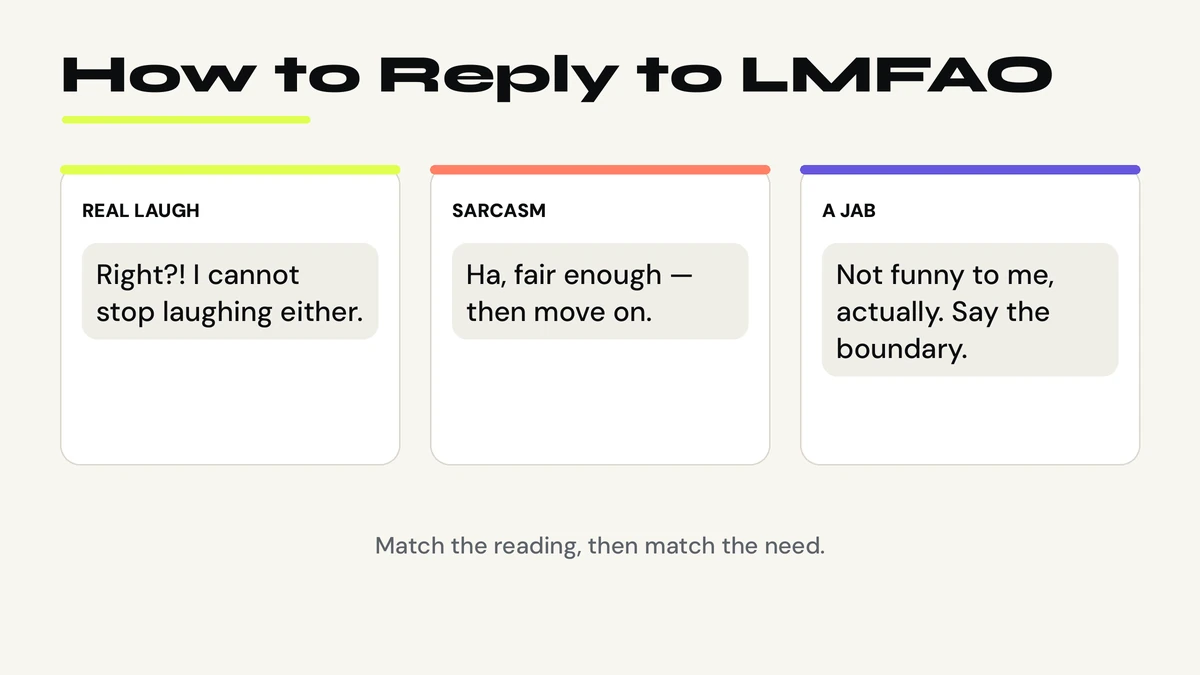
Six replies, matched to the reading and the tone. Name the reading first, or every reply below can misfire:
- Genuine laugh, and you agree: “Right?! I cannot stop laughing either.” Match the energy, then add a detail, so the laugh becomes a conversation instead of an echo.
- Genuine laugh, and you want a plan: turn the laugh into a next step — our HMU guide covers the open invitation that does exactly that: “LMFAO, same — so, are we doing this Saturday?” Energy without a plan fades; energy plus a time becomes a memory.
- Sarcastic laugh, and it is a joke: “Ha, fair enough” or a laughing emoji. A sarcastic LMFAO answered lightly stays a joke; answered defensively, it becomes a fight.
- Mocking jab, and it stings: “Not funny to me, actually.” A boundary beats a louder laugh, and it beats silence too — silence tells a jab it landed safely.
- Group-chat laugh, and you are the room: answer briefly in the group (“LMFAO, yes, exactly”) and do not single one sender out for a private reading of a public laugh. The room laughed together; the reply belongs to the room.
- Laugh in the wrong room, and you need to leave: if a laugh thread has run its course, exit cleanly — our GTG guide covers the polite exit that does not leave anyone hanging: “Haha, ok, I have to run — talk later!” A clean exit beats a forced laugh every time.
What never works: answering sarcasm with a real laugh when a claim was being rejected, answering a genuine laugh with a defense when nobody attacked you, or answering a workplace LMFAO with one of your own. The golden rule: match the reading, then match the need.
Frequently Asked Questions
What does “LMFAO” mean in a text message?
Extreme, exaggerated laughter — the asterisked form is “laughing my f***ing a** off.” In practice it means something was so funny, ridiculous, or unbelievable that a plain laugh would undersell it. Run the Laugh-or-Sarcasm Test to tell a real laugh from sarcasm: check the trigger, the company, and the room.
Is LMFAO a swear word?
The letters themselves are not a swear word, but the expansion contains a vulgar word, which is why Wiktionary marks the entry vulgar and why this guide spells the full phrase out only once and asterisks it everywhere else. In polite, professional, school, or family rooms, use “that is hilarious” or “haha” instead.
Is LMFAO stronger than LOL?
Yes, in the only sense the evidence supports: LMFAO is an extreme-laughter reaction, while LOL is the everyday, often bleached laugh. No study ranks every laughter term on one scale, so this guide claims no fixed ladder — only that LMFAO sits at the extreme end, and that Wiktionary calls it more emphatic than the shorter four-letter laughter term.
What does LMFAO mean on TikTok?
Almost always a public laugh: a reaction in a comment or caption to a funny video, edit, or fail. A TikTok DM can still be sarcastic or mocking, so run the test on private messages — the stage changes the odds, not the meaning.
What does LMFAO mean on Snapchat?
Usually a quick story-reply laugh at a friend’s snap — genuine or exaggerated, landing lightly before it disappears. Because the message vanishes, judge a jab-style LMFAO from memory: what rode with it, an emoji or a flat “sure,” decides the reading.
What does LMFAO mean on Instagram?
The same extreme laugh everywhere on the app — applause in comments, a reaction in captions, the full range in DMs. A stranger’s LMFAO under your post is usually laughing at the post, not at you, so read the trigger (the post) before answering it like a personal jab.
What should I reply when someone sends LMFAO?
Match the reading: answer a genuine laugh with matching energy plus a detail (“Right?! I cannot stop laughing either”), answer sarcasm lightly (“Ha, fair enough”), and answer a jab with a boundary (“Not funny to me, actually”). The reply bank above has one for each reading and tone.
Does lowercase lmfao mean something different from LMFAO?
No, the meaning is the same; only the volume changes. Lowercase lmfao reads casual and relaxed, all-caps LMFAO reads louder and more emphatic, and neither changes the reading — the Trigger Check and Company Check do that.
The Takeaway
Five letters, one extreme laugh, many jobs. LMFAO means exaggerated laughter — genuine, teasing, sarcastic, or mocking — and whether the message you just got is a compliment, a joke, or a jab is decided by the Laugh-or-Sarcasm Test: check the trigger, check the company, check the room. Send the big laugh when the moment genuinely deserves it, swap to clean words when the room requires them, and answer the reading you actually received.