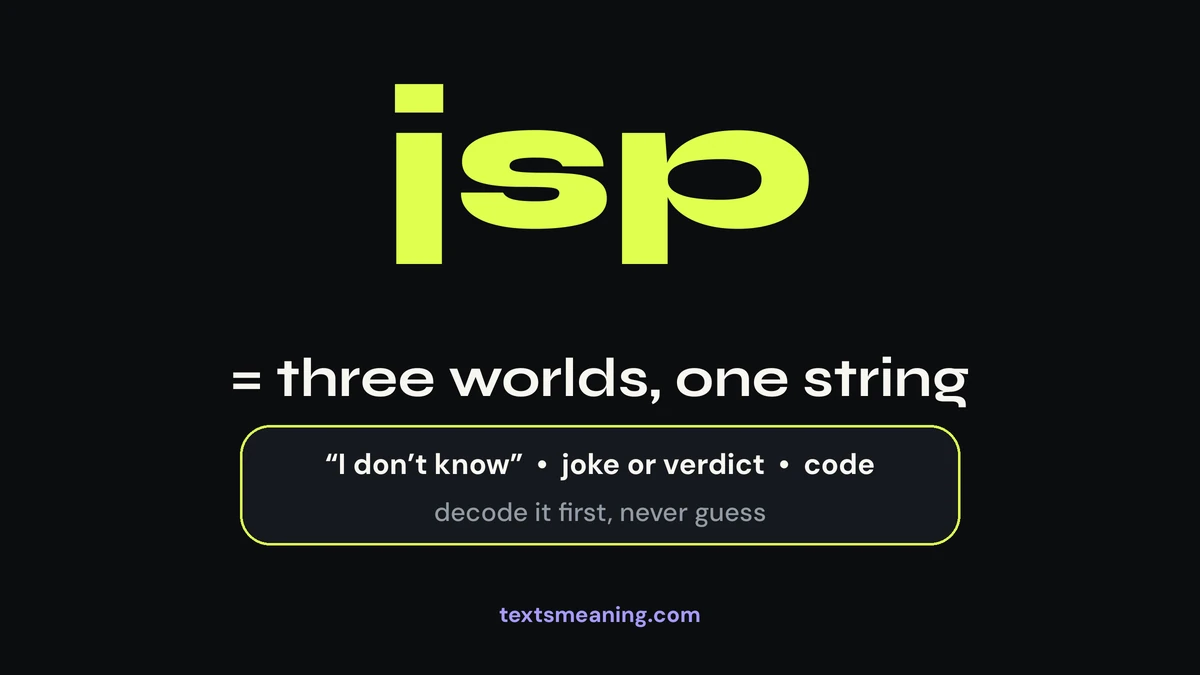
What does jsp mean in text? There is no single English answer: in French chats jsp means “I don’t know,” in English chats it usually softens a joke or firms up an opinion, and in code it means Jakarta Server Pages — so read the language and the sentence first, never the letters alone.
This guide to jsp meaning in text sorts those readings honestly instead of crowning one of them. It covers the graded evidence for each reading, the JSP Language-First Test, a seven-reading tone list, jsp on TikTok, Snapchat, Instagram, and in texts, senders, misreads, graded claims, cousins, history, and a reply bank keyed to the reading you just found.
What “JSP” Means in Text
Start with the one reading that is documented rather than merely repeated. In French digital writing, lowercase jsp abbreviates je ne sais pas, or in its everyday spoken form je sais pas, meaning “I don’t know.” The main competitor for this article reports that Wiktionary documents jsp as French internet and text-messaging slang for exactly that phrase, and every other competitor read agrees that the French reading is real — which makes it the strongest texting reading in this guide. It does the same job as English IDK guide, with different letters: it answers a question by admitting what the sender does not know. “Tu viens demain?” — “jsp” is not a joke and not an opinion; it is a shrug in French.
The English readings are a different kind of evidence. Competitors disagree with each other, and that disagreement is itself the finding. One guide leads with “Just Playing,” used after a joke or a tease to say the last line was not serious. Another leads with “Just Saying, Period,” used after a firm opinion to say the sender has made their point and is done debating it. Others offer “Just Saying,” “Just Saying, Please,” or “Just Saying, Peace.” No dictionary entry was found in this run for any English expansion of JSP, and no competitor cites one either — so this guide treats every English expansion as contextual slang, attested by user-generated entries and current guides, never as a settled definition. That is not a hedge; it is the honest grade, and it changes how you read every English jsp you meet.
Then there is the reading that has nothing to do with texting at all. In software, JSP stands for JavaServer Pages, now Jakarta Server Pages under Jakarta EE (the current specification is branded Jakarta Pages), a technology for building dynamic web pages that dates to 1999. If the message sits next to code, a file name ending in .jsp, or words like servlet, server, or deployment, the tech reading wins immediately and the slang readings should not even be tried. Three worlds, one string of letters — French uncertainty, English tone, and web technology — and the rest of this guide is a procedure for telling which world you are in before you answer.
The JSP Language-First Test
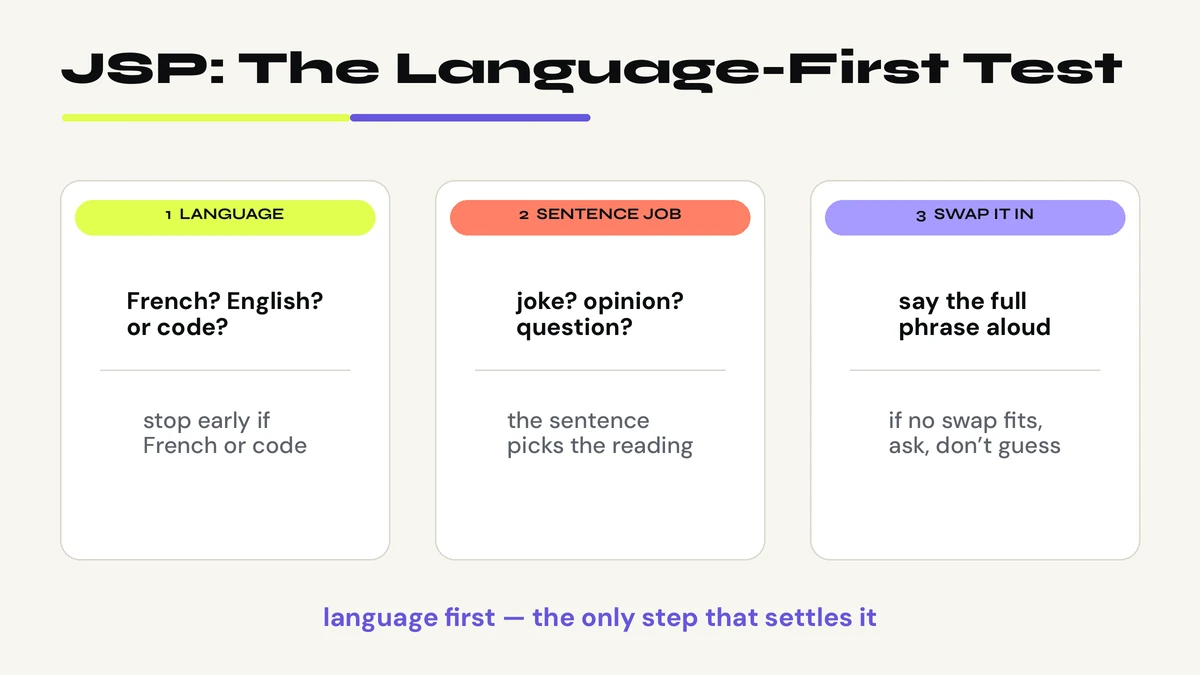
Before you answer a jsp — or send one — run three steps in this order. The order matters: language first, because it is the only step that can settle the question outright, and the competitors all skip it by jumping straight to “context matters” without saying which context to check first:
- Step 1 — Name the language. Is the conversation in French, in English, or in code? A French sentence, a French-speaking sender, or jsp standing alone as the answer to a French question points to je ne sais pas. Code words, a .jsp file name, or a developer thread points to Jakarta Server Pages. Only if the conversation is English and not code do you move on — and that exclusion is the test doing its hardest work for you.
- Step 2 — Name the sentence job. What is the sentence before jsp doing? A joke, a tease, or an exaggerated claim points to Just Playing. A firm opinion, advice, or a verdict points to Just Saying or Just Saying, Period. A question answered with nothing but jsp, or jsp tucked inside a sentence about not knowing, points back to the French reading even in a mixed-language chat. The job, not the letters, picks the English reading.
- Step 3 — Swap it in. Replace jsp with the full phrase you think it means and read the sentence out loud. “You are the worst cook ever, just playing” works; “You are the worst cook ever, just saying, period” works too, but it changes the temperature from playful to final — and that difference is information, not noise. If no swap sounds like something a person would actually say, you have not found the meaning yet, and the honest move is to ask, not to pick the swap that flatters your first guess.
Worked trio. “Tu viens ce soir?” — “jsp”: Step 1 says French, so stop — “I don’t know,” and no English reading gets tried. “You are officially banned from picking movies JSP 😂”: Step 1 says English, Step 2 says tease, Step 3 swaps in “just playing” and the sentence relaxes — joke, answer it with a laugh. “That restaurant is not worth $100, JSP.”: Step 1 says English, Step 2 says opinion, Step 3 swaps in “just saying, period” and the sentence hardens into a verdict — opinion, answer the opinion, not the joke. Same letters, three answers, one test.
“JSP” in Real Chats
Illustrative examples written for this guide, not real transcripts:
- The French shrug. “Tu viens demain?” — “jsp”. A question answered with uncertainty. Reply with patience, not pressure: “No problem, let me know when you know.”
- The French sentence. “jsp si je peux venir” — “I don’t know if I can come.” The jsp sits inside a French sentence doing the job of a verb phrase, not a tag. Translate the sentence, not the abbreviation.
- The joke softener. “You owe me lunch for a month, JSP 😂”. The tease lands, then jsp takes the sting out. Laugh, or fire back in kind — but do not answer it as a real debt.
- The firm opinion. “That movie was overrated, JSP.” No emoji, no joke in sight. This is a verdict with the door closed behind it. Answer the opinion if you want a debate, or let it stand if you do not.
- The advice tag. “You should probably call her back, JSP.” Softer than the verdict: an opinion offered as a nudge, not a ruling. The swap that fits is Just Saying, and the reply is a simple acknowledgment.
- The code line. “Can you edit login.jsp before the deploy?” No slang reading survives Step 1 here. This is a file, and the only correct reply is about the file.
- The stranded jsp. A lone “JSP” with no sentence before it, no language to lean on, and no code in sight. Step 3 fails for every swap, which is the test telling you the truth: there is not enough message to decode, so ask one plain question instead of guessing.
The JSP Tone List
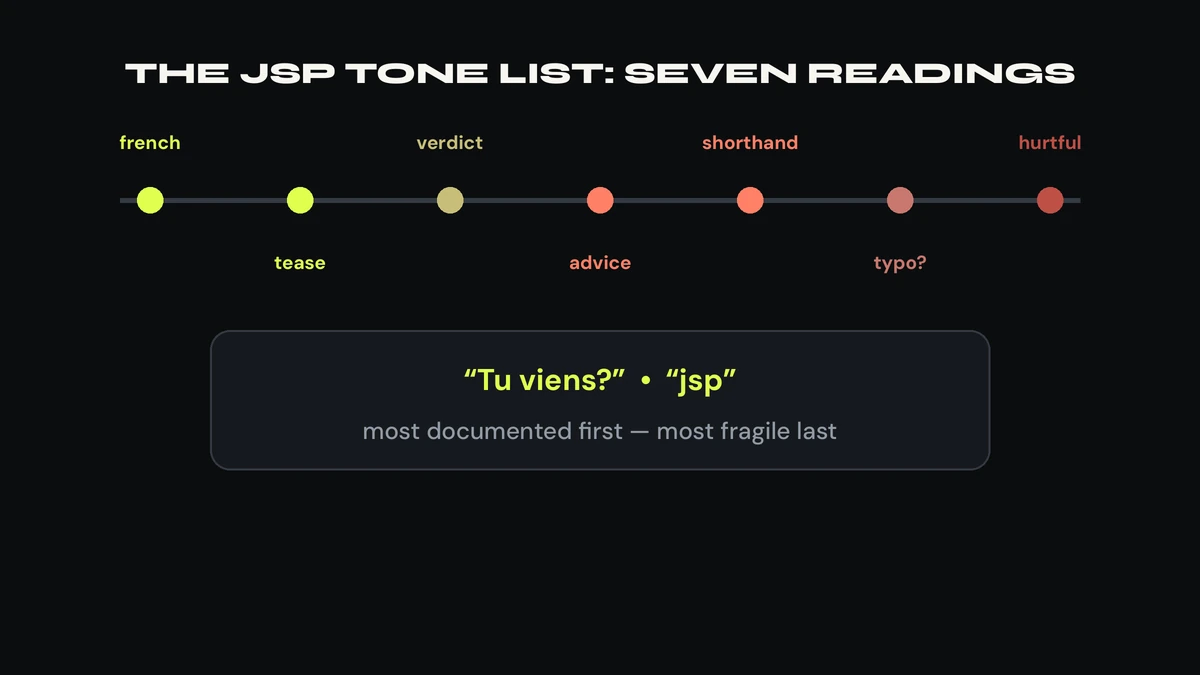
JSP has no single tone, because it has no single meaning — but its readings do fall on a scale, from the most documented to the most fragile. Read the scale as a warning label: the further down you go, the more you are trusting a guess:
- Documented French uncertainty: “jsp” after “Tu viens?” The firmest texting reading in this guide. Answer with patience.
- Attested playful tease: “You are the worst teammate ever, JSP 😂”. The English reading with the most user-generated support, and the laughing emoji is doing half the work.
- Attested firm opinion: “That place is overpriced, JSP.” The verdict reading. No emoji, no joke — the period, literal or implied, is the tell.
- Softened advice: “Try getting there earlier, JSP.” An opinion offered gently. The softest of the English readings, and the easiest to confuse with the verdict above.
- Group shorthand: a jsp that only makes sense inside one friend group, one server, or one running joke. Real inside that room, meaningless outside it — and no guide, including this one, can decode it for you.
- Probable typo: “That movie was not very good jsp.” The sender may have meant JS or JP, and typed an extra letter. Fast thumbs explain more jsps than any slang dictionary admits.
- Hurtful line with a tag: “Nobody likes you, JSP.” A tag does not launder the sentence before it. If the line would hurt without jsp, it hurts with it — answer the line, not the tag.
What moves a reading up or down this list is never the letters alone: it is the language of the conversation, the sentence before the abbreviation, the emoji riding with it, and whether the sender’s history gives you a private meaning to lean on. A laughing emoji pulls any English jsp toward play; a flat, punctuation-free opinion pulls it toward verdict; a French sentence anywhere nearby pulls it toward uncertainty. When two pulls point in opposite directions, Step 1 of the test breaks the tie — language first, always.
“JSP” on TikTok
On TikTok, jsp is a comment-section tone tag more than a private message: “Bro needs to delete this JSP” under a failed stunt, or “This song is elite JSP” under a ranking nobody takes seriously. The public stage suits the playful and firm-opinion readings best, because a comment thread is an audience, not a conversation — and the audience reads the tag, not the sender’s heart. A comment that says “jsp” on its own, with no sentence before it, is the stranded case from the Real Chats section: there is nothing to swap in, so the honest reading is “unknown,” not whichever expansion the loudest reply claims.
The trap on TikTok is the reverse of the private-chat trap: taking a public tag personally. A creator who captions a ranking with jsp is performing a take for a crowd, not sending you a message, and a commenter who writes jsp under a stranger’s video is joining a tone, not starting a relationship. If a jsp arrives in a TikTok DM, though, run the test as usual — a DM is private again, and the language and sentence rules return with it. And on TikTok, French comments are common enough that Step 1 earns its keep: a French sentence in the thread can flip a comment you read as a joke into an “I don’t know” you almost answered with a laugh.
“JSP” on Snapchat
On Snapchat, jsp fits the fast, disappearing caption: “That snap was terrible JSP” over a blurry photo, or a story reply carrying a tease for a few seconds before it vanishes. The disappearing format suits the playful reading — a tag that lands lightly and is gone — but disappearance also removes your evidence: if a jsp felt like a verdict rather than a joke, you cannot re-read it, so judge from memory what rode with it, an emoji, a follow-up, or nothing at all.
Snapchat is also where the photo does half the work, and that cuts both ways. A picture of a disastrous haircut plus “JSP” needs no explanation: the image names the joke, and the letters only soften it. But a snap with no visible joke and a bare jsp is the stranded case again, and the disappearing format means you cannot even scroll back to check the sentence you missed. When a Snapchat jsp is genuinely unclear, the cheapest fix is also the most honest one: reply with a laughing emoji and a question, not a verdict of your own.
“JSP” on Instagram
On Instagram, jsp shows up in comments, captions, story replies, and DMs, and the stage decides the reading the way it does for every tone tag. Comments lean playful: “You post too much lol JSP” under a photo dump is a tease the whole thread can join. Captions lean performative: a creator ending a bold ranking with jsp is softening a take for an audience. DMs carry the full range, exactly like texts — a friend’s joke, a match’s firm opinion, and a French speaker’s “I don’t know” live in the same inbox, and only the test tells them apart.
Instagram is also where jsp meets its closest letter-trap, and it is a trap this series has seen before. A bio or cross-post that says “follow my IG” is pointing at the app, not softening a joke — our IG guide covers that pointer in full, and confusing the two is the one Instagram-specific misread worth naming: “IG” is a two-letter app pointer, “JSP” is a three-letter tone tag or a French shrug, and the extra letter changes everything. Read the whole string, never just the familiar part — and never read an Instagram jsp as the app, or an IG as a joke tag.
“JSP” in Text Messages
Plain texts are jsp’s home ground, and the place its companion phrases are easiest to see. A jsp in a private thread usually travels with the channel itself: a tease sent as a DM guide — “You are never picking the movie again, JSP” — is a private joke, not a public take, and the privacy is part of why the joke is safe to send. Texts are also where the French reading is most likely to ambush an English reader: a bilingual friend who switches languages mid-thread can drop a French jsp into an English conversation, and Step 1 is the only thing standing between you and answering “I don’t know” with a laugh.
Texts are also jsp’s work limit, stated plainly: never use jsp in a professional message. A client, a manager, or a first contact deserves a spelled-out sentence, not three letters that might mean a joke, an opinion, or “I don’t know” in another language. The same rule covers formal writing, complaints, and any serious topic — ambiguity is a cost, and in a serious message the reader should never have to pay it. If clarity matters more than slang style, write “I’m joking,” “just saying,” or “I don’t know” in full; each one costs a few more characters and removes the whole puzzle.
Who Is Sending It: How “JSP” Lands by Sender
No source documents a different meaning of jsp per sender — the readings stay fixed; what changes is which reading is likely, and how much a wrong guess can sting:
- Friend: the default. A friend’s jsp is a joke, an opinion, or a French shrug at face value; run the test and answer the reading you found, not the sender.
- Crush: overread territory. A crush’s jsp feels bigger than it is — usually play, not a confession and not a rejection. Answer the sentence, not the hope, and never mine a tone tag for devotion.
- Partner: pattern rules. A partner’s jsp is usually routine tone; judge the pattern across days, not one message — but a sudden run of firm-opinion jsps after a calm stretch is a conversation worth having.
- Parent: usually literal and plain. A parent who writes jsp has often learned it from you and means the reading plainly; do not read a parent’s jsp as a verdict unless the sentence around it is one.
- Coworker: context decides. In a casual channel a coworker’s jsp is a joke or an opinion you can answer lightly; in any formal thread it is out of place, and never send one upward to a manager or client.
- Group chat: the shorthand habitat. A group’s jsp may carry a private meaning the whole group shares and you do not; answer briefly in the group, and do not single one sender out for a private reading of a group tag.
- Stranger or creator: the public-tag habitat. A stranger’s jsp under your post, or a creator’s jsp in a caption, is a tone for an audience, not a message to you personally. A laugh or a short acknowledgment is enough; never answer in kind with your own ambiguous tag.
When “JSP” Is Not Just a Joke
Four misfires, graded. First, the joke assumption: treating every English jsp as play. A flat opinion with no emoji and no joke in sight is a verdict, not a tease, and answering a verdict with a laugh starts the argument the sender was trying to close. Second, the French miss: answering a French jsp as if it were English play or opinion. “Tu viens?” — “jsp” answered with “Haha, same” is a reply to a message nobody sent; the sender said they did not know, and they are still waiting for patience, not laughter.
Third, the tag-laundering misfire: believing jsp erases the sentence before it. A hurtful line with jsp attached is still a hurtful line, and a firm verdict with jsp attached is still a verdict — the tag changes the temperature, never the content. Fourth, the code miss in the other direction: reading a developer’s jsp as slang. “The JSP page won’t render” is a work problem, and answering it with a joke reply wastes everyone’s time. On appropriateness: jsp is not rude and not vulgar in any reading; its risk is social, not moral — a joke taken as a verdict, a verdict taken as a joke, or an “I don’t know” taken as either. Keep it out of formal, professional, and first-impression messages, out of condolences and serious topics, and out of any first message to someone you do not know well.
Checked Claims: Expansions That Do Not Hold Up
- “JSP always means Just Playing” — rejected as a sole meaning. It is the leading English reading in one competitor and an Urban Dictionary attestation from 2020, but another competitor leads with Just Saying, Period, and no dictionary entry settles it. Attested, not established.
- “JSP always means Just Saying, Period” — rejected as a sole meaning, for the mirror reason: it leads a different competitor, it fits firm opinions well, and it has no dictionary attestation either. Two guides leading with different expansions is evidence of disagreement, not of a tie to break by picking the louder one.
- “JSP means Just Saying, Please” as a standard reading — rejected as standard. It appears in current guides as a possible reading for requests and softened advice, but the evidence is thinner than for either lead reading, and this guide treats it as possible, never as the default.
- “JSP means Just Saying, Peace / Just Saying, Peeps / Just Saying, People” — rejected as working texting meanings. Each appears on one list-style page with no dictionary attestation, no chat example in any source read, and no competitor agreement. The letters can be made to spell many phrases; that is not evidence that people use them that way.
- “Capitalization decides the meaning” — rejected as a rule. Lowercase jsp is common in French writing and uppercase JSP is conventional in code, so case is a useful hint — but people typing fast ignore case constantly, and a lowercase English joke and an uppercase French shrug both exist. The sentence decides; case only suggests.
- “JSP means something different on each platform” — rejected. No source documents a platform-specific meaning; TikTok comments, Snapchat captions, and texts stage the same readings differently, and the main competitor says so explicitly: the app does not determine what jsp means, the conversation does.
- “JSP is flirty by itself” — rejected. A jsp can ride inside a flirty message, the way any tone tag can, but the letters alone prove nothing about romance — no source splits jsp by gender either, and this guide does not: relationship and sentence decide, never the sender’s gender.
- “JSP is always a typo for JS or JP” — rejected as a rule, kept as a possibility. The letter-count mismatch is real evidence (see the cousins section), and fast thumbs do produce stray letters — but the French reading and the tech reading are not typos at all, and a repeated jsp from one sender is a habit, not an accident.
What SURVIVES: the French reading je ne sais pas / je sais pas = “I don’t know” (the strongest texting attestation, reported as dictionary-documented by the main competitor and agreed by every competitor read); the tech reading Jakarta/JavaServer Pages (established since 1999, fenced to code contexts); and two attested-but-unsettled English readings, Just Playing and Just Saying / Just Saying, Period, graded as contextual slang rather than definitions. No competitor percentages are repeated here as fact, and nothing is claimed about a Wiktionary entry that was not read directly — see the research record for the honest limit.
“JSP” vs Its Closest Cousins
JSP belongs to the tone-tag family — words that say how a sentence should be taken, not what it says. Its closest cousins split by how much they certify, and two of them expose jsp’s central problem: the letters do not add up.
- JK: the clearer joke tag. Our JK guide covers it in full. JK means “just kidding,” and its letters map cleanly onto its phrase. When jsp means Just Playing, it does JK’s job with worse spelling — which is why, if clarity matters, JK is the better tag to send.
- JP (name only): the direct joke tag. JP maps letter-for-letter onto “just playing”: J for just, P for playing. JSP, read as Just Playing, carries an unexplained S — and that unexplained letter is evidence, not trivia: it tells you the expansion was fitted to the letters afterward, not built from them.
- JS (name only): the direct opinion tag. JS maps letter-for-letter onto “just saying,” and the same mismatch applies in reverse: JSP read as Just Saying carries an unexplained P. A tag whose letters do not map onto its phrase is a tag you should never trust on letters alone.
ISTG (emphasis cousin): ISTG guide swears by a sentence the way jsp firms one up, but ISTG has one settled expansion and jsp has several unsettled ones — so ISTG can be answered by naming its job, while jsp must first be sorted by language. Do not answer a jsp the way you would answer an oath.
IMO (opinion cousin): IMO guide labels a view as personal, while jsp-as-opinion closes a view down. IMO invites an answer; Just Saying, Period ends one. Same family, opposite invitations — and confusing them turns a debate you were invited to into a verdict you were not.
IKR (agreement cousin): IKR guide agrees with a feeling someone else already stated, while jsp never agrees with anything — it softens a joke, firms an opinion, or shrugs in French. IKR needs a line to echo; jsp needs a language to stand in. Answer an IKR with a feeling, and answer a jsp with the reading the test found.
One rule across the family: when a tag’s letters map cleanly onto its phrase (JK, JP, JS), trust the phrase; when they do not (JSP in English), trust the test. The mismatch is not a flaw in your reading — it is the most honest clue the letters give you.
Where “JSP” Came From
JSP has no single origin, because it has three histories that never met. The tech history is the oldest and the only one with a date anyone can defend: Sun Microsystems released JavaServer Pages in 1999, and the technology has lived under that name — and now Jakarta Server Pages, with the current specification branded Jakarta Pages — ever since. The move of Java EE to the Eclipse Foundation as Jakarta EE is documented in the Foundation’s own account, and that lineage is why developers still write .jsp files a quarter-century later.
The French history is a shortening, not an invention: je ne sais pas loses its ne in everyday speech to become je sais pas, and fast thumbs compress that further to jsp. No inventor and no first-use date is claimed for it here, because none was found in any source read — the main competitor reports its dictionary documentation without dating it, and this guide does the same. The English slang history is the thinnest of the three: user-generated entries record a Just Playing reading by May 2020, current guides disagree about whether Just Playing or Just Saying, Period leads, and no source dates a first English use with anything stronger than a list page. The honest timeline, then, is a tech term from 1999, a French shortening from everyday speech, and an English tag whose history is still being argued about by the guides that publish it. The Eclipse Foundation account of the Jakarta EE move is the one primary-source anchor in this section; everything else in it is graded competitor and user-generated evidence, labeled as such.
That three-history shape is also why jsp will probably never settle into one meaning the way simpler tags have. A tag that is a file extension in one room, a French shrug in another, and a contested joke-or-verdict tag in a third cannot be fixed by a dictionary entry, because no single community owns it. Expect the guides to keep disagreeing, and expect the Language-First Test to keep being the cheapest way through the disagreement.
How to Reply When Someone Sends “JSP”
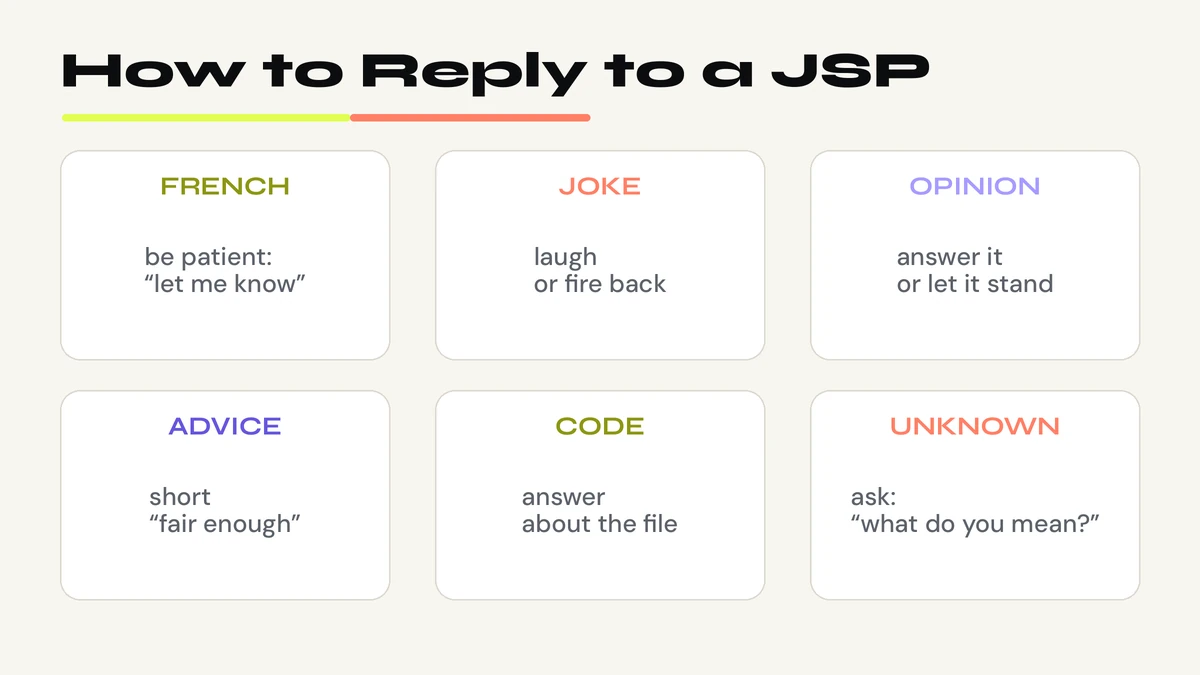
Match the reply to the reading the test found — and when the test finds nothing, make asking the reply. That last rule is new in emphasis here, and it is the one this guide most wants you to keep:
- French shrug: “No problem, let me know when you know” or “Okay, we will decide later.” Patience, not pressure, and never a laugh at a question the sender could not answer.
- Joke or tease: “Lol, I figured,” “You almost got me,” or “Nice try 😂”. Laugh, or fire back in kind — the sender handed you a joke, so take it as one.
- Firm opinion: “Fair point,” “I see what you mean,” or “Agree to disagree.” Answer the opinion if you want the debate; let it stand if you do not. Do not answer a verdict with a joke.
- Softened advice: “Fair enough” or “Good idea, I will try that.” The sender offered a nudge, not a ruling, so a short acknowledgment is the whole reply.
- Code or file: answer about the file. “On it” or “Which page?” — and nothing about jokes, because no joke was sent.
- Unknown: ask. “What do you mean by JSP here?” costs nothing, embarrasses nobody, and prevents every misfire in this guide at once. A sender who meant a joke will laugh; a sender who meant French will translate; a sender who meant a verdict will restate it. Guessing, by contrast, can only be right by luck.
One boundary across all six: never reply to a jsp with a bare jsp of your own. Two ambiguous tags do not make a clear message, and mirroring a tag you have not decoded only doubles the puzzle for the next reader in the thread.
Frequently Asked Questions
What does “JSP” mean in a text message?
It depends on the language and the sentence. In French chats jsp means “I don’t know” (je ne sais pas / je sais pas). In English chats it most often softens a joke (“just playing”) or firms up an opinion (“just saying” or “just saying, period”). In code it means Jakarta Server Pages. Run the Language-First Test: language first, sentence job second, swap check third.
Is jsp French or English?
Both, and that is the point. Lowercase jsp in a French conversation is the French shrug, documented as French internet slang. Uppercase JSP in an English conversation is the contested English tag. Neither language owns the letters, so never answer a jsp until you know which language the conversation is in.
Does JSP mean “Just Playing” or “Just Saying”?
It can mean either in English, and no dictionary entry settles which one leads. A joke, a tease, or a laughing emoji points to Just Playing; a firm opinion with no joke in sight points to Just Saying or Just Saying, Period. The sentence before jsp is the best evidence, and the swap check in Step 3 is how you test your guess before you act on it.
Is JSP the same as JK?
Not quite. JK means “just kidding” with clean letter mapping and wide agreement, so it is the clearer joke tag. JSP overlaps JK only when it means Just Playing, and even then it carries extra readings — French uncertainty, firm opinion, tech — that JK never carries. If clarity matters, send JK, not JSP.
What does JSP mean in code?
In code, JSP means Jakarta Server Pages (formerly JavaServer Pages), a technology for building dynamic web pages, and .jsp is its file extension. If the message mentions a page, a servlet, a server, or a deploy, the tech reading wins and the slang readings should not be tried.
Is JSP rude?
Not by itself. As a joke softener it usually makes a message kinder, and as a French shrug it is neutral. It turns rude only through the sentence it rides on: a hurtful line stays hurtful with jsp attached, and a firm verdict can sound dismissive. Judge the sentence, not the tag, and keep jsp out of formal or serious messages where ambiguity itself is the rudeness.
Should I use JSP myself?
Only when you are sure your reader shares your reading. In a French chat, jsp is safe and standard. In an English chat with close friends who already use it, it is fine. Everywhere else — work, formal writing, first messages, serious topics — spell it out instead: “I’m joking,” “just saying,” or “I don’t know” removes the whole puzzle for the price of a few more characters.
Does lowercase jsp mean something different from JSP?
Sometimes, but never by rule. Lowercase jsp is the usual French form, and uppercase JSP is the usual code form, so case is a useful hint. But fast typists ignore case constantly, and both cases appear in both languages — so treat case as a suggestion and let the language and the sentence decide, exactly as the Language-First Test does.
The Takeaway
JSP is three abbreviations wearing one set of letters: a French “I don’t know” with the strongest texting documentation, an English joke-or-verdict tag whose two lead readings are attested but unsettled, and a web technology from 1999 that has nothing to do with either. No guide that crowns one of them is telling you the whole truth, and no reader who guesses from the letters alone is reading at all.
So run the Language-First Test, in order: name the language, name the sentence job, swap the full phrase in — and when no swap fits, ask. That is the whole guide in one paragraph: language first, sentence second, swap third, question when stuck. JSP does not mean one thing; it means whichever thing the conversation around it proves — and now you know how to make the conversation prove it.