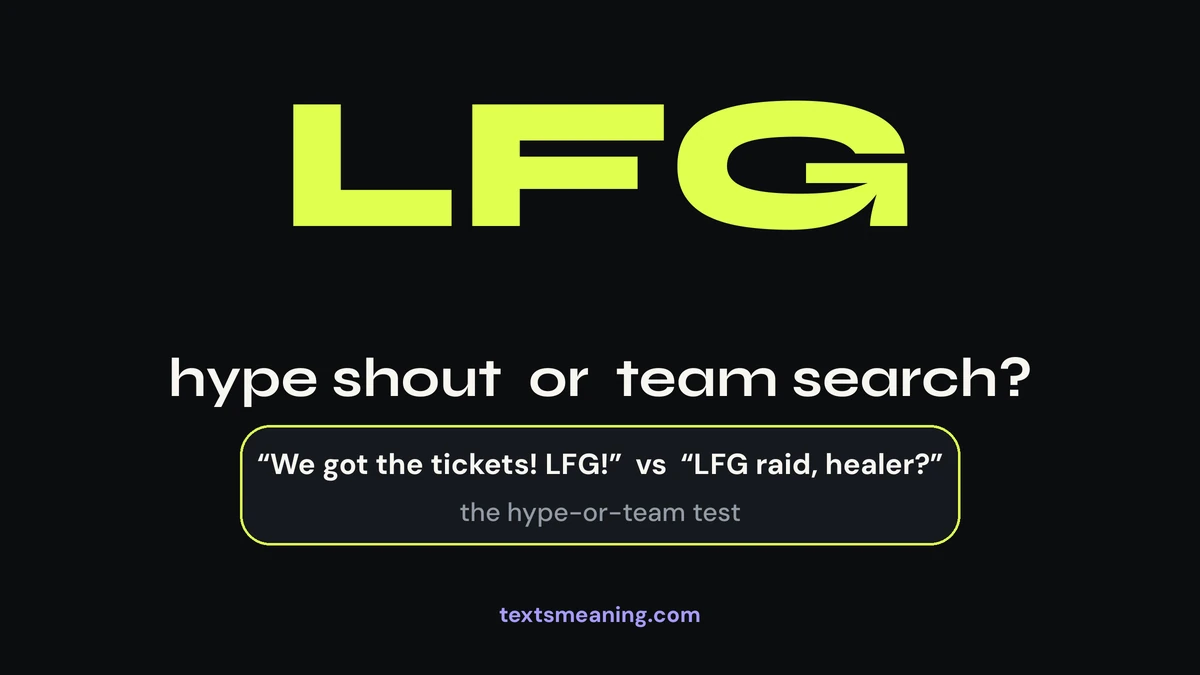
What does lfg mean in text? LFG has two live meanings, and they do opposite jobs: it can be a hype shout that fires a group up, or a practical call for teammates. This guide to lfg meaning in text gives you the LFG Hype-or-Team Test, so you can tell in seconds which one just landed in your chat.
This guide covers both dictionary-attested meanings, the three-check test, seven tones, LFG on TikTok, Snapchat, Instagram, and in texts, how it lands by sender, when it is too much for work, school, and family, graded claims, cousins, history, and a reply bank keyed to the reading you just identified.
What “LFG” Means in Text
LFG is an initialism, built from the first letters of a phrase, and it carries two meanings that share nothing but their letters. The first is the team-search reading: “looking for group.” The second is the hype reading: an emphatic way of saying “let’s go,” with extra force. Same three letters, opposite directions: one asks a question of the room (“who wants in?”), the other answers the room with energy (“we are doing this!”).
The dictionary record is direct and unusually clean for a slang term, and this guide leans on it. Wiktionary, read directly for this article, lists LFG as an internet-slang phrase with two senses: first, “looking for group” (also given as “looking for game”), and second, marked vulgar, the emphatic hype phrase. That hype phrase is spelled out here, once, because the term requires it: let’s fucking go. Everywhere else in this guide it appears only in asterisked form, as “let’s f***ing go,” following the series vulgar-term policy. No other texting expansion of LFG has dictionary attestation, and the cousins and claims sections below grade the rest openly.
Two facts from that record do most of the work. First, neither meaning is a joke spelling or a typo: both are listed senses of the same entry, so neither reading can be dismissed as “wrong.” Second, the order matters less than the company the letters keep. A hype LFG travels with celebrations, plans, and exclamation marks. A team-search LFG travels with a game, a role, a time, or a task. The test in the next section turns that observation into a procedure, because “context matters” is true and useless on its own.
The LFG Hype-or-Team Test
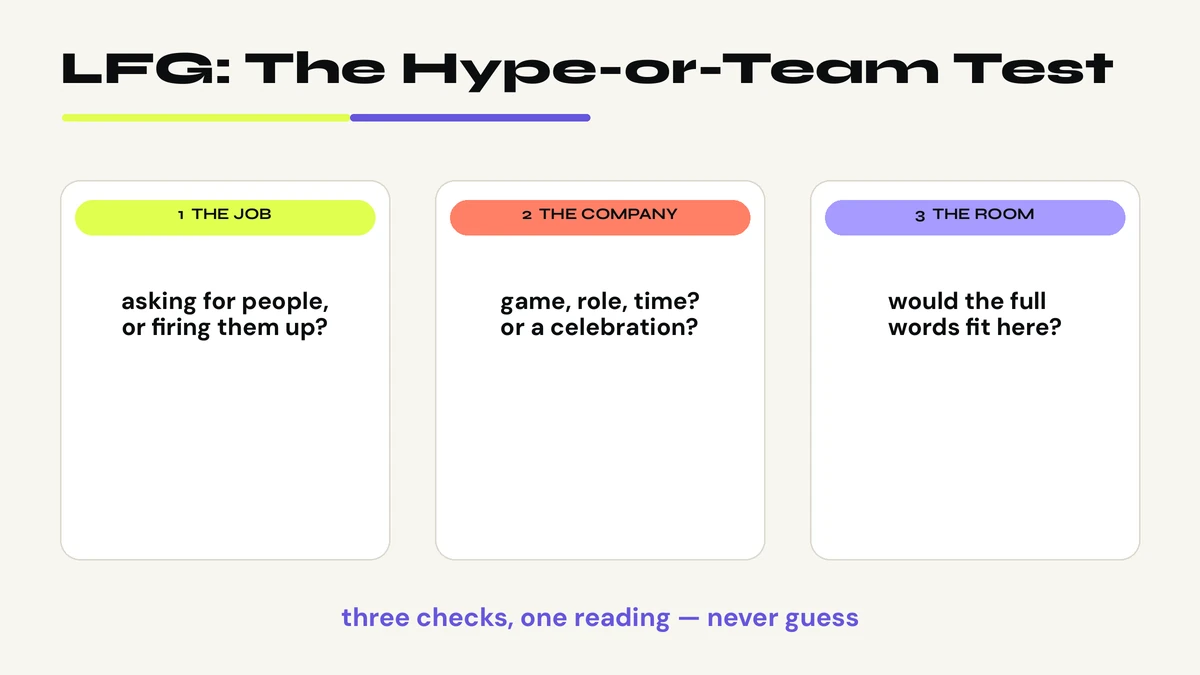
Before you answer an LFG — or send one — run three checks. They take about five seconds, and they beat every shortcut the competitors offer, because the competitors all say “context matters” without giving you a procedure for reading it:
- Check 1 — The Job Check. Is the sender asking for people, or firing people up? A message that needs an answer about joining something (“LFG raid tonight, need a healer”) is a team search. A message that needs no answer except shared energy (“We got the tickets! LFG!”) is hype. If the sentence works as a question about membership, it is the team reading; if it works as a cheer, it is the hype reading.
- Check 2 — The Company Check. What travels with the letters? A game name, a role, a time, a quest, or a task (“LFG Destiny raid, 8 pm”) points to the team reading. A celebration, a plan confirmed, a victory, or a pep talk (“Finals are over, LFG!”) points to hype. Company is the fastest single clue: teammates bring details, hype brings feelings.
- Check 3 — The Room Check. Would the sender say the full hype phrase to this person, in this place? If the asterisked version would sound wrong — to a boss, in a school group, to a grandparent — then the hype reading is either wrong for the room or the sender meant the team reading all along. Abbreviation does not launder meaning: three letters do not make a vulgar phrase polite; they only make it shorter. When the room fails, switch to the clean version, “let’s freaking go,” or drop the letters entirely.
Worked trio. “LFG for tonight’s raid, healer needed” — job: asking for people; company: a raid and a role; room: gaming chat, fine. Team search. “We passed! LFG!!!” — job: cheering; company: a victory and exclamation marks; room: friends, fine. Hype. “LFG: morning yoga, 7 am” — job: asking for people; company: an activity and a time; room: public post, fine. Team search, even though it is not a video game. Three messages, two readings, one test.
“LFG” in Real Chats
Illustrative examples written for this guide, not real transcripts:
- The pre-game cheer. “Game day. LFG!” — the team is set, the energy is the message. Answer with energy, not a roster question.
- The good-news explosion. “I got the job! LFG!” — a celebration that wants witnesses. Congratulate first; details can follow.
- The raid recruitment. “LFG level 60+ for tonight’s dungeon” — a job posting in miniature. Answer with your level and role, or scroll past.
- The plan confirmation. “Tickets booked, hotel booked. LFG!” — the plan is locked, so the letters are a green light, not a request. Confirm the plan, do not ask what group is needed.
- The pep talk. “You are going to crush that interview. LFG!” — encouragement aimed at one person. The hype is a gift; accept it and go.
- The casual group hunt. “LFG: study group for Friday’s exam?” — no game involved, same job: who wants in? The team reading escaped gaming years ago, and this is the proof.
- The bare hype reply. “LFG.” alone under a friend’s announcement — a whole cheer in three letters. It adds no information and needs none; it says “I am with you, at full volume.”
The LFG Tone List
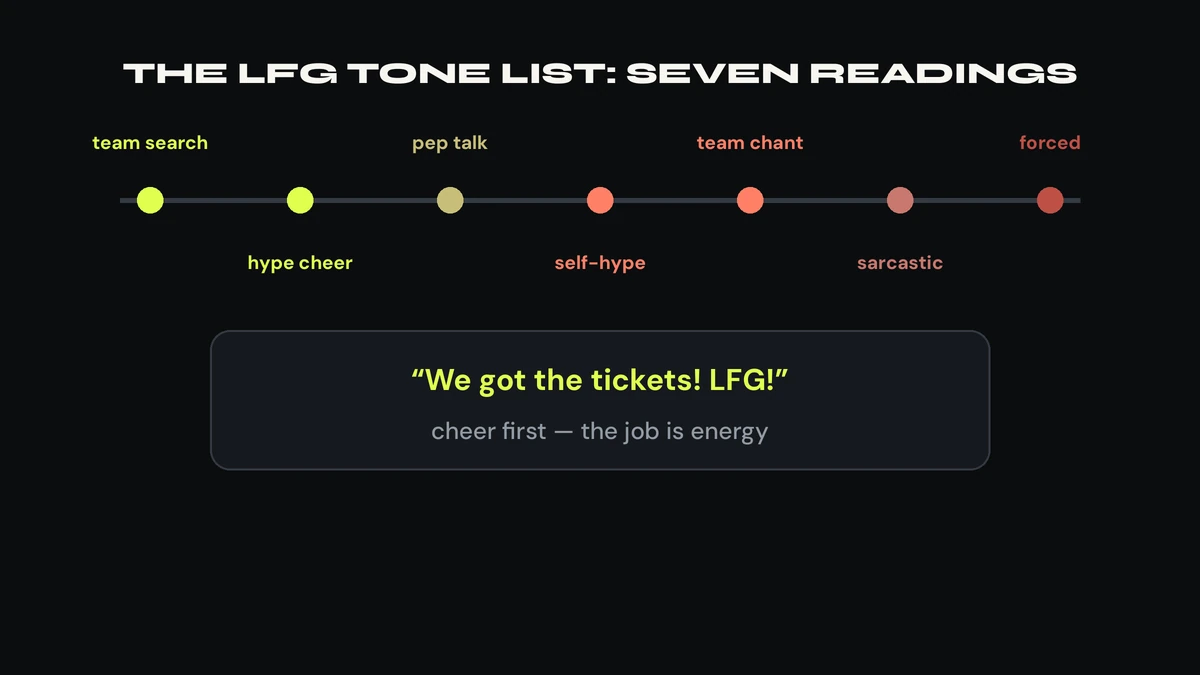
LFG’s letters stay the same; its job slides across seven readings. The first two are the dictionary readings; the rest are tones of the hype reading, because hype is where the variety lives:
- Team search: “LFG raid tonight, need a healer” — practical, specific, and answerable. The tone is logistics, not emotion.
- Hype cheer: “LFG! We did it!” — pure celebration. The tone is joy at full volume.
- Pep talk: “You have got this. LFG!” — hype aimed outward, at one person’s nerves. The tone is coaching, not boasting.
- Self-hype: “New week, new me. LFG.” — hype aimed inward, a public promise to yourself. The tone is determination, performed for an audience.
- Team chant: “LFG, let’s bring it home!” — hype aimed at a group that already exists. The tone is belonging: we, not I.
- Sarcastic hype: “Oh great, another Monday. LFG.” — the cheer performed ironically, so the energy is the joke. The tone is the opposite of the words, and the sarcasm lives in the sentence around it, not in the letters.
- Forced hype: “LFG” dropped into a flat announcement nobody asked to celebrate — hype as decoration, not feeling. The tone is hollow, and readers can tell: energy with nothing behind it reads as noise, not enthusiasm.
What moves a reading between these tones is never the letters alone: it is the sentence around them, the punctuation (exclamation marks raise the volume, a period flattens it), the emoji (a fire emoji confirms hype, a game controller confirms the team search), and the relationship. The same “LFG” that is a sincere cheer on Saturday can be a sarcastic sigh on Monday morning — and the test, not the spelling, tells you which day you are on.
“LFG” on TikTok
On TikTok, LFG is overwhelmingly the hype reading, staged in public: a creator captions a launch “LFG, new video out now,” a commenter writes “LFG!!!” under a comeback story, or a fan account cheers a team with a bare “LFG” before a match. The public stage suits hype best, because a comment thread is an audience, not a roster — nobody there is being asked to join a raid. A TikTok LFG usually means something close to “yes, let’s do this,” “I am so excited,” or “we are all in.”
The trap on TikTok is the reverse of the gaming trap: taking a public cheer too literally. A creator who writes “LFG” under their own video is performing energy for a crowd, not recruiting you, and a commenter who writes “LFG” is agreeing in public, not asking you to form a group. If an LFG arrives in a TikTok DM about a game, though, run the test as usual — a DM is private again, and the team reading returns with it.
“LFG” on Snapchat
On Snapchat, LFG fits the fast, disappearing caption: “LFG, road trip starts now” over a photo of packed bags, “LFG, we actually made it” on a late-night snap, or a story reply carrying the excitement for a few seconds before it vanishes. The disappearing format suits hype — energy that lands lightly and is gone. But disappearance also removes your evidence: if an LFG felt like a team search, you cannot re-read it, so judge from memory what rode with it — a game name, a time, or nothing at all.
Snapchat is also where the photo does half the work. A picture of a trophy plus “LFG” needs no explanation: the image names the victory, and the letters only turn the volume up. That is the Company Check working in real life — remove the LFG and the snap still celebrates, which is how you know the job was hype, not recruitment.
“LFG” on Instagram
On Instagram, LFG shows up in captions, comments, story replies, and DMs, and the stage decides the reading the way it does for every two-meaning term. Captions lean public and performative: “LFG, launch day is here” under a product photo is a cheer for an audience. Comments lean agreement: “LFG!!!” under a friend’s announcement is a co-sign the whole thread can join. DMs carry the full range, exactly like texts — a squad’s team search and a friend’s hype cheer live in the same inbox, and only the test tells them apart.
Instagram is also where LFG meets its closest letter-trap. A bio that says “follow my IG” is pointing at the app, not cheering, and an “LFG” in a fitness caption is not a longer way of writing anything else. The extra letters change everything — read the whole string, never just the familiar part, and never assume a caption cheer is a recruitment post.
“LFG” in Text Messages
Plain texts are LFG’s home ground for both readings, and the one-to-one setting makes the distinction sharpest. A hype text wants a witness: “We got the tickets! LFG!” A team-search text wants an answer: “LFG for Saturday’s hike, who is in?” The reply each one deserves is completely different, which is why the Job Check comes first — answering a cheer with a roster question, or a recruitment post with a cheer, is the classic LFG misfire.
Texts are also where a team search turns into a plan, and the plan usually moves somewhere private. A group-hunt message that gets a yes often continues in a private thread — our DM guide covers that move in full, because the channel changes what the next message can say. And texts are LFG’s work limit in miniature: never send the hype reading, even abbreviated, in a professional message. A client, a manager, or a first contact deserves “let’s do this” spelled out, not three letters that presume an intimacy and a casualness you do not have.
Who Is Sending It: How “LFG” Lands by Sender
No source documents a different meaning of LFG per sender — the two readings stay fixed; what changes is which reading you should expect, and therefore what you owe back:
- Friend: the default. A friend’s LFG is hype or a group hunt at face value; run the test and answer that, not the letters.
- Crush: overread territory. A crush’s hype LFG feels bigger than it is — usually shared excitement, not a confession about you. Answer the energy, not a romance you invented.
- Partner: pattern rules. A partner’s LFG is usually routine hype; judge the pattern across days, not one message — but a sudden run of team-search LFGs after a calm stretch may just mean a new game, not a new life.
- Parent: usually literal and plain. A parent who writes LFG has usually learned it from you and means the hype plainly; do not read a parent’s cheer as a recruitment post unless a game or activity is named.
- Coworker or boss: context decides. In a friendly team chat a colleague’s hype LFG about a launch is a cheer; in any formal thread it is out of place, and never send one upward to a manager or client.
- Group chat: both habitats at scale. A group’s “LFG, trip is on!” cheers for everyone; a group’s “LFG for Saturday, who is in?” recruits everyone. Answer briefly in the group either way, and do not single one sender out for a private reading of a public cheer.
- Stranger or creator: the applause habitat. A stranger’s LFG under your post, or a creator’s LFG in a caption, is a public cheer, not a recruitment post aimed at you personally. A thank-you or a matching cheer is enough; never answer a public cheer with your gaming roster.
When “LFG” Is Too Much: Work, School, and Family
This section is mandatory for LFG in a way it is not for most terms in this series, because the hype reading carries a vulgar phrase inside it, even abbreviated. Four rooms, four rules. At work: never send the hype reading in a professional message, a client thread, or a formal channel. A launch cheer among close peers in a casual chat is one thing; the same letters to a manager, a client, or a hiring thread read as careless, because the reader may expand the abbreviation in their head, and the expansion is the problem. If the room would flinch at the full phrase, the letters do not fix it.
At school: the same rule, with a younger audience. Teachers, school groups, and class chats are not hype rooms, and a student who sends LFG to a teacher has sent a vulgar phrase in code, whether they meant to or not. The clean swap, “let’s freaking go,” is still loud for a teacher, so the safer swap is “let’s do this” or “let’s go.” In family chats, read the room person by person: a sibling group may love it, a grandparent group may not know it, and a parent who dislikes casual swearing will dislike the abbreviation exactly as much as the phrase, once they learn what it stands for. Abbreviation is not permission.
The general rule covers every room at once: if someone tells you LFG bothers them, simply stop. Switching words is easy, and it shows respect. The swap menu is free and it loses nothing: “let’s go” for the cheer, “let’s do this” for the pep talk, “who wants in?” for the team search. And one boundary worth stating plainly: never use the hype reading to dress up aggression. A cheer aimed at intimidating someone is not hype; it is a threat wearing a cheer’s clothes, and the Room Check catches it, because the room that receives a threat is not a hype room at all.
Checked Claims: Expansions That Do Not Hold Up
Three letters attract folklore. Each claim below was graded against the dictionary record and the competitors read in full; nothing is repeated here as fact on a single blog’s say-so:
- “LFG means only ‘let’s f***ing go’” — rejected as a complete account. Wiktionary lists the team-search reading first, and the main competitor calls it the most common definition in gaming. A guide teaching only the hype reading misreads every recruitment post.
- “LFG means only ‘looking for group’” — rejected. The hype reading is the dominant use in ordinary texts, social captions, and sports cheers, with its own dictionary sense. Teaching only the gaming reading misreads every celebration.
- “LFG means ‘looking for girlfriend’” — graded as a joke, not a standard meaning. The main competitor reports it as a humorous secondary use inside MMO culture, parodying the real team-search reading. It is a gag that depends on the real meaning, not a third meaning to teach.
- “LFG means Luna Foundation Guard” — graded as a domain homonym, real outside chat. In crypto writing about one specific ecosystem, the same letters name an organization. That is a proper noun in its own field, not a texting meaning: nobody texting “LFG!” after good news is naming a foundation.
- “LFG means ‘let’s freaking go’ as a separate meaning” — graded as a clean variant, not a separate meaning. The “freaking” version is the same hype reading with the vulgar word swapped out for polite company. It changes the register, not the meaning, and it is the version to use wherever the room requires it.
- “LFG is 74% hype and 21% team search” — rejected as a statistic. One competitor publishes exact percentages from a self-described personal tracking exercise with no method a reader can check. No frequency study of LFG exists in any source read for this article, so this guide reports no percentages and no dominance claim: both readings are live, and the test, not a number, decides each message.
- “LFG was invented by sports teams or crypto traders” — rejected. Sports and crypto spread the hype reading, and the main competitor documents both spreads, but the letters predate both: the team-search reading dates to early MMO culture, and the hype reading to 2010s campus texting. Spreaders are not inventors.
- “Lowercase lfg means something different from LFG” — rejected. Case is volume, not a new definition. Lowercase lfg reads casual and relaxed, all-caps LFG reads louder, and neither changes the reading — the Job Check and Company Check do that.
What SURVIVES: “looking for group” (also “looking for game”) and the hype reading, decided by job, company, and room. Everything else failed evidence, was fenced as a joke, a variant, or a domain homonym, or was refused a number it cannot support.
“LFG” vs Its Closest Cousins
LFG belongs to two families at once, which is why it confuses people: the hype family and the group-forming family. Its closest cousins split by which family they serve:
- ISTG (“I swear to God”) — the emphasis cousin. Our ISTG guide covers an intensifier that underlines a sentence; LFG’s hype reading cheers a moment instead. ISTG says “believe this”; LFG says “let’s go.”
- GTG (“got to go” / “good to go”) — the go cousin. Our GTG guide covers the readiness-and-exit fork; LFG’s hype reading is the cheer that GTG’s readiness reading only implies. GTG says “I am ready”; LFG says “we are doing this.”
- FR (“for real”) — the co-sign cousin. Our FR guide covers agreement and sincerity; a hype LFG often arrives right after an FR-worthy moment, but FR certifies a claim while LFG fires up a plan. FR says “this is true”; LFG says “let’s move.”
- IKR (“I know, right?”) — the echo cousin. Our IKR guide covers shared feeling; LFG’s hype reading shares energy, not agreement. IKR says “I feel that too”; LFG says “let’s act on it.”
- LFM (“looking for more”) — the sibling recruitment cousin. Where LFG asks for a whole group, LFM asks for more members for a group that already exists. Same job, different starting point: LFG builds, LFM fills.
- “Let’s go” itself — the clean twin. The hype reading without the vulgar word and without the abbreviation. When the room fails the Room Check, this is the swap that loses nothing: same cheer, no risk.
LFG often travels with a plan or a celebration — a ticket confirmation, a game night, a launch — and that companion is what makes the reading readable at a glance. Read the companion first, and the letters second.
Where “LFG” Came From
LFG’s team-search reading came first. The main competitor, read in full, dates the earliest slang-repository entry for LFG to 2002, reading “looking for group,” with a reference to EverQuest, widely considered the first successful massively multiplayer game, which launched in 1999. Players typed LFG in chat when looking for guilds or groups to complete quests with, and the habit spread through every MMO after it, then to tabletop groups, study groups, and any activity that needed a roster. The non-gaming team search (“LFG: morning yoga, 7 am”) is that same job, freed from its original game.
The hype reading arrived later and from a different room. The main competitor dates its first slang-repository entry to 2010, in texts across college campuses as part of partying culture, and documents its spread through sports, music, and gaming, and its adoption as an informal slogan by a national women’s soccer team that won a World Cup in 2019. Crypto communities then adopted the same cheer for price rallies and launches. No inventor or first-use date earlier than these attestations is claimed; the attestations are user-generated repository entries, not primary dictionary records, and this guide grades them as such. What is certain is the direction: a practical gaming call became a general cheer, and the cheer is now the reading most people meet first.
How to Reply When Someone Sends “LFG”
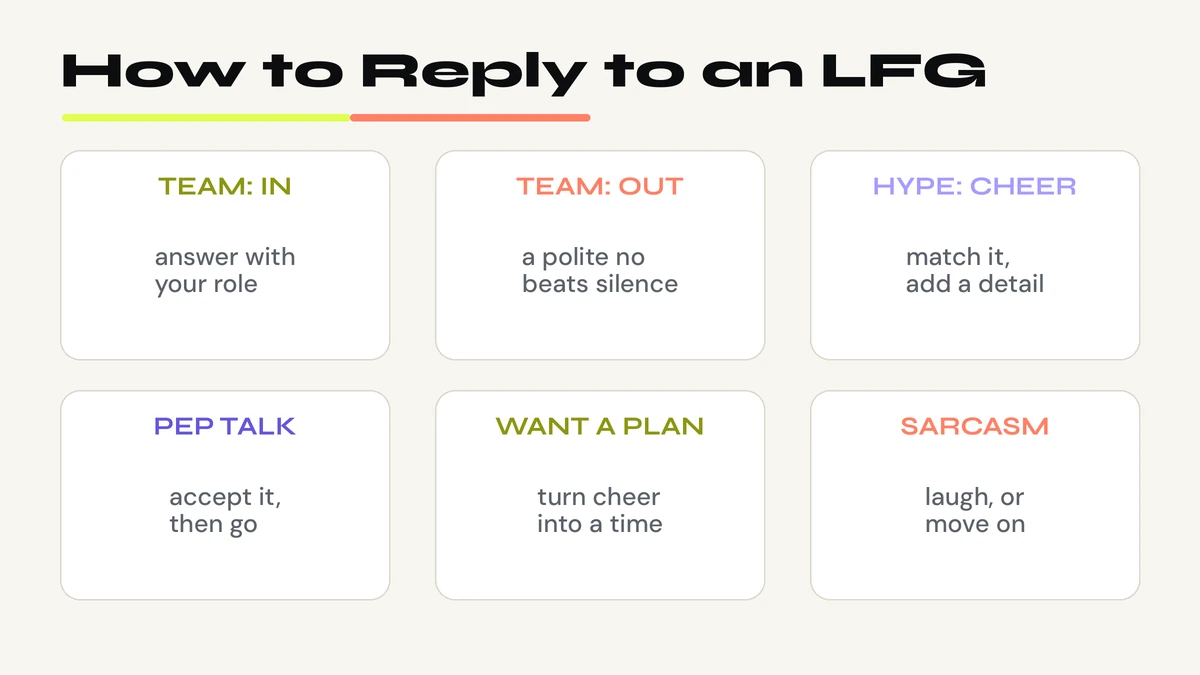
Six replies, matched to the reading and the tone. Name the reading first, or every reply below can misfire:
- Team search, and you are in: “In! What role do you need?” or “Count me in, what time?” A recruitment post wants a roster answer, not a cheer.
- Team search, and you are out: “Not tonight, have fun though!” A polite no beats silence, because a roster is waiting on your answer.
- Hype cheer, shared news: “LFG!!! So happy for you!” or “Yes! Let’s go!” Match the energy, then add a detail, so the cheer becomes a conversation.
- Pep talk aimed at you: “Thank you, I needed that. Let’s do this.” Accept the gift, and answer in clean words if the room requires them.
- Hype cheer, and you want a plan: turn the cheer into a next step — our HMU guide covers the open invitation that does exactly that: “LFG! So, when are we meeting?” Energy without a plan fades; energy plus a time becomes a memory.
- Sarcastic or forced hype: “Ha, same energy” for the joke, or silence for the forced one. Do not feed a hollow cheer with a louder one; a laugh answers sarcasm, and nothing answers noise better than moving on.
What never works: answering a team search with a cheer when a roster is waiting, answering a cheer with a roster question when nobody asked for one, or answering a hype message at work with hype of your own. The golden rule: match the reading, then match the need.
Frequently Asked Questions
What does “LFG” mean in a text message?
Two things, decided by the Hype-or-Team Test: a hype cheer (“let’s f***ing go” in asterisked form) or a search for teammates (“looking for group”). If the message celebrates or fires you up, it is hype; if it asks who wants in, it is a team search.
Is LFG a swear word?
The letters themselves are not a swear word, but the hype reading expands to a phrase containing one, which is why this guide spells that phrase out only once and asterisks it everywhere else. In polite, professional, school, or family rooms, use “let’s go” or “let’s freaking go” instead.
What does LFG mean on TikTok?
Almost always hype: a public cheer in a caption or comment, celebrating a launch, a win, or a comeback. A TikTok DM about a game can still be a team search, so run the test on private messages.
What does LFG mean in gaming?
Usually “looking for group”: a player looking for teammates for a raid, quest, or match, often with a role or level attached. In a gaming celebration, though, the same letters can be hype — check whether the message asks for people or just cheers.
Is LFG the same as “let’s go”?
Nearly, but louder. The hype reading is “let’s go” with extra force, and that force comes from a vulgar word inside the full phrase. “Let’s go” is the clean twin: same cheer, no risk, and the right swap for any formal room.
Can I use LFG at work or school?
Not the hype reading, and not in formal messages. A casual team chat among close peers may tolerate it, but a manager, client, teacher, or school group deserves “let’s do this” spelled out. The team-search reading is safer, but only where a group is genuinely being formed, and still not in formal writing.
What should I reply when someone sends LFG?
Match the reading: answer a team search with a roster answer (“In! What role?”) or a polite no, and answer hype with matching energy plus a detail (“LFG! So happy for you!”). The reply bank above has one for each reading and tone.
Does lowercase lfg mean something different from LFG?
No, the meaning is the same; only the volume changes. Lowercase lfg reads casual and relaxed, all-caps LFG reads louder and more emphatic, and neither changes the reading — the Job Check and Company Check do that.
The Takeaway
Three letters, two jobs. LFG means “looking for group” when it asks who wants in, and a hype cheer when it fires a moment up — and whether the message you just got is a roster or a roar is decided by the Hype-or-Team Test: check the job, check the company, check the room. Send the cheer when the moment genuinely deserves energy, send the team search when a group genuinely needs people, swap to clean words when the room requires them, and answer the reading you actually received.