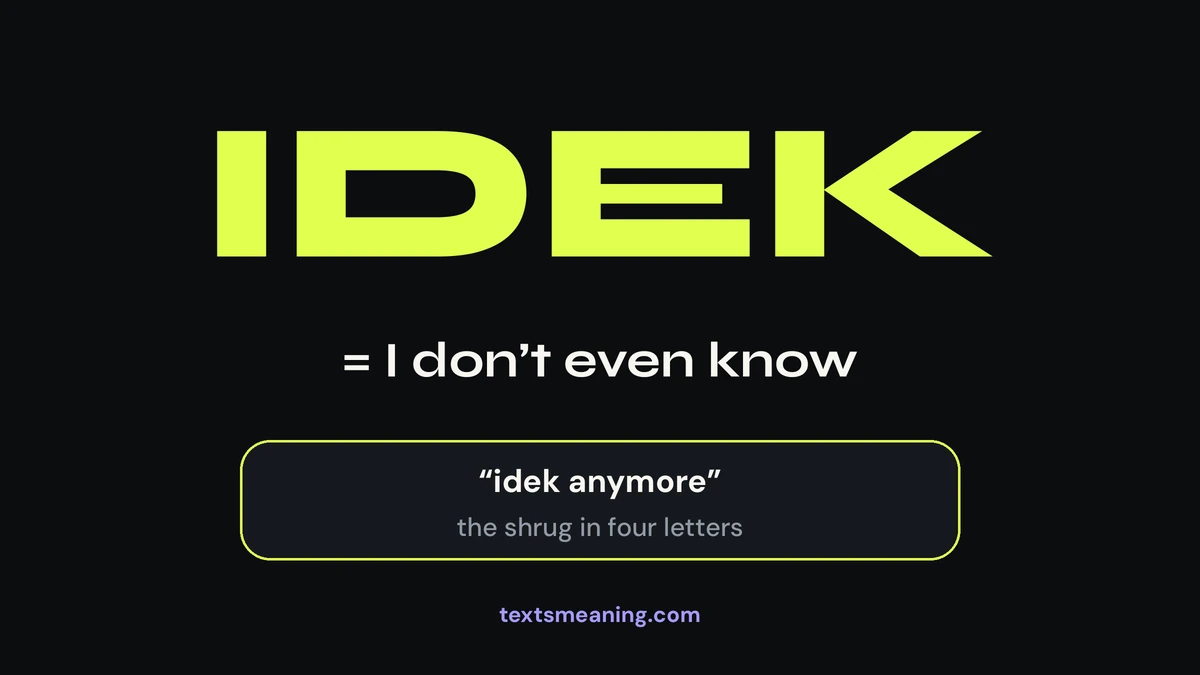
What does IDEK mean in text? IDEK means “I don’t even know” — the shrug you type when a situation has gone past simple not-knowing. It is confusion with a feeling attached: tired, overwhelmed, or done trying to explain.
This guide to idek meaning in text covers the IDEK Even Test, a seven-reading tone list, IDEK on TikTok, Snapchat, Instagram, and in texts, senders, misreads, graded claims, cousins, history, and the reply rule that matches the load, not just the letters.
What “IDEK” Means in Text
“IDEK” means “I don’t even know.” Letter by letter: I (don’t) E (ven) K (now), with “don’t” doing the negation work the initials skip. It is IDK — “I don’t know” — with one word added back in, and that word does heavy lifting: “even” turns a missing fact into a feeling about the missing fact.
Here is the honesty part, stated plainly because it changes how much weight to put on the word. The primary dictionary source was checked but not quoted: Wiktionary lists idek among English terms derived from the know-root, which confirms a Wiktionary page exists, but the entry body was not directly read in this run, so no dictionary definition is quoted here. The expansion itself needs no such help: every competitor guide read in full agrees on “I don’t even know,” and no competing expansion with any attestation was found.
IDEK does three headline jobs. As a confusion report: “idek what the teacher wants for question 5.” As an overload confession: “idek anymore, honestly.” As an indecision handoff: “idek, you choose.” Same four letters, three jobs — and the Even Test below tells you which one you just received. One casing rule first: idek is almost always lowercase. Writing IDEK in capitals in a casual chat looks oddly emphatic, like shouting a shrug.
The IDEK Even Test
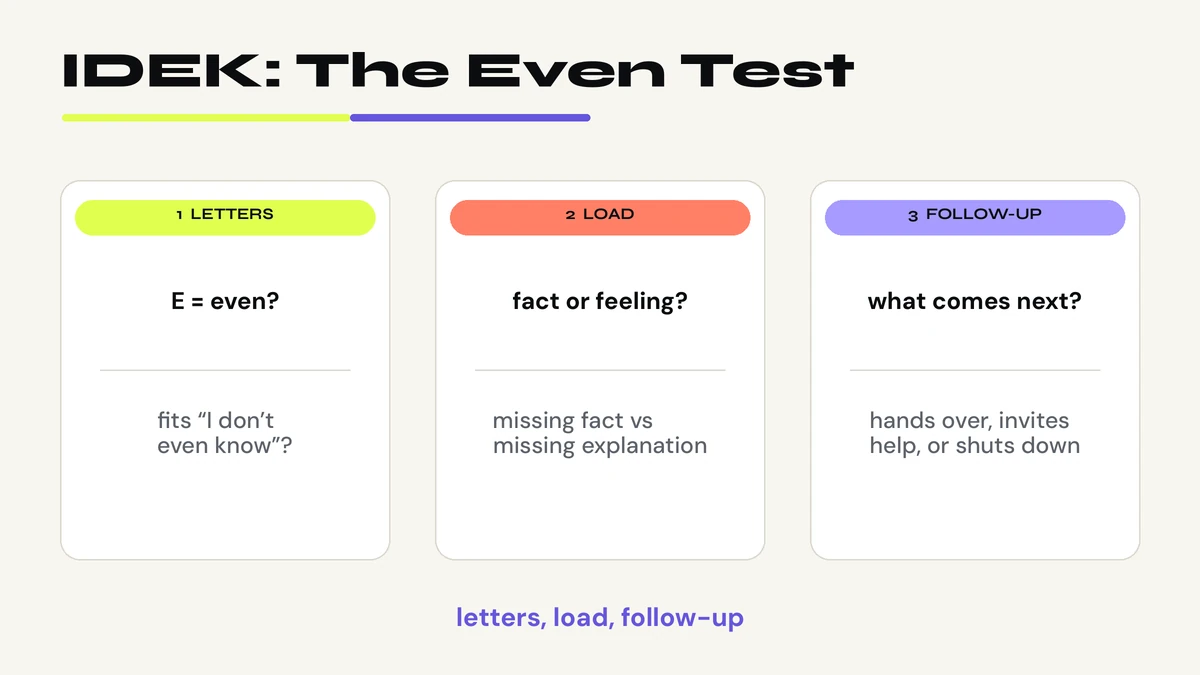
Before you read or send an idek, run three checks:
- Check 1 — The Letters Check. Does the E stand for “even”? If the sentence works as “I don’t even know,” the expansion is confirmed and no other meaning is in play. If it does not fit that sentence, you are looking at a typo, not a term.
- Check 2 — The Load Check. Is this a missing fact or a missing explanation? A missing fact (“idek what time it starts”) sits close to IDK. A missing explanation (“idek what’s happening anymore”) is pure IDEK: the situation, not just the answer, is the problem.
- Check 3 — The Follow-up Check. What comes after it? “idek, you choose” hands a decision over. “idek, it’s just been a lot” invites help. A bare “idek.” with nothing after it closes the topic. The follow-up, not the letters, decides whether the shrug is a request, a confession, or a shutdown.
Worked trio. “idek what the teacher wants for question 5” — letters pass, load is a missing fact plus school stress, follow-up invites a classmate to fill the gap: a request, not a shutdown. “idek anymore, honestly” — load is exhaustion, follow-up is a confession: answer with care, not a quiz. A bare “idek” to a partner’s “what’s wrong?” — follow-up empty, question serious: this is the dismissive reading, and the sender owes a real sentence.
“IDEK” in Real Chats
Illustrative examples written for this guide, not real transcripts:
- The school mystery. “idek what the teacher wants for question 5” — confusion shared, help invited.
- The tired confession. “idek anymore, honestly” — exhaustion stated plainly, no joke attached.
- The self-mock. “idek why I said that lol” — laughing at your own cluelessness.
- The indecision handoff. “idek, you choose” — the decision moves to the other person.
- The group-chat stall. “idek at this point, just tell me where to show up” — twenty minutes of planning, ended kindly.
- The bare shutdown. A lone “idek” to a serious question — the shrug becomes a door closing.
The IDEK Tone List
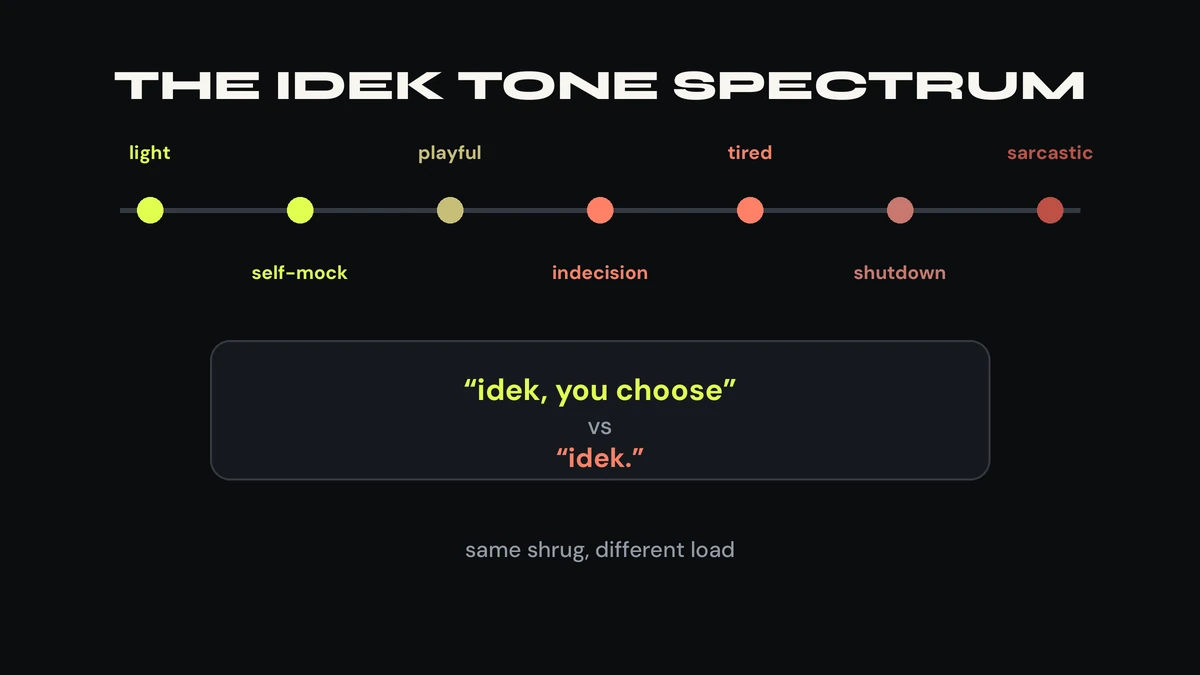
IDEK’s meaning stays “I don’t even know”; its load slides — and at the far end it stops being confusion at all. Seven readings, lightest to heaviest:
- Light confusion: “idek what time it starts” — a missing fact, no feeling attached.
- Self-mocking: “idek why I said that lol” — you are the joke, and you know it.
- Playful reaction: “IDEK who let them leave the house like that” — a joke about something absurd.
- Indecision: “idek, you choose” — handing the decision over, not refusing it.
- Tired overload: “idek anymore, honestly” — the sender has stopped trying to work it out.
- Frustrated shutdown: a bare “idek” to a serious question — reads as checked-out, even if the sender only meant tired.
- Sarcastic: “idek, maybe because the sky is blue??” — not real confusion; the sender knows and is mocking the question.
Emoji and follow-up words move a reading up or down this list: “idek lol” lightens it, “idek.” alone hardens it, and a real sentence after it (“idek, it’s just been a lot”) rescues it entirely.
“IDEK” on TikTok
On TikTok, IDEK is a comment-section reaction — “idek what’s going on with this app anymore” under a confusing trend, or “idek 💀” under something absurd. The public stage suits the playful and self-mocking readings best: a comment cannot carry a private explanation, so the tired-confession reading lands flat here, and a bare “idek” under a creator’s serious post reads as dismissive rather than relatable. If the post matters to someone, a full sentence beats a shrug.
“IDEK” on Snapchat
On Snapchat, IDEK fits the fast, disappearing DM: “idek my schedule’s a mess this week” as a reply to a plan, or “idek lol this is wild” as a story reply to something chaotic. The disappearing format suits a shrug: it lands lightly and vanishes. But disappearance also removes the evidence, so a bare “idek” that felt like a shutdown cannot be re-read for the follow-up words that would have softened it. Judge it from what rode with it — an emoji, a joke, or nothing at all.
“IDEK” on Instagram
On Instagram, IDEK shows up in story replies and DMs: “idek why I’m still awake” as a late-night story reply, or “idek, you choose” in a DM about weekend plans. Public replies lean playful reaction; DMs carry the full range, including the tired confession. Instagram is also where the indecision handoff lives most naturally: a DM thread that has stalled on a choice is exactly where “idek, you choose” does useful work, because it ends the loop instead of extending it.
“IDEK” in Text Messages
Plain texts are IDEK’s home ground, and the place its companions show up most. It pairs with the reassurance companion DW — “idek anymore, dw, I’ll figure it out” pairs a shrug with self-reassurance in one breath — and with the side-note companion BTW: “idek what to do, btw, did you see the game?” shrugs and pivots in the same message. Texts also carry IDEK’s work limit: in a casual team chat, an “idek” about a low-stakes question is fine small talk, but a manager asking about a deadline deserves “I’m not sure, I’ll check” — a shrug to a serious question reads as careless, not casual.
Who’s Sending It: How “IDEK” Lands by Sender
No source documents a different meaning of IDEK per sender — the shrug stays fixed; what changes is how much patience the reader owes it, and what the sender wants:
- Friend: the default. A friend’s “idek” is confusion or tiredness at face value; answer the feeling, not just the question.
- Crush: overread territory. A crush’s “idek” is rarely a signal about you — it is usually about the situation, not the relationship.
- Partner: pattern rules. A partner’s occasional “idek” is tiredness; a partner’s constant bare “idek” to serious questions is a conversation to have, not a message to decode.
- Parent: recognition risk, reversed. A parent’s “idek” usually means they genuinely do not follow the topic — answer plainly, and do not mirror slang they may not know.
- Coworker: context decides. In a casual channel it is fine; in a deadline thread, answer the work first — and never open a client message with it.
- Group chat: the stall habitat. A group’s “idek” usually ends a planning loop; someone else can pick up the decision without a scene.
- Stranger or ex: the low-effort habitat. A bare “idek” here is a door barely open; a short answer, or silence, both end it without rudeness.
When “IDEK” Is Not Just Confused
Three misfires, graded. First, the dismissive misread: a bare “idek” to a serious question sounds like shutting someone out, even when the sender only meant tired. If you sent it, a follow-up sentence repairs it. Second, the default-reply trap: if every third message from you is “idek,” people stop asking you things — not because they are angry, but because they have learned you will not answer. Third, the indifference confusion: IDEK is not IDC. IDC says “I don’t care”; IDEK says “I don’t even know.” Mixing them up turns confusion into an insult.
On appropriateness: IDEK is not rude and not vulgar in any reading; its risk is social, not moral — sounding checked-out when someone needed you present. Keep it out of formal, professional, and first-impression messages, where “I’m not sure” costs nothing and a shrug costs goodwill. And never use it to dodge a question you owe an answer to: a shrug is not an answer, and everyone on the other end knows it.
Checked Claims: Expansions That Don’t Hold Up
- “IDEK means just ‘I don’t know’ and nothing more” — rejected as incomplete. The “even” adds exasperation, exhaustion, or self-mockery that plain IDK does not carry.
- “IDEK is always rude or dismissive” — rejected. Among friends it reads as casual and relatable; it only sounds dismissive as a bare reply to a serious question.
- “IDEK means something different on each platform” — rejected. No source documents a platform-specific meaning; platforms stage the same shrug differently.
- “IDEK is just lazy texting” — rejected. It reports that the sender has stopped trying to work something out — that is information, not laziness.
- “IDEK is a secret code or insult” — rejected. No hidden meaning is documented; it is exactly what it says.
- “A payment app flags IDEK because of its texting meaning” — fenced, not a texting claim. The flag story concerns an unrelated same-letters acronym in a different domain, not chat usage, and no name from that story is repeated here.
- “IDEK works in formal writing” — rejected. Formal contexts want “I’m not sure” or “I don’t have enough information” spelled out.
- “IDEK and IDC are interchangeable” — rejected. IDC says “I don’t care”; IDEK says “I don’t even know” — confusion, not indifference.
- “Typing IDEK in capitals is the same as lowercase” — rejected. Lowercase is the default; capitals in a casual chat read as oddly emphatic, like shouting a shrug.
What SURVIVES: “I don’t even know” (unanimous across competitors, Wiktionary listing noted honestly in the meaning section), with the readings above as jobs of the same shrug — not different meanings. No competitor percentages are repeated here as fact, and nothing is claimed about a dictionary entry body that was not read.
“IDEK” vs Its Closest Cousins
IDEK belongs to the not-knowing family — words that report what the sender does not know, does not care about, or cannot decide. Its parent IDK (“I don’t know”) is discussed by name throughout this guide but is not linked: its TextsMeaning article is still a pending queue row, not a live page, and this series never links a draft. IDC (“I don’t care”) is published in this series: IDC says indifference where IDEK says confusion. The published cousins:
- HYD (“how you doing?”) — the question cousin. HYD asks about you; IDEK reports about the sender. HYD opens a chat; IDEK stalls one.
- HYDD (“how you doing?”, extended) — the risky cousin. HYDD carries a clarity risk because some readers do not know it; IDEK carries a different risk, sounding dismissive when bare.
- HRU (“how are you?”) — the feeling-question cousin. HRU asks how you feel; IDEK says the sender does not even know how things stand.
- HBU (“how about you?”) — the return cousin. HBU asks second; IDEK answers first, badly. The pair is one system: IDEK shrugs, HBU returns the question.
IDEK often travels with a bounce-back — “idek, hbu?” — but never answer an idek with another bare “idek”: two shrugs do not make an answer.
Where “IDEK” Came From
The phrase “I don’t even know” is ordinary spoken English, and “even” has long signaled frustration in negative sentences — “I don’t even care,” “she didn’t even try.” The abbreviation path is the usual SMS-era story: early-2000s character limits and T9 keypads rewarded short forms, IDK condensed “I don’t know,” and IDEK added the “even” back in when plain IDK felt too flat for a situation that was confusing, absurd, or exhausting. Competitors place wide IDEK use by the early 2010s. No inventor, no first-use date, and no dictionary first-citation is claimed for IDEK itself.
How to Reply When Someone Sends “IDEK”
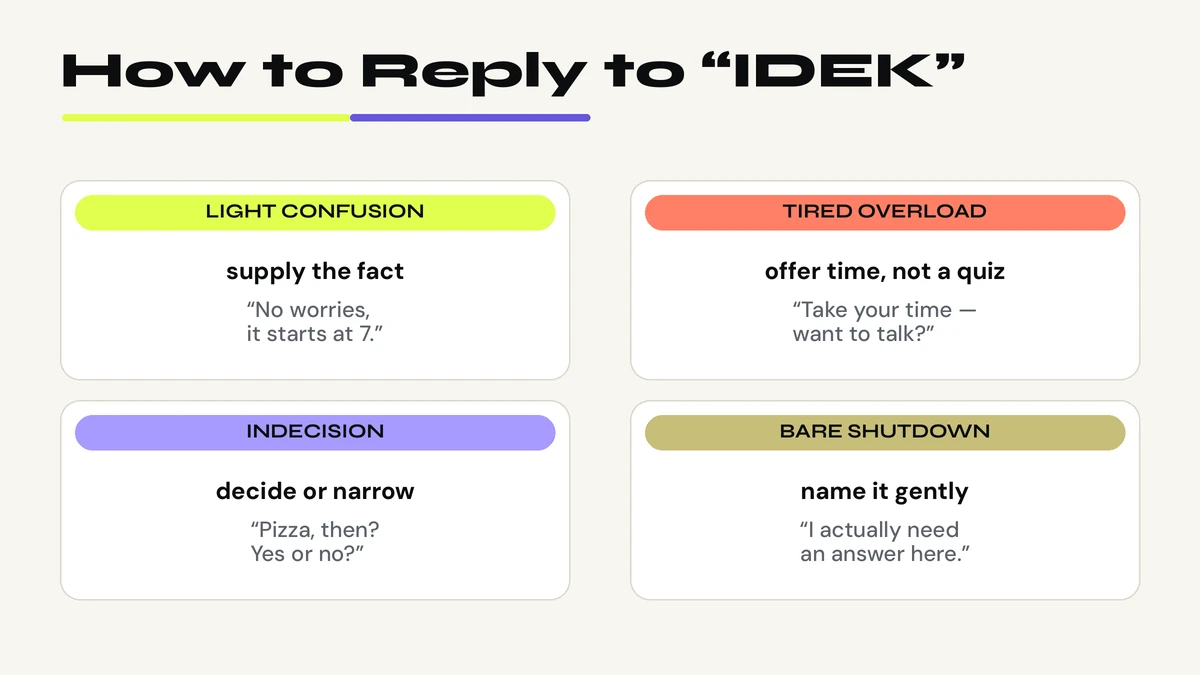
One rule, then six replies: match the load the Even Test found, not the letters. A shrug answered with a quiz feels like an interrogation; a shrug answered with patience feels like help:
- Light confusion — supply the fact: “No worries, it starts at 7.” A missing fact wants a fact.
- Indecision — decide or narrow: “Pizza, then? Yes or no?” A stalled choice wants a smaller choice.
- Tired overload — offer time, not a quiz: “Take your time — want to talk about it?” Patience beats pressure.
- Self-mocking or playful — laugh along, briefly: “Same, honestly lol.” Match the joke, then move on.
- Bare shutdown to a serious question — name it gently, once: “Hey, I actually need an answer on this.” One clear sentence reopens the topic.
- Sarcastic — do not take the bait: answer the real question if there is one, or let the message pass. A sarcastic idek wants a reaction; not giving it one ends it.
Weak versus strong. Weak: “idek” back. Strong: “Take your time — want to talk about it?” Small change, big difference. Golden rule: never answer an idek with another bare “idek” — and if you sent a bare “idek” to a serious question, follow it with a real sentence before the other person has to ask twice. You can also hand the chat forward with HMU — “idek right now, hmu later?” shrugs, then keeps the door open.
Frequently Asked Questions
What does “IDEK” mean in a text message?
“I don’t even know” — a casual shrug for confusion, exhaustion, indecision, or giving up on explaining something.
Is IDEK the same as IDK?
No. IDK is neutral: you lack information. IDEK is emotional: the situation is confusing, absurd, or exhausting, and you have stopped trying to work it out.
Does any dictionary list IDEK?
Wiktionary lists idek among English know-root terms, but this guide quotes no dictionary definition for it, because the entry body was not directly read in this run. The expansion rests on unanimous competitor agreement, stated openly.
What does “IDEK” mean on TikTok, Snapchat, and Instagram?
The same shrug everywhere — no platform-specific meaning exists. TikTok stages it as a comment reaction, Snapchat as a disappearing DM shrug, Instagram as a story reply or DM handoff.
Is a bare “idek” rude?
Not rude by itself — but risky. To a casual question it reads as tired; to a serious question, with nothing after it, it reads as dismissive. Add a sentence and the risk vanishes.
What’s the difference between “IDEK” and “IDC”?
IDEK says “I don’t even know” (confusion); IDC says “I don’t care” (indifference). Confusing the two turns a shrug into an insult.
Should I write idek in lowercase or capitals?
Lowercase, almost always. “idek” matches the tired, casual tone; “IDEK” in capitals in a casual chat looks oddly emphatic, like shouting a shrug.
Someone just sent me “IDEK”. What do I say?
Match the load: supply the fact for light confusion, narrow the choice for indecision, and offer time — “Take your time, want to talk about it?” — for tired overload. Never answer with another bare “idek.”
The Takeaway
“IDEK” is a four-letter shrug — “I don’t even know” — that reports confusion, overload, or indecision. When the letters arrive, run the Even Test: letters, load, follow-up. And when you send one, remember: a shrug your reader cannot tell from a shutdown is not a shrug at all — it is a door closing in four letters.