What does lmy mean in text? LMY usually means “love and miss you” — a short, warm sign-off for someone you love and have not seen in a while. But the same three letters can also be a typo for “let me know” in the middle of a planning question. This guide to lmy meaning in text gives you the LMY Love-or-Request Test, so you can tell in seconds whether you just received affection or a question.
This guide covers the dictionary-attested meaning, the three-check test, seven tones, LMY on TikTok, Snapchat, Instagram, and in texts, how it lands by sender, when it is too much for work, school, and family, graded claims, cousins, history, and a reply bank keyed to the reading you just identified.
What “LMY” Means in Text
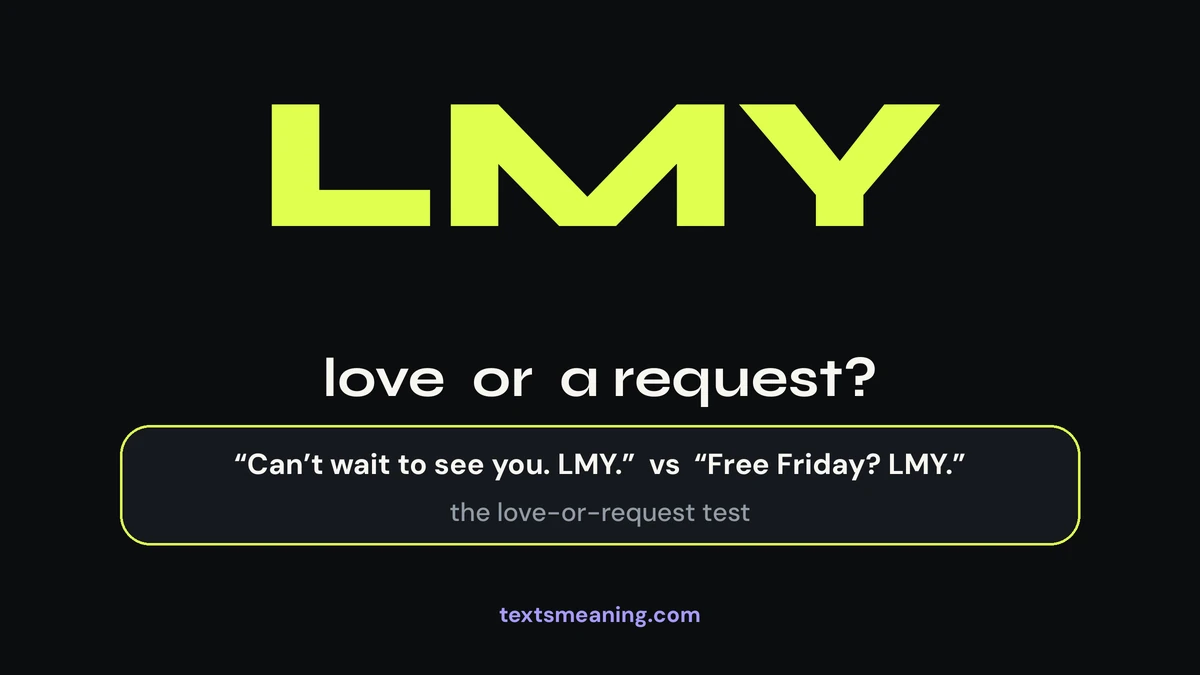
LMY is an initialism, built from the first letters of a phrase, and its lead reading is a complete feeling in miniature: “love and miss you.” It works as a sign-off, closing a message the way a hug closes a visit: it can stand alone as a whole reply (“LMY”), close a longer message (“Can’t wait to see you this weekend. LMY.”), or sit inside a warm sentence (“Thinking of you a lot lately. LMY.”). Unlike the shrug terms in this series, LMY is not hedging anything. It is saying something, just in the lightest possible packaging.
The dictionary record is direct, and this guide leans on it honestly. , read directly for this article, states plainly that LMY is a textspeak acronym standing for “love and miss you,” and it backs that with real usage examples from 2016 and 2017: a sister thanked as a lovely sweet sister with LMY, a friend writing “girl lmy! I hate how we are not close anymore,” and a poster quoting messages that simply said “lmy.” The entry notes, as its own caveat, that it is an informal word summary rather than a formal definition — and this guide repeats that caveat, because an honest source note beats a grander claim. One thing this guide does not claim: a Wiktionary read. A direct fetch of the Wiktionary LMY page was refused on the day of research, and no Wiktionary LMY entry surfaced in search, so no Wiktionary attestation is claimed and no Wiktionary link is used here.
Two companion readings ride alongside the lead, and both need grading before they can be used. The first is the reply variant: when someone says “I love you” and the other person fires back “LMY,” the letters can mean “love you more” — a playful, slightly competitive comeback between couples and close friends. Competitors report it, but no dictionary source found for this article attests it, so treat it as a reply-only reading: it only works as an answer to “I love you,” never as an opener. The second is the typo reading: inside a planning question (“Are you free Friday? LMY.”), the letters are probably a mistyped LMK, “let me know.” That is not a second dictionary meaning; it is a keyboard error to recognize, and the test in the next section exists to catch it. No frequency claim is made for any reading: no frequency study exists in any source read for this article, and the main competitor itself states there is no documented first use.
The LMY Love-or-Request Test
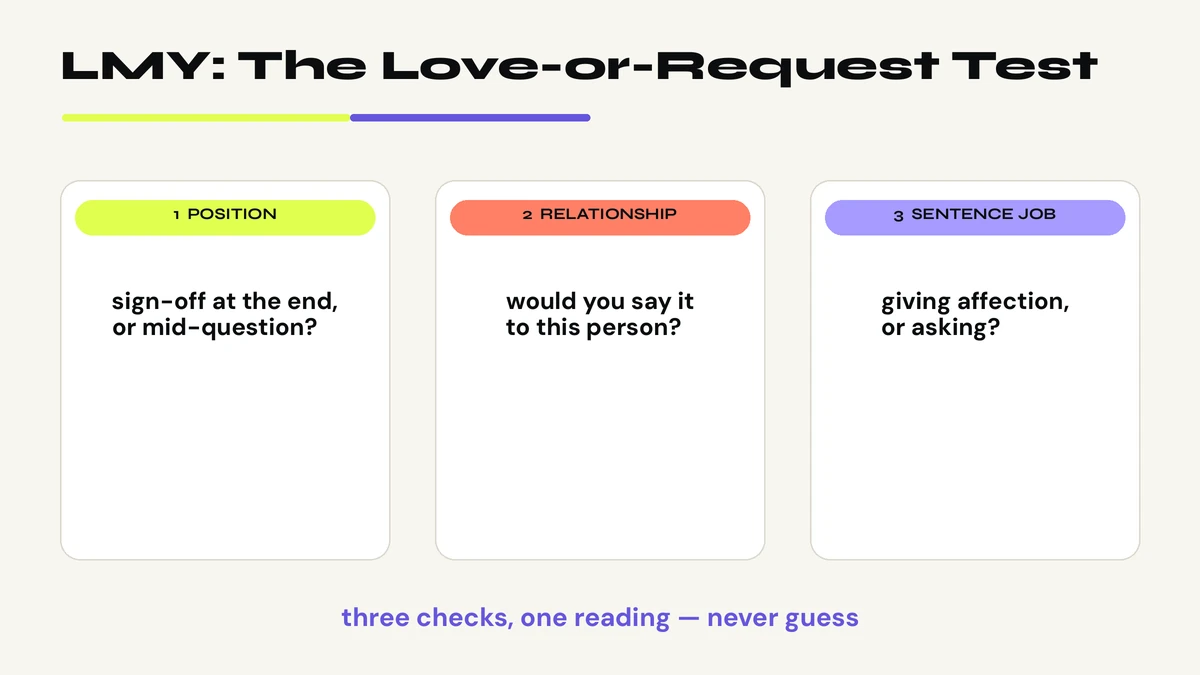
Before you answer an LMY — or send one — run three checks. They take about five seconds, and they beat every shortcut the competitors offer, because the competitors all say “context matters” without giving you a procedure for reading it:
- Check 1 — The Position Check. Where does LMY sit in the message? At the end of a warm message, as a sign-off, it is love: “Can’t wait to see you this weekend. LMY.” Buried mid-message inside a question about plans, times, or availability, it is probably a typo for “let me know”: “Are you free Friday? LMY.” Position is the fastest single clue, because sign-offs close messages and requests open them.
- Check 2 — The Relationship Check. Would you say “love and miss you” to this person, out loud, in this conversation? If the answer is plainly no — a coworker about a meeting, a seller about a delivery, a classmate about homework — then the affectionate reading is almost certainly wrong, and the typo reading wins. If the answer is obviously yes — a partner, a best friend, a parent — then the affectionate reading wins, and a planning question would have to work very hard to overturn it.
- Check 3 — The Sentence Job Check. Does the sentence give affection, or does it ask for something? A sentence that gives (“Missing your voice already. LMY.”) is love. A sentence that asks (“I might have an extra ticket. LMY if you are interested.”) wants an answer, a decision, or an update, and that is the request job. When the sentence job and the position agree, you are done; when they split, ask instead of guessing.
Worked trio. “Only 12 more days until I see you. LMY so much.” — position: sign-off at the end; relationship: partner or close friend; job: giving affection. Love. “Trying to figure out if we are doing brunch or dinner Saturday. LMY!” — position: mid-message inside a planning question; relationship: friend, but the sentence asks for a decision; job: requesting. Typo for “let me know,” so answer the question: dinner works. “I love you.” → “LMY.” — position: whole reply; relationship: couple or best friends; job: answering affection with affection. The reply variant, “love you more.” Three messages, three outcomes, one test.
“LMY” in Real Chats
Illustrative examples written for this guide, not real transcripts:
- The long-distance sign-off. “Only 12 more days until I see you. LMY so much.” — affection plus a countdown. Answer with warmth and a detail about the visit, not a question.
- The after-visit thank-you. “Thanks for coming down this weekend, Mom. LMY already.” — family warmth, already missing someone who just left. A simple “miss you too” closes it.
- The reply-to-ILY comeback. “I love you.” → “LMY.” — the playful one-up: love you more. Only works as a reply, never as an opener.
- The playful tease. “You are annoying but LMY anyway lol” — affection with the joke doing the safety work. The “lol” keeps it light; without it, the same message reads heavier.
- The checking-in note. “Thinking of you a lot lately. LMY.” — a check-in during a tough week. The letters carry the feeling; the sentence before them carries the reason.
- The planning typo. “I might have an extra ticket for the show. LMY if you are interested.” — a request wearing affection’s letters. Answer the question (interested or not), not the affection.
- The bare ambiguous LMY. “LMY” alone, with no sentence around it, from someone you barely know — the test cannot settle it, because position, relationship, and job all point nowhere. Ask: “Did you mean let me know, or love and miss you?” A five-second question beats a wrong guess.
The LMY Tone List
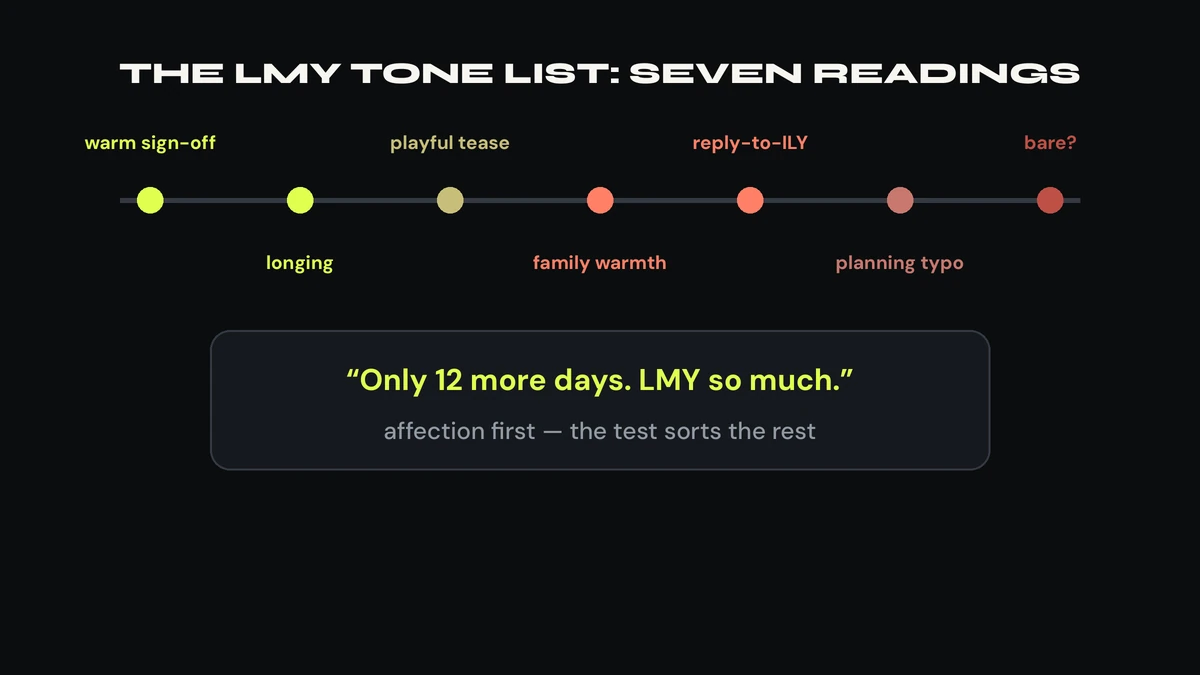
LMY’s letters stay the same; its job slides across seven readings. The first four are tones of the lead reading; the fifth is the reply variant; the sixth is the typo reading; the seventh is the failure mode, and it is the most honest entry on the list:
- Warm sign-off: “Talk soon. LMY.” — the default. Affection as a closer, warm precisely because it is regular.
- Long-distance longing: “Missing your voice already. LMY.” — the missing half turned up. Distance is the reason the letters exist at all.
- Playful tease: “You are annoying but LMY anyway lol” — affection with a joke attached, so it lands lightly. The humor is the permission slip.
- Family warmth: “Thanks for coming down this weekend, Mom. LMY already.” — love for family, stated plainly, with nothing romantic meant.
- Reply-to-ILY: “LMY.” after “I love you” — “love you more,” competitive in a sweet way. Only valid as a reply; as an opener it reads as a non sequitur.
- Planning typo: “Are you free Friday? LMY.” — almost certainly “let me know” mistyped. The sentence asks for a decision, so answer the decision.
- Bare or ambiguous: “LMY” alone from someone you barely know — no sentence, no relationship, no job to read. Do not guess; ask. A clarifying question is a complete reply.
What moves a reading between these tones is never the letters alone: it is the sentence around them, the position (sign-off versus mid-question), the relationship, and the emoji (a heart confirms affection, nothing at all after a planning question confirms the typo). The same “LMY” that is a warm sign-off on Sunday can be a typo on Monday morning — and the test, not the spelling, tells you which day you are on.
“LMY” on TikTok
On TikTok, LMY is a comment-section and caption affection statement more than a private message: “LMY!!” under a friend’s video, or a creator captioning a photo of friends with a bare “LMY.” The public stage suits the lightest readings best — warm sign-off and playful tease — because a comment thread is an audience, not a confession booth. Nobody owes a commenter a full sentence, and nobody should read a public LMY as a private declaration.
The trap on TikTok is the reverse of the private-chat trap: taking a public LMY too seriously. A creator who writes “LMY” to a whole comment section is thanking a crowd, not proposing to you, and a commenter who writes “LMY” under a stranger’s video is applauding, not confessing. If an LMY arrives in a TikTok DM, though, run the test as usual — a DM is private again, and the typo reading returns with it.
“LMY” on Snapchat
On Snapchat, LMY fits the fast, disappearing DM: “LMY” as a story reply, “LMY, thanks for today” on a streak snap, or a photo caption carrying the affection for a few seconds before it vanishes. The disappearing format suits the warm sign-off and playful readings — affection that lands lightly and is gone. But disappearance also removes your evidence: if an LMY felt like a planning typo, you cannot re-read it, so judge from memory what rode with it — a question about plans, an emoji, or nothing at all.
Snapchat is also where emoji does the most work. A heart or a pleading face next to LMY almost always confirms the affectionate reading, because nobody decorates a typo. If there is no emoji and the sentence reads like a question or a request, lean toward the “let me know” interpretation instead — and answer the question that was actually asked.
“LMY” on Instagram
On Instagram, LMY shows up in captions, comments, story replies, and DMs, and the stage decides the weight the way it does for every affection term. Captions lean warm and public: “LMY” under a photo of friends or family is a toast to an audience. Comments lean playful: “LMY!!” under a post is applause with a heart attached. DMs carry the full range, exactly like texts — a partner’s goodnight LMY and a friend’s planning-question LMY live in the same inbox, and only the test tells them apart.
Instagram is also where LMY meets its closest letter-trap. A bio or cross-post that says “follow my IG” is pointing at the app, not sending affection, and an “LMY” in a sales caption asking about availability is usually the typo reading, not a love letter to the customers. Read the whole message, never just the familiar letters, and never assume a public comment carries private weight.
“LMY” in Text Messages
Plain texts are LMY’s home ground, and the place both readings are easiest to see — because texts carry both affection threads and planning threads, sometimes to the same person on the same day. An affection text wants warmth back: “Can’t wait to see you this weekend. LMY.” A planning text wants an answer: “Are you free Friday? LMY.” The reply each one deserves is completely different, which is why the Position Check comes first — answering affection with a calendar answer, or a planning question with a heart, is the classic LMY misfire.
Texts are also where an LMY thread turns into a plan, and the plan usually moves somewhere private. A planning-question LMY that gets a yes often continues in a private thread — our DM guide covers that move in full, because the channel changes what the next message can say. And texts are LMY’s work limit in miniature: never send the affectionate reading, even abbreviated, in a professional message. A client, a manager, or a first contact deserves a plain thank-you or the full sentence, not three letters that presume an intimacy you do not have.
Who Is Sending It: How “LMY” Lands by Sender
No source documents a different meaning of LMY per sender — the lead reading stays fixed; what changes is which reading you should expect, and therefore what you owe back:
- Friend: the default. A friend’s LMY is a warm sign-off or a playful tease at face value; run the test and answer that, not the letters.
- Crush: overread territory. A crush’s LMY feels bigger than it is — usually affection, not a confession about the relationship. Answer warmly, not with a verdict about the two of you.
- Partner: pattern rules. A partner’s LMY is usually routine affection; judge the pattern across days, not one message — but a sudden stop in a partner’s LMYs, or a sudden first one after a fight, is a conversation worth having.
- Parent or family: the sign-off habitat. A parent’s or sibling’s LMY is almost always a warm closer (“Night, LMY”); return it simply, and do not read romance into a family habit.
- Coworker or boss: context decides. In a friendly team chat a colleague’s planning-question LMY is almost certainly the typo reading; in any formal thread affectionate shorthand is out of place, and never send one upward to a manager or client.
- Group chat: the sign-off habitat at scale. A group’s “LMY all” closes the evening for everyone; answer briefly in the group, and do not single one sender out for a private reading of a public message.
- Stranger or creator: the applause habitat. A stranger’s LMY under your post, or a creator’s LMY in a caption, is public thanks or applause, not affection for you personally. A thank-you is enough; never answer in kind.
When “LMY” Is Too Much: Work, School, and Family
This section is mandatory for LMY in a way it is not for most terms in this series, because the misread runs both ways: sending affectionate shorthand where it does not belong reads as careless, and misreading a message in either direction embarrasses both sides. Four rooms, four rules. At work: never send the affectionate reading in a professional message, a client thread, or a formal channel. A planning-question LMY to a colleague is already a risk — if they read it as affection, the thread goes sideways — so in any work message, spell out “let me know” instead of trusting three letters.
At school: the same rule, with a younger audience. Teachers, school groups, and class chats are not affection rooms, and a student who sends LMY to a teacher has sent a private feeling in code, whether they meant to or not. The clean swap is the full sentence: “let me know” for the request, and nothing at all for the affection, which does not belong there. In family chats, read the room person by person: a sibling group may love it, a grandparent group may not know it, and a parent who dislikes casual shorthand will dislike the abbreviation exactly as much as the phrase, once they learn what it stands for.
The general rule covers every room at once: if someone tells you LMY bothers them, simply stop. Switching words is easy, and it shows respect. The swap menu is free and it loses nothing: “love and miss you” spelled out for the affection, “let me know” spelled out for the request. And one boundary worth stating plainly: never use LMY to dress up a message you would not say out loud. If the full sentence would sound wrong to this person, in this place, the abbreviation does not fix it; it only makes it shorter.
Checked Claims: Expansions That Do Not Hold Up
Three letters attract folklore. Each claim below was graded against the dictionary record and the competitors read in full; nothing is repeated here as fact on a single blog’s say-so:
- “LMY means ‘love me yet?’” — rejected as a lead. One competitor leads with it, but no dictionary source and no usage example in any source read supports it. A flirty question is a different sentence from a sign-off, and the letters do not carry it.
- “LMY means ‘leave me alone’” — rejected. A single competitor’s secondary listing. The established abbreviation for that phrase uses different letters, and no dictionary source ties it to LMY. If a message wants space, it says so in words, not in these letters.
- “LMY means ‘laughing my yell’ or ‘laughing my yarn off’” — rejected. Joke expansions with no attestation beyond single low-quality pages. Laughter already has its own letters in this series, and LMY is not among them.
- “LMY means ‘love me yesterday,’ ‘let me yelp,’ or ‘love me yourself’” — rejected. Low-quality-page inventions, each contradicted by the dictionary source. Nostalgia, a business review, and a self-love slogan are three different messages; none of them is what LMY carries.
- “LMY always means ‘let me know’” — rejected as a complete account. Two competitors lead with it, but the dictionary source and the majority support the affectionate reading, and “let me know” already has its own established abbreviation, LMK. The typo reading is real, but it is a typo, not the meaning.
- “LMY is just a typo, so it is wrong” — rejected. The affectionate reading is dictionary-attested, so only the planning-question use is a probable typo, not the letters themselves. Calling the whole term a typo misreads every sign-off.
- “LMY has a documented first use or a measured frequency” — rejected. The main competitor states there is no documented first use, and no frequency study exists in any source read for this article. This guide reports no percentages and no dominance claim: the lead reading is the best-supported one, and the test, not a number, decides each message.
- “Lowercase lmy means something different from LMY” — rejected. Case is volume, not a new definition. Lowercase lmy reads casual and relaxed, all-caps LMY reads warmer and more emphatic, and neither changes the reading — the Position Check and Sentence Job Check do that. Non-texting homonyms (an airport code, a meat-yield term, an airline code, a highway term) are fenced as domain homonyms: real outside chat, never texting meanings.
What SURVIVES: “love and miss you” as the lead, “love you more” as a reply-only variant, and “let me know” as a probable typo in planning questions, decided by position, relationship, and sentence job. Everything else failed evidence, was fenced as a domain homonym, or was refused a number it cannot support.
“LMY” vs Its Closest Cousins
LMY belongs to the affection family, which is why it confuses people: its cousins each carry one half of what LMY carries whole, or a neighboring job entirely. Its closest cousins split by which half they serve:
- ILY (“I love you”) — the direct love cousin. Our ILY guide covers the love half without the missing half; LMY adds longing to it. ILY says “I love you”; LMY says “I love you and I miss you.”
- IMY (“I miss you”) — the missing cousin. The longing half without the love half. IMY says “I miss you”; LMY says both at once, which is why it fits long-distance messages better than either half alone.
- ILYSM (“I love you so much”) — the amplified cousin. Love turned up, without the missing half. ILYSM says “I love you, a lot”; LMY says “I love you and I miss you,” a different shape of feeling, not a louder version of the same one.
- ISTG (“I swear to God”) — the emphasis cousin. Our ISTG guide covers an intensifier that underlines a sentence; LMY sends a feeling instead. ISTG says “believe this”; LMY says “I love and miss you.”
- IKR (“I know, right?”) — the echo cousin. Our IKR guide covers shared feeling; LMY sends a feeling of its own, not an echo of yours. IKR says “I feel that too”; LMY says “I feel this about you.”
- LMK (“let me know”) — the typo-source cousin. The abbreviation a planning-question LMY is usually a typo for. LMK asks for an answer; LMY gives affection — and the whole test exists because one mistyped letter can swap the two.
- LMS — the social cousin. Our LMS guide covers “let me see” in a private chat, or “like my status” on a public post. LMY misses a person; LMS asks to see them. One aches for the person, the other asks for the photo.
- MFM — the arrangement cousin. Our MFM guide covers “male-female-male” — shorthand for a threesome or an arrangement, among its other readings. LMY is love and missing; MFM is an adult arrangement. Different rooms of the same relationship house — one tender, one explicit.
LMY often travels with a visit, a countdown, or a reunion — a ticket home, a holiday, a first meeting after months apart — and that companion is what makes the reading readable at a glance. Read the companion first, and the letters second.
Where “LMY” Came From
No documented first use exists, and this guide claims none: the main competitor, read in full, states that plainly, and inventing an origin date would be worse than admitting the gap. What is clear is the shape of the origin. LMY grew out of the same SMS-era compression that produced ILY and IMY: when every character counted, common affectionate phrases collapsed into initials, and the habit survived after character limits vanished, because shorthand now signals a relaxed, familiar relationship as much as it saves keystrokes.
One reported theory deserves a careful grade, not a repetition. The Word Counter reports, via a user-generated slang repository, the theory that LMY began as a misspelling of IMY that morphed into common usage over time. That is attestation, not evidence: a theory about a typo, reported second-hand, about a term whose lead reading is affection, not error. It is plausible — the letters are close, and the feelings overlap — but plausibility is not proof, and this guide teaches it as a theory. The earliest dated evidence actually read for this article is Dictionary.com’s 2018 entry with usage examples from 2016 and 2017, which shows the affectionate reading already established in ordinary messages by then.
How to Reply When Someone Sends “LMY”
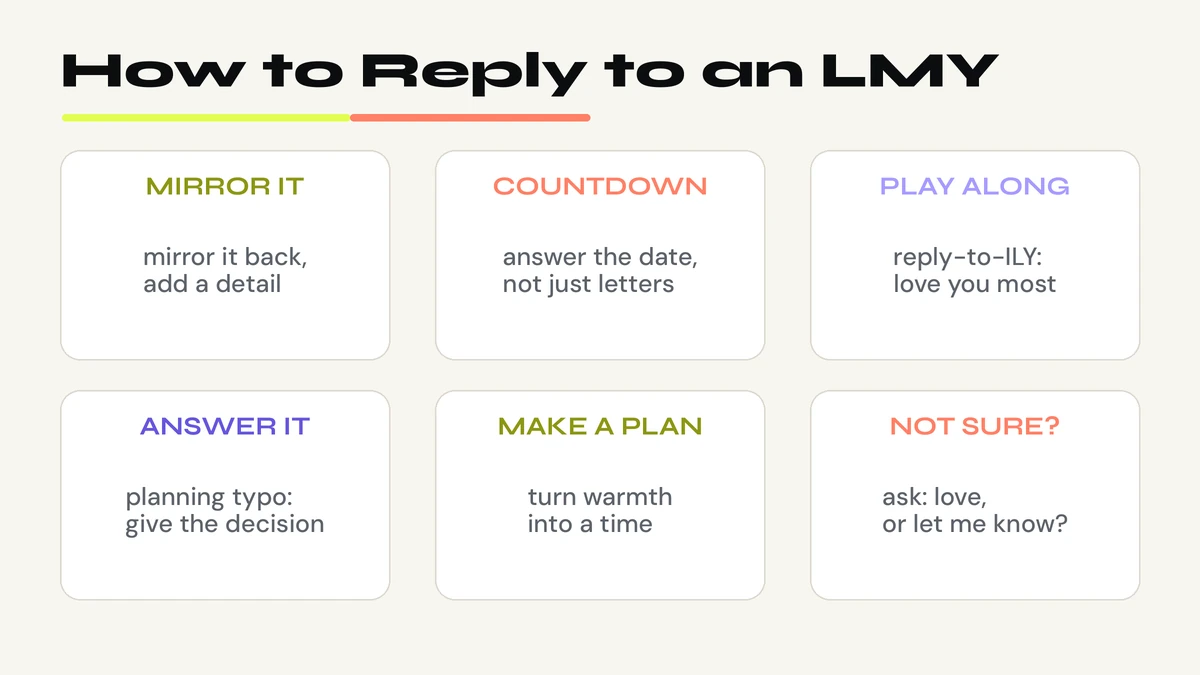
Six replies, matched to the reading and the tone. Name the reading first, or every reply below can misfire:
- Warm sign-off, and you feel the same: “LMY too” or “Miss you more!” Mirror it back, then add a detail, so the affection becomes a conversation.
- Long-distance longing, and you are counting down too: “Only 12 more days! Can’t wait.” Answer the countdown, not just the letters; the date is the real message.
- Reply-to-ILY, and you want to play along: “LMY most!” or “Love you more, actually.” The game is the affection; play it, and do not turn a joke into a debate.
- Planning typo, and you have an answer: just answer the question that was asked — “Dinner works for me” or “I am interested in the ticket.” No heart required, and none expected.
- Affection, and you want a plan: turn the warmth into a next step — our HMU guide covers the open invitation that does exactly that: “LMY too! So, when are we meeting?” Warmth without a plan fades; warmth plus a time becomes a memory.
- Bare or ambiguous, and you genuinely cannot tell: “Wait, did you mean let me know or love and miss you?” A five-second question beats a wrong guess in either direction, and nobody is offended by being asked.
What never works: answering affection with a calendar answer when warmth was owed, answering a planning question with a heart when a decision was owed, or answering a bare LMY from someone you barely know as if it were a declaration. The golden rule: match the reading, then match the need.
Frequently Asked Questions
What does “LMY” mean in a text message?
Usually “love and miss you,” a warm sign-off for someone you love and have not seen in a while. Run the Love-or-Request Test first, though: inside a planning question, the same letters are probably a typo for “let me know.”
Is LMY the same as “let me know”?
No. “Let me know” already has its own abbreviation, LMK. LMY inside a planning question is probably a mistyped LMK, but that makes it a typo to recognize, not a second meaning to teach.
What does LMY mean on TikTok?
Almost always public affection: a warm comment or caption under a friend’s video, lighter than a private message. A TikTok DM about plans can still be the typo reading, so run the test on private messages.
What does LMY mean on Snapchat?
Usually affection in a fast, disappearing DM or story reply, often paired with a heart or pleading-face emoji. Because the message vanishes, judge from memory whether a question about plans rode with it.
Can I use LMY at work or school?
Not the affectionate reading, and not in formal messages. A teacher, manager, or client deserves the full sentence, and a planning-question LMY at work should be spelled out as “let me know” so nobody misreads it as affection.
What should I reply when someone sends LMY?
Match the reading: mirror affection with affection (“LMY too”), answer a planning question with the decision it asked for, play along with a reply-to-ILY comeback, and ask directly when the message is bare or ambiguous. The reply bank above has one for each case.
Is LMY the same as ILY?
Close, but not the same. ILY says “I love you”; LMY adds the missing half and says “I love you and I miss you.” Use ILY for love alone, LMY when distance is part of the feeling.
Does lowercase lmy mean something different from LMY?
No, the meaning is the same; only the volume changes. Lowercase lmy reads casual and relaxed, all-caps LMY reads warmer and more emphatic, and neither changes the reading — the Position Check and Sentence Job Check do that.
The Takeaway
Three letters, two jobs, and one honest failure mode. LMY means “love and miss you” when it signs off a warm message, “love you more” when it answers “I love you,” and probably “let me know” mistyped when it sits inside a planning question — and whether the message you just got is affection or a request is decided by the Love-or-Request Test: check the position, check the relationship, check the sentence job. Send the affection when the feeling is real, spell out “let me know” when you are asking, ask directly when the message is bare, and answer the reading you actually received.