What does np mean in text? NP means “no problem” — a quick, casual way to say “you’re welcome,” “that’s fine,” or “sure, I can do that.” This guide to np meaning in text gives you the NP Two-Letter Test, so you can tell in seconds whether the np you just got was warm thanks, a brushed-off apology, a yes to a small request, or praise for a good play in a game.
This guide covers the three jobs NP does, the three-check test, seven tones from warm to flat, NP on TikTok, Snapchat, Instagram, and in texts, how it lands by sender, when two letters are too few at work, school, and home, graded claims about the other things NP can stand for, cousins, a short history from chatrooms to phones, and a reply bank that starts with the surprising truth that most of the time, you do not need to reply at all.
What “NP” Means in Text
NP is an initialism, not a word you pronounce: you read the letters N and P, one at a time, and they stand for “no problem.” It is almost always a reply, never an opener. Somebody thanks you, apologizes, or asks for a small favour, and NP closes the moment in two keystrokes. That is the whole trick of it: two letters do the work of a full sentence, which is why it is everywhere and why it sometimes lands wrong.
The dictionary record is short and unusually clear for a slang term, and this guide leans on all of it. Wiktionary, read directly for this article, lists np as an abbreviation of “no problem” in text messaging and on the internet, and its “no problem” entry gives the phrase three spoken jobs: granting a request (“Certainly, sure”), answering thanks (“No thanks are necessary; you’re welcome”), and answering regret (“No apology is necessary; think nothing of it”). Dictionary.com agrees in its own words: NP is an abbreviation “used in digital communications” meaning “no problem,” and it lists the same letters in lower case too. Both entries file NP under online usage, which tells you it is casual shorthand, not something you would write in a formal letter.
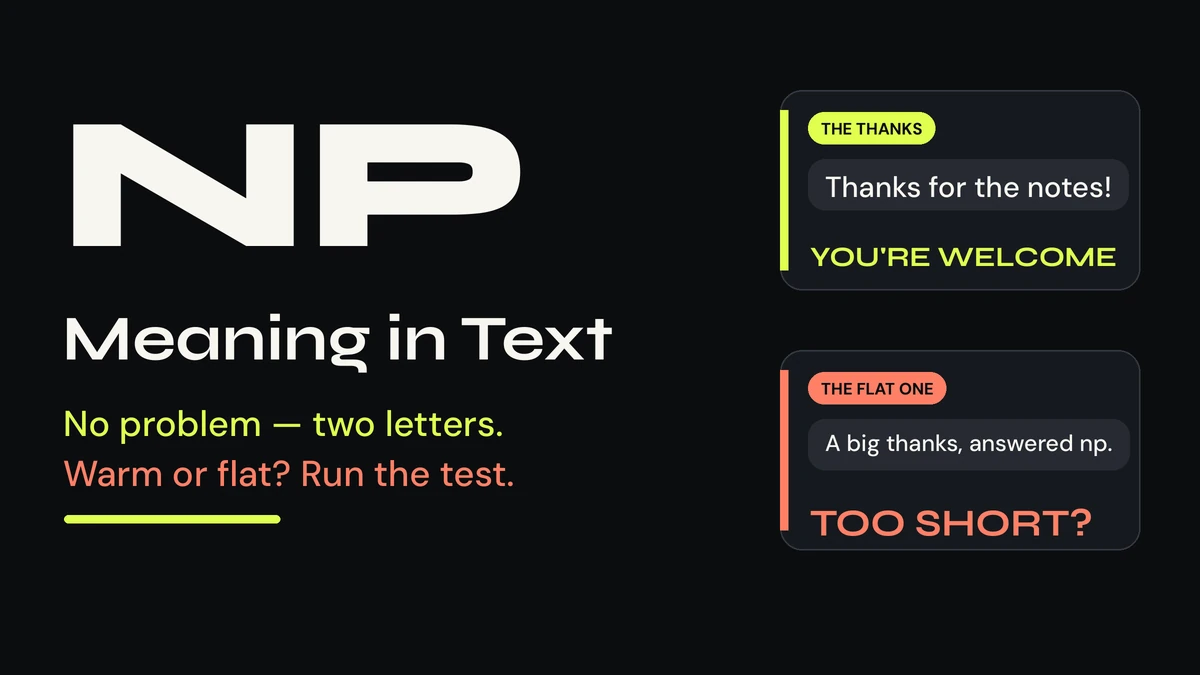
Three jobs, then, and the difference between them is the first thing to learn. Job one answers thanks: “Thanks for the notes!” gets “np,” which means “you’re welcome, it was no trouble.” Job two accepts an apology: “Sorry I’m late” gets “Np, just got here too,” which means “that’s okay, don’t worry about it.” Job three agrees to a small request: “Can you send me that file?” gets “Np, sending now,” which means “sure, I can do that.” One abbreviation, three jobs — and the message before NP tells you which job it is doing, which is exactly why this guide’s test starts there, not with the letters.
The NP Two-Letter Test
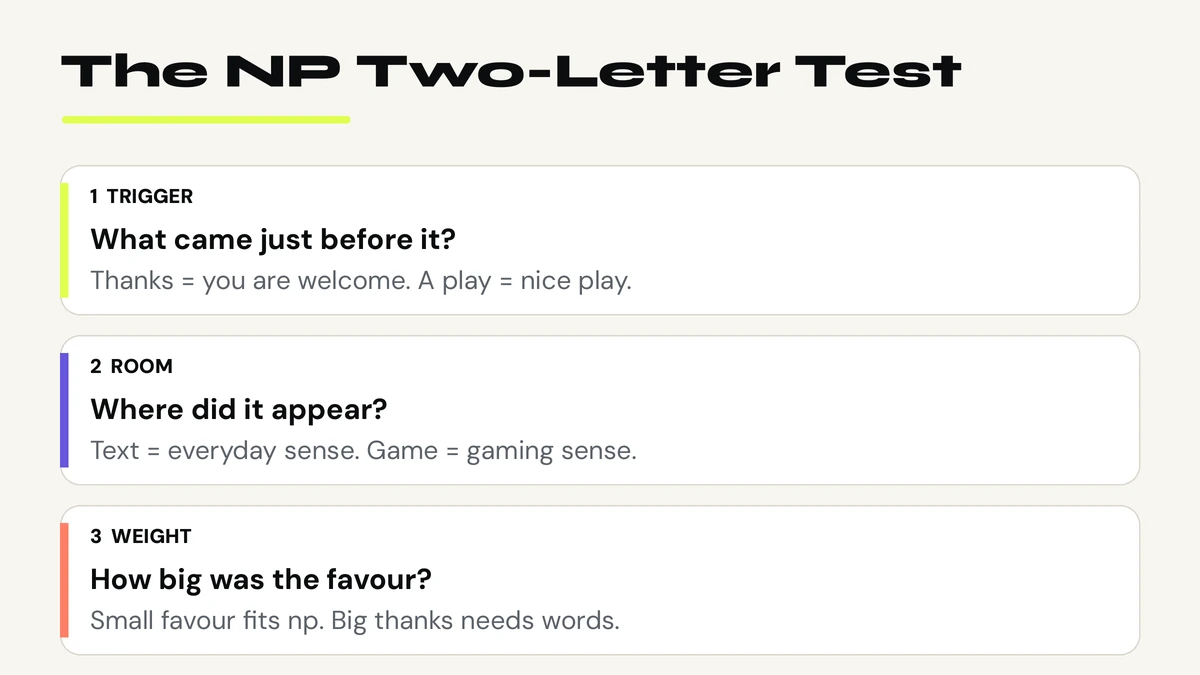
Before you answer an NP — or send one — run three checks. They take about five seconds, and they beat every shortcut the competitors offer, because the competitors all say “it depends on context” without giving you a procedure for reading it:
- Check 1 — The Trigger Check. What came just before it? A “thanks” means job one, you’re welcome. A “sorry” means job two, it’s okay. A small request means job three, sure. A great move in a game means the gaming sense, nice play. If you cannot see the message NP is answering, scroll up — NP is the second half of an exchange, and without the first half you are guessing.
- Check 2 — The Room Check. Where did it appear? A text or a DM means the everyday sense. A game lobby or a match chat means the gaming sense is on the table. A work chat means the everyday sense too, but with the warmth rules of the office attached. A classroom group chat means keep it casual and keep it kind. The room never changes the letters; it changes which reading is even possible.
- Check 3 — The Weight Check. How big was the favour, or the thanks? A passed link or a shared note is light, and a bare “np” fits it perfectly. A night of help, a covered shift, or a heartfelt thank-you is heavy, and two letters under-answer it. Weight is the check the competitors miss: they tell you NP can sound flat, but they never tell you how to measure when it will.
Worked trio. “Thanks for covering my shift yesterday.” “NP, happy to help.” Trigger thanks, room a text, weight a full shift — the reply adds words because the favour was big, and the test says warm. “Sorry I sent the wrong file.” “NP, just send the right one when you can.” Trigger apology, room a work chat, weight small — a bare NP plus a next step, and the test says fine. “Ty for the heal, that clutch saved us.” “np.” Trigger a good play, room a game lobby, weight a compliment — and the test says this one might not mean “no problem” at all. Three messages, two letters, four readings — and the test, not the spelling, sorted them.
“NP” in Real Chats
Illustrative examples written for this guide, not real transcripts:
- The thanks reply. “Thanks for the notes!” “np, gl on the test tomorrow!” — our GL guide covers the good-luck wish that rides along with it. The NP closes the thanks; the GL opens the next thing.
- The apology brush-off. “Sorry I’m late.” “Np, just got here too.” The apology is small, the reply is small, and both sides move on.
- The favour yes. “Can you send me that file?” “Np, sending now.” The NP is the yes; the rest of the sentence is the delivery.
- The big-thanks mismatch. “Thanks so much for picking up the kids!!” “np.” The thanks is huge and heartfelt, the reply is two letters, and the gap is what the other person feels. Match the effort, or add a sentence.
- The gaming thanks. “Ty for the heal.” “np.” In a game lobby this is the everyday sense — thanks answered, moment closed — but if the “ty” was for a great play, the same two letters can mean “nice play” instead. The trigger decides.
- The plan change. “Can we meet 15 minutes later?” “NP, that works for me.” No thanks involved at all: the NP is a yes to a changed plan, and the sentence after it proves it.
- The late-night apology. “Sorry for texting so late.” “NP, I’m still awake.” The apology is about timing, the reply says the timing is fine, and the chat can carry on.
The NP Tone List
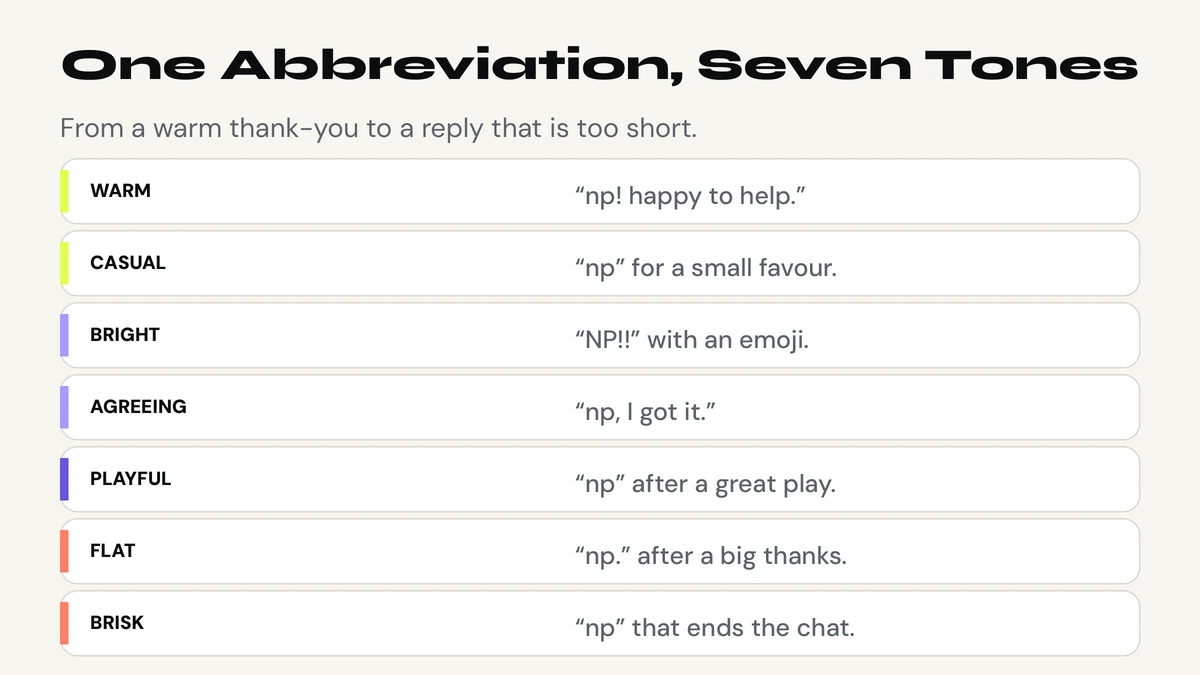
NP never changes its letters; its feeling slides across seven readings, warmest to flattest. The first five are safe to send; the last two are the ones that cost you warmth:
- Warm: “np! happy to help” — an exclamation mark, a follow-up sentence, or both. The sender adds warmth on purpose, and the thanks feels received.
- Casual: “np” between friends for a small favour — a passed link, a shared note. Quick, easy, and exactly enough.
- Bright: “NP!!” with capitals or an emoji — louder and lighter, the way a laugh sounds in text. Same meaning, more energy.
- Agreeing: “np, I got it” — a yes to a request, not an answer to thanks. The sentence after the letters does the agreeing; the letters just open the door.
- Playful: “np” after a great move in a game — praise for a good play, the gaming sense. The room makes it a compliment instead of a close.
- Flat: “np.” after a big, heartfelt thank-you — correct, but thin. Nothing is wrong with the letters; the weight is wrong.
- Brisk: “np” that ends a conversation the other person wanted to continue — a favour asked, a question unanswered, a door closed. The shortest reply can also be the coldest one.
What moves a reading between these tones is never the letters alone: it is the punctuation (an exclamation warms, a full stop cools), the follow-up sentence (one more clause turns a close into a conversation), and the weight of what came before (a small favour forgives a short reply; a big one does not). The same “np” that is perfect after “thanks for the link” is too little after “thank you for staying up all night to help” — and the Weight Check, not the spelling, tells you which day you are on.
“NP” on TikTok
On TikTok, NP lives in comments and DMs, and the comment thread is its natural habitat for quick closes: a creator answers a question, a follower says thanks, and “NP!” closes it in front of everyone. The public stage suits the warm and bright readings best, because a comment thread is an audience, not a private conversation — nobody there is owed a sentence, and the close lands precisely because everyone in the thread knows the feeling of a small favour done quickly.
TikTok is also the one platform where the gaming sense shows up in the open. A clip of a great play, a clutch moment, a clever move — and the comments fill with “np,” meaning “nice play,” aimed at the player, not at anyone’s thanks. If an NP arrives in a TikTok DM, though, run the test as usual: a DM is private again, the everyday sense returns, and the trigger message before it decides the job.
“NP” on Snapchat
On Snapchat, NP fits the fast, private, disappearing DM: “thanks for the snap!” gets “np” as a story reply, or a bare “np” on a streak snap between close friends. The disappearing format suits the casual readings — a quick close that lands lightly and is gone. But disappearance also removes your evidence: if an NP felt flat, you cannot re-read it, so judge from memory what rode with it — an exclamation, a follow-up sentence, or nothing at all.
Snapchat is also where the photo does half the work. A snap of the notes you asked for, plus “np,” needs no explanation: the picture names the favour, and the letters only say it was no trouble. That is the Trigger Check working in real life — remove the NP and the snap still shows the help, which is how you know the job was answering thanks, not starting a conversation.
“NP” on Instagram
On Instagram, NP shows up in comments, DMs, and story replies, and the stage decides the tone the way it does for every reply term. DMs carry the full range, exactly like texts: a friend’s warm “np! happy to help” and a stranger’s flat “np.” live in the same inbox, and only the test tells them apart. Comments lean public and quick: “np!” under a thank-you is applause the whole thread can see, and nobody expects more than two letters there.
Instagram is also where NP meets its closest platform trap: reading a public close as a private cold shoulder. A creator’s “np” under your thank-you is a quick close in front of an audience, not a verdict on your gratitude, and answering it with a longer thank-you embarrasses both sides. A heart, a matching “thanks again,” or silence all end it cleanly; the comment was never asking for more. The exception is a DM that answers a big favour with a bare “np” and nothing else — that is flat, and the reply section below covers it.
“NP” in Text Messages
Plain texts are NP’s home ground, and the one-to-one setting makes the three jobs sharpest. A thanks text wants a close: “Thanks for the help last night.” “Ah, np. It’s the least I could do.” An apology text wants reassurance: “Sorry I forgot to call.” “NP, don’t worry about it.” A request text wants a yes: “Can you save me a seat?” “NP!” The reply each one deserves is different, which is why the Trigger Check comes before the reply — answering thanks with a yes, or a request with a shrug, is the classic NP misfire.
Texts are also where NP picks up travelling companions. A file on its way gets an arrival time — “np, sending now, ETA two minutes” — and our ETA guide covers that little time stamp in full. A quick heads-up rides along too — “np, fyi the file is already in the drive” — and our FYI guide covers the heads-up in full. And texts are NP’s work limit in miniature: never send NP in a professional message to a client, a manager, or a first contact. They deserve a full sentence, not two letters that presume a casualness you do not have yet.
Who Is Sending It: How “NP” Lands by Sender
No source documents a different meaning of NP per sender — the abbreviation stays fixed; what changes is which reading you should expect, and therefore what you owe back:
- Friend: the default. A friend’s NP is warm or casual at face value; a bare “np” for a small favour is fine, and a warm “np! happy to help” for a big one is better. Run the test and answer that, not the letters.
- Crush: overread territory. A crush’s NP feels bigger than it is — usually “you’re welcome,” not a signal of interest. Answer the thanks, not a romance you invented, and judge the pattern across days, not one message.
- Partner: pattern rules. A partner’s NP is usually routine and warm; judge the pattern across days, not one message — but a sudden run of bare, flat “np” replies after warm ones is worth one plain question, not a fight.
- Parent: usually literal and plain. A parent who writes NP has usually learned it from you and means the favour was no trouble; do not read a parent’s NP as cold unless the sentence around it is cold too.
- Coworker or boss: context decides. In a friendly team chat a colleague’s NP for a link or a quick fix is fine; in any formal thread it is out of place, and never send one upward to a manager or a client — and never one that answers a serious apology with two letters.
- Group chat: the quick close at scale. A group’s “np!” ends a thanks thread cleanly for everyone; answer briefly in the group either way, and do not single one sender out for a private reading of a public close.
- Stranger or creator: the public-close habitat. A stranger’s NP under your thank-you, or a creator’s NP in a reply, is a quick close in front of an audience, not a verdict on you personally. A heart or a matching thanks is enough; never answer a public close with a private confession about how grateful you are.
When “NP” Sounds Flat: Work, School, and Family
This section is mandatory for NP in a way it is not for most terms in this series, because NP’s risk is not vulgarity — the word is clean — but flatness: two letters can under-answer a big thanks, and the person who thanked you feels the gap even when they cannot name it. Four rooms, four rules. At work: NP is fine in a casual team chat for small things, a link or a quick fix. With managers or clients, write it in full or use a warmer phrase: “No problem at all, glad it helped” reads as engaged and friendly, while “np” can look like you are dashing between tasks.
At school: the same rule, with a younger audience. Between classmates, “NP!” after shared notes is natural and kind. In a message to a teacher, a formal email, or an assignment, write the full phrase — teachers read short replies as short effort, and a thank-you to a teacher deserves the whole sentence. In family chats, read the room person by person: a sibling group may love the shorthand, a grandparent group may not know the letters at all, and a parent who dislikes short replies will dislike the abbreviation exactly as much as the words, once they learn what it stands for. Abbreviation is not permission.
The general rule covers every room at once: match the effort. If the thanks was big and heartfelt, match it with more than two letters; if it was a quick “ty” for passing on a link, “np” fits perfectly. The swap menu is free and it loses nothing: “No problem at all!” for warmth, “Happy to help” for work, “Anytime” for friends, “You’re welcome” for formality. And one boundary worth stating plainly: if someone tells you your “np” felt cold, add words next time instead of defending the abbreviation. Switching words is easy, and it shows respect.
Checked Claims: Expansions That Do Not Hold Up
Two letters attract folklore, and an abbreviation this crowded attracts more than most. Each claim below was graded against the dictionaries read in full and the competitors read in full; nothing is repeated here as fact on a single blog’s say-so:
- “NP means ‘nope’” — rejected. One guide reports a colloquial “nop/np” for “no” in passing, but no dictionary supports it, and every competitor leads with “no problem.” “Nope” is its own word; NP is not its abbreviation.
- “NP always means ‘nice play’” — rejected as a full account. The gaming sense is real, but it lives in game lobbies and match chats, and every dictionary read for this article lists “no problem” first. A good play earns “nice play”; a thank-you earns “no problem.” The trigger decides, not the letters.
- “NP is rude” — rejected. NP is usually neutral or friendly, and the dictionaries file it as ordinary digital shorthand. What can feel rude is a weight mismatch — two letters after a huge favour — and that is a property of the exchange, not of the abbreviation.
- “NP means ‘now playing’” — fenced, not a texting meaning. Beside a song title in a music chat, NP can label what is playing right now, and one competitor notes it. In a text thread, nobody announcing a song is answering your thanks.
- “NP means ‘no pressure’” — rejected as a texting meaning. One guide lists it as a less-common plan-talk reading (“Come by if you can, NP if not”), but no dictionary supports it and no competitor repeats it. Graded possible-but-undocumented, not a live sense.
- “NP is short for ‘Nepal’” — fenced, not a texting meaning. NP is a country code, and Dictionary.com lists Nepal among the abbreviation’s other lives. In a chat, nobody typing “np” is naming a country.
- “NP means ‘nurse practitioner’” — fenced, not a texting meaning. After a person’s name, NP is a professional title for a licensed nurse who can diagnose and treat patients. In a text thread, the letters after a name are a title; the letters after “thanks” are a reply.
- “Lowercase np and capital NP mean different things” — rejected. Capitalization changes volume, not meaning: capital NP reads a touch louder, lowercase np reads softer and faster, and both mean “no problem.” What changes the reading is the trigger, the room, and the weight — never the case alone.
What SURVIVES: NP means “no problem” in three jobs — answering thanks, accepting an apology, agreeing to a small request — with the gaming “nice play” as a real room-bound secondary; Wiktionary and Dictionary.com as the two dictionary anchors; chatrooms in the 1980s as the likely birthplace, an Urban Dictionary entry dated 2002 as the earliest attestation anyone has reported, and no inventor, because a community shortened the phrase, not a person.
“NP” vs Its Closest Cousins
NP belongs to the reply family — words that close a moment instead of opening one. Its closest cousins split by which job they do:
- DW (reassurance cousin). Our DW guide covers “don’t worry”: after an apology, NP and DW say the same thing in different lengths. “Sorry I’m late.” “NP” is the short form; “DW about it” is the spelled-out form. One closes the apology, the other names the reassurance.
- “YW” (the formal twin). “You’re welcome” is what NP means when it dresses up: NP says it was no trouble, YW says you are welcome. Same job, different room — YW for clients and new contacts, NP for friends and quick chats.
- “No prob” (the spoken twin). The clipping you say out loud: same job, same warmth, one sound shorter than “no problem” and one step warmer than two letters. If NP feels too short, “no prob” is the smallest possible upgrade.
- “NBD” (the downplay cousin). “No big deal” says the favour was small; NP says it was no trouble. They overlap after thanks, and they split after effort: a night of help deserves NP with a follow-up sentence, not an NBD that pretends the night never happened.
- “Anytime” (the warm cousin). The reply that offers future help: NP closes this favour, “anytime” opens the next one. When the thanks was big, “anytime” is the warmer close, because it promises the help again.
- “GG” (the gaming cousin). “Good game” closes a match the way NP closes a thanks — a short, ritual reply that ends the moment cleanly. In a game lobby the two even meet: a great play earns “np” as “nice play,” and the match earns “GG” as its goodbye.
Where “NP” Came From
The phrase came first, and it came long before the abbreviation. “No problem” is a long-standing informal idiom, and Wiktionary’s entry records all three of its spoken jobs — granting a request, answering thanks, and answering regret — before it lists NP as the Internet abbreviation. The abbreviation itself belongs to the early chatroom era: How-To Geek, the oldest competitor read for this article, reports that NP emerged when early internet chatrooms needed short phrases for limited screen space, that the oldest Urban Dictionary definition dates to 2002, and that use likely predates that because chatrooms date to the 1980s. Those dates are competitor-reported, not direct reads, and this guide repeats them as reported, not as settled fact.
No inventor is claimed, because there is none: the phrase was shortened by a community, not coined by a person. “No prob” is the spoken clipping that travelled alongside it, and the abbreviation spread from chatrooms to phones, social platforms, and games, where the “nice play” reading grew up separately in gaming chat. Two letters, a complete sentence, three jobs, and no owner — that is why NP stuck, and why it is still the fastest honest reply in a chat.
How to Reply When Someone Sends NP

Golden rule: most of the time, you do not need to reply at all. NP usually closes the exchange — you thanked someone, they said it was no trouble, and the conversation is done. A reply bank keyed to the situation, starting with the answer the other guides never give you:
- Silence — the exchange is closed: Nothing is owed. If you thanked someone and they answered “np,” the conversation ended cleanly, and another message only reopens it. Leave it there.
- Warm thanks back — “Thanks again!” or “Appreciate it!” When the help mattered, a second thanks tells the other person the first one was real. Short, warm, and done.
- Keep the door open — “Hmu anytime you need a hand” turns a closed thanks into an open offer, and our HMU guide covers the open invitation in full, because a favour answered deserves a favour offered back.
- Make a plan — “Hml later and we’ll sort the rest” turns a closed thanks into a next step, and our HML guide covers the later check-in in full, because some thanks deserve a follow-up, not just a close.
- After an apology NP — “Thanks for understanding” or “Glad we’re good.” The NP said the mistake was fine; your reply says you heard the forgiveness, and the thread moves on.
- In a game — “gg!” or a “nice play” back. The NP was praise for a move or thanks for the help; either way, a short, warm answer in the same register keeps the lobby friendly.
Frequently Asked Questions
What does NP mean in a text message?
NP means “no problem.” In a text it is usually a reply to thanks (“you’re welcome”), an apology (“that’s okay”), or a small request (“sure, I can do that”). Run the Two-Letter Test before you decide which job it is doing: check the message before it, the room it is in, and how big the favour was.
Is NP rude?
Not usually. NP is a common, informal way to say something is fine or that helping was no trouble. It can feel brief after a heartfelt thank-you, because two letters under-answer a big favour — but the flatness comes from the weight mismatch, not from the letters. When the thanks is big, write more.
What does NP mean on TikTok?
On TikTok, NP usually means “no problem” in comments and DMs, closing a thank-you quickly in front of an audience. In gaming clips and comments it can also mean “nice play,” praise for a good move. The trigger decides: thanks earns “no problem,” a great play earns “nice play.”
What does NP mean on Snapchat?
On Snapchat, NP usually means “no problem” in private DMs and story replies, closing a thank-you or brushing off a small apology. The disappearing format suits the casual readings, but it also removes your evidence — if an NP felt flat, judge from memory what rode with it.
What does NP mean in gaming?
In gaming chat, NP has two live readings. After thanks for help, it means “no problem,” the everyday sense. After a good move, it can mean “nice play,” praise for the play — attested by gaming glossaries, including a poker dictionary that defines np as a chat term for “nice play.” The message before it tells you which one you just got.
Can I use NP at work or school?
In casual team chat between coworkers, and between classmates, yes — for small things, a link or a quick fix. In a formal email, a message to a client or a manager, or a message to a teacher, write it in full instead: “No problem at all, glad it helped.” Two letters presume a casualness that formal rooms have not granted.
How do I reply when someone sends NP?
Usually, you do not need to. NP closes the exchange after you thanked someone or apologized. If you want to answer anyway, a warm “Thanks again!” works, or turn it into a plan with an open invitation. The full reply bank is in the section above.
Does lowercase np mean something different from NP?
No. Capitalization changes volume, not meaning: capital NP reads a touch louder, lowercase np reads softer and faster, and both mean “no problem.” Lowercase is more common in personal messages because it is quickest to type. What changes the reading is the trigger, the room, and the weight — never the case alone.
The Takeaway
NP means “no problem”: two letters that close a moment — a thanks answered, an apology accepted, a small request agreed to — and, in a game, a good play praised. The abbreviation never changes; the weight does. When an NP lands, run the Two-Letter Test: check the trigger, check the room, check the weight. And when you send one, remember the only rule that matters: match the effort. If the favour was small, two letters are plenty; if the thanks was big, prove it with a follow-up sentence, because the fastest reply in a chat is only a good reply when it is big enough for the moment it answers.