What does otw mean in text? OTW means “on the way” — a quick status update that says you are already moving, or about to be. This guide to otw meaning in text gives you the OTW On-the-Way Test, so you can tell in seconds whether the otw you just got means “I left five minutes ago,” “I am leaving right now,” or “I have not moved yet and I am stalling.”
This guide covers the one dictionary-backed texting meaning, the three-check test, seven tones, OTW on TikTok, Snapchat, Instagram, and in texts, how it lands by sender, when it crosses a line at work, school, and home, graded claims about rival expansions, cousins, a dated history from early chat rooms to a 2018 dictionary entry, and a reply bank keyed to the reading you just identified.
What “OTW” Means in Text
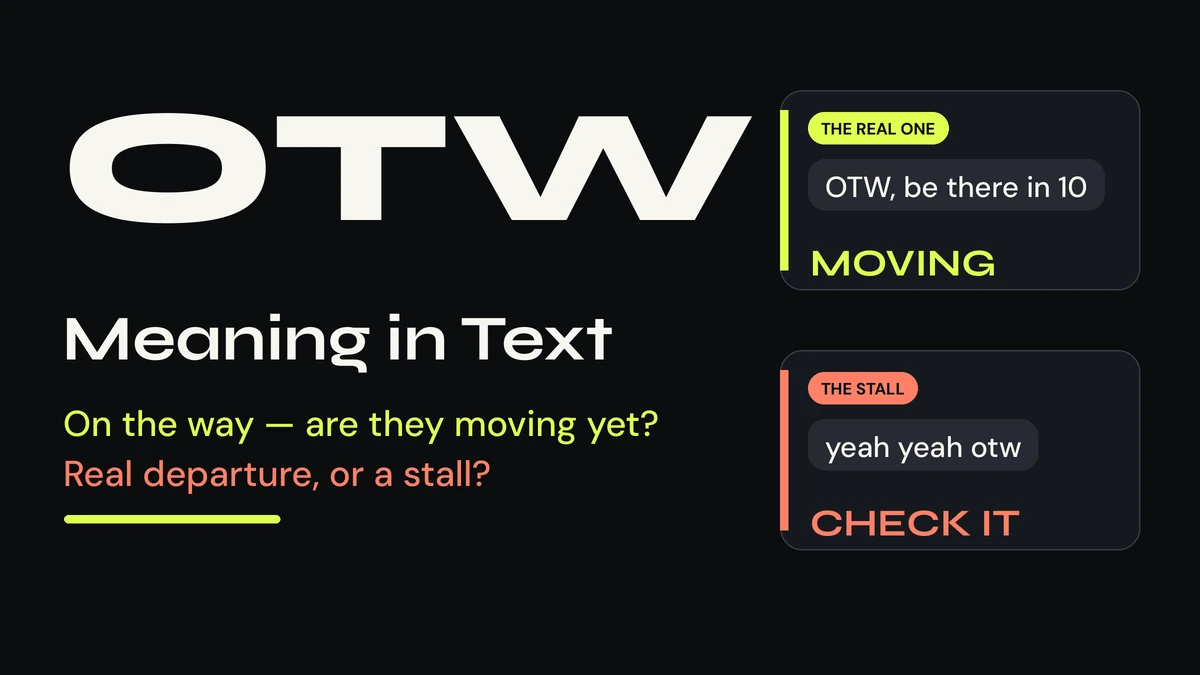
OTW is an initialism: take the first letters of the phrase “on the way” and squeeze out the spaces, and you get O, T, W. It does exactly what the full phrase does, only faster. It tells the person waiting that movement has started, or is about to start, and that arrival is coming. “Where are you?” “OTW.” That is the whole job in two messages: a question about a location, and an answer that is really a promise about time. It is also a substitute for a whole sentence — “I left already,” “I am heading over now,” “expect me soon” — without typing any of them. Nobody says OTW out loud in a real conversation; you type it, and when you read it aloud you just say “on the way.”
The dictionary record is short and unusually unanimous for a slang term, and this guide leans on all of it. Wiktionary, read directly for this article, lists capital OTW as an initialism of “on the way,” with the example “I’m OTW home right now.” Dictionary.com, also read directly, calls OTW a textspeak acronym for “on the way” in an entry dated July 19, 2018, and gives real dated examples: a 2015 message about two singers being “otw to the studio,” a 2017 message about being “otw to work,” and a 2017 message about something good being “otw afterwards.” Notice what that second example proves: “otw to work” means on the way to work, not “off to work” — the destination rides after the letters, and the letters themselves never change. No dedicated Merriam-Webster slang page for OTW exists; Merriam-Webster defines only the full phrase “on the way,” so the abbreviation’s dictionary record rests on Wiktionary and Dictionary.com, and this guide says so rather than pretending otherwise.
One meaning, then, with a sliding scale of honesty underneath it. In a chat, a comment, or a DM, OTW means “on the way,” full stop — but “on the way” can mean three different things in practice. It can mean “I am in the car right now.” It can mean “I am walking out the door this second.” And, honestly, it can mean “I am still on the couch and I am about to leave, I promise.” The letters do not tell you which one you got. The test in the next section does, because the company the letters keep — an arrival time, an emoji, an excuse, or nothing at all — is what separates a real departure from a polite stall.
The OTW On-the-Way Test
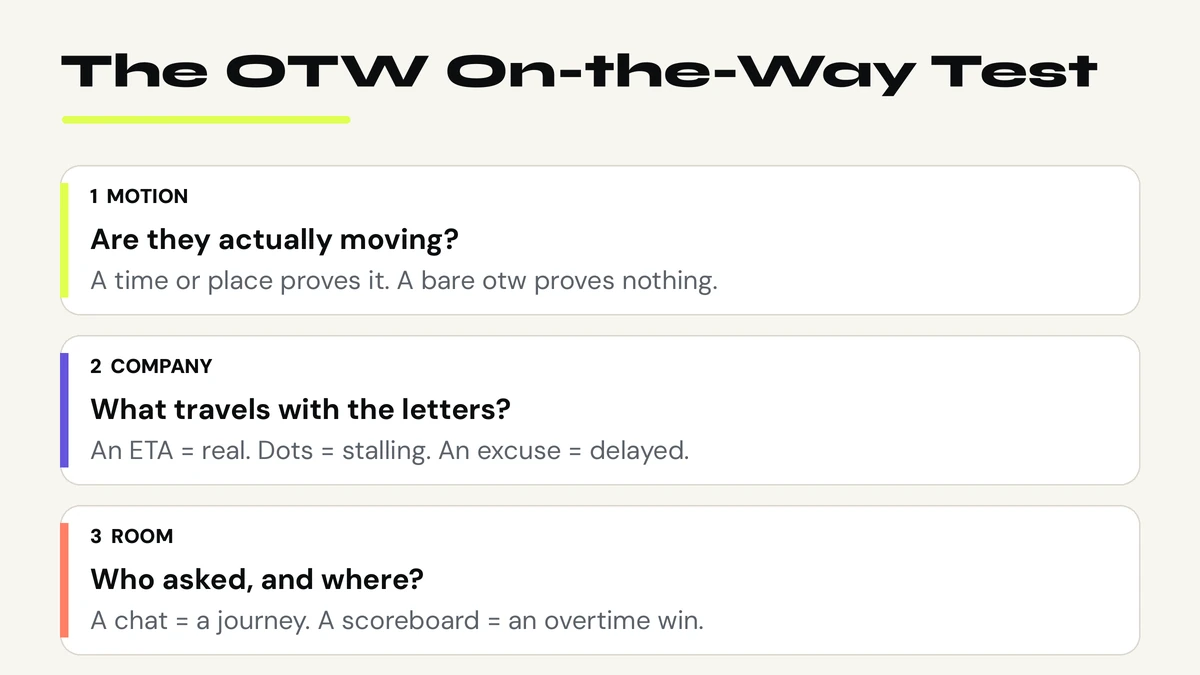
Before you believe an otw — or send one — run three checks. They take about five seconds, and they beat every shortcut the competitors offer, because the competitors all say “it means on the way” without giving you a procedure for telling a real departure from a stall:
- Check 1 — The Motion Check. Is the sender actually moving? A time, a place, or a detail proves motion: “OTW, be there in 10” or “OTW, just passed the park” is a person in transit. A bare “otw” with no detail proves nothing — it is a claim about movement, not evidence of it. Ask for the detail once if the arrival matters: “How far out are you?” Motion you can check is motion you can trust.
- Check 2 — The Company Check. What travels with the letters? An arrival time (“OTW, 10 mins”) points to a real departure. An emoji or a car (“OTW 🚗💨”) points to excitement and a genuine start. An excuse (“OTW, traffic’s bad”) points to movement with a delay attached. Dots after it (“otw…”) point to reluctance or a stall — the sender is buying time, not reporting motion. The company is the truth made visible, and a bare otw with no company at all is the one case where you should read it as a plain status update, not as a hidden lie.
- Check 3 — The Room Check. Who asked, and where? A friend waiting at a café, a partner waiting at home, or a group chat waiting on one person all take the plain reading — somebody is coming. A sports scoreboard or a gaming lobby takes a different one entirely: Wiktionary lists “overtime win” as a sports sense of OTW, and that is a result, not a journey. A formal room — work email, a teacher’s message, a first contact — takes neither, because OTW does not belong there at all. If the room is a game or a scoreboard, read it as a win; everywhere else in a chat, read it as a journey.
Worked trio. “Where are you?” “OTW, be there in 10”: motion a stated arrival time, company a number, room a friend waiting. Real departure, no doubt anywhere. “Are you coming?” “otw…”: motion none stated, company trailing dots, room a casual chat. A stall — the sender is not moving yet, and the dots are the tell. “Our team got the OTW last night”: motion none, company talk of a team and a result, room a sports thread. Not a journey at all — an overtime win. Three messages, one abbreviation, three readings — and the test, not the spelling, sorted them.
“OTW” in Real Chats
Illustrative examples written for this guide, not real transcripts:
- The café yes. “Where are you?” “OTW, be there in 10.” A status update with a time attached. The question was about a location; the answer is really about a clock.
- The bare reply. “Are you close?” “OTW 🚗💨” A three-letter answer with a car doing the excitement. The emoji is the proof of motion; without it, the same letters would say half as much.
- The family check-in. “Mom, OTW home!” A child telling a parent the journey has started. Short, warm, and complete — nobody in this exchange needs a sentence.
- The date-night promise. “OTW 😘 can’t wait to see you.” The letters carry the journey; the kiss carries the feeling. The message is a status update that is also a compliment.
- The delivery update. “Delivery’s OTW. Be ready!” Nobody in this message is travelling at all — a package is. OTW covers things as well as people, and the room tells you which one is moving.
- The stall. “You coming?” “yeah yeah otw.” Two “yeahs” and a lowercase otw is the classic stall: the sender is agreeing twice because they have not started moving once. Give it ten minutes, then ask again.
- The sports result. “Our team got the OTW last night.” No journey anywhere in the sentence. The room is sports, the company is a team and a result, and the letters mean an overtime win.
The OTW Tone List
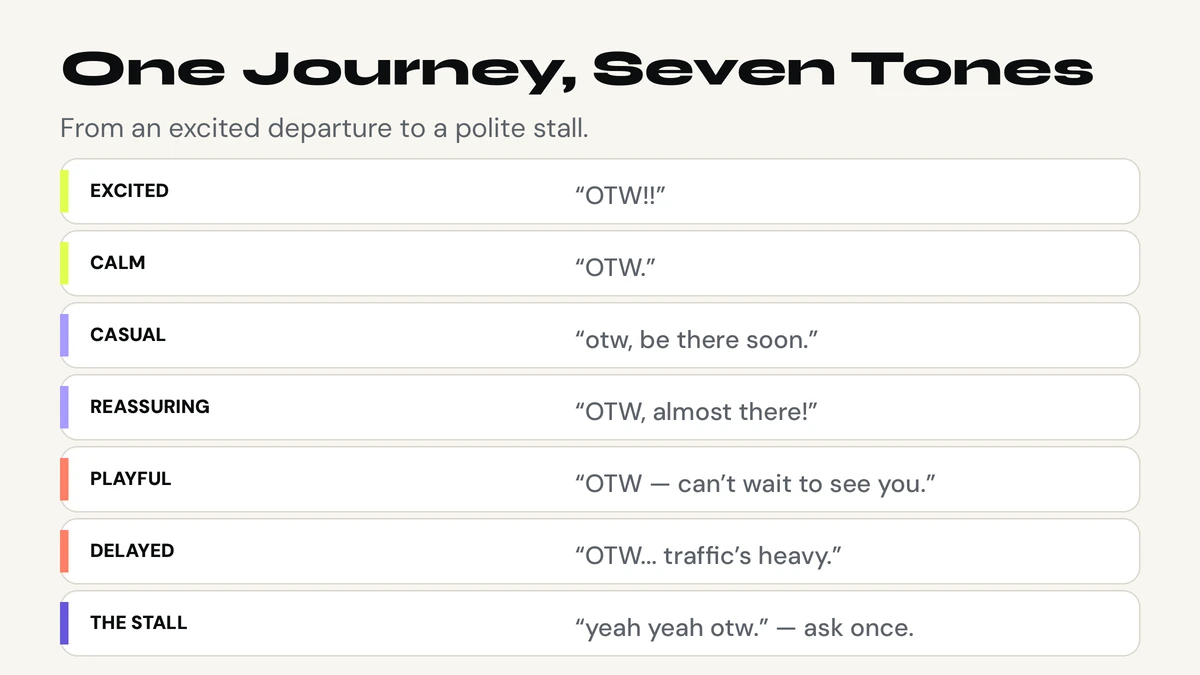
OTW’s meaning never changes; its feeling slides across seven readings, most honest to least. The first three are safe to send anywhere casual; the last two are safe only when the friendship can carry them:
- Excited departure: “OTW!!” Capitals plus exclamation marks turn a status update up loud. The sender is happy to be coming, and the journey is the good news.
- Calm confirmation: “OTW.” A steady, certain update. No excitement, no edge — just a person in motion, reporting in.
- Casual shrug-update: “otw, be there soon.” Lowercase, unhurried, unbothered. The sender is moving and does not need the movement to be a big moment.
- Reassuring update: “OTW, almost there!” The extra words are the reassurance. The sender knows you are waiting and is telling you the wait is nearly over.
- Playful promise: “OTW 😘 can’t wait to see you.” The kiss turns a timetable into a flirt. The journey is real; the feeling is the point.
- Delayed update: “OTW… traffic’s a bit heavy.” The dots slow the update down until it almost is not one. The sender is moving, but slowly, and the excuse is doing half the work.
- The stall: “yeah yeah otw.” Two agreements and no detail. The sender has not left yet and is buying time with enthusiasm instead of honesty — and a second message asking “how far out?” is usually welcome.
What moves a reading between these tones is never the letters alone: it is the motion (a time, a place, or nothing), the company (an arrival time, an emoji, an excuse, or dots), and the room (a friend waiting, a date, or a scoreboard). The same “otw” that is an excited departure at the start of a trip on Saturday can be a stall on Monday night — and the test, not the spelling, tells you which day you are on.
“OTW” on TikTok
On TikTok, OTW lives in comments and captions, and the comment thread is its natural habitat: a creator posts a “getting ready” video captioned “OTW to the party,” and the thread reads it as a journey in progress. The public stage suits the excited and reassuring readings best, because a comment thread is an audience, not a private conversation — nobody there is owed a timetable, and the update lands precisely because everyone in the thread already knows the destination. The playful reading travels well here too: “OTW 😘” under a date-night video is a promise the whole thread can enjoy, and “OTW to ruin your day” under a prank clip is a joke about a journey that has not started yet.
TikTok is also the one platform where the sports meaning can ambush you. A highlight video captioned “OTW last night” is not telling you anyone is travelling; it is celebrating an overtime win, and the Room Check catches it before you ask where the team is driving to. If an OTW arrives in a TikTok DM, though, run the test as usual — a DM is private again, the sports reading falls away unless the conversation is about a game, and the stall reading returns with it, because a private “where are you?” still deserves a real answer.
“OTW” on Snapchat
On Snapchat, OTW fits the fast, private, disappearing DM: “otw, send the address” as a story reply, or a bare “OTW” on a streak snap between close friends. The disappearing format suits the casual and reassuring readings — an update that lands lightly and is gone. But disappearance also removes your evidence: if an otw felt like a stall, you cannot re-read it, so judge from memory what rode with it — an arrival time, an emoji, or nothing at all. A bare “OTW” with no company is the one case where the plain reading is the right one; a stall needs a stage, and a disappearing snap gives it none.
Snapchat is also where the photo does half the work. A snap of a car dashboard plus “OTW” needs no explanation: the image proves the motion, and the letters only label it. That is the Motion Check working in real life — remove the OTW and the snap still shows a person driving, which is how you know the job was labelling, not claiming. And because streaks run on speed, otw is a streak-saver: it keeps the conversation alive in three letters when a full sentence would slow the whole exchange down.
“OTW” on Instagram
On Instagram, OTW shows up in comments, captions, story replies, and DMs, and the stage decides the tone the way it does for every status term. Comments lean public and excited: “OTW!!” under a friend’s party post is applause the whole thread can join. Captions lean playful: “OTW to the beach” under a car selfie is a journey the followers are invited to enjoy. DMs carry the full range, exactly like texts — a friend’s calm confirmation and a date’s playful promise live in the same inbox, and only the test tells them apart.
Instagram is also where OTW meets its closest platform trap: reading a public caption as a private promise. A creator’s “OTW” under their own post is a caption about a journey, not a promise to come to you, and answering it with “hurry up, I’m waiting” embarrasses both sides. A like, a matching laugh, or silence all end it cleanly; the caption was never asking for more. The exception is a DM that keeps the stall register going across several messages — that is a honesty problem, not a word problem, and the reply section below covers it. For a business, OTW is one of the safer slang terms to use in a casual reply — “Your order is OTW!” feels warm in a DM — but avoid it when the customer needs a real time, because “on the way” without a time is a promise with no clock on it, and in that case “Your order ships today and arrives Friday” is kinder.
“OTW” in Text Messages
Plain texts are OTW’s home ground, and the one-to-one setting makes the distinction sharpest. An honest text wants a witness: “OTW, be there in 10.” A stall text wants a reaction from you: is this a real departure, or is someone buying time? The reply each one deserves is completely different, which is why the Motion Check comes before the reply — believing a stall costs you a cold dinner, and doubting a real departure costs you trust. Lowercase otw is significantly more common here than the capitals, because texts are typed fast and lowercase reads softer; capitals in a text are a choice, and a choice is information.
Texts are also where a journey confirmed with otw turns into a longer conversation, and the conversation usually moves somewhere private. A friend who replies “OTW” and means it often follows up with the details themselves — the time, the place, the link — and our DM guide covers that move in full, because the channel changes what the next message can say. And texts are OTW’s work limit in miniature: never send OTW in a professional message. A client, a manager, or a first contact deserves plain language, not three letters that presume an intimacy and a casualness you do not have — and never one that could be read as a shrug at a meeting you are already late for.
Who Is Sending It: How “OTW” Lands by Sender
No source documents a different meaning of OTW per sender — the journey stays fixed; what changes is how much patience you should grant, and therefore what you owe back:
- Friend: the default. A friend’s OTW is a status update at face value; run the test and answer that, not the letters. If the test says stall, one “how far out?” is fair game.
- Crush: overread territory. A crush’s OTW feels bigger than it is — usually “yes, I’m coming to see you,” not a confession about you. Answer the plan, not a romance you invented.
- Partner: pattern rules. A partner’s OTW is usually routine confirmation; judge the pattern across days, not one message — but a sudden run of stalls after honest updates is worth one plain question, not a fight.
- Parent: usually literal and plain. A parent who writes OTW has usually learned it from you and means the journey plainly; do not read a parent’s OTW as a stall unless the message around it is all dots and no detail.
- Coworker or boss: context decides. In a friendly team chat a colleague’s otw about a delivery is an update; in any formal thread it is out of place, and never send one upward to a manager or client — and never one that could sound like you are stalling on a deadline.
- Group chat: both habitats at scale. A group’s “OTW!!” cheers for everyone; a group’s single “yeah yeah otw” after your question still stalls, but answer briefly in the group either way, and do not single one sender out for a private reading of a public update.
- Delivery driver or seller: the package habitat. A driver’s OTW means a parcel is moving, not a person coming to see you. A thank-you or a tracking check is enough; never answer a delivery update with a personal question about the driver’s day.
When “OTW” Is Too Much: Work, School, and Family
OTW’s risk is not rudeness — the word is clean, and there is no vulgar reading at all — but the stall: it can promise a journey that has not started, and a person who is waiting feels lied to when the clock proves it. Four rooms, four rules. At work: never send OTW in a professional message, a client thread, or a formal channel. An update among close peers in a casual chat is one thing; the same letters answering a client’s “where is the delivery?” read as a shrug, and a client who feels brushed off does not come back. If the room would want an update, give one that names a clock: “I’m on my way — arriving in about 10 minutes.”
At school: the same rule, with a younger audience, and the same stall in miniature. Teachers, school groups, and class chats are not OTW rooms, and a student who answers a classmate’s “where are you?” with “yeah yeah otw” has sent a small stall whether they meant to or not. In family chats, read the room person by person: a sibling group may love the shortcut, a grandparent group may not know the letters, and a parent who dislikes waiting will dislike the abbreviation exactly as much as the full phrase, once they learn what it stands for. Abbreviation is not permission. The general rule covers every room at once: if someone tells you OTW bothers them, simply stop. Switching words is easy, and it shows respect. The swap menu is free and it loses nothing: “I’m on my way now” for a real departure, “Just left — see you in 10” for a timed promise, “Heading over shortly” for a soft start. And one boundary worth stating plainly: never use OTW to dress up a journey you have not started, because you cannot control who is waiting or how long they have already waited.
Checked Claims: Expansions That Do Not Hold Up
Three letters attract folklore, and a word this common attracts more than most. Each claim below was graded against the dictionaries read in full and the competitors read in full; nothing is repeated here as fact on a single blog’s say-so:
- “OTW means ‘off the wall’” — rejected. No dictionary lists it. A handful of low-quality guides repeat it, but Wiktionary and Dictionary.com both give only “on the way,” and “off the wall” is a phrase about something wild or crazy, not a journey. Never quote it as what the letters stand for.
- “OTW means ‘off to work’” — rejected as an expansion. The letters map to “on the way,” not “off to work.” Dictionary.com’s own example, “otw to work,” means on the way to work — the destination rides after the letters. “Off to work” is a guess built on that one example, not a sense of the abbreviation.
- “OTW means ‘on the watch’ in gaming” — rejected. The claim circulates on low-quality guides, but no dictionary supports it, and no source in this build documents it as a live texting meaning. A gaming lobby is not a watchtower.
- “OTW means ‘one true way’ in texts” — fenced, not a texting meaning. “One true way” genuinely exists as a phrase in tech and hobby communities, but it lives in arguments about the right method, not in chats. Nobody replying “OTW” to “where are you?” is naming a method.
- “OTW always means the sender has already left” — rejected. The loose use is documented by every competitor in this build: people send OTW when they are leaving now, or about to leave, not only when they are already in transit. The Motion Check exists precisely because the letters alone do not prove a departure.
- “OTW and OMW mean exactly the same thing” — rejected as an equation. The words overlap, but OMW is personal — “on my way” means I am coming myself — while OTW can cover anything in motion: a person, a delivery, or an update. A package is OTW; a package is never OMW.
- “OTW was invented on TikTok” — rejected. TikTok spread the word; it did not invent it. Dictionary.com’s entry dates to July 2018 and quotes messages from 2015 and 2017, and the abbreviation grew out of early texting and chat culture, where brevity was everything. TikTok is the stage, not the author.
- “OTW means ‘overtime win’ in texts” — fenced, not a texting meaning. OTW genuinely means “overtime win” in sports writing, and Wiktionary lists it, but that sense lives in scoreboards and game recaps, not in chats. Nobody replying “OTW” to “where are you?” is reporting a score.
What SURVIVES: in chats, OTW means “on the way,” a quick status update that says movement has started or is about to start, with the seven tones above as feelings of the same journey — not different meanings; the loose use is real, so a bare otw with no time and no detail is a claim, not proof, and the Motion Check is the tool that tests it; the sports sense “overtime win” is real but fenced to scoreboards; and the person-versus-thing split — OTW covers deliveries and updates, OMW covers only people — is the one distinction every competitor in this build agrees on.
“OTW” vs Its Closest Cousins
OTW belongs to the arrival family — words that say somebody, or something, is coming. Its closest cousins split by what kind of arrival they give:
- OMW (personal cousin). The twin that is all about you: “on my way” means I am coming myself, while OTW can mean a package, a delivery, or an update is coming instead. No published guide for OMW exists in this series yet, so it is named here, not linked.
- ETA (clock cousin). Our ETA guide covers the estimated time of arrival that turns an OTW into a promise with a number on it. “OTW” says I am moving; “ETA 10 mins” says when the moving ends — and the two together are the most complete arrival update in the series.
- GTG (departure cousin). Our GTG guide covers the “got to go” that ends a conversation. GTG says I am leaving the chat; OTW says I am leaving the house — one word closes a thread, the other opens a journey.
- GNG (plan cousin). Our GNG guide covers the going word that states a plan. “OTW, I’m gng to the café” pairs the journey with the destination: OTW says I am moving, GNG says where — and the two together are the most common plan-confirmation pair in the series.
- BRB (return cousin). Our BRB guide covers the “be right back” that promises a return. BRB says I am stepping away and coming back; OTW says I am on my way to you — one word pauses a chat, the other starts a trip.
- “En route” (full-phrase cousin). The polished phrase OTW becomes when the room is formal. “I’m en route” and “OTW” are the same message in different clothes, but the full phrase carries a time and a place with it, while OTW keeps the update to three letters and no clock.
Where “OTW” Came From
The phrase came first, by centuries. “On the way” is old, ordinary English for “in the course of a journey,” and it was a complete, everyday phrase long before anyone typed it. The abbreviation is the new part, and it was born the way most texting abbreviations were: out of impatience. In early internet chat rooms, on instant messaging, and then on SMS, people who typed all day started squeezing common phrases into their first letters, and “on the way” — a phrase everyone says ten times a day when somebody is waiting — was an obvious candidate. No single person coined it: a community shortened it, the way communities shorten everything they say often.
The rise of instant messaging and then SMS made OTW ubiquitous, because text threads reward speed above all else, and three letters beat ten every time. Lowercase otw became the default in texts, while the capitals survived for emphasis. Dictionary.com gave the abbreviation its dictionary moment on July 19, 2018, calling it a textspeak acronym for “on the way” and quoting messages from 2015 and 2017 — including a 2015 message about two singers being “otw to the studio” — which puts the abbreviation firmly in the social-media era, years before the current wave of slang guides. The letters never needed a second meaning in chats, because one job — telling somebody you are coming — was enough to keep them alive for a decade.
The split that did survive is the sports one. While chatters kept shortening, sports writers kept score, and Wiktionary records OTW as an “overtime win” in sports — a result, not a journey. The two rooms never collided: one room needed a faster status update, the other needed a shorter box score. That is why the Room Check works at all — the history of the abbreviation is a history of two separate rooms, and the room you are standing in still tells you which OTW you are reading.
How to Reply When Someone Sends “OTW”
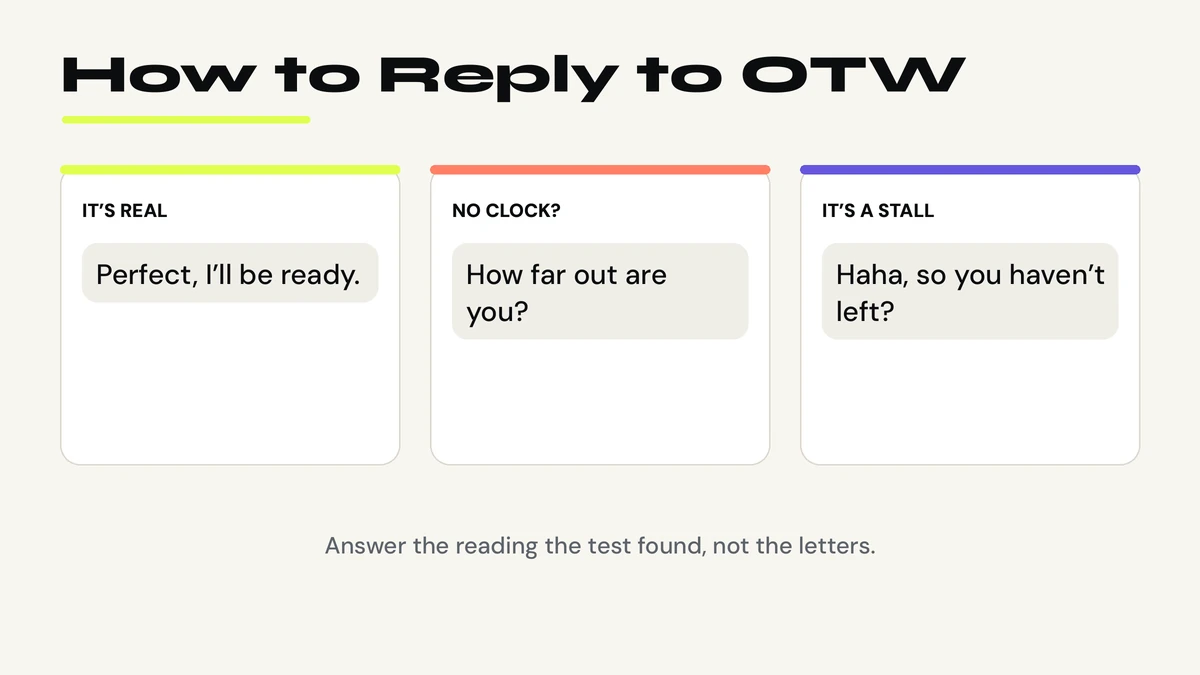
Golden rule: answer the reading the test found, not the letters. A reply bank keyed to the reading:
- Real departure — confirm and get ready: “Perfect, I’ll be ready” or “Awesome, see you soon!” The journey was the whole message; a confirmation is the whole reply. Do not ask “are you sure?” when the arrival time already proved it.
- Waiting on a friend — ask for the clock once: “How far out are you?” A bare otw with no time deserves one question, not an interrogation. If the answer has a number, believe it; if it has another bare otw, the stall is confirmed.
- Running late yourself — match honesty with honesty: “No rush, take your time” or “Drive safe, see you when you get here.” The sender told you the truth about the delay; a gracious reply is the reward that keeps them honest next time.
- The stall — call it kindly: “Haha, so you haven’t left yet?” One light question beats a lecture, because a stall answered with anger is how a plan turns into a fight. If the stall repeats, stop asking and start without them.
- You want to add warmth or a wish — turn the arrival into something more: An “OTW, good luck today!” is an arrival with a wish attached, and our GL guide covers the good-luck wish in full. And an arrival is an opening, not just an answer — our HML guide covers the open invitation, because “OTW, hit me up when you get here” turns a status update into a plan, and plans beat bare arrivals every time.
- Delivery or package — track it, don’t chat it: “Got it, thanks for the update!” A driver’s OTW is a tracking event, not a conversation. A thank-you ends it cleanly; a personal question embarrasses both sides.
Frequently Asked Questions
What does OTW mean in a text message?
OTW means “on the way” in a text message — a quick status update that says the sender is already moving, or about to be, and will arrive soon. Run the On-the-Way Test before you decide whether the otw you just got is a real departure or a stall.
What does OTW mean on Snapchat?
On Snapchat, OTW means “on the way” in DMs and story replies — usually that someone is heading toward you or that something is being sent. A snap of a car dashboard plus “OTW” is proof of motion; a bare “OTW” with no photo and no time is a claim, not proof.
What is the difference between OTW and OMW?
OTW means “on the way” and OMW means “on my way.” They overlap, but OMW is personal — it means I am coming myself — while OTW can refer to anything in motion: a person, a delivery, or an update. A package is OTW; a package is never OMW.
Does OTW mean the person has already left?
Not always. OTW can mean the sender is already in transit, is leaving right now, or is about to leave — the loose use is documented by every competitor in this build. A time, a place, or a photo proves a real departure; a bare “otw” with no detail proves nothing, so ask “how far out are you?” if the arrival matters.
Is OTW rude?
No. The letters themselves are clean, and there is no vulgar reading of OTW at all. The rudeness, when there is any, lives in the stall — promising a journey that has not started while somebody waits — not in the abbreviation.
Can I use OTW at work?
Generally, no. OTW belongs in casual digital conversations. In work messages, formal chats, or school messages it can sound unprofessional, and a bare OTW answering a client’s question reads as a shrug. In a casual peer chat about a delivery, it is fine; anywhere formal, spell it out with a time instead.
What does OTW mean on TikTok?
On TikTok, OTW usually means “on the way” in comments and captions — a journey in progress, like “OTW to the party.” In sports videos it can mean “overtime win” instead, so check whether the video is about a game before you ask where anyone is driving to.
Does lowercase otw mean something different from OTW?
No. Capitalization changes volume, not meaning: capital OTW reads a touch louder and can feel more excited, lowercase otw reads softer, faster, and more relaxed, but both mean “on the way.” What changes the reading is the motion, the company, and the room — never the case alone.
The Takeaway
OTW means “on the way”: a quick status update that says movement has started, or is about to start, and arrival is coming. The journey never changes; the honesty does — excited, calm, casual, reassuring, playful, delayed, or stalled. When an OTW lands, run the On-the-Way Test: check the motion, check the company, check the room. And when you send one, remember the only rule that matters: a status update with a time on it is a promise, and a status update without one is only a claim — so if you mean it honestly, add the minutes and prove it with a photo of the road, because three letters are the fastest arrival update in the language, and the fastest update deserves the clearest one.