What “TMB” Means in Text
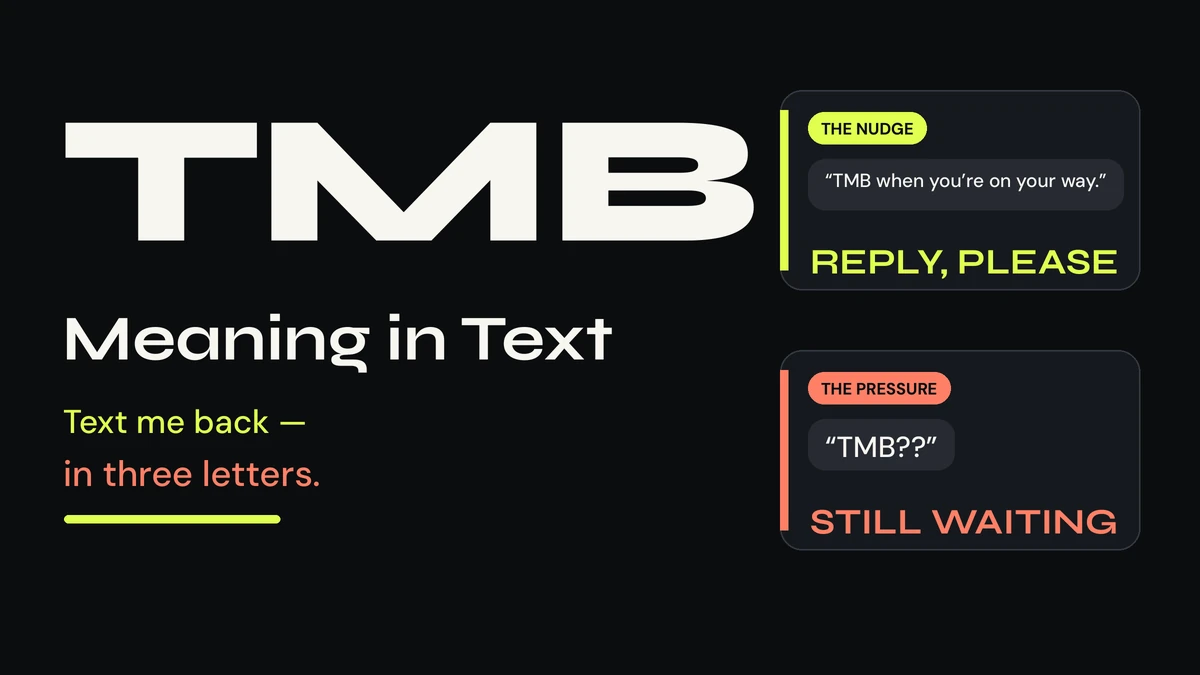
TMB means “text me back” in text. If you send a friend the address for tonight and add “TMB when you’re on your way,” you have just asked for one thing: a reply, once they have read it — and that is the tmb meaning in text in one sentence: three letters that turn a message into a small, polite request for an answer. TMB is an initialism, three letters standing in for three words, and it is one of the most practical abbreviations in texting, because it does a job no other abbreviation does: it asks for a reply without sounding like a demand.
The first thing to say about TMB is that the dictionaries are silent about it in a way they were not silent about the last term in this series. Wiktionary has a page for “tmb,” and it does not list “text me back” anywhere on it: the English entry is only the ISO 639-3 language code for Avava, and the only texting senses on the page are the Portuguese and Spanish abbreviation of “tambien,” meaning “also” or “too.” Merriam-Webster has no TMB entry at all. Dictionary.com has no standalone TMB entry either, though its slang article on “text me” from 2018 defines the plain phrase — “text me” is a common way to ask someone to send you a text message — and lists “hmu” and “tml” as related words. Cambridge and Oxford define “text” as a verb, to send somebody a written message using a mobile phone, but neither one lists TMB. The meaning itself is not in doubt — every guide read for this article agrees it is “text me back” — but no major dictionary has caught up with it yet, and this guide says so in the opening rather than burying it, because the gap is the story: after an article where four dictionaries lined up in perfect agreement, TMB is the one where the dictionaries have nothing to say at all, and the evidence has to come from how people actually use the letters.
What TMB does in a sentence is different from what most abbreviations in this series do. It is not a reaction to something, like a laugh or a head-shake, and it is not a label on the sentence itself, like an honesty marker. It is a request aimed at the other person: do something for me, and do it by text. Picture the moment it lands. You have sent a question, a plan, or a piece of news, and the conversation has gone quiet. Instead of typing “Please respond when you get a chance, I am waiting to hear from you,” you type three letters at the end of the message and let the reader fill in the rest. The best way to hear TMB is as a tap on the shoulder in a crowded room — not a shout, not a demand, just a small signal that says “I am still here, and I am waiting for your answer.”
TMB almost always sits at the end of a message, and the spot it takes is part of the message. “Sent you the address. TMB when you’re on your way” reads like a practical nudge, the request tucked after the useful information. “Missed you today, tmb later!” reads like a warm one, the request softened by the feeling in front of it. A bare “tmb” on its own, sent after a long silence, reads like the whole message is the request: there is nothing else to say, and the sender is just asking to be answered. A capital “TMB!!” reads louder and more impatient than a lowercase “tmb” at the end of a calm sentence, but both forms mean the same thing, and the words around them decide the pressure far more than the shift key does. This guide spends a whole section on the test that sorts those readings apart, because the context around TMB is the single most useful clue to what the sender is doing with it.
One small thing about the request itself, because every guide mentions it and most of them glide past it. TMB does not guarantee a reply. It is a request the sender makes, not a promise the reader owes — and the letters have no power to make someone answer. “TMB when you see this” is still a message that can sit unread, and a second “tmb” sent an hour later does not make the first one any stronger, it only makes the sender look more impatient. That distinction matters, because the most common mistake with TMB is treating it as a lever: if someone does not reply, the answer is not a louder TMB, it is a phone call, a different message, or patience. The pressure-scale section below shows how repeated TMBs turn a casual nudge into something that feels like a demand, and the rest of this guide treats TMB as what it is — a polite ask, not a summons.
The TMB Reply Test
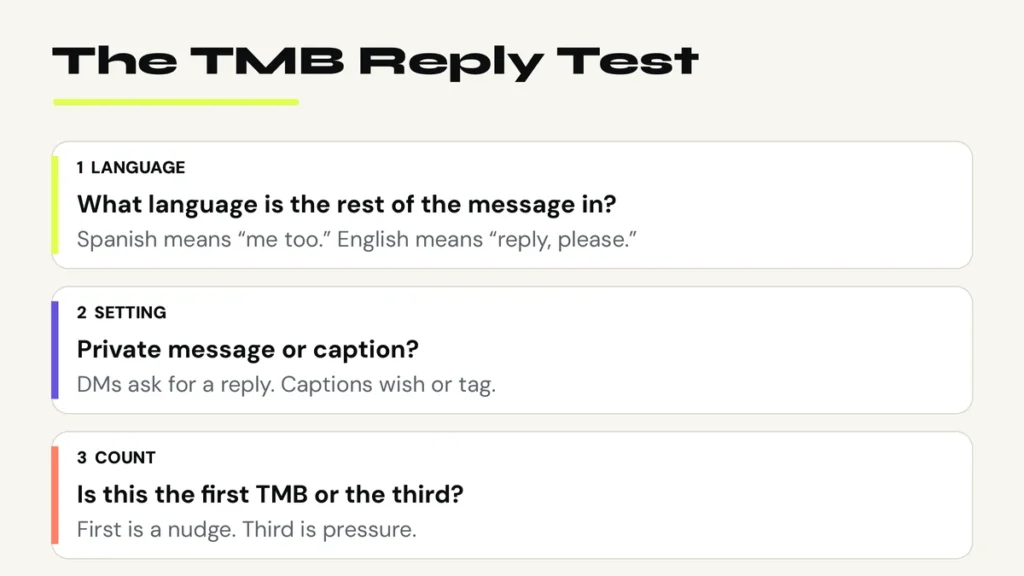
TMB is easy to define and hard to read, because the same three letters can mean “please reply when you can,” “reply to me right now,” or “me too” — and the only thing separating those readings is the message around them. The TMB Reply Test sorts them out with three questions, asked in order. Stop at the first question that gives a clear answer, and if two questions disagree, trust the first one, because language beats setting: a Spanish sentence that says “yo tmb” is “me too” no matter what app it arrived on.
- Question 1 — LANGUAGE: what language is the rest of the message in? If the sentence around TMB is in Spanish or Portuguese, TMB is almost certainly “tambien” or “tambem,” meaning “also” or “too”: “yo tmb” is “me too,” not “text me back.” If the rest of the message is in English, TMB is almost certainly a reply request. Language is the first question because it is the only one that can flip the meaning completely — every other question only changes the tone.
- Question 2 — SETTING: is it a private message or a caption? In a private message, a DM, or a one-to-one chat, TMB means “text me back”: “Sent you the address. TMB when you’re on your way.” Under a photo, the setting changes the reading: a caption under an old holiday photo — “TMB to this” — means “take me back,” a wish to return, not a request for a reply. In a photo-challenge comment — “tagged you, tmb” — it means “tag me back,” a request to be tagged in a similar post. The setting tells you which job the letters are doing.
- Question 3 — COUNT: is this the first TMB or the third? The first TMB in a conversation is a nudge: “tmb when you can” is a casual ask with no edge to it. The second TMB, sent after silence, is a follow-up: the sender is checking whether the first one was seen. The third TMB, sent with nothing else attached, is pressure: the request has turned into a demand, and the reply it gets will be shaped by that pressure as much as by the question it asked. Count the TMBs before you judge the tone, because the same three letters mean something different the third time they arrive.
Run it on a real example. “Found tickets for Friday. TMB, need to know soon.” Language: English, so it is a reply request, not “tambien.” Setting: a private message, so it is “text me back,” not a caption or a tag request. Count: first TMB, so it is a nudge with a deadline attached — the sender needs an answer, and the “need to know soon” is doing the urgent work, not the TMB. All three questions agree, and the right reply is the answer itself: “Just saw this, I’m in!” The test earns its keep on the messages where the questions disagree, so here is one of those: “yo tmb quiero ir.” Language: Spanish, so it is “tambien,” meaning “also” — “me too, I want to go.” Setting: a group chat, which might tempt a reader to hear a reply request. Count: first TMB, which might tempt a reader to hear a nudge. The language overrules both, and the answer is not a reply request at all — it is a person saying they want to come along, and answering it with a text back would miss the point entirely.
One more, because the count question is the flavor readers underestimate most often. “Long day, tmb when you’re free to vent lol.” Language: English, so it is a reply request. Setting: a private message, so it is “text me back.” Count: first TMB, so it is a nudge — but a warm one, because the sentence in front of it is an invitation to talk, not a demand for an answer. The sender is offering a conversation, not collecting a debt, and the right reply is a time, not an apology: “Free now, what’s up?” That is the reliable flavor of TMB between friends, the one that keeps a chat alive, and answering it with suspicion would land wrong while answering it with a simple “I’m here” would land right. The test is the difference between those two replies.
The hardest case for the test is a bare “TMB” sent as a whole message with nothing else attached — no question before it, no sentence around it, just three letters after hours of silence. The test can narrow it down — the language is English, the setting is a private message, so it is a reply request — but it cannot tell you why the sender wants a reply, or how urgently, because there is no sentence to run the questions on. A bare TMB is a tap on the shoulder with no words attached, and the only honest reply is the one that asks what the tap was for: “Hey, what’s up?” Read it as a door opening, not a verdict, and answer with the question itself — or with the reply the sender was waiting for, if you already know what it is.
“TMB” in Real Chats
The examples below are written for this guide, in the shape of real messages, so the reader can see the Reply Test working instead of just reading about it. Each one names its flavor, because the flavor is the lesson.
- “Sent you the address. TMB when you’re on your way.” A practical nudge. The classic use: useful information first, then a small request for a reply once the reader has it, so the sender knows the plan landed.
- “This is kind of important, tmb when you can.” A softened urgent ask. The “kind of important” does the urgent work and the lowercase “tmb” keeps it from sounding like an order, and the reader hears “please answer” instead of “answer now.”
- “Missed you today, tmb later!” A warm nudge. The feeling in front of it — missing someone — turns a reply request into an invitation, and the exclamation mark is doing the warmth, not the letters.
- “Found tickets for Friday. TMB, need to know soon.” A nudge with a deadline. The sender needs an answer by a real time, and the TMB is there to make sure the question does not get lost in the thread.
- “Long day, tmb when you’re free to vent lol.” An open door. The sender is offering a conversation, not collecting a debt, and the right reply is a time, not an apology.
- “Call me after work, tmb.” A short instruction. The whole message is two jobs — a plan and a request — and the TMB is the part that says “confirm this with me later.”
- “yo tmb.” Not a reply request at all. In a Spanish chat, this is “me too,” and the Reply Test’s first question — language — catches it before the reader answers a question nobody asked.
Notice what the examples share. In every one of them except the last, the sentence before TMB does the heavy lifting, and TMB itself adds only the request and the timing. Remove TMB from “Sent you the address” and the information is still information. Remove it from “Missed you today” and the feeling is still a feeling. TMB is a request attached to a message, not the message, which is why the Reply Test starts with the language and the setting around it instead of the letters.
The TMB Pressure Scale
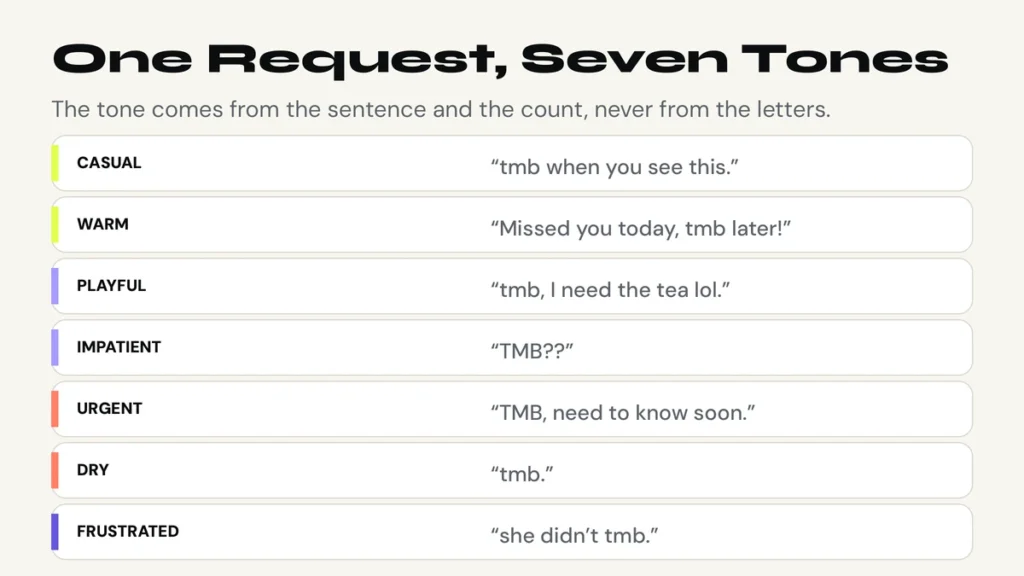
TMB wears seven tones, and the letters never change between them. Read the tone off the sentence around TMB, the count of TMBs so far, and the relationship — never off the three letters alone, because the same “tmb” can be a warm invitation or a cold demand depending on what sits next to it and how many times it has already arrived.
- Casual. “tmb when you see this.” The default flavor, for a reply request with no edge at all. The sender wants an answer when the reader gets around to it, and the lowercase letters are doing the relaxing, not the rushing.
- Warm. “Missed you today, tmb later!” The kind flavor, for a reply request wrapped in a feeling. The warmth comes from the sentence in front of it, and the TMB is just the practical part — the part that says “and yes, I do want to hear back.”
- Playful. “tmb, I need the tea lol.” The teasing flavor, for a low-stakes ask between friends. The request is real, but the sentence is a joke, and the TMB is what tells the reader to take the whole thing lightly.
- Impatient. “TMB??” The edged flavor, for a request that has already waited longer than the sender expected. The question marks are doing the impatience, and the capital letters are doing the volume — one TMB with two question marks carries more pressure than three plain ones.
- Urgent. “Found tickets for Friday. TMB, need to know soon.” The deadline flavor, for a request that has a real time attached to it. The urgency is honest here, because the sender named the reason, and the TMB is just making sure the question does not get buried.
- Dry. “tmb.” The flat flavor, for a message that needs nothing more than a nudge. Shortness alone does not prove irritation — the sender might just be busy — but it does not prove warmth either, and a bare “tmb” after a long silence is the hardest TMB in this guide to read.
- Frustrated. “I texted her a few days ago, but she didn’t tmb.” The reported flavor, for a TMB that never came. The frustration here is not in the letters at all — it is in the waiting, and the sentence is a complaint about a reply that never arrived, not a request for one.
The tones overlap, and that is the point of listing them separately from the test: the test sorts reply requests from “me too” from caption wishes, and the pressure scale gives the reader the vocabulary for the in-between cases, the dry TMB and the impatient TMB that are neither warm invitations nor open demands. Two signals help more than any other. The sentence before TMB decides the warmth, and the count of TMBs so far decides the pressure. Everything else is context, and context is the message around it.
When “TMB” Does Not Mean “Text Me Back”
Almost always, in English texting, TMB means text me back. Almost is doing real work in that sentence, because the same three letters belong to other things — in other languages, in other settings, and in a few guides that list meanings no dictionary and no real chat supports. This section lists the documented ones first, then the ones that only exist in guides, so the reader can tell them apart.
- “Tambien” — also, too. In Spanish texting, “tmb” is short for “tambien,” meaning “also” or “too”: “yo tmb” is “me too.” Wiktionary lists this sense directly, for both Spanish and Portuguese, and every guide read for this article agrees on it. The Portuguese spelling “tambem” shortens the same way. This is the one alternate reading with dictionary backing, and it is the reason the Reply Test asks about language first.
- “Tag me back.” On Instagram and TikTok, during photo challenges or trend posts, TMB can mean “tag me back” — asking someone to tag the sender in a similar post. The surrounding caption usually makes it obvious which one applies, and the main competitor’s Instagram section documents it the same way. Treat it as plausible but uncommon: it only shows up where tagging is the activity in progress.
- “Take me back.” Under an old photo or a vacation memory, a caption that reads “TMB to this” means “take me back” — a wish to return to the place or the moment, not a request for a reply. The main competitor documents it as a caption trend, not a texting habit, and in an actual back-and-forth conversation TMB almost never means it.
- “Tweet me back.” On older Twitter posts, TMB could mean “tweet me back,” asking someone to reply publicly. It is a leftover from the years when the platform was called Twitter and its posts were called tweets, and it has faded as the platform and its vocabulary have changed. Treat it as a historical reading, not a live one.
- “Tumor Mutational Burden.” In medicine, particularly oncology, TMB stands for Tumor Mutational Burden, a measurement of how many mutations appear in a tumor’s genetic makeup. Doctors and researchers use TMB scores to help predict how well a patient might respond to certain immunotherapy treatments. This meaning is entirely unrelated to texting slang and shows up almost exclusively in clinical or research settings.
- “Tour du Mont Blanc.” Among hikers, TMB refers to the Tour du Mont Blanc, a long-distance trekking route that circles the Mont Blanc massif through France, Italy, and Switzerland. The trail runs roughly 170 kilometers and is typically completed over 10 to 11 days. Trekking forums, guidebooks, and trail maps use “TMB” as shorthand for the route constantly, so travelers researching the hike will see it everywhere.
- “Trust me bro,” “too much bro,” “text me babe,” and “tell me back.” A few guides list these as alternate meanings of TMB. None of them has dictionary backing, none of them comes with an example sentence of anyone typing TMB to mean it in a real chat, and no two guides agree on the same list. This guide grades all four as rejected in the checked-claims section below.
The practical rule is simple. Read the language first. If the rest of the message is in Spanish or Portuguese, TMB means “also” or “too,” and no further thought is needed. If the rest of the message is in English and it arrived as a private message, TMB means “text me back.” Only if that reading makes no sense at all should the alternates come out — a caption under an old photo points to “take me back,” a photo-challenge comment points to “tag me back,” and a medical paper points to the tumor measurement. The next section shows the default reading doing its work across different senders.
Who Is Sending It: How “TMB” Lands by Sender
Meaning stays “text me back” for every sender; what changes is how the request lands. A TMB from a close friend is a different experience from a TMB from a stranger, even when the letters are identical, because the relationship decides how much pressure the request carries.
- Close friend. The safest TMB, usually warm and practical. “Sent you the address. TMB when you’re on your way” from a best friend is a plan, not a demand, and the reply it wants is the answer itself, not an apology for being slow.
- Crush. The most over-read TMB. A “tmb” from someone you like can feel loaded with meaning it may not actually have — a warm invitation, a test of interest, a door opening — when it is usually just a request for a reply, same as anyone else’s. The letters do not flirt; the reader does.
- Partner. Usually comfortable shorthand built on shared history. A partner’s TMB is a fast request for a reply about a plan, a question, or a feeling, and it rarely needs decoding, because the two of you already know what “reply soon” means in your own thread.
- Parent or family. Plain and practical, rarer so heavier. A parent’s “tmb” usually means “I need an answer about the plan,” and because parents send it less often, it carries more weight when it arrives — answer it the way you would answer a phone call from them.
- Coworker. Friendly but risky, because work threads keep receipts. A coworker’s TMB about a shift or a deadline is a normal request, but TMB itself is too informal for a work email, and spelling out “please let me know when you can” removes any chance of confusion.
- Stranger or creator. The easiest TMB to ignore. A stranger’s “tmb” in a public comment is a request for a private reply from someone who owes them nothing, and the right reply is usually no reply at all, unless the conversation is one you want to continue.
- Group chat. The hardest TMB to place. A “tmb” in a group chat could be aimed at one person or at the whole room, and answering it as a group when it was meant for one person — or ignoring it when it was meant for everyone — is the most common small mix-up in this guide. Read the message before it: the TMB usually belongs to whoever was just asked a question.
Gender does not change the meaning. One guide’s FAQ puts it plainly — TMB still means “text me back,” and what can shift is the tone, which comes from the relationship and the rest of the message, not the sender’s gender. A caring “miss you, tmb” reads differently from a plain “tmb when you’re free” because of the words around it, not because of who typed it. No distinct meaning per sender is claimed anywhere in the article.
“TMB” on TikTok
On TikTok, TMB is less common in comments than in DMs, since public comment threads do not usually call for a personal reply request. When it does show up, it keeps the same meaning: someone wants a response, either in the comments or in a private message. The typical TikTok shape is a caption about waiting — a creator posting about a reply they are still waiting for, or a commenter asking the creator to answer them — and the letters are doing the same job they do in a text: “I asked, and I am still waiting.”
That public stage is also why TikTok is the likeliest home of the “tag me back” reading. In comments about posts — photo challenges, trend replies, duets — “tagged you, tmb” asks the other person to tag the sender back in a similar post. The surrounding post usually makes it obvious which one applies: if the post is a photo challenge, the TMB is probably a tag request; if the post is a question, the TMB is probably a reply request. The FYP guide covers the feed those comments collect on, and the same rule applies there as here: the video supplies the context, the comment supplies the request, and the platform supplies neither the meaning nor the pressure. TMB does not gain a TikTok-only definition, and no source in this guide claims one.
“TMB” on Snapchat
On Snapchat, TMB is at home. Conversations move fast, snaps disappear, and streaks add pressure to keep replying — and TMB fits that rhythm exactly, because it is a request for a reply that takes less time to type than the reply itself. “TMB when you see this” on Snapchat means what it means everywhere else — reply once you have read it — but the disappearing context makes the message above it matter more: the snap supplies the thing being answered, and the TMB supplies the nudge to answer it.
Snapchat is also the platform where the count question matters most. A single “tmb” after a snap is a casual nudge, the kind that keeps a streak alive. A second “tmb” after silence is a follow-up, and a third is pressure — and because Snapchat shows when a message has been opened, a repeated TMB carries a sharper edge than it would in a text thread, where the sender cannot tell whether the message was even seen. The main competitor’s Snapchat section agrees in substance: TMB here almost always means “text me back,” a way of saying “reply once you’ve seen this” without breaking the flow of a quick chat. No distinct Snapchat meaning is claimed, and no source supports one.
“TMB” on Instagram
On Instagram, TMB lives in two places, and the place decides the reading. In DMs, it almost always means “text me back”: a friend waiting on a response sends “tmb when you’re free” the same way they would in a text thread, and the reply it wants is the answer itself. In comments and captions, the second reading appears: during photo challenges or trend posts, TMB can mean “tag me back,” asking people to tag the sender in a similar post, and the surrounding caption usually makes it obvious which one applies.
Instagram is the only platform in this guide with a genuine second reading in regular use, and it is worth naming plainly: the “tag me back” TMB is real, but it is a photo-challenge reading, not a texting reading, and it only shows up where tagging is the activity in progress. The IG guide covers the app where both readings live, and the same rule applies there as here: read the caption before you read the letters, because a caption under a challenge post and a DM about weekend plans are two different conversations, even when the same three letters show up in both.
“TMB” in Text Messages
In text messages, TMB has the widest range of any platform in this guide, because texting is where the request was born and where it still does the most work. A practical nudge (“Sent you the address. TMB when you’re on your way”), a softened urgent ask (“This is kind of important, tmb when you can”), a warm invitation (“Missed you today, tmb later!”), a nudge with a deadline (“Found tickets for Friday. TMB, need to know soon”), and an open door (“Long day, tmb when you’re free to vent lol”) — all of them live in the same thread, and all of them mean the same thing at the core: please reply.
Texting is also where TMB is most likely to be repeated, and where the repetition matters most. In a DM thread on a social app, a second TMB is a small thing, because the conversation is already open. In a text thread, a second TMB after hours of silence is a louder thing, because the sender chose to reopen a quiet conversation just to ask again. The DM guide covers the one-to-one thread where TMB lives, and the same rule applies there as here: one TMB is a nudge, two is a follow-up, and three is pressure — and the reply to a third TMB should acknowledge the wait, not just answer the question, because the wait is half of what the sender is saying.
“TMB” vs Its Closest Cousins
TMB is a request for a reply, and its cousins are the other abbreviations that manage the same job — asking someone to answer, promising to answer, or closing the conversation instead. Each one does a slightly different piece of the work, and the differences are the lesson.
- HMU — “hit me up.” The closest cousin, and the one most likely to be confused with TMB. HMU asks someone to contact you, usually to start a conversation or make a plan; TMB asks someone to reply to a message you already sent. HMU opens a door, TMB knocks on one that is already open. The HMU guide covers the opener; this guide covers the knock.
- BRB — “be right back.” The opposite move in the same conversation. BRB is a promise: the sender is leaving and will return. TMB is a request: the sender is staying and wants the other person to return. One says “wait for me,” the other says “come back to me.” The BRB guide covers the promise.
- GTG — “got to go.” The exit to TMB’s entrance. GTG closes a conversation; TMB reopens one. A “gtg, tmb later” message does both jobs at once — leaving now, asking for a reply later — and the two abbreviations sit together in the same sentence because they are two halves of the same exchange. The GTG guide covers the exit.
- HBU — “how about you?” A question that asks for a reply, like TMB asks for a reply, but a different kind of reply. HBU asks for an opinion or a status — “I’m good, how about you?” — while TMB asks for the reply itself, whatever it contains. HBU is a question with a topic; TMB is a request with no topic of its own. The HBU guide covers the question.
- GN — “good night.” The sign-off to TMB’s nudge. GN ends a conversation for the day; TMB asks for the conversation to continue. A “gn, tmb tomorrow” message does both jobs at once — closing tonight, asking for a reply in the morning — and the pairing is common because the two abbreviations are the two ends of the same thread. The GN guide covers the sign-off.
- TTYL — “talk to you later.” The cousin with the closest shape to TMB’s job, and the one this guide cannot link yet: TTYL is the next term in the queue after TMB, still Pending, with no TextsMeaning article of its own. TTYL promises a future conversation; TMB asks for a present reply. One says “we will talk later,” the other says “talk to me now, when you can.” Named here unlinked, because no article exists to link to.
- TML — “text me later.” The cousin that sounds like TMB and does the opposite job. TML tells someone to text later; TMB asks someone to text back. One delays the conversation, the other hurries it along. No TextsMeaning article covers TML yet, so it is named here unlinked, and Dictionary.com lists it as a related word beside “text me.”
The practical rule is simple. If you want someone to start a conversation, say HMU. If you want someone to answer a message you already sent, say TMB. If you are leaving, say BRB or GTG. If you are closing for the night, say GN. The cousins are not interchangeable, and the wrong one in the wrong moment is the most common small mix-up in this guide — a TMB sent when the sender meant HMU asks for a reply to a message that was never sent, and a HMU sent when the sender meant TMB asks for a new conversation when the old one is still waiting.
Checked Claims: Expansions That Do Not Hold Up
Eight claims graded against Wiktionary, Merriam-Webster, Dictionary.com, Cambridge, Oxford Learner’s Dictionaries, and the two full competitor reads. A claim is rejected when no dictionary lists it and no guide shows an example sentence of anyone typing TMB to mean it in a real chat.
- “TMB means trust me bro” — REJECTED. One guide lists “Trust Me Bro” as an alternate meaning of TMB, with no example sentence, no dictionary backing, and no other guide agreeing. “Trust me bro” has its own abbreviation in texting, and it is not TMB. The letters fit, and that is all that fits.
- “TMB means too much bro” — REJECTED. One guide lists “Too Much Bro” and “Too Much, Man” as alternate meanings, with no example sentence and no other source agreeing. “Too much” is a phrase people type out in full; nobody shortens it to TMB, because the letters already have a job.
- “TMB means text me babe” — REJECTED. One guide lists “Text Me Babe” as an alternate meaning, and another guide claims the primary meaning of TMB “from a girl” is “text me b***h.” Neither claim has dictionary backing, neither comes with an example sentence of anyone typing TMB to mean it, and no other guide agrees with either one. The “from a girl” version is a vulgar invention dressed as a definition, and this guide says so plainly: TMB means “text me back” from a girl, from a guy, and from anyone else, and the tone comes from the relationship and the rest of the message, not the sender’s gender.
- “TMB means tell me back” — REJECTED. One guide lists “Tell Me Back” as a rare interpretation, with no example sentence and no other source agreeing. “Tell me back” is not a phrase people use — the natural phrase is “tell me,” and adding “back” to it produces a sentence nobody says. The letters fit, and that is all that fits.
- “TMB evolved from the childhood game of tag” — REJECTED. One guide claims the abbreviation evolved from the childhood game of tag, where participants respond back and forth. No evidence is offered, no source is cited, and no other guide repeats the claim. Tag is a game about chasing, not about replying, and the supposed connection is a folk etymology — a story invented after the fact because the letters happen to share a word with the game.
- “TMB came from the 160-character SMS limit” — UNVERIFIED. One guide claims TMB first emerged when text messages were limited to 160 characters per message, and the limit forced people to shorten “text me back” into three letters. The mechanism is plausible — short forms did spread under character limits — but the guide offers no citation, no date, and no evidence that TMB in particular was born that way, and no other source repeats the claim. Treat it as a plausible story, not a documented origin.
- “TMB is Gen Z slang” — REJECTED as a generational claim. One guide calls TMB “a simple Gen Z slang,” and another calls it a teen abbreviation. No first-use date exists for TMB in any source read for this build, no dictionary lists it at all, and no study ties it to a generation. TMB is popular with Gen Z, and it is popular with plenty of people who are not Gen Z, and calling it a generational term says more about who is writing the guide than about who is typing the letters.
- “TMB always means text me back” — REJECTED. Most guides say the meaning is the same everywhere, and most of them are mostly right — but “always” is doing too much work. In a Spanish chat, TMB means “tambien,” and Wiktionary lists that sense directly. In a photo-challenge comment, it can mean “tag me back.” Under an old holiday photo, it can mean “take me back.” The meaning is “text me back” by default, in English, in a private message — and the default is not the whole story, which is why this guide built a test for the exceptions instead of pretending they do not exist.
The pattern across the eight claims is the same one this series keeps finding: the letters fit more phrases than people actually use, and a guide that lists every phrase the letters could spell is not describing the language, it is describing the alphabet. The test is the example sentence. If no guide can show someone typing TMB to mean it in a real chat, the expansion is a puzzle answer, not a definition, and this guide grades it that way.
Where “TMB” Came From
TMB has no first-use date, and that is the honest way to start this section. No dictionary lists the texting sense at all, no guide in this build cites a dated first appearance, and the one guide that claims a mechanism — the 160-character SMS limit — offers no citation for it. What can be said, with sources behind it, is narrower than the origin stories in the last article, and this guide says the narrower version instead of inventing a date.
The phrase came first and the abbreviation came later, and the two histories must not be confused. “Text me” is an old request in new clothes: Dictionary.com’s slang article on “text me,” from 2018, notes that the phrase “text message” dates back to at least 1977 and the shortened “text” to 1990, and that “text me” is a common way to ask someone to send a text message on their phone, often to catch up or make plans. The request — send me a message — is older than the abbreviation, and the abbreviation is only the latest shortening of it. When the phrase became the three letters has no dated paper trail: no Usenet post, no Urban Dictionary entry, and no dictionary addition are cited by any source read for this build, and the two guides that describe the origin both admit, in their own words, that nobody can point to the first person who typed TMB.
What the guides agree on is the mechanism, even where they disagree on the date. TMB grew out of texting, where people cut phrases down to a few letters to save time on small keyboards — the same family as TTYL and HMU, the same shorthand logic behind BRB and IDK. It spread from SMS into Snapchat and TikTok, where it shows up in captions about waiting for someone to reply, and from there into everyday texting. One guide dates the spread to the early days of mobile texting, when character limits encouraged shortening; another dates it to the early smartphone era, when texting became the primary way younger people talked. Both are describing the same shift — a request that used to take a sentence now takes three letters — and neither one can put a year on it, because the shift happened gradually, in millions of private messages, and nobody was keeping score.
The Spanish meaning has its own path, and it is the one alternate reading with a dictionary behind it. Spanish speakers have long shortened “tambien” to “tmb” or “tmbn” in quick messages, so the letters were already in use there before the English abbreviation spread — and Wiktionary lists the Spanish and Portuguese senses directly, while listing no English texting sense at all. The two meanings are not related to each other: one is a shortening of a Spanish word, the other is an initialism of an English phrase, and they happen to share the same three letters. That accident is the whole reason bilingual group chats mix them up, and the whole reason the Reply Test asks about language first. No first-use date is claimed anywhere in the article beyond the documented milestones above — and for TMB, the honest list of milestones is a short one: the phrase “text me” documented in 2018, the Spanish shortening documented by Wiktionary, and the abbreviation itself documented by unanimous competitor agreement with no dictionary entry at all.
How to Reply When Someone Sends “TMB”
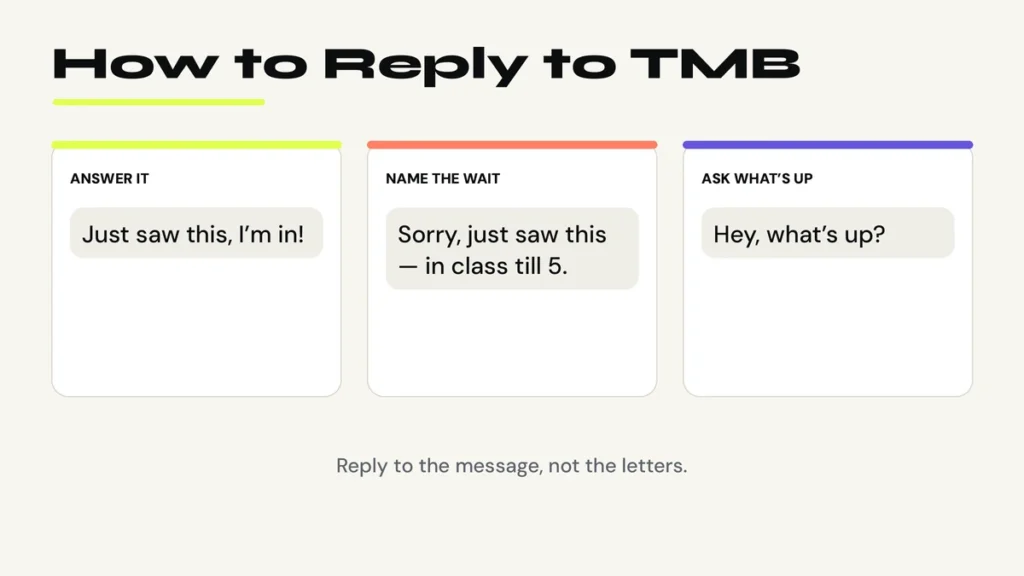
The easiest reply to TMB is the reply itself. TMB is a request for an answer, not a message that needs an answer of its own, and the sender is waiting for the thing they asked about, not for a comment on the abbreviation. Answer the question, the plan, or the news — even with a short line — and the TMB has done its job.
- Answer the message, not the letters. “Found tickets for Friday. TMB, need to know soon.” — “Just saw this, I’m in!” The reply is the answer, and repeating “tmb” back would add nothing, because the abbreviation is a request, not something you need to echo.
- If you are busy, say when you will answer. “In class, will text you at 5.” A quick note that you will get back to them later is kinder than leaving them on read, and it costs less than the message they are waiting for.
- If you missed it, say so plainly. “Sorry, just saw this.” A short apology for the delay is better than a long explanation, and it answers the TMB and the waiting behind it at the same time.
- If you do not know what they want, ask. “Hey, what’s up?” A bare “tmb” with no question before it is a tap on the shoulder with no words attached, and the honest reply is the question that asks what the tap was for.
- If the TMBs keep coming, name the wait. “I saw your messages — I was in a meeting, I’ll reply properly tonight.” A repeated TMB is pressure, and the reply that works is the one that acknowledges the pressure instead of pretending the waiting did not happen.
- If the TMB was “yo tmb,” answer in Spanish. “Yo tmb quiero ir” is “me too, I want to go,” not a request for a reply, and the right answer is the one that joins the plan, not the one that texts back.
The one reply to avoid is the one that matches pressure with pressure. A third “tmb” answered with a sharp “what?!” turns a small request into a small fight, and a TMB answered with another TMB — “tmb” for “tmb” — answers a question nobody asked. Reply to the message, name the wait if there was one, and let the abbreviation do what it was built to do: get the conversation moving again.
Frequently Asked Questions
What does TMB mean in a text message?
TMB means “text me back” in a text message. It is a casual request asking someone to reply to a message or respond when they are free. The sender usually adds it at the end of a message that asks a question or shares news, so the reader knows an answer is wanted. If the rest of the message is in Spanish, read it as “tambien” instead — “yo tmb” means “me too.”
What does TMB mean on Snapchat?
On Snapchat, TMB almost always means “text me back.” People send it when they want a reply from a friend or a crush, usually after opening a snap or a message. The disappearing context makes the message above it matter more, and a repeated TMB on Snapchat carries a sharper edge than it would in a text thread, because Snapchat shows when a message has been opened.
Is TMB rude?
Not usually. TMB is a casual request, and it typically reads as a friendly nudge rather than a demand. It only feels rude if someone sends it many times in a row, or to a person who is clearly busy — and even then, the rudeness is in the repetition, not in the letters. One TMB is a nudge; three TMBs with nothing else attached is pressure.
What does “tmb” mean from a girl?
It means the same thing it means from anyone: “text me back.” The tone depends on the relationship and the rest of the message, not the sender’s gender. A caring “miss you, tmb” reads differently from a plain “tmb when you’re free” because of the words around it, not because of who typed it — and no dictionary or reputable guide supports any different meaning based on gender.
What does TMB mean in Spanish?
In Spanish chats, TMB is short for “tambien,” meaning “also” or “too.” “Yo tmb” means “me too.” The Portuguese spelling “tambem” shortens the same way. Wiktionary lists both senses directly, and this is the one alternate reading of TMB with dictionary backing — which is why the Reply Test asks about language before anything else.
What is the difference between TMB and HMU?
HMU means “hit me up” — it asks someone to contact you, usually to start a conversation or make a plan. TMB means “text me back” — it asks someone to reply to a message you already sent. HMU opens a door; TMB knocks on one that is already open. If you want someone to start talking, say HMU; if you want an answer to a message you sent, say TMB.
Can I use TMB at work?
No. TMB is texting slang and it does not fit formal or professional writing. In a work email, spell out the request instead: “Please let me know when you can” removes any chance of confusion, and it does not risk a colleague or a client mistaking the letters for something unrelated. TMB belongs in casual texting, DMs, and chats with people who already use texting slang.
What does “tag me back” mean?
“Tag me back” is the second reading of TMB on Instagram and TikTok, used during photo challenges or trend posts: someone tags you in a post, and you tag them back in a similar one. It only shows up where tagging is the activity in progress, and the surrounding caption usually makes it obvious which reading applies. In a private message, TMB almost always means “text me back” instead.
The Takeaway
TMB is simple once you know it: mostly, it means “text me back,” a casual nudge for a reply, used when someone has sent you something and wants to hear back. The letters are a request, not a demand, and one TMB is a tap on the shoulder — the kind that keeps a conversation alive between friends, plans moving between people who need an answer, and threads from going quiet after the important part has already been sent.
The complications are real, and they are worth naming plainly. In a Spanish chat, the same three letters mean “also” or “too,” and Wiktionary is the only dictionary that says so, because no major dictionary lists the English texting sense at all. In a photo challenge, TMB can mean “tag me back.” Under an old holiday photo, it can mean “take me back.” And a TMB sent three times in a row is not three nudges — it is pressure, and the reply it gets will be shaped by the waiting as much as by the question. The Reply Test exists for those cases: check the language first, then the setting, then the count, and trust the language when the questions disagree.
When in doubt, read the full message before assuming what someone meant — and then just reply. TMB is the one abbreviation in this series where the right answer is also the easiest one: the sender asked for a text back, so text them back. Answer the question, name the wait if there was one, and let three letters do what they were built to do, which is get the conversation moving again.