What “TTY” Means in Text
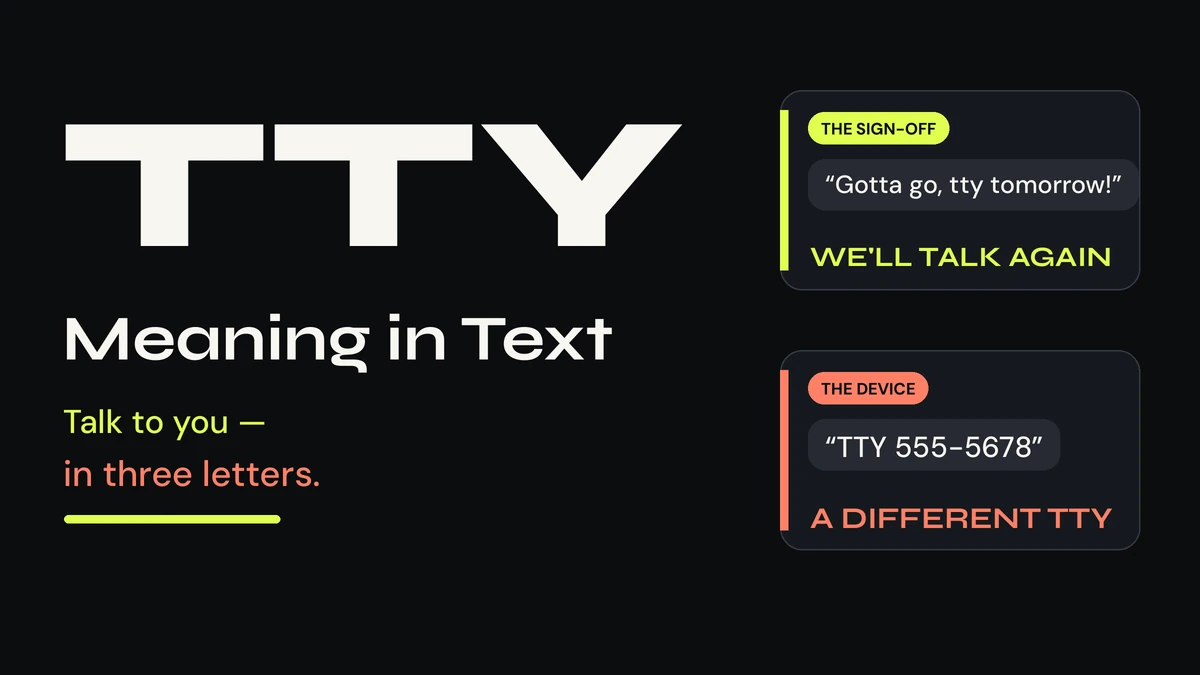
TTY means “talk to you” in text. When a friend ends a chat with “Gotta go, tty!” they are saying one thing: we will talk again — and that is the tty meaning in text in one sentence: three letters that close a conversation without closing the door on it. TTY is an initialism, three letters standing in for three words, and it is one of the warmest abbreviations in texting, because it does a job no other abbreviation does: it says goodbye and promises a hello at the same time.
The first thing to say about TTY is that the dictionaries agree about it in a way they did not agree about the last term in this series. Wiktionary has a page for “TTY,” and it lists both readings side by side: a teletypewriter, a text display device used by deaf people to read voice communication converted to text, a command line interface or terminal emulator in computing — and, separately, “(text messaging, Internet slang) Initialism of talk to you.” Merriam-Webster lists TTY as a teletypewriter and as a computer program that emulates one, with the first known use of “teletypewriter” dated to 1903. Collins lists TTY as an abbreviation of teletypewriter. No major dictionary lists the texting sense except Wiktionary — but Wiktionary lists it directly, with TTYL named beside it, and that is already more dictionary backing than the last article in this series had, where no dictionary listed the texting sense at all.
What TTY does in a sentence is different from what most abbreviations in this series do. It is not a request aimed at the other person, like a nudge for a reply, and it is not a label on the sentence itself, like an honesty marker. It is a sign-off: a promise attached to a goodbye. Picture the moment it lands. The conversation has run its course for now — someone has to go to class, to work, to bed — and instead of typing “I have to go now, but I will talk to you again soon,” they type three letters at the end of the message and let the reader fill in the rest. The best way to hear TTY is as a wave from a doorway — not a slammed door, not a disappearing act, just a small signal that says “I am going now, and I will be back.”
TTY almost always sits at the end of a message, and the spot it takes is part of the message. “Gotta go, tty!” reads like a warm close, the promise tucked after the reason for leaving. “I had a great time talking to you. Tty tomorrow!” reads like a warmer one, the promise given a time so the reader knows when to expect it. A bare “tty” on its own, sent after a long chat, reads like the whole message is the goodbye: there is nothing else to say, and the sender is just closing the conversation kindly. A capital “TTY!” reads a little brighter than a lowercase “tty” at the end of a tired sentence, but both forms mean the same thing, and the words around them decide the warmth far more than the shift key does. This guide spends a whole section on the test that sorts the sign-off from the device, because the same three letters name a machine as well as a goodbye, and the context around TTY is the single most useful clue to which one you are reading.
One small thing about the promise itself, because every guide mentions it and most of them glide past it. TTY does not name a time. It says “talk to you” and stops there — no “later,” no “tomorrow,” no “soon” — and the reader has to guess when the next conversation will happen from the rest of the message. “Tty tomorrow!” names the time. “Tty later!” names a looser one. A bare “tty” names none at all, and that openness is the whole point of the abbreviation: it is the shortest possible promise, and it leaves the timing to the two people who made it. That distinction matters, because the most common mistake with TTY is treating it as a promise with a deadline attached: TTY is a door left open, not an appointment, and the cousins section below shows which abbreviations add the clock back in.
The TTY Sign-Off Test
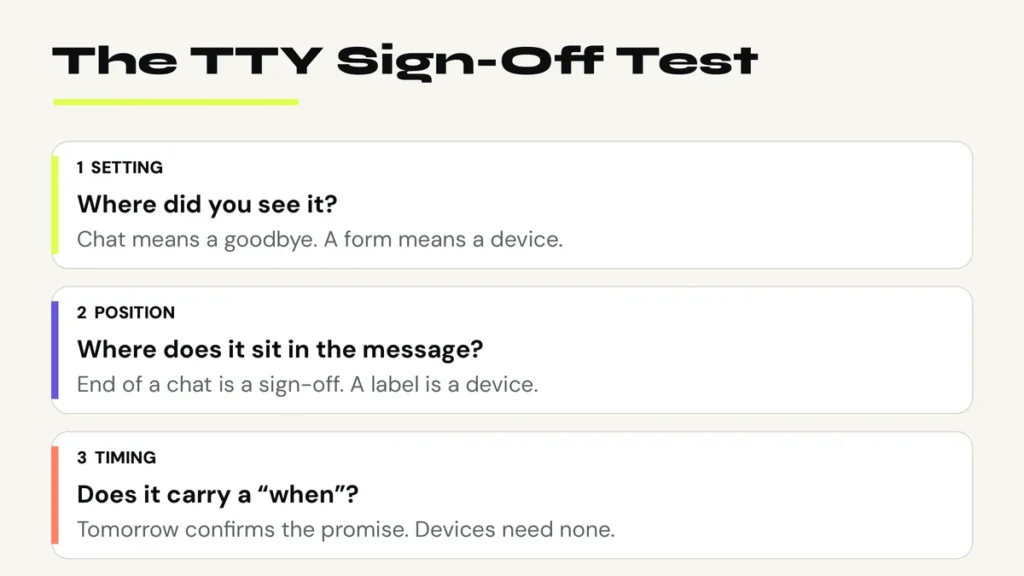
TTY is easy to define and hard to place, because the same three letters can mean “we will talk again,” “a teletypewriter,” or “a terminal session” — and the only thing separating those readings is where you found them. The TTY Sign-Off Test sorts them out with three questions, asked in order. Stop at the first question that gives a clear answer, and if two questions disagree, trust the first one, because setting beats position: a TTY on a contact page is a device no matter where it sits on the line.
- Question 1 — SETTING: where did you see it? In a chat, a DM, or a text thread, TTY almost always means “talk to you”: “Gotta go, tty!” is a goodbye, not a machine. On a contact page, a form, or next to a phone number — “Call us at 555-1234 (TTY 555-5678)” — it means a teletypewriter, a device for typed phone calls. In a discussion about Linux, terminals, or the command line, it means a terminal session. Setting is the first question because it is the only one that can flip the meaning completely — every other question only changes the tone.
- Question 2 — POSITION: where does it sit in the message? At the end of a message, after the reason for leaving, TTY is a sign-off: “I need to go now, but tty later!” In a label, a list, or a line of its own — “TTY: 555-5678” — it is a device or a service, not a goodbye. A TTY in the middle of a sentence usually belongs to the sentence it is in: “tty when I get back” is a promise inside a plan, and “tty mode” on a phone is a setting, not a farewell.
- Question 3 — TIMING: does it carry a “when”? A time word attached to TTY — tomorrow, later, soon, in the morning, after lunch — confirms the sign-off, because devices do not need a time: “Tty tomorrow!” is a promise with a date on it. A TTY with no time word at all is still usually a sign-off in a chat, but it is the loosest one, and the reader has to supply the timing from the relationship. No time word, in a formal setting, points the other way: a TTY on a form has no “when” because it is not promising anything.
Run it on a real example. “Gotta go, tty tomorrow!” Setting: a chat, so it is a sign-off, not a device. Position: at the end of the message, after the reason for leaving, so it is a goodbye. Timing: “tomorrow” is attached, so it is a promise with a date on it. All three questions agree, and the right reply is the one that accepts the promise: “Sounds good, tty tomorrow!” The test earns its keep on the messages where the questions disagree, so here is one of those: “Call us at 555-1234 (TTY 555-5678).” Setting: a contact page, so it is a device. Position: in a label next to a phone number, so it is a device. Timing: no time word, and none is needed, because a device number is not a promise. The setting overrules any temptation to read it as a goodbye, and the right response is to use the number, not to answer it.
One more, because the timing question is the flavor readers underestimate most often. “I have to run some errands, but tty when I get back!” Setting: a chat, so it is a sign-off. Position: at the end of the message, after the plan, so it is a goodbye. Timing: “when I get back” is attached, so it is a promise with a condition on it — the sender will talk again once the errands are done, and the right reply is a simple acceptance, not a question about when: “Sure, tty then!” That is the reliable flavor of TTY between friends, the one that keeps a chat alive across a pause, and answering it with suspicion would land wrong while answering it with a simple “sounds good” would land right. The test is the difference between those two replies.
The hardest case for the test is a bare “tty” sent as a whole message with nothing else attached — no reason for leaving, no time word, just three letters after a long chat. The test can narrow it down — the setting is a chat, the position is the end of the conversation, so it is a sign-off — but it cannot tell you when the sender will be back, because there is no time word to run the third question on. A bare TTY is a wave with no date attached, and the only honest reply is the one that accepts the wave and adds a time of your own: “Sounds good, tty soon!” Read it as a door left open, not a verdict, and answer with the promise itself — or with a time, if you are the one who knows when you will be free.
“TTY” in Real Chats
The examples below are written for this guide, in the shape of real messages, so the reader can see the Sign-Off Test working instead of just reading about it. Each one names its flavor, because the flavor is the lesson.
- “Gotta go, tty!” The classic sign-off. The whole job in four words: a reason for leaving, then a promise to talk again, so the reader knows the conversation is paused, not ended.
- “Thx 4 chatting, tty 2morrow!” A promise with a time. The thanks in front of it does the warmth, and the “2morrow” does the timing, so the reader knows exactly when to expect the next message.
- “I had a great time talking to you. Tty tomorrow!” A warm close. The feeling in front of it — a great time — turns a goodbye into an invitation to do it again, and the tomorrow turns the invitation into a plan.
- “I need to go now, but tty later!” The pause, not the end. The “but” is doing the important work: the sender is leaving, and the TTY is the part that says the conversation is only on hold.
- “I’m going to bed now. Tty in the morning!” The overnight sign-off. The most common TTY in any thread, because bedtime is the one goodbye everyone sends every day, and the morning is the time everyone can count on.
- “Call us at 555-1234 (TTY 555-5678).” Not a sign-off at all. On a contact page, TTY is a teletypewriter number for typed phone calls, and the Sign-Off Test’s first question — setting — catches it before the reader answers a goodbye nobody sent.
- “Running late for class, tty after lunch!” A plan attached to the promise. The sender is not just leaving, they are telling the reader when the conversation picks up again, and the TTY is the part that keeps the thread warm until then.
Notice what the examples share. In every one of them except the contact-page line, the sentence before TTY does the heavy lifting, and TTY itself adds only the promise and the timing. Remove TTY from “Gotta go” and the leaving is still leaving. Remove it from “I had a great time talking to you” and the feeling is still a feeling. TTY is a promise attached to a goodbye, not the goodbye, which is why the Sign-Off Test starts with the setting around it instead of the letters.
The TTY Tone Scale

TTY wears seven tones, and the letters never change between them. Read the tone off the sentence around TTY, the time word attached to it, and the relationship — never off the three letters alone, because the same “tty” can be a warm promise or a cold goodbye depending on what sits next to it and how much time it names.
- Hopeful. “Tty tomorrow!” The brightest flavor, for a goodbye that is really a plan. The sender is not just leaving, they are telling the reader when the conversation picks up again, and the tomorrow is doing the hope, not the letters.
- Warm. “I had a great time talking to you. Tty tomorrow!” The kind flavor, for a goodbye wrapped in a feeling. The warmth comes from the sentence in front of it, and the TTY is just the practical part — the part that says “and yes, I do want to talk again.”
- Casual. “Gotta go, tty!” The default flavor, for a goodbye with no edge at all. The sender is leaving, the reader knows it, and the TTY is the part that keeps the door open without making a fuss about it.
- Brisk. “I need to go now, but tty later!” The busy flavor, for a goodbye sent on the move. The sender has somewhere to be, and the TTY is there to make sure the reader does not mistake a quick exit for a cold one.
- Dry. “Okay tty.” The flat flavor, for a message that needs nothing more than a close. Shortness alone does not prove coldness — the sender might just be busy — but it does not prove warmth either, and a bare “tty” after a short conversation is the hardest TTY in this guide to read.
- Distant. “Yeah, tty.” The cooling flavor, for a goodbye that closes a door a little. The words around it are short, the time word is missing, and the reader is left to guess whether the sender will really be back — and the guess is usually “not soon.”
- Final. “It was nice catching up. TTY.” The last-word flavor, for a goodbye that does not promise much. The sentence sounds like a closing line, the TTY sounds like a formality, and the reader hears a conversation ending for good rather than pausing for a day.
The tones overlap, and that is the point of listing them separately from the test: the test sorts sign-offs from devices, and the tone scale gives the reader the vocabulary for the in-between cases, the dry TTY and the distant TTY that are neither warm promises nor open doors. Two signals help more than any other. The time word attached to TTY decides the hope — a tomorrow is warmer than a later, and a later is warmer than nothing at all — and the sentence before TTY decides the warmth. Everything else is context, and context is the message around it.
When “TTY” Does Not Mean “Talk to You”
Almost always, in a chat, TTY means talk to you. Almost is doing real work in that sentence, because the same three letters belong to other things — in other settings, on other pages, and in a few guides that list meanings no dictionary and no real chat supports. This section lists the documented ones first, then the ones that only exist in guides, so the reader can tell them apart.
- “Teletypewriter” — a device for typed phone calls. This is the oldest meaning of TTY, and the only one with a dated dictionary record: Merriam-Webster dates “teletypewriter” to 1903, and defines TTY as a printing device resembling a typewriter used to send and receive telephonic signals. A TTY is a machine with a small keyboard and a narrow screen that plugs into a phone, and it lets people who are deaf, hard of hearing, or speech-impaired type messages over a telephone line instead of speaking them. You will see it on contact pages and forms — “TTY 555-5678” next to a voice number — and in government and business listings, where the TTY number is the one a typed conversation reaches. This meaning is entirely unrelated to texting slang, and it is older than texting by nearly a century.
- “Text telephone” and TDD. The same device under its other names. TTY is also called a text telephone, and the older name for the device is TDD, short for Telecommunications Device for the Deaf — though the deaf community and the industry shifted toward TTY, because it describes the technology rather than the user. A TTY needs a TTY at both ends of the conversation to work directly, and where the other person has no TTY, a relay service carries the typed messages between them. Modern alternatives exist — captioned phones, real-time text, internet-based relay — but the letters TTY are still the ones on the form.
- A terminal session in computing. In Linux and Unix, “tty” is the name for a text terminal: the command line interface a user types into, with no graphics and no mouse. The Unix “tty” command, first released on November 3, 1971, prints the file name of the terminal connected to the input, and the name survives today in every terminal window, SSH session, and container, where each one is a pseudo-terminal — a software TTY. The letters are a leftover from the teletypewriter hardware the first terminals were built from, and the computing meaning is the direct descendant of the 1903 device, not of the texting abbreviation.
- “TTY mode” on a phone. On modern phones, TTY mode is a setting, not a message: it tells the phone to work with a TTY device, so a deaf or hard-of-hearing user can type a call instead of speaking it. You will find it in the accessibility settings, beside the hearing-aid and real-time-text options, and turning it on changes how the phone handles calls, not how it handles texts.
- “Talk to you later,” “talk to you soon,” and “talk to you tomorrow.” These are not meanings of TTY at all — they are its cousins, TTYL, TTYS, and TTYT, and each one adds the time word that TTY leaves out. Guides that list them as TTY meanings are describing the family, not the word, and the cousins section below tells them apart.
- “Talk to you never.” A joke variant, TTYN, listed by one guide as a cousin of TTY: the letters add an “N” for “never,” and the meaning is a goodbye that is not a promise at all. It is a different abbreviation, not a reading of TTY, and it shows up as a joke, not as a sign-off anyone sends in earnest.
- A sexual or rude reading. None exists. One guide states it plainly — the term does not have a sexual meaning — and no source read for this build supports any vulgar expansion of TTY. This guide grades every such claim as rejected in the checked-claims section below.
The practical rule is simple. Read the setting first. If the TTY is in a chat, it means “talk to you.” If it is on a contact page, a form, or next to a phone number, it means a teletypewriter. If it is in a discussion about Linux or terminals, it means a terminal session. Only if the setting gives no answer at all should the other readings come out — and in a chat, the setting almost always does. The next section shows the sign-off doing its work across different senders.
Who Is Sending It: How “TTY” Lands by Sender
Meaning stays “talk to you” for every sender; what changes is how the promise lands. A TTY from a close friend is a different experience from a TTY from a stranger, even when the letters are identical, because the relationship decides how much the promise is worth.
- Close friend. The safest TTY, usually warm and practical. “Gotta go, tty tomorrow!” from a best friend is a plan, not a formality, and the reply it wants is the acceptance itself, not a question about when.
- Crush. The most over-read TTY. A “tty soon!” from someone you like can feel loaded with meaning it may not actually have — a warm invitation, a test of interest, a door opening — when it is usually just a goodbye with a promise attached, same as anyone else’s. The letters do not flirt; the reader does.
- Partner. Usually comfortable shorthand built on shared history. A partner’s TTY is a fast goodbye for the night or the day, and it rarely needs decoding, because the two of you already know what “talk to you tomorrow” means in your own thread.
- Parent or family. Plain and practical, rarer so warmer. A parent’s “tty later!” usually means “I have to go, but I will check in,” and because parents send it less often, it carries more weight when it arrives — answer it the way you would answer a wave from them.
- Coworker. Friendly but risky, because work threads keep receipts. A coworker’s TTY about a shift or a deadline is a normal goodbye, but TTY itself is too informal for a work email, and spelling out “I will follow up with you tomorrow” removes any chance of confusion.
- Stranger or creator. The easiest TTY to leave unanswered. A stranger’s “tty!” in a public comment is a promise of a private conversation from someone who owes the reader nothing, and the right reply is usually no reply at all, unless the conversation is one you want to continue.
- Group chat. The hardest TTY to place. A “tty!” in a group chat could be aimed at one person or at the whole room, and answering it as a group when it was meant for one person — or ignoring it when it was meant for everyone — is the most common small mix-up in this guide. Read the message before it: the TTY usually belongs to whoever was just talking.
Gender does not change the meaning. One guide’s FAQ puts it plainly — TTY means the same thing from a girl and from a guy, and what can shift is the tone, which comes from the relationship and the rest of the message, not the sender’s gender. A caring “had a great time, tty tomorrow!” reads differently from a plain “tty later” because of the words around it, not because of who typed it. No distinct meaning per sender is claimed anywhere in the article.
“TTY” on TikTok
On TikTok, TTY is less common in comments than in DMs, since public comment threads do not usually call for a personal goodbye. When it does show up, it keeps the same meaning: someone is leaving a conversation and promising to come back to it, either in the comments or in a private message. The typical TikTok shape is a comment under a video — a viewer telling the creator they have to go but will be back — and the letters are doing the same job they do in a text: “I am leaving, and I will talk to you again.”
That public stage is also why TikTok is the likeliest home of the loosest TTY in this guide. In a comment thread, a bare “tty!” with no time word and no reason for leaving is easy to send and easy to ignore, because the promise is made to a stranger in front of other strangers, and nobody in the thread can hold the sender to it. The FYP guide covers the feed those comments collect on, and the same rule applies there as here: the video supplies the context, the comment supplies the goodbye, and the platform supplies neither the meaning nor the warmth. TTY does not gain a TikTok-only definition, and no source in this guide claims one.
“TTY” on Snapchat
On Snapchat, TTY is at home. Conversations move fast, snaps disappear, and streaks add pressure to keep replying — and TTY fits that rhythm exactly, because it is a goodbye that takes less time to type than the conversation it closes. “Tty in the morning!” on Snapchat means what it means everywhere else — we will talk again — but the disappearing context makes the message above it matter more: the snap supplies the thing being closed, and the TTY supplies the promise to reopen it.
Snapchat is also the platform where the timing question matters most. A “tty tomorrow!” after a snap is a promise with a date on it, the kind that keeps a streak alive. A bare “tty” after a snap is the loosest goodbye in this guide, because the snap disappears and the promise has nothing to attach to — and because Snapchat shows when a message has been opened, a TTY sent after a long silence carries a sharper edge than it would in a text thread, where the sender cannot tell whether the message was even seen. The main competitor’s platform sections agree in substance: TTY here almost always means “talk to you,” a way of saying “we will chat again” without breaking the flow of a quick chat. No distinct Snapchat meaning is claimed, and no source supports one.
“TTY” on Instagram
On Instagram, TTY lives in two places, and the place decides the reading. In DMs, it almost always means “talk to you”: a friend closing a conversation sends “tty tomorrow!” the same way they would in a text thread, and the promise it makes is the same one. In comments and captions, the goodbye is looser: a commenter telling a creator “tty!” is promising a conversation that may never happen, and the surrounding post usually makes it obvious how much the promise is worth.
Instagram is the platform in this guide where the promise is most likely to be a formality, and it is worth naming plainly: a TTY in a DM is a real promise between two people who talk every day, and a TTY in a public comment is a polite wave to a stranger, and the same three letters do both jobs depending on where they sit. The IG guide covers the app where both readings live, and the same rule applies there as here: read the place before you read the letters, because a DM about weekend plans and a comment under a stranger’s post are two different conversations, even when the same three letters show up in both.
“TTY” in Text Messages
In text messages, TTY has the widest range of any platform in this guide, because texting is where the goodbye was born and where it still does the most work. A classic sign-off (“Gotta go, tty!”), a promise with a time (“Thx 4 chatting, tty 2morrow!”), a warm close (“I had a great time talking to you. Tty tomorrow!”), a pause rather than an end (“I need to go now, but tty later!”), and an overnight goodbye (“I’m going to bed now. Tty in the morning!”) — all of them live in the same thread, and all of them mean the same thing at the core: we will talk again.
Texting is also where TTY is most likely to be repeated, and where the repetition matters most. In a DM thread on a social app, a second TTY is a small thing, because the conversation is already open. In a text thread, a second TTY after hours of silence is a louder thing, because the sender chose to reopen a quiet conversation just to say goodbye again — and a TTY sent twice in a row usually means the first one was not answered, and the sender is closing a door that was already half closed. The DM guide covers the one-to-one thread where TTY lives, and the same rule applies there as here: one TTY is a promise, two is a reminder, and three is a door closing — and the reply to a repeated TTY should name the wait, not just accept the goodbye, because the wait is half of what the sender is saying.
“TTY” vs Its Closest Cousins
TTY is a goodbye with a promise, and its cousins are the other abbreviations that manage the same job — closing a conversation, promising to return, or leaving it open instead. Each one does a slightly different piece of the work, and the differences are the lesson.
- TTYL — “talk to you later.” The cousin with the closest shape to TTY’s job, and the one this guide cannot link yet: TTYL is the next term in the queue after TTY, still Pending, with no TextsMeaning article of its own. TTYL is TTY with the clock added back in — “later” names a loose time, where TTY names none at all. One says “we will talk, sometime later,” the other says “we will talk,” and the difference is a single word. Named here unlinked, because no article exists to link to.
- TTYS — “talk to you soon.” The cousin that tightens the promise. TTYS says the next conversation is coming soon, where TTY says only that it is coming. No TextsMeaning article covers TTYS yet, so it is named here unlinked.
- TTYT — “talk to you tomorrow.” The cousin that names the day. TTYT is the most specific promise in the family, and it is the one a “tty tomorrow!” message is spelling out in full. No TextsMeaning article covers TTYT yet, so it is named here unlinked.
- HMU — “hit me up.” The closest cousin that is not a goodbye at all. HMU asks someone to contact you, usually to start a conversation or make a plan; TTY promises to talk again after a conversation that already happened. HMU opens a door, TTY leaves one open. The HMU guide covers the opener; this guide covers the goodbye.
- BRB — “be right back.” The opposite move in the same conversation. BRB is a promise: the sender is leaving and will return right away. TTY is also a promise, but a looser one: the sender is leaving and will talk again, sometime. One says “wait a minute,” the other says “talk to you.” The BRB guide covers the quick return.
- GTG — “got to go.” The exit to TTY’s entrance. GTG closes a conversation; TTY closes it with a promise attached. A “gtg, tty later” message does both jobs at once — leaving now, promising to talk later — and the two abbreviations sit together in the same sentence because they are two halves of the same exchange. The GTG guide covers the exit.
- GN — “good night.” The sign-off to TTY’s sign-off. GN ends a conversation for the day; TTY promises the conversation will continue. A “gn, tty tomorrow” message does both jobs at once — closing tonight, promising a reply in the morning — and the pairing is common because the two abbreviations are the two ends of the same thread. The GN guide covers the sign-off.
- CYA — “see you.” The cousin that promises a meeting, not a message. CYA says the next contact will be in person, or at least face to face, where TTY says only that the two of you will talk. One is a plan to meet, the other is a plan to chat. The CYA guide covers the meeting.
The practical rule is simple. If you want someone to start a conversation, say HMU. If you are leaving a conversation and will be back soon, say BRB. If you are leaving for the night, say GN. If you are leaving with a promise to talk again and no time attached, say TTY. If you want to name the time, say TTYL, TTYS, or TTYT instead. The cousins are not interchangeable, and the wrong one in the wrong moment is the most common small mix-up in this guide — a TTY sent when the sender meant TTYL promises a conversation with no time on it, and a TTYL sent when the sender meant TTY promises a “later” the sender never meant.
Checked Claims: Expansions That Do Not Hold Up
Eight claims graded against Wiktionary, Merriam-Webster, Collins, Dictionary.com, and the two full competitor reads. A claim is rejected when no dictionary lists it and no guide shows an example sentence of anyone typing TTY to mean it in a real chat.
- “TTY means talk to you later” — REJECTED. One guide’s own comparison table says it plainly: TTY means “Talk To You” and TTYL means “Talk To You Later,” and the difference is the timing. TTY carries no “later” at all, and reading one into it turns the shortest promise in the family into a different abbreviation. The letters fit, and that is all that fits.
- “TTY is a typo” — REJECTED. One guide states it plainly — TTY is not a typo or a typing mistake, but an intentional abbreviation used to make the message more concise. Nobody types three letters by accident at the end of a goodbye, and the abbreviation shows up in the same shape in guide after guide, in the same position, doing the same job.
- “TTY works in formal conversations” — REJECTED. One guide claims the term is used by people of all ages and can be used in both casual and formal conversations. The first half is right and the second half is not: TTY is a slang sign-off, and it does not belong in a work email, a resume, a cover letter, or any message where the reader might not know the abbreviation. A formal goodbye is spelled out — “I will follow up with you tomorrow” — and the letters stay in the chat where they were born.
- “TTY has a sexual meaning” — REJECTED. One guide states it plainly — the term does not have a sexual meaning, and it is simply a way to express the desire to communicate with someone. No source read for this build supports any vulgar expansion of TTY, and no guide shows an example sentence of anyone typing TTY to mean anything but a goodbye or a device.
- “TTY means talk to you never” — REJECTED as a TTY reading. One guide lists TTYN, “talk to you never,” as a cousin of TTY, usually joking or negative. TTYN is a different abbreviation with an extra letter, and its joke meaning belongs to those four letters, not to the three. TTY on its own never means “never” — the whole point of the abbreviation is the promise that the conversation will continue.
- “TTY is only for teenagers” — REJECTED as a generational claim. One guide says the term is used by people of all ages, and no first-use date exists for the texting sense in any source read for this build, no dictionary dates the slang meaning at all, and no study ties it to a generation. TTY is popular with teenagers, and it is popular with plenty of people who are not teenagers, and calling it a teen term says more about who is writing the guide than about who is typing the letters.
- “TTY always means talk to you” — REJECTED. Most guides say the meaning is the same everywhere, and most of them are mostly right — but “always” is doing too much work. On a contact page, TTY means a teletypewriter, and Wiktionary and Merriam-Webster both list that sense. In a Linux discussion, it means a terminal session. The meaning is “talk to you” by default, in a chat, in a private message — and the default is not the whole story, which is why this guide built a test for the exceptions instead of pretending they do not exist.
- “TTY is brand-new internet slang with no history” — REJECTED. The texting sense is recent, and no first-use date exists for it in any source read — but the letters are over a century old. Merriam-Webster dates “teletypewriter” to 1903, the TDD concept was developed in the late 1960s, and the Unix “tty” command dates to November 3, 1971. Only the goodbye is new; the letters have been naming machines since before the telephone was in every home.
The pattern across the eight claims is the same one this series keeps finding: the letters fit more phrases than people actually use, and a guide that lists every phrase the letters could spell is not describing the language, it is describing the alphabet. The test is the example sentence. If no guide can show someone typing TTY to mean it in a real chat, the expansion is a puzzle answer, not a definition, and this guide grades it that way.
Where “TTY” Came From
TTY has two histories, and they must not be confused, because one of them is dated and the other is not. The device has a paper trail; the goodbye does not — and this guide says so openly instead of inventing a date for either one.
The device came first, by nearly a century. Merriam-Webster dates the first known use of “teletypewriter” to 1903, when the machines were electromechanical typewriters that sent and received typed messages over telegraph and telephone wires. The machines grew into the TTY devices that let deaf people make phone calls: the TDD concept was developed in the late 1960s by James C. Marsters and Robert Weitbrecht, who combined teletype machines with modems so a typed message could travel over an ordinary telephone line, and the whole configuration — teleprinter, acoustic coupler, and telephone set — became known as the TTY. In computing, the name stuck to the terminal itself: the Unix “tty” command was first released on November 3, 1971, and every terminal window since has been a TTY in software, a descendant of the machine, not of the abbreviation. That is the dated history, and it is the only half of TTY that has one.
The goodbye came later, and when it came has no dated paper trail: no Usenet post, no Urban Dictionary entry, and no dictionary addition are cited by any source read for this build, and the two guides that describe the origin both admit, in their own words, that the origins are not clear. What the guides agree on is the mechanism: TTY grew out of online chat and instant messaging, where people cut phrases down to a few letters to save time on small keyboards — the same family as TTYL and BRB, the same shorthand logic behind HMU and GN — and spread from chat rooms into texting, Snapchat, and TikTok, where it shows up as the shortest possible goodbye with a promise attached. One guide traces it to the rise of online chatting; another dates the spread to the early days of mobile texting, when character limits encouraged shortening. Both are describing the same shift — a goodbye that used to take a sentence now takes three letters — and neither one can put a year on it, because the shift happened gradually, in millions of private chats, and nobody was keeping score.
The two histories collided in the same three letters by accident, not by design: one is an abbreviation of a machine’s name, the other is an initialism of a phrase, and they happen to share the same letters. That accident is the whole reason a contact page and a chat thread can both say TTY and mean opposite things, and the whole reason the Sign-Off Test asks about setting first. No first-use date is claimed anywhere in the article beyond the documented milestones above — and for TTY, the honest list of milestones is a short one on the slang side and a long one on the device side: teletypewriter in 1903, the TDD concept in the late 1960s, the Unix command in 1971, and the goodbye documented by unanimous competitor agreement with a direct Wiktionary listing and no date at all.
How to Reply When Someone Sends “TTY”
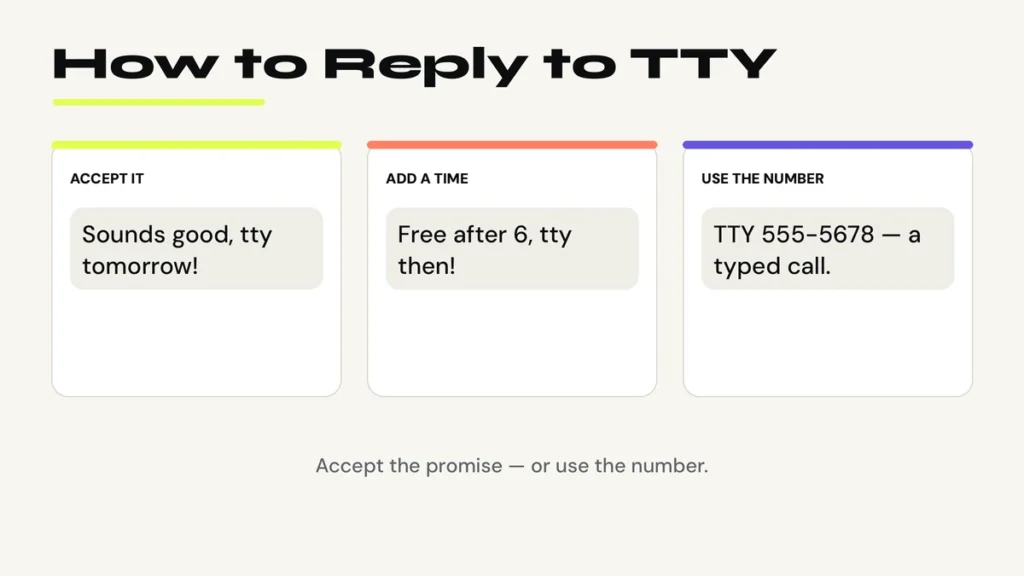
The easiest reply to TTY is the promise back. TTY is a goodbye with a promise attached, not a message that needs an answer of its own, and the sender is waiting for the next conversation, not for a comment on the abbreviation. Accept the promise, add a time if you have one, and the TTY has done its job.
- Accept the promise. “Gotta go, tty tomorrow!” — “Sounds good, tty tomorrow!” The reply echoes the promise, and the conversation closes warmly, because both people agreed on when it opens again.
- If you know when you will be free, say so. “Free after 6, tty then!” A time word of your own turns a loose promise into a plan, and it costs less than the message the sender is waiting for.
- If you are going too, say so plainly. “Same here, tty soon!” A short matching goodbye is better than a long explanation, and it closes the conversation the way the sender opened the closing.
- If the TTY was bare, add the time yourself. “Sounds good, tty soon!” A bare “tty” with no time word is a wave with no date attached, and the honest reply is the one that supplies the date, so the promise is not left hanging.
- If the TTY was on a contact page, use the number. “Call us at 555-1234 (TTY 555-5678)” is not a goodbye, and the right response is to use the TTY number for a typed call, not to answer it with a text back.
- If the TTYs keep coming, name the wait. “I saw your messages — I was in a meeting, tty tonight for real.” A repeated TTY is a door closing, and the reply that works is the one that acknowledges the closing instead of pretending the waiting did not happen.
The one reply to avoid is the one that answers a promise with a question nobody asked. A “tty tomorrow!” answered with a sharp “why are you leaving?” turns a warm goodbye into a small fight, and a TTY answered with another bare TTY — “tty” for “tty” — echoes the promise without adding anything to it. Accept the goodbye, add a time if you have one, and let the abbreviation do what it was built to do: close the conversation kindly and keep the next one warm.
Frequently Asked Questions
What does TTY mean in a text message?
TTY means “talk to you” in a text message. It is a casual sign-off, a friendly way to end a conversation while promising to talk again. The sender usually adds it at the end of a message that explains why they are leaving — “Gotta go, tty!” — so the reader knows the conversation is paused, not ended. If the TTY is on a contact page instead, read it as a teletypewriter number.
What does TTY mean on Snapchat?
On Snapchat, TTY almost always means “talk to you.” People send it when they are closing a chat, usually after opening a snap or a message, and the disappearing context makes the message above it matter more. A “tty tomorrow!” after a snap is a promise with a date on it, and a bare “tty” after a snap is the loosest goodbye in this guide, because the snap disappears and the promise has nothing to attach to.
Is TTY rude?
Not usually. TTY is a casual sign-off, and it typically reads as a warm goodbye rather than a dismissal. It only feels rude if someone sends it in the middle of a conversation that is not finished, or to a person who was clearly still talking — and even then, the rudeness is in the timing, not in the letters. One TTY is a promise; a TTY sent to cut someone off is a door closing.
What does “tty” mean from a girl?
It means the same thing it means from anyone: “talk to you.” The tone depends on the relationship and the rest of the message, not the sender’s gender. A caring “had a great time, tty tomorrow!” reads differently from a plain “tty later” because of the words around it, not because of who typed it — and no dictionary or reputable guide supports any different meaning based on gender.
What is the difference between TTY and TTYL?
TTY means “talk to you” — a promise with no time attached. TTYL means “talk to you later” — the same promise with “later” added, naming a loose time. TTY leaves the timing open; TTYL pins it down a little. If someone sends “tty tomorrow!” they are spelling out in full what TTYT means, and if they send a bare “tty” they are leaving the timing to the two people in the conversation.
Can I use TTY at work?
No. TTY is texting slang and it does not fit formal or professional writing. In a work email, spell out the goodbye instead: “I will follow up with you tomorrow” removes any chance of confusion, and it does not risk a colleague or a client mistaking the letters for a teletypewriter number. TTY belongs in casual texting, DMs, and chats with people who already use texting slang.
What does TTY mean on a contact page or form?
On a contact page or a form, TTY means a teletypewriter — a device that lets people who are deaf, hard of hearing, or speech-impaired type a phone call instead of speaking it. A TTY number next to a voice number is the one a typed conversation reaches, and a relay service can carry the messages when the other person has no TTY of their own. It is the oldest meaning of the letters, dated to 1903, and it has nothing to do with texting slang.
What does TTY mean in computing or on Linux?
In Linux and Unix, a TTY is a text terminal — the command line interface a user types into. The Unix “tty” command, first released on November 3, 1971, prints the file name of the terminal connected to the input, and every terminal window, SSH session, and container today is a pseudo-terminal, a software TTY. The name is a leftover from the teletypewriter hardware the first terminals were built from.
The Takeaway
TTY is simple once you know it: mostly, it means “talk to you,” a casual sign-off for a conversation that is pausing, not ending, used when someone has to go and wants the reader to know they will be back. The letters are a promise, not a deadline, and one TTY is a wave from a doorway — the kind that keeps a friendship warm between chats, plans moving between people who need to talk again, and threads from going cold after the important part has already been said.
The complications are real, and they are worth naming plainly. On a contact page, the same three letters mean a teletypewriter, a device for typed phone calls that Merriam-Webster dates to 1903, and Wiktionary is the only dictionary that lists both the device and the goodbye side by side. In a Linux discussion, TTY means a terminal session. And a TTY with no time word is the loosest promise in this series — it says “we will talk” and leaves the “when” to the two people who made it, which is why the cousins exist: TTYL, TTYS, and TTYT are the same promise with the clock added back in. The Sign-Off Test exists for those cases: check the setting first, then the position, then the timing, and trust the setting when the questions disagree.
When in doubt, read the full message before assuming what someone meant — and then just accept the promise. TTY is the one abbreviation in this series where the right answer is also the easiest one: the sender said they will talk to you again, so say it back, add a time if you have one, and let three letters do what they were built to do, which is close a conversation kindly and keep the next one warm.