What “Skibidi” Means in Text
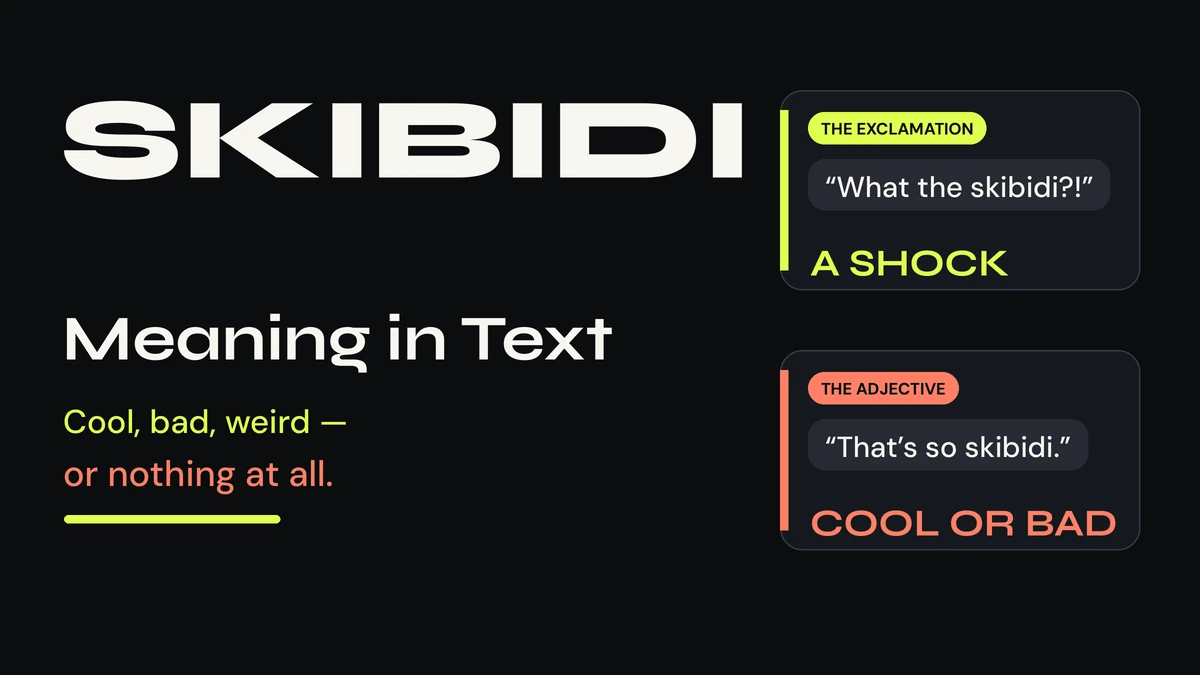
Skibidi has no fixed meaning. If someone texts you “skibidi,” they might mean cool, bad, weird, or nothing at all — and that is the skibidi meaning in text in one sentence, and also the reason this guide exists, because a word with no fixed meaning still has to be read correctly. Skibidi is a nonsense word, closer to a sound effect than a real word, and its meaning comes from the room, the job it is doing in the sentence, and the words traveling with it — never from a dictionary definition alone.
That sounds like a trick, and for most slang it would be. Every other term in this series has a definition you can memorize: one expansion, one feeling, one job. Skibidi refuses all of that. Cambridge Dictionary, which added the word in August 2025, defines it as a word that can have different meanings, such as “cool” or “bad,” or can be used with no real meaning, as a joke. Merriam-Webster calls it a gibberish word, widely used as a nonsensical and occasionally pejorative expression and meme online, and says it is mainly used for humorous, expressive, and ironic effect. Wiktionary lists it as a nonsense word four ways at once — as a noun, an interjection, an adjective, and a verb — and every one of those entries says the same thing in different grammar: the word is there for the joke, not for the meaning.
The closest comparison is a swear word with the swearing removed. Merriam-Webster points out that skibidi can mimic the grammatical versatility of expletives, as in “Oh my skibidi! I didn’t expect this game to be so skibidi hard.” It slides into the exact slots where a swear word would sit — the exclamation at the start of a sentence, the adjective before a noun, the intensifier before another adjective — and it does the same emotional work without being a swear word at all. That is why adults keep asking whether it is a bad word, and why the answer keeps coming back no: it is a clean word doing a rude word’s job, and the confusion is the point.
The word also refuses to sit still in one part of speech. As a noun, it is a nonsense word, sometimes used to form compounds for humorous effect — “a skibidi moment,” “skibidi rizz.” As an interjection, it is a strong reaction or an exclamation, sometimes used to replace words in set phrases — “holy skibidi,” “what the skibidi.” As an adjective, it is a nonsense word used in an ironic or humorous manner, or to mock the slang of Generation Alpha — “you’re so skibidi,” “that’s so skibidi.” As a verb, it means to use the nonsense word itself — “you gotta be skibiding me.” No other term in this series has ever needed four parts of speech to describe one word, and that is the first clue about how to read it: do not ask what skibidi means, ask what it is doing.
One more thing before the test: skibidi is clean language. It has no profane, sexual, or violent meaning, and no vulgar expansion exists to spell out, asterisk, or fence. The word sounds rude to some adults only because it behaves like a swear word in a sentence, and because it arrives wrapped in the chaotic, fast-moving videos it came from. This guide never needs the profanity rules that the earlier trade and vent terms needed, and that is worth saying plainly, because the question “is skibidi a bad word” is the question most readers arrive with, and the answer is no.
The Skibidi Context Test
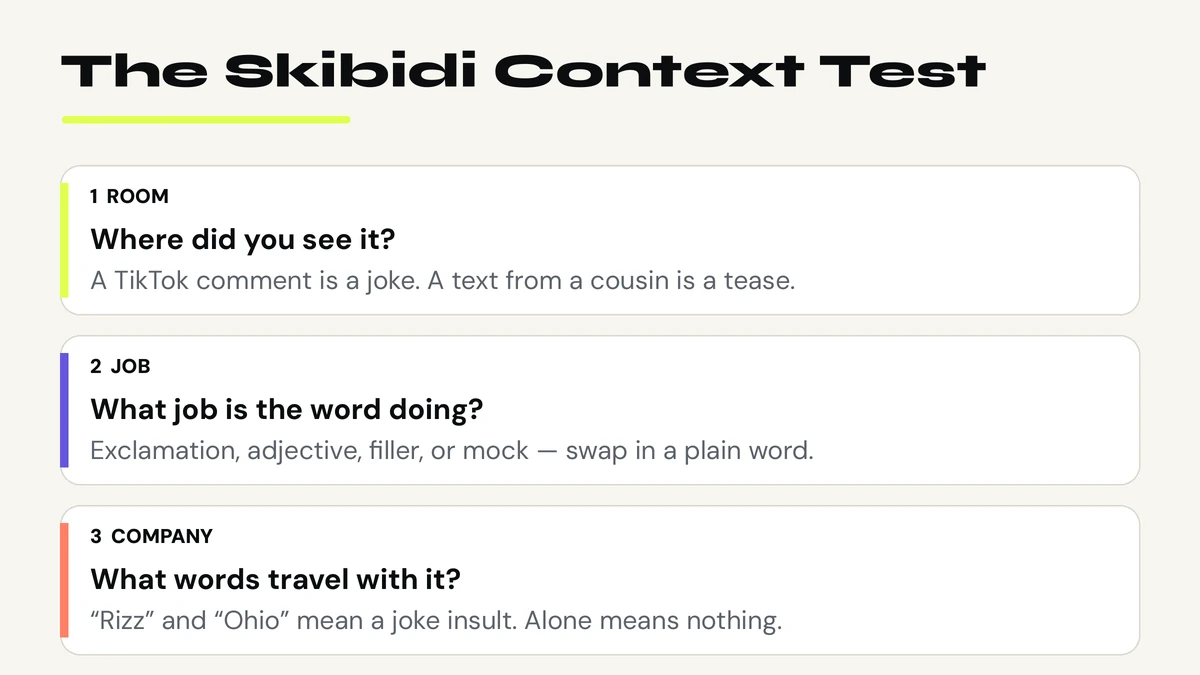
Most slang in this series is sorted by grammar, by volume, or by room. Skibidi is sorted by company — by the words traveling with it — because a word with no fixed meaning can only be read through its neighbors. That is why this guide’s test is built differently from the last one. The SFS Trade Test asked what room you were standing in, because SFS changes its meaning by room; The Skibidi Context Test asks what job the word is doing and who it arrived with, because skibidi changes its meaning by sentence. It takes about five seconds, and it works on a TikTok comment, a text message, a classroom shout, and a bare “skibidi.” alike, because the test follows the company instead of the letters.
- Check 1 — Room. Ask where you saw it. In a TikTok comment under a gaming clip, it is almost always a joke, an exclamation, or a mock. In a text from a younger cousin, it is usually a filler or a tease. In a classroom, it is usually a shout for laughs, said because saying it is fun. In a parent’s group chat, it is usually a question — someone repeating a word they heard and asking what it means. The room tells you who is joking before the word tells you anything at all.
- Check 2 — Job. Ask what job the word is doing in the sentence. Swap in a plain word and see if the sentence survives. If “what the skibidi” becomes “what on earth,” the job is exclamation. If “that’s so skibidi” becomes “that’s so cool” or “that’s so weird,” the job is adjective, and the tone of the sentence picks which one. If the word sits where any old word would do — “the skibidi of skibidi is skibidi” — the job is filler, and the sentence means nothing on purpose. If removing the word changes nothing at all, the word meant nothing at all.
- Check 3 — Company. Ask what words are traveling with it. “Rizz” and “Ohio” next to skibidi point to the joke insult — “skibidi Ohio rizz” is a mostly joking insult for someone thought of as bizarre or awkward, and the company is the whole clue. “What the” before it points to mock shock. “So” before it points to the adjective, cool or bad depending on the face that goes with it. “My” before it points to the exclamation, “oh my skibidi.” Alone, with no company at all, it points to nothing — a sound, a laugh, a shrug in word form.
Run it on the hardest case in this guide: a bare “skibidi.” in a DM from a kid cousin, with no other words attached. The Room check says a casual chat, so the word is a joke, not a message. The Job check says filler, because the word is doing no work in the sentence — there is no adjective slot, no exclamation mark, nothing for it to modify. The Company check agrees, because the word arrived alone, with no “rizz,” no “Ohio,” no “what the” to give it a direction. The test says “nothing at all — a joke, not a message,” and the test is right: the correct reply is a laugh, not a definition.
What the test cannot do is give you a definition to memorize, and it does not try. If someone sends skibidi and the checks disagree — the room says classroom, but the company says “skibidi rizz” — ask one question before you answer, because the cheapest reply in this whole guide is “cool skibidi, or weird skibidi?” and it is also the one that never argues with a joke. The test is for your own reading, not for policing anyone else’s. Its job is to stop you from answering a joke like a question, not to tell anyone else what their nonsense word means.
“Skibidi” in Real Chats
Skibidi shows up wherever a joke needs a sound, a reaction needs a word that means nothing, or a sentence needs a punchline that lands on the laugh instead of the meaning — and the examples below are written for this guide from the documented uses, so you can recognize each job the moment you meet it. One thing ties them together: in every example, the word is the joke, the reaction, or the sound — never the information. The sentence around the word does the real work; skibidi just makes it funny.
- The exclamation. “What the skibidi is going on?” The classic job, and the one every parent’s guide opens with: a silly, filler way of saying “what on earth,” where the word stands exactly where a swear word would stand and does the same job without being one. The question mark is doing half the work, because it turns a nonsense word into mock shock.
- The compliment. “That new game is totally skibidi.” The cool reading: said with a grin, about something impressive, where the word means “cool” and nothing else. The tone is the whole clue — the same sentence said flat, with an eye-roll, would mean the opposite, and that is why the Context Test checks the job and the company instead of the letters.
- The joke insult. “Skibidi Ohio rizz.” The compound job: three nonsense words stacked together specifically because the combination sounds ridiculous. Merriam-Webster reports it as a mostly joking insult for someone thought of as bizarre or awkward, and the insult is in the stack, not in any one word — pull “skibidi” out on its own and the insult falls apart.
- The adjective swap. “Oh my skibidi! I didn’t expect this game to be so skibidi hard.” The grammar job, and the one Merriam-Webster uses to show how flexible the word is: skibidi as an exclamation at the start of a sentence, then as an intensifier before “hard,” doing the work of a swear word in both slots without being one in either.
- The filler. “He’s built different, full skibidi mode.” Pure nonsense humor with no real meaning, where the word is a sound effect that makes the sentence funnier and adds nothing to it. Remove the word and the sentence means the same thing — which is exactly how you know the job was filler.
- The tease. “Stop being so skibidi.” Loosely teasing someone for acting weird or annoying, where the word means “weird” and the sentence is a joke, not a complaint. The tease only works between people who already know each other, because a stranger hearing it would have no idea whether they were being praised or mocked.
- The mock. “You’re so skibidi, you’re so Fanum tax.” The lyric job, from the viral TikTok song “Sticking Out Your Gyatt for the Rizzler,” where the word sits in a parody of memetic internet slang — a song making fun of overused young-people words by stacking them until they collapse. Wiktionary records that the adjective sense was not used before that song, which makes this example the birthday of a whole sense of the word.
Notice what nearly all of these examples do: they put skibidi where the laugh belongs, at the moment the joke lands or the reaction peaks. The word is a sound, not a statement — nobody answers a “what the skibidi” with a definition, because there is nothing to define. If you read every skibidi as a small report from the sentence — “this is a joke,” “this is a reaction,” “this is a sound” — you will read nearly all of them correctly, and the one that breaks the pattern, a skibidi with no joke and no reaction and no sound attached, will stand out precisely because it has no job at all.
The Skibidi Tone List

Seven readings, one nonsense word. Unlike the last term in the series, whose readings were seven jobs for the same three letters, these are seven tones for the same sound — the same skibidi, sent as a shock, a compliment, an insult, a filler, a mock, a hype, or a shrug. Read the list as a set of tones, not as a set of meanings, because the meaning moves with the sentence and the tone moves with the face that goes with it.
- The exclamation. Loud, surprised, a question mark or an exclamation mark at the end. “What the skibidi?!” The word is doing the work of a gasp, and the tone is the tone of someone who just saw something they cannot explain. This is the default skibidi for most adults meeting the word, because it is the one that needs no context at all.
- The compliment. Warm, grinning, approving. “That’s so skibidi.” The tone is the tone of a kid who just saw something impressive — a game, a trick, a goal — and the word means “cool” only because the face says so. The same sentence with a flat voice means the opposite, and the tone list is the only thing that tells them apart.
- The insult. Dry, eye-rolling, teasing. “You’re so skibidi.” The tone is the tone of someone calling a friend weird, and the word means “bad” or “bizarre” only because the company — the eye-roll, the laugh, the “Ohio rizz” that usually follows — says so. It is a soft insult, a joke insult, and it lands as one only between friends.
- The filler. Flat, throwaway, almost bored. “The skibidi of skibidi is skibidi.” The tone is the tone of someone filling a sentence with sound because the sound is funny, and the word means nothing at all — which is the point. This is the hardest tone for an adult to hear correctly, because the sentence is a joke about having no meaning, and the joke only works if you do not look for one.
- The mock. Imitating, exaggerated, a little cruel. “OK, skibidi.” The tone is the tone of someone copying Generation Alpha slang to make fun of it — an adult mocking a kid, a kid mocking an adult who just tried it, or a song stacking slang words until they collapse. Wiktionary’s verb sense lives here: to “skibid” is to use the word to mock the slang itself.
- The hype. Loud, all-in, chaotic energy. “Full skibidi mode.” The tone is the tone of someone going all in on the joke — a game, a challenge, a dare — and the word means “maximum,” the way “full beast mode” means maximum effort. It is the only tone in the list where the word is a volume knob rather than a meaning.
- The shrug. Quiet, alone, a single word and nothing else. “Skibidi.” The tone is the tone of a shrug in word form — no sentence, no job, no company, just the sound, said for the laugh. This is the one tone where the correct reply is a laugh and nothing else, because there is nothing to answer.
Five of these are safe to send anywhere casual — the exclamation, the compliment, the filler, the hype, and the shrug — because a nonsense word offends nobody, and the worst it can do is confuse someone. The insult belongs between friends, because a joke insult sent to a stranger reads as a real one, and a stranger has no reason to know it is a joke. The mock belongs nowhere you need to be believed, because a skibidi that means “your slang is silly” will be misread by half your audience. If you are unsure which tone you are hearing, answer the sentence around the word, not the word — ask about the game, or ask about the joke — and the conversation will correct you gently if you picked wrong.
“Skibidi” on TikTok
On TikTok, skibidi lives in comments, captions, and songs, and the comment is its home ground — because TikTok is where the word grew up after it left YouTube. A creator captions a video with the word, a commenter answers with it, and a song stacks it with other slang until the whole comment section is a joke that only makes sense if you already know the joke. The meaning is the same as everywhere else — no source in this build documents a distinct TikTok-only meaning — but the platform changes the shape: on TikTok, skibidi travels in stacks, and the stack is the meaning.
The feed that surfaces these videos is the same one our FYP guide explains, and the skibidi comments riding on it are passengers, not drivers — nobody follows an account for the word, they follow it for the video, the joke, or the creator. The one TikTok habit worth naming is the lyric stack: the viral song “Sticking Out Your Gyatt for the Rizzler” put “you’re so skibidi” next to “you’re so Fanum tax” and “I just want to be your sigma,” and Wiktionary records that the adjective sense of the word did not exist before that song. On TikTok, the word is a lyric first and a message second, and the comment that just says “skibidi” is usually quoting the song, not starting a conversation.
Replying on TikTok rewards the same shortness the platform rewards everywhere else. A “what does skibidi mean” comment under a video wants the one-sentence answer — a nonsense word that can mean cool, bad, weird, or nothing at all — and nothing else. A longer explanation will be scrolled past, and a lecture will be read as missing the joke. If you are the creator, pin the definition: it will save you answering the same comment fifty times.
“Skibidi” on Snapchat
Snapchat is where skibidi is smallest, and every guide in this build agrees on why, even if none of them says it in one sentence: Snapchat is a private app, and skibidi is a public joke. The word lives in group chats and story captions, where a friend sends a snap of something weird with “skibidi” over it, or captions a story with “full skibidi mode” before a night out. The meaning is the same as everywhere else — no source documents a distinct Snapchat-only meaning — but the room is smaller, and the word does less work there, because a snap disappears before the joke can travel.
The one Snapchat habit worth naming is the caption habit: skibidi as a sticker on a photo, the way “what the skibidi” sits over a picture of something strange, or “stop being so skibidi” sits over a picture of a friend doing something silly. The word is a caption, not a conversation — it labels the photo, and the photo does the talking. A “skibidi” sent as a snap with no picture attached is the shrug tone, a sound with nothing to label, and the reply it wants is a laugh, not a question.
One habit makes Snapchatting skibidi painless: keep the joke in the chat, where it can be answered, rather than in a snap that disappears before the other person sees it. A “skibidi” sent as a snap can vanish before the other person ever knows a joke was made; the same word sent as a chat message waits to be seen, and the reply can be a laugh instead of a confused “what?” Nothing about Snapchat changes the meaning; the app only changes how long your joke lasts, so put the word where it can be read.
“Skibidi” on Instagram
On Instagram, skibidi lives in reels, comments, and captions, and it arrives there as a visitor from TikTok and YouTube rather than a native. You will see it in a reel caption (“skibidi rizz”), in a comment under a gaming clip (“that’s so skibidi”), and in a story from a younger cousin who is quoting the song. The meaning is the same as everywhere else — no source documents a distinct Instagram-only meaning — but the platform changes the audience: on Instagram, the word is usually being performed for people who already know the joke, and the performance is the point.
Our IG guide covers the shorthand itself; the point here is narrower — on Instagram, skibidi is a caption word, not a conversation word, and the details are the whole joke. A reel captioned “skibidi Ohio rizz” is a joke about being weird, and the caption is doing the work of a punchline; a comment that just says “skibidi” under a reel is a laugh, typed out. The word is doing the same job a laughing emoji does, except it is funnier, because the joke is that the word means nothing.
Less often, skibidi on Instagram shows up in a bio or a username, where a young creator puts the word in their name to signal they are in on the joke. If the bio says “skibidi,” it is a flag, not a message — a way of saying “I speak this language” to anyone who reads it. The practical rule follows from that split: if the word names a video, a reel, or a joke, it is a caption; if the word names a person, it is a flag. A bare “skibidi” with nothing attached is almost always the laugh, and on Instagram the half that might misread it is the half that did not watch the reel.
“Skibidi” in Text Messages
Text messages are the room where skibidi is hardest to read, and the reason is simple: a text has no video to lean on. On TikTok the video answers first, and on Instagram the reel answers second — but in a plain text, the word arrives with nothing but the conversation, and the conversation has to do all the work. That is why this section matters more than the three platform sections above it: the text message is the room where the Context Test earns its keep, and where the filler meaning lives.
In a private text, skibidi can be a tease, a laugh, or a sound — and the message around it decides which one. “Stop being so skibidi” is the tease, aimed at a friend doing something weird. “What the skibidi is going on?” is the laugh, aimed at something nobody can explain. A bare “skibidi.” is the sound, aimed at nobody at all, sent because saying it is fun. The shape is the whole clue: a tease names a person, a laugh names a surprise, and a sound names nothing — and if the message is a single word with no sentence around it, it is the sound, and the correct reply is a laugh.
The other text-message job is translation: a parent or an older sibling texting “what does skibidi mean?” after hearing it from a child, or a kid texting the word to an adult to see what happens. If the conversation needs to move somewhere longer, that is what a DM guide move is for: take the question out of the group chat and into a one-to-one thread, where the answer — a nonsense word that can mean cool, bad, weird, or nothing at all — can be given without an audience laughing at the person who asked.
Who Is Sending It: How “Skibidi” Lands by Sender
The word does not change with the sender. The weight you give it does, and so does the reply it deserves. A “skibidi” from a friend is a joke; the same word from a stranger is a meme; from a crush, it is almost never about you at all. Read the sender first, then the word — and read the room second, because the room outranks the sender every time.
- Friend. Default, low stakes. A friend sending skibidi is usually sharing a joke — a tease, a laugh, a sound — and no performance is required on either side. Just laugh, or send it back, because a friend who sends a nonsense word wants a nonsense word in return, not a definition.
- Crush. Overread territory, but gently. A crush sending skibidi is almost always joking, not flirting — the word itself has no romantic meaning, and “skibidi rizz” is a nonsense combo phrase said for laughs, not a compliment you can rely on. Answer the joke, not the crush, and let the crush part happen somewhere else. The one exception is context: if someone you have been talking to sends “skibidi rizz” with a winking face, they may be joking about flirting — but even then, the word is the joke, and the person and the conversation around it tell you more than the letters do.
- Partner. Pattern rules. A partner sending skibidi is usually young, usually joking, and usually quoting the same songs and videos you have both seen — a shared joke, not a message. It feels warm rather than meaningful, because the word is the excuse and the shared laugh is the point. A partner who sends a bare “skibidi.” and nothing else might just be bored — the history between you answers faster than the word does.
- Parent. Usually a question, and a kind one. A parent sending skibidi in a family chat usually means one of two things: they heard the word from a child and are repeating it to ask what it means, or they are trying the joke themselves to connect. The kind answer is one sentence — “a nonsense word that can mean cool, bad, weird, or nothing at all” — not a lecture, because a parent who wanted a lecture would have asked for one.
- Teacher or classmate. Classroom room, mostly harmless. A classmate sending skibidi in a study group is usually joking around, and the reply that helps is a laugh, and then the next problem. A teacher hearing skibidi is usually hearing a distraction — the word is loud, silly, and contagious, and a classroom full of kids saying it is a classroom not doing its work. The teacher’s job is not to learn the word; it is to get the class back.
- Coworker or boss. Read twice. A coworker sending skibidi about a work-adjacent joke — a meme in the team chat, a silly moment in a meeting — is normal, friendly, and safe, and almost always ironic: an adult using a kid’s word to show they are in on the joke. A boss sending skibidi is a surprise, and it usually means the room is relaxed and the boss is joking — but do not take it as an invitation to say it all day. The word is casual here only because the moment is, and the moment will pass.
- Stranger. The opening move, but a soft one. A stranger sending skibidi in a comment you did not ask for is sharing a meme, not starting a conversation — a laugh, not a greeting — and a stranger is owed a short, factual answer and nothing personal: no details about where you are, what your schedule is, or whether you are alone. A stranger’s skibidi is the easiest message in this guide to answer, because the correct reply is almost always nothing at all, or a laugh, and the conversation was never really about you.
The sender rule that covers all seven is short: answer the joke, not the word. A friend wants a laugh back, a crush wants a joke answered, a partner wants a shared laugh, a parent wants one kind sentence, a classmate wants a laugh and then the next problem, a boss wants the work to continue, and a stranger wants nothing you have not chosen to give. Get the job right and the word takes care of itself.
When “Skibidi” Is Too Much: Work, School, and Family
Skibidi is welcome almost everywhere casual, because a nonsense word offends nobody and the word is the friendliest way to join a joke. A “what the skibidi” in a friends’ group chat, a “that’s so skibidi” under a gaming clip, a bare “skibidi.” from a younger cousin — none of these will offend anyone, and none of them need a content warning. The risk in this article is not rudeness. It is the wrong room: a joke told where no joke belongs, or a word that sounds like a swear word to someone who does not know it is not one.
At work, keep skibidi in the casual chat and out of the formal one. A “skibidi” in a team group chat about a meme is normal, and a coworker will read it as friendly. A “skibidi” in a formal email, a report, or a message to a client reads as careless in a room where care is the job — and a “skibidi” sent during a serious meeting, about a mistake that cost someone their afternoon, will read as mockery even if you meant it as a joke. At school, the word is harmless in a class group, but a formal essay or an email to a teacher deserves plain words, and a “what the skibidi” shouted across a quiet classroom will read very differently from the same words sent to a friend. In family chats, read the room person by person — a grandparent who hears skibidi is probably hearing it for the first time, and nobody needs a lecture on internet slang at the dinner table.
The stop-when-asked rule applies here the way it applies to every term in this series. If someone says your “skibidi” felt like noise rather than a joke, believe them and soften it next time — “that was so weird” costs nothing, and it is also the version a stranger can actually answer. And the swap menu is easy: say “that’s so cool” or “that’s so weird” in any formal room, say nothing at all when the room is grieving, angry, or serious — sometimes the kindest reply to a message is not a joke but a pause. Plain language is never the wrong choice with a word this easy to misread.
Checked Claims: Expansions That Do Not Hold Up
Skibidi collects claims the way a meme collects remixes: most of them are real, a few are guesses, and the job is sorting which is which. The rule for this section is the series rule — grade every claim, fence the real-but-narrow ones, and reject the invented ones openly, with the reason stated. The “Word of the Year” claim sits near the top of this list on purpose, because it is the misunderstanding every new reader arrives with, and it deserves a straight answer.
- FENCED — “Skibidi means cool.” Real, but only half the story. Cambridge Dictionary says the word can mean “cool” or “bad,” and the parent’s guides agree: “that’s so skibidi” can mean cool, said with a grin, about something impressive. But the same sentence said flat, with an eye-roll, means the opposite, and no dictionary can tell you which one you are hearing — only the tone can. Use the face, not the word, to decide.
- FENCED — “Skibidi means bad.” Real, and the other half of the same coin. The same Cambridge definition covers it, and Merriam-Webster adds that the word’s connotation can skew negative, because of its association with the villainous toilets in the show and its frequent appearance in “skibidi Ohio rizz,” a mostly joking insult. It is a soft “bad” — weird, bizarre, awkward — not a serious one, and the joke around it is usually doing more work than the word.
- FENCED — “Skibidi means nothing at all.” Real, and the most honest reading of the three. Cambridge says the word can be used with no real meaning, as a joke; Merriam-Webster says it tends to be used intentionally as gibberish; Wiktionary calls it a nonsense word in every part of speech it lists. A bare “skibidi.” with no sentence around it means nothing on purpose, and the correct reply is a laugh, not a definition.
- REJECTED — “Skibidi is a bad word.” No. Skibidi has no profane, sexual, or violent meaning, and every parent’s guide in this build says so plainly: on its own, it is completely fine for kids to say. The confusion comes from the word’s grammar — it slides into the exact slots where a swear word would sit, as in “oh my skibidi” and “what the skibidi” — which makes it sound rude to an adult who does not know it is clean. A clean word doing a rude word’s job is not a rude word.
- REJECTED — “Skibidi was Cambridge Dictionary’s Word of the Year for 2025.” No, and this is the claim this guide grades most carefully, because a good source gets it wrong. Mental Floss writes that Cambridge named skibidi one of their words of the year in 2025 — but the news report of Cambridge’s own announcement says “parasocial” was crowned Cambridge Dictionary’s word of the year for 2025, while skibidi, delulu, and tradwife were new entries added to the dictionary in August 2025. Being added to the dictionary is not the same as being named word of the year, and this guide reports the addition, not the crown.
- FENCED — “Skibidi rizz means good flirting.” Real as a joke phrase, and unreliable as a compliment. The parent’s guides describe “skibidi rizz” as a nonsense combo phrase said for laughs, and Merriam-Webster’s example — “which animatronic has the most skibidi rizz?” — shows the phrase used as a joke, not as praise. The words are stacked because the stack sounds ridiculous, not because the flirting is real. Do not take it as a compliment, and do not send it as one.
- REJECTED — “Skibidi means something different on TikTok than on Instagram.” No. No source in this build documents a distinct per-platform meaning, and the guides that cover the platforms agree: the word is the same everywhere, and only the company changes — the song on TikTok, the caption on Instagram, the snap on Snapchat. The platform sections in this guide report documented usage context only, and say so openly where a source is silent. Anyone who tells you one platform owns a different skibidi has not read the messages.
- REJECTED — “Skibidi is short for something.” No. Skibidi is not an acronym, not initials, and not short for a longer phrase — it is a nonlexical vocable, a sung sound from a song, and anyone selling you an expansion is inventing it. Wiktionary traces the sound to scat singing in the song “Dom Dom Yes Yes,” and the word arrived empty: a sound first, a joke second, and a meaning never. If someone offers you what the letters stand for, ask which room it lives in before you believe it — a real expansion always has a room, and an invented one never does.
Two more claims deserve a grade, and they do not fit neatly in the list. The exact first-video date of 7 February 2023, given by one small guide, is unverified in this build: Merriam-Webster and Wiktionary both say February 2023 and name no day, so this guide reports the month, not the day. The story that the word comes from a TikTok dance video by Yasin Cengiz in April 2022, reported second-hand through a parent’s guide that credits Dictionary.com, is reported second-hand in this build: the dance and the song agree with each other — the sound comes from “Dom Dom Yes Yes” either way — but no primary dictionary page in this build confirms the dancer, so this guide does not adopt the dancer as the origin. “Skibidi Toilet Syndrome,” the ailment Merriam-Webster mentions, is fictional by its own source’s admission: a joke diagnosis for the effects of the show’s grim absurdity, not a real condition. Two habits follow from this list. First, when someone offers you a fact about skibidi, ask which dictionary it lives in before you believe it — a real fact always has a dictionary, and an invented one never does. Second, when a claim arrives as an absolute — always, never, only — test it against the Context Test, because the absolute that survives “what the skibidi” and a bare “skibidi.” in the same guide is the one worth keeping.
“Skibidi” vs Its Closest Cousins
Skibidi is a member of a family, not a lone invention, and meeting the relatives makes the word itself easier to hold. The cousins below sort into two groups: the Gen Alpha words, which share the same playground, and the reaction words, which share the same job. Four of them are linked; the rest are named only, because no TextsMeaning article exists for them yet — and two of them, gyatt and rizz, are named in passing here as the words skibidi travels with, without a link of their own.
- MOG — to dominate, to outshine. The Gen Alpha cousin, and the first linked one: our MOG guide covers the word that sits next to skibidi in Merriam-Webster’s own Gen Alpha slang piece, where the two words share a headline. Mog is a verb with a meaning — to look better than someone, to dominate — while skibidi is a sound with no meaning, and the pair shows the two ends of Gen Alpha slang: one word that does a job, one word that does a joke.
- IYKYK — if you know, you know. The in-joke cousin, and the second linked one: our IYKYK guide covers the letters that mean “this joke is only for people who already know it,” which is the same contract skibidi makes with its audience. Both words only work if you are already in on the joke — and both of them fall flat the moment someone has to ask what they mean.
- ICK — the gross-out reaction. The weird-reaction cousin, and the third linked one: our ICK guide covers the word for the feeling you get when something is cringey or off-putting, which is the feeling “skibidi Ohio rizz” is joking about. Ick is the honest reaction; skibidi is the joke version of the same reaction, said with a laugh instead of a shudder.
- LMAO — laughing my ass off. The laugh cousin, and the fourth linked one: our LMAO guide covers the laugh that skibidi is often shouted next to — “oh my skibidi” is an exclamation the way LMAO is a reaction, and both of them say “that was funny” without saying anything else. LMAO is the laugh with a meaning; skibidi is the laugh with the meaning removed.
- GYATT — the excited exclamation. The stack cousin, named only: gyatt is the word skibidi travels with most often, in “skibidi Ohio rizz” and in the viral song’s lyrics, “sticking out your gyatt for the Rizzler.” It is an excited exclamation, often about someone’s body, and it is the word that gives the stack its energy — skibidi gives it the nonsense. Name only — no TextsMeaning article exists.
- RIZZ — charm, the ability to attract. The combo cousin, named only: rizz is the word that turns skibidi into a phrase, in “skibidi rizz,” a nonsense combo said for laughs. Rizz on its own means charm; skibidi on its own means nothing; together they mean a joke about charm, not charm itself. Name only — no TextsMeaning article exists.
The pattern across the cousins is the point of the section: skibidi is not special because it is confusing, it is confusing because it is a sound — one word doing the work of a laugh, a gasp, a tease, and a shrug at once, while sharing the family with words that actually mean something. Learn the company, and the cousins sort themselves.
Where “Skibidi” Came From
Skibidi is young by internet standards, younger than the smartphone in your pocket and younger than most of the people who say it daily — but unlike the last term in this series, this one has a birthday the dictionaries agree on, and this guide can give it. The word comes from Skibidi Toilet, a short computer-animated YouTube series by the Georgian animator Alexey Gerasimov, first released in February 2023 on his channel DaFuq!?Boom!, and the dictionaries agree on the month, the creator, and the channel. What no dictionary can give you is a meaning, because the word arrived empty.
The sound itself is older than the series. In the early episodes, the grimacing human toilet heads were shown singing along to a viral mashup of two songs: Timbaland’s 2007 hit “Give It To Me” and the 2022 track “Dom Dom Yes Yes” by the Bulgarian singer Biser King. King’s track features a bridge of nonsensical scat-style singing — sounds sung for rhythm, not sense — which included a short repeated line that has come to be heard online, and in the series’ title, as “skibidi.” Wiktionary traces the word to that scat vocable, and Merriam-Webster agrees: the toilets sing a remix of a song that features scat-style singing, including a word now primarily rendered as skibidi. The word was a sound before it was a joke, and a joke before it was a word.
The series went viral fast — around eight or nine episodes in, according to its creator — and the word spun off on its own and became a meme, finding a place in the “brain rot” vocabulary of Generation Alpha kids. The numbers tell the scale: the first video has amassed tens of millions of views, the series is nearing 200 instalments, the channel has over 47 million subscribers, and the Washington Post has reported that Skibidi Toilet videos in all shapes and sizes have amassed around 65 billion views online. The spread followed the apps — from YouTube to TikTok, from TikTok to Instagram and Snapchat, from the apps to the playground — each new app inheriting the sound along with the habit of saying it for laughs. The adjective sense has its own birthday inside that story: Wiktionary records that it was coined or popularised by the TikTok song “Sticking Out Your Gyatt for the Rizzler” in October 2023, a parody of overused young-people slang that put “you’re so skibidi” next to “you’re so Fanum tax” — and the word was not used as an adjective before that song. The sound itself has an even older echo: the Russian band Little Big released a dance song called “Skibidi” in 2018, using the same nonsense sound, and Merriam-Webster notes it was not the first time the syllables went viral in a song. When a word can be a sound, a joke, a meme, and a dictionary entry in the same three years, it has finished its journey from scat singing to ordinary language — and skibidi finished it by August 2025, when Cambridge Dictionary added it, in a batch of more than 6,000 new words, because the dictionary only adds words it believes will stay.
How to Reply When Someone Sends “Skibidi”
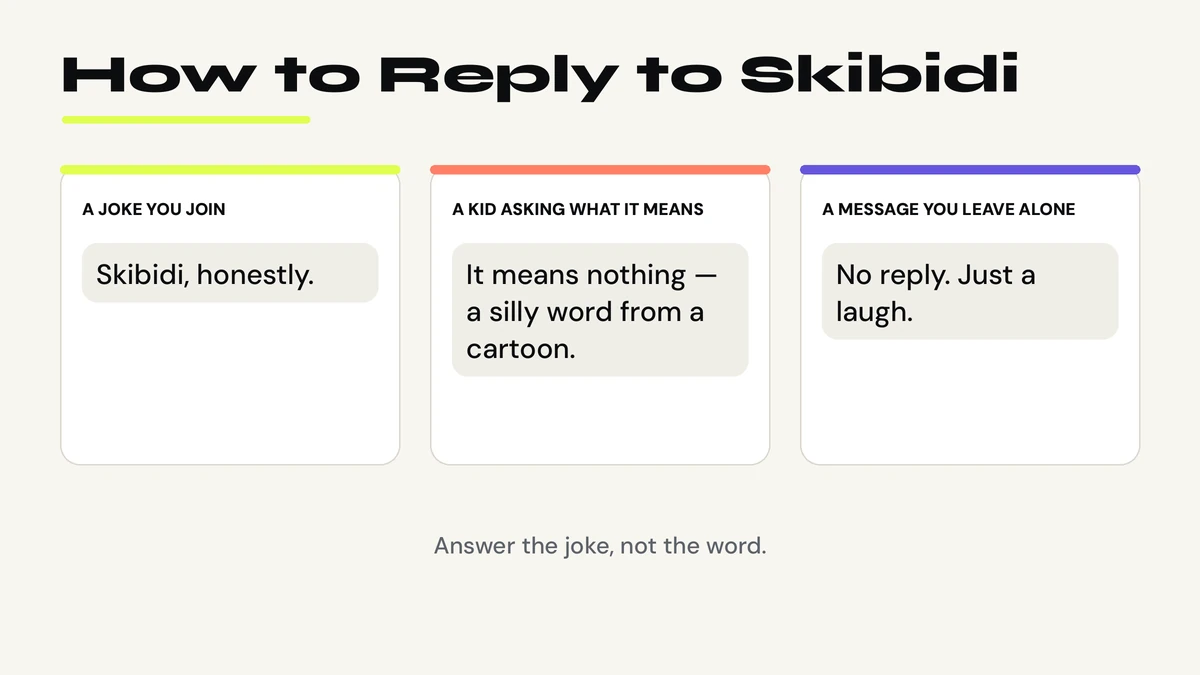
The reply follows the test. Check the room, check the job, check the company — then answer the joke, not the word. Six replies cover nearly every skibidi message you will ever receive, and each one names its moment out loud so the other person can correct you if you picked wrong.
- To a joke you join. “Skibidi, honestly.” The fastest honest reply in this guide, because it joins the joke without pretending the word means something — and the joke is the whole point, because a nonsense word answered with a nonsense word is a conversation, not a confusion.
- To an exclamation. “What the skibidi, indeed.” Matches the mock shock with mock shock, and adds nothing — the exclamation needed a laugh, not an explanation, and the kindest answer to “what the skibidi” is the one that laughs with it.
- To a tease. “OK, you got me, that was skibidi.” Takes the tease gracefully, because a tease answered with a laugh ends the tease, and a tease answered with a definition starts an argument about a joke.
- To a kid asking what it means. “It doesn’t really mean anything — it’s a silly word from a cartoon about singing toilets.” The honest answer, short and complete, with no explanation owed beyond it. A kid who asks what skibidi means is asking for a story, not a definition, and the story is better than the definition anyway.
- To a “skibidi rizz” joke. “Skibidi rizz indeed.” Plays along with the stack, because the phrase is a joke about flirting, not flirting itself, and the reply that plays along is the reply that gets laughed with. Our HBU guide covers the return question — “hbu?” — for when the joke ends and the conversation begins again, because a laughed-at joke is not a closed door unless you close it.
- To a message you leave alone. Nothing at all. The polite no-reply, short and complete, for a bare “skibidi.” from a stranger in a comment section, where the word was a laugh aimed at nobody in particular. Not every joke needs an answer, and the kindest reply to a sound is sometimes silence.
The reply to avoid is the empty definition: a bare “it means cool” to a skibidi message, with no room and no company attached, which reads as confidence about a word that has no fixed meaning. Both mistakes in this guide come from skipping the Context Test — answering a joke like a question, or answering a sound like a statement — and both are fixed the same way: one honest sentence about what you actually heard, sent before you reach for the word.
Frequently Asked Questions
What does skibidi mean in a text message?
In most texts it means nothing fixed at all — a nonsense word that can mean cool, bad, weird, or nothing, depending on the sentence around it. “Stop being so skibidi” means weird, “that new game is totally skibidi” means cool, and a bare “skibidi.” means nothing on purpose. If the text names a person, it is a tease; if it names a surprise, it is an exclamation; if it names nothing, it is a sound.
What does skibidi mean on TikTok?
The same thing it means everywhere else: a nonsense word used for humorous, expressive, and ironic effect, usually in a comment, a caption, or a song lyric. No source documents a distinct TikTok-only meaning, and the word is most often found there stacked with other slang — “skibidi Ohio rizz,” “you’re so skibidi, you’re so Fanum tax” — because TikTok is where the viral song that made the adjective sense popular was born. If a comment asks what skibidi means under a video, the one-sentence answer is “a nonsense word that can mean cool, bad, weird, or nothing at all.”
Is skibidi a bad word?
No. Skibidi is a made-up nonsense word with no profane, sexual, or violent meaning, and every parent’s guide in this build says so plainly. It sounds rude to some adults only because it slides into the exact slots where a swear word would sit — “oh my skibidi,” “what the skibidi” — and does the same emotional work without being a swear word at all. The show it comes from features cartoon fighting and can be intense for very young viewers, but the word itself is harmless.
What does “skibidi rizz” mean?
It is a nonsense combo phrase, said for laughs. “Skibidi rizz” stacks two slang words — skibidi, which means nothing fixed, and rizz, which means charm — into a phrase that is funny precisely because the stack makes no sense. Merriam-Webster’s example, “which animatronic has the most skibidi rizz?”, shows it used as a joke, not as praise. Do not take it as a compliment, and do not send it as one.
What does “skibidi Ohio” mean?
It is a mostly joking insult for someone thought of as bizarre or awkward. “Ohio” is itself slang for something weird, cringey, or bad, and “skibidi Ohio rizz” stacks three nonsense words together because the combination sounds ridiculous. The insult is in the stack, not in any one word — and it is a joke insult between friends, not a serious one.
Is skibidi rude?
No. Skibidi is a neutral nonsense word, and the term itself is not rude. Some people find it annoying, especially when it is shouted across a quiet room or repeated fifty times in a row, but the word is not an insult and it is not a come-on. The one use that can sting is the mock — an adult copying the word to make fun of the kids who say it — and the one reply that can sting is a joke answered with a lecture. A short, honest laugh costs nothing.
What does “what the skibidi” mean?
It means “what on earth?” — a silly, filler way of sounding shocked without swearing. It is the exclamation job of the word: skibidi stands exactly where a swear word would stand in “what the hell,” and does the same work without being one. It is the most common skibidi phrase for adults meeting the word, because it needs no context at all to understand.
Does lowercase skibidi mean something different from Skibidi?
No, not by itself. The case is a tone knob, not a different word — a capital Skibidi at the start of a sentence is the same word as a lowercase skibidi in the middle of one, and the sentence around it decides how the joke lands, not the capital letter. The Context Test outranks the capitalisation every time. A bare “skibidi.” with no company and no job attached is the one case where the case cannot help you — laugh, and ask one question if you need to.
The Takeaway
Skibidi is the strangest lesson in this series and the simplest one to carry: a word that means nothing, used to mean cool, bad, weird, or nothing at all, depending on the sentence you find it in. In most messages it is a joke, a reaction, or a sound — a nonsense word from a cartoon about singing toilets, carried by a song, a meme, and a generation that finds it funny. Run the Context Test: check the room, check the job, and check the company. The meaning that fits is the meaning you answer.
Keep the two habits this guide is built on. Never answer a joke like a question — laugh first, and ask what the word is doing before you ask what it means, because a nonsense word answered with a definition is a joke that died on arrival. And when a skibidi message arrives bare — no job, no company, no sentence — laugh, because the cheapest reply in this whole guide is a laugh, and it is also the one that never argues with a sound.