
What does FWIW mean in text? FWIW means “for what it’s worth” — a soft way to offer an opinion or a fact without forcing it on anyone. “FWIW, I think you’ll love that movie” is a suggestion, not a demand. But the same four letters can also carry a polite disagreement — or a quiet snark. The expansion never changes; the intent does. And the Weight Test below tells you which one you just received.
Most guides give FWIW one definition and stop. This one maps the whole territory: the three-check test for genuine modesty versus polite disagreement versus snark, a six-reading tone spectrum, FWIW on TikTok, Snapchat, Instagram, and in plain texts, how it lands by sender, the cousins it gets confused with, a history from an 1844 play to a 1986 Usenet post to a 2022 dictionary entry, and the work-email register no other term in this series can claim.
What “FWIW” Means in Text
“FWIW” means “for what it’s worth.” It is a hedge — a way of saying “take it or leave it, but here’s my thought” in four letters. The primary dictionary source attests it directly: Wiktionary lists FWIW as (Internet slang, text messaging) an initialism of “for what it’s worth,” with citations from Usenet in 1986 — the oldest abbreviation in this series.
FWIW does three headline jobs inside ordinary conversation. As a tip, it offers: “FWIW, they have a really cheap lunch special.” As an opinion, it softens: “FWIW, I think you’ll love that movie.” As a disagreement, it cushions: “FWIW, Meryl Streep has won more Oscars” — a counterpoint that does not start a fight. Same expansion, three intents — and the difference between them is never in the letters.
The lowercase “fwiw” is common in casual chats; all-caps “FWIW” in emails and posts. Caps carry no signal here — what carries the signal is everything around it.
The FWIW Weight Test

FWIW has one real ambiguity, and it is not about the expansion: how much weight is the sender putting on what follows? Three checks settle it:
- Check 1 — The Position Check. Sentence-initial FWIW = a softening preface for an opinion. Sentence-final FWIW = an afterthought, closer to a shrug or a dismissal.
- Check 2 — The Newness Check. Is what follows new or non-obvious? New information = genuine modesty. Obvious information = condescension risk; the sender is “reminding” you of what you should already know.
- Check 3 — The Stakes Check. Low-stakes tip = genuine. Debate point (“FWIW, Meryl Streep has won more Oscars”) = polite disagreement. “For what it’s worth — nothing” energy = snark.
Worked trio. “FWIW, the weather looks perfect” before a beach plan — new, low-stakes: genuine tip. “FWIW, Meryl Streep has won more Oscars” in a debate about the greatest actress — a counterpoint, cushioned: polite disagreement. “FWIW, water is wet” — obvious, and therefore condescending: snark. Same letters, three intents, all decided by position, newness, and stakes.
“FWIW” in Real Chats
Illustrative examples written for this guide — not presented as real transcripts:
- The lunch tip. “FWIW, they have a really cheap lunch special” — the platonic FWIW: useful, low-pressure, easy to ignore.
- The movie opinion. “FWIW, I think you’ll love that movie” — an opinion offered, not imposed.
- The polite disagreement. “FWIW, Meryl Streep has won more Oscars” — a counterpoint that keeps the conversation friendly.
- The counter-FWIW. “FWIW, Viola Davis is an EGOT winner” — the native reply to a FWIW disagreement: answer the point with your own hedged point.
- The phone advice. “FWIW, I would wait before buying that phone, the new model comes out soon” — advice with an escape hatch built in.
- The work-email option. “FWIW, we could save 10% if we renegotiate with that vendor” — an idea offered to a team, not an order.
- The snark trap. “FWIW, the meeting is at 9” to someone who set the meeting — obvious, and therefore condescending.
The FWIW Tone Spectrum

FWIW’s meaning stays “for what it’s worth”; its tone slides. Six readings, lightest to heaviest:
- Helpful tip: “FWIW, the weather looks perfect” — low stakes, genuine. The tip is the point.
- Modest opinion: “FWIW, I think you’ll love that movie” — an opinion offered, pressure lowered.
- Polite disagreement: “FWIW, Meryl Streep has won more Oscars” — a counterpoint without a fight.
- Optional data: “FWIW, we could save 10% if we renegotiate” — work-email use; take it or leave it.
- Dry hedge: “FWIW, not everyone hated the finale” — softening a hot take in public.
- Snark / dismissal: FWIW before an obvious fact, or the 1844 “for what it’s worth — nothing” shrug — the hedge turned into a weapon.
The tone lives in the newness and the stakes, not in FWIW alone. A “FWIW” before a useful tip reads kind; before an obvious fact, cold.
“FWIW” on TikTok
On TikTok, FWIW softens hot takes: “FWIW, not everyone hated the finale” under a video everyone is arguing about, or “FWIW, this song is underrated” as a caption that invites agreement without demanding it. The platform rewards strong opinions, so FWIW’s job here is diplomatic — it lets a creator disagree with the crowd without becoming the crowd’s target.
TikTok is also where FWIW skews youngest in tone but oldest in history: a 1986 abbreviation doing diplomacy on a 2020s app.
“FWIW” on Snapchat
On Snapchat, FWIW fits private softening: a snap reply that disagrees gently (“FWIW, I liked the other one better”), or a late-night tip that does not want to sound preachy. The ephemeral, in-the-moment format suits FWIW’s job — an opinion that lands lightly and disappears, rather than sitting in a thread as a permanent position.
Snapchat is where FWIW’s snark reading is easiest to miss, because the message vanishes. If a Snapchat FWIW feels off, run the Newness Check — obvious information is the tell.
“FWIW” on Instagram
On Instagram, FWIW shows up in comments and captions: “FWIW, the coffee here is really good” under a cafe post, or “FWIW, this finale deserved better” as a caption that softens a strong take. The public-facing version leans modest opinion — a hedge is Instagram’s cheapest diplomacy. In DMs, the full range appears, including the work-email-style optional data and the private disagreement.
Instagram is also where FWIW’s age shows most clearly: a term born on Usenet now softening Reels captions.
“FWIW” in Text Messages
Plain texts are FWIW’s home ground: the tip text, the opinion text, the disagreement text. It pairs naturally with its conversation-opening cousin WYO — where WYO (“what you on”) opens the conversation, FWIW softens what follows in it — and with BRB in the status-update cluster, where FWIW offers the thought and BRB marks the pause. It also travels with the site’s reassurance move DW — “dw, FWIW, I’ve been there too”: reassurance, then a hedged opinion. Three abbreviations, three jobs, one fluent conversation.
Texts are also where FWIW’s second home lives: work email. FWIW is the only abbreviation in this series genuinely at home in a workplace inbox — “FWIW, we could save 10% if we renegotiate” is a normal team-email sentence. In very formal emails, spell it out as “for what it’s worth” instead.
Who’s Sending It: How “FWIW” Lands by Sender
No source documents a different meaning of FWIW per sender — the meaning stays fixed; what changes is how the hedge reads:
- Friend: the default. A friend’s “FWIW” is a tip or an opinion at face value.
- Crush: overread territory. A crush’s “FWIW, I liked your post” is a soft opinion, not a confession.
- Partner: context rules. A partner’s “FWIW, I’d rather stay in” is a preference, not a verdict.
- Parent: common and usually genuine. A parent texting “FWIW” is usually offering advice the way parents do.
- Coworker / boss: the formal edge, and FWIW’s natural habitat. A coworker’s “FWIW” is an optional idea — evaluate the idea, not the informality.
When “FWIW” Is Not Just Modest
Three cousins, graded — and one trap. First, FYI (“for your information”): direct and factual, often an announcement or a warning. FWIW is subjective and tentative where FYI is flat; FYI tells you something, FWIW offers you something. If the message is a fact you need, it is FYI, not FWIW.
Second, IMO (“in my opinion”): claims a belief outright, while FWIW offers data without taking a hard stance. Third, IMHO (“in my humble opinion”): centers the speaker’s humility, while FWIW centers the information’s possibly-minor value. And the trap: FWIW before an obvious fact is not modest at all — it is the snark reading, and the Newness Check is how you catch it.
Checked Claims: Expansions That Don’t Hold Up
Four letters attract folklore. The claims that fail evidence:
- “FWIW means ‘for whatever I wish’” — rejected. Joke expansions; the attested expansion is “for what it’s worth.”
- “FWIW is just FYI” — rejected. FYI is direct and factual; FWIW is subjective and tentative, and the listener may ignore it.
- “FWIW is just IMO” — rejected. IMO claims a belief; FWIW offers information whose value the sender deliberately understates.
- “FWIW is always polite” — rejected. The 1844 sarcastic use and the obvious-fact trap show FWIW can be snide or condescending.
- “FWIW was invented by Gen Z / on TikTok” — rejected. The abbreviation is attested on Usenet in 1986, decades before TikTok.
- “FWIW means the information is worthless” — rejected. The hedge understates value rhetorically; it does not assert worthlessness.
What SURVIVES: “for what it’s worth” (strong, universal, intent-dependent), with FYI, IMO, and IMHO as distinct cousins and snark as a real but bounded reading. Everything else failed evidence.
“FWIW” vs Its Closest Cousins
FWIW belongs to the softening family — the words that lower the pressure on what follows:
- FT (“FaceTime”) — the upgrade cousin. FT moves a conversation from text to video; FWIW softens what stays in text. “FWIW, let’s FT about it” uses both: hedge the idea, then upgrade the medium.
- FS (“for sure”) — the opposite cousin. FS swears certainty; FWIW understates value. FS says “definitely”; FWIW says “maybe, take it or leave it.”
- FR (“for real”) — the sincerity cousin. FR certifies that something is true; FWIW offers something that might be useful. FR swears a claim; FWIW hedges one.
- FML (“f*** my life”) — the reaction cousin. FML reacts to bad luck; FWIW reacts to a decision. FML mourns; FWIW advises, softly.
The conversational companion: FWIW often travels with the counter-FWIW — one hedged point answered by another, the politest debate format texting ever invented.
Where “FWIW” Came From
“For what it’s worth” began as a pricing expression: buyers offering to pay what an item was truly valued at. The sarcastic twist came early — in William Henry Oxberry’s 1844 play Newton Foster, a character dismisses an opinion as going “for what it’s worth — nothing.”
The abbreviation was born on Usenet. The Oxford English Dictionary points to 1986, in “Re: UNIX v.3 Query” — and the dictionary entry itself carries 1986 citations showing FWIW already in use as a standalone closer. It spread through early email lists and forums in the 1990s, rode the texting wave into the 2000s, and kept going: Merriam-Webster added FWIW in September 2022. Buffalo Springfield’s 1966 song “For What It’s Worth” kept the phrase in public memory along the way — though the song is not about giving advice.
How to Reply When Someone Sends “FWIW”
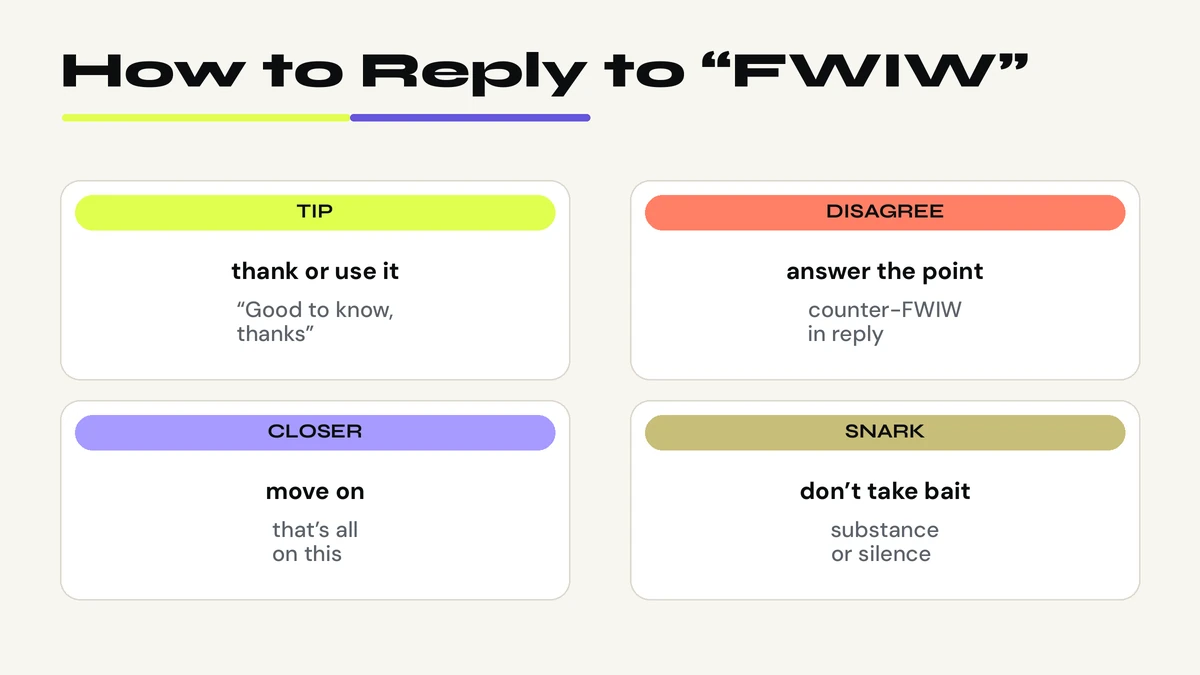
Five replies, matched to the intent:
- Genuine tip — thank or use it: “Good to know, thanks.” A tip wants acknowledgment, not a debate.
- Polite disagreement — answer the point: “Fair — but FWIW, Viola Davis is an EGOT winner.” The counter-FWIW is the native reply.
- Optional data — accept or decline the idea: judge the idea itself, not the hedge. “Let’s try it” or “not this time” both work.
- Standalone closer — move on: a bare “…FWIW.” means “that’s all I have on this.” Let the conversation move on.
- Snark — don’t take the bait: answer the substance or let it pass. Attacking the hedge (“don’t FWIW me”) only feeds it.
What never works: answering a genuine tip with suspicion, a disagreement with a fight, or a snark FWIW as a sincere offer. The golden rule: answer the content, not the hedge.
Frequently Asked Questions
What does “FWIW” mean in a text message?
“For what it’s worth” — a soft way to offer an opinion or a fact. “FWIW, I think you’ll love that movie” is a suggestion, not a demand.
What does “FWIW” mean on TikTok, Snapchat, and Instagram?
The same hedge everywhere — no platform-specific meaning exists. TikTok stages it as a public softener for hot takes, Snapchat keeps it as private softening, Instagram uses it in comments and captions. Same letters, different stage.
Is “FWIW” rude?
Not by itself — it is usually polite. It turns snarky only when what follows is an obvious fact, or when it carries the 1844 “for what it’s worth — nothing” shrug.
What’s the difference between “FWIW” and “FYI”?
FYI is direct and factual — information you need. FWIW is subjective and tentative — an opinion or a fact you may ignore.
What’s the difference between “FWIW” and “IMO”?
IMO claims a belief (“this is what I think”). FWIW offers information whose value the sender deliberately understates (“here is something, do with it what you will”).
Can I use “FWIW” at work?
Yes — FWIW is at home in workplace emails (“FWIW, we could save 10% if we renegotiate”). In very formal emails, spell it out as “for what it’s worth” instead.
Someone just sent me “FWIW”. What do I say?
Answer the content, not the hedge: thank a tip, answer a disagreement with a counter-FWIW, accept or decline optional data, or let a snark pass.
The Takeaway
“FWIW” is a four-letter hedge — “for what it’s worth,” offering an opinion or a fact while lowering the pressure to accept it. When the letters arrive, run the Weight Test: position, newness, stakes. And when you send one, remember the only rule that matters: the weight is the meaning — put FWIW where you mean it.