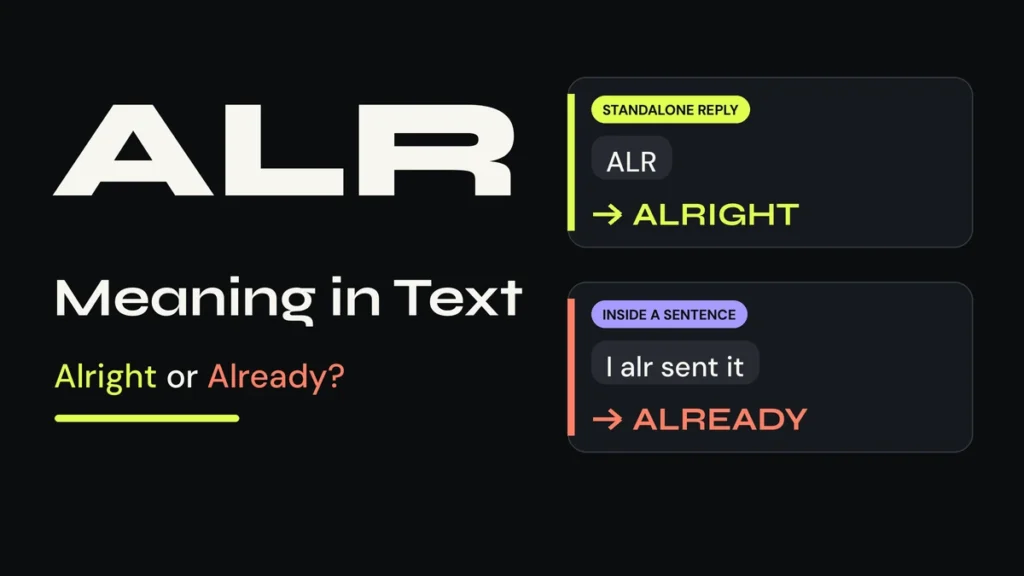

What does HBU mean in text? HBU means “how about you?” — a question bounced straight back to you. Someone shares something about themselves, then adds those three letters, and suddenly the ball is in your court: “I’m doing great today, hbu?” is not asking anything new. It is handing you the same topic and waiting to hear your version. That is the whole trick of HBU, and the Bounce-Back Test below tells you exactly which question just bounced back.
This guide to HBU meaning in text covers the three-check Bounce-Back Test, a six-reading tone spectrum, HBU on TikTok, Snapchat, Instagram, and in plain texts, how it lands by sender, the cousins it gets confused with, its history from old polite English to mid-2000s chat shorthand, the group-address rule, and the reply that keeps a conversation alive instead of killing it.
What “HBU” Means in Text
“HBU” means “how about you?” It is the shortest way to return a question without repeating it. The pattern is always the same: share first, bounce second. “Just finished my run, feeling great. HBU?” shares a status, then asks for yours. “I’m ordering pizza, hbu?” shares a plan, then asks for yours. “I like tea. HBU?” shares an opinion, then asks for yours. The primary dictionary source for this series is Wiktionary (HBU entry); every secondary guide read for this article glosses HBU the same way, and no source read disagrees with the expansion. The entry was verified directly before publishing: Wiktionary lists lowercase hbu as a phrase, Internet slang, an initialism of “how ’bout you?”, with HBU as its alternative form.
HBU does three headline jobs inside ordinary conversation. As a check-in: “I’m doing great today, hbu?” As a plan-swap: “I’m free Saturday, hbu guys?” As an opinion mirror: “This movie is boring. HBU?” In each case HBU asks nothing new — it returns the topic that was just shared, with “you?” attached.
That return-job is what makes HBU different from its cousins. An opener asks the first question; a sign-off ends the conversation; HBU does neither. It sits in the middle of a chat and keeps it two-sided. A conversation with no HBU in it can easily turn into a monologue — one person reporting, the other reacting. HBU is the three-letter fix for that: it says “I shared mine, now yours,” and the chat stays a conversation.
The HBU Bounce-Back Test

HBU has one real ambiguity, and it is not about the expansion: which question just bounced back to you? Three checks settle it:
- Check 1 — The Shared-Bit Check. What did the sender just share — a mood (“I’m exhausted”), a plan (“I’m ordering pizza”), an opinion (“This movie is boring”), or a status (“Just got home”)? That shared bit IS the question, with “you?” attached. Answer that topic, not some other one.
- Check 2 — The Address Check. Is it addressed to you alone, or to a group (“hbu guys”, “hbu all”)? A solo HBU wants your answer; a group HBU wants anyone’s, and answering it does not obligate a private follow-up.
- Check 3 — The Genuine-or-Filler Check. Did the sender engage with your last message, or just bounce it? “That sounds rough — I’m good, hbu?” is genuine interest. A bare “hbu?” after your serious news, or a third straight bounce with no new sharing, is polite filler or a dodge — and the reply should match that, not the letters.
Worked trio. “Just finished my run, feeling great. HBU?” — shared status, solo address, genuine: answer with your own status. “I’m free Saturday, hbu guys?” in a group chat — shared plan, group address: answer the plan, briefly, in the group. “I just lost my job.” / “oh no. hbu?” — serious news met with a bounce: filler, bordering on a dodge; do not reward it with a cheery status update.
“HBU” in Real Chats
Illustrative examples written for this guide — not presented as real transcripts:
- The warm check-in. “I’m doing great today, hbu?” — genuine interest, the classic friendly bounce.
- The status bounce. “Just finished my run. HBU?” — share first, ask second. The default HBU.
- The plan bounce. “I’m ordering pizza, hbu?” — a plan handed over for a matching plan.
- The opinion mirror. “I like tea. HBU?” — a light swap; the bounce is the game.
- The group poll. “I’m free Saturday, hbu guys?” — an open bounce to everyone; low pressure, anyone may answer.
- The dodge. “oh no. hbu?” after serious news — the bounce ducks the topic instead of engaging with it.
The HBU Tone Spectrum

HBU’s meaning stays “how about you?”; its tone slides. Six readings, lightest to heaviest:
- Warm check-in: “I’m doing great today, hbu?” — genuine interest; the sender actually wants your answer.
- Casual keep-it-going: “Just chilling at home, hbu?” — small talk, no weight. The default reading.
- Group poll: “I’m free Saturday, hbu guys?” — an open bounce; nobody is singled out and nobody is pressured.
- Playful mirror: “I like tea. HBU?” — a light opinion swap; the bounce is part of the fun.
- Polite filler: a bare “hbu?” that adds nothing new — not rude, just empty. The conversation is idling.
- Cold dodge: “hbu?” after serious news or a long personal message — the bounce ducks the topic; the letters do avoidance work the sender did not say out loud.
The tone lives in the shared bit, the address, and the engagement — not in HBU alone. When in doubt, assume the casual keep-it-going reading; coldness needs a dodge context, not just brevity.
“HBU” on TikTok
On TikTok, HBU is a comment-section bounce: “I loved this song, hbu?” under a video, or “I tried this recipe, hbu guys?” as a creator’s open question to thousands of strangers. The group-address rule matters most here — a creator’s “hbu guys” is a poll, not a personal question, and no single viewer owes an answer.
The dodge reading is rare on TikTok, since a comment cannot duck a private conversation; the playful-mirror reading dominates, with opinion swaps (“I like this one, hbu?”) filling whole threads.
“HBU” on Snapchat
On Snapchat, HBU fits the quick, disappearing DM: “Just got home, hbu?” as a streak check-in, or “Bored lol, hbu?” as a low-effort opener that is really a bounce. The ephemeral format suits HBU — a return question that lands lightly and vanishes.
On Snapchat the filler reading is easiest to miss, because the message vanishes. If an HBU felt empty, ask from memory: did the sender share anything new, or just bounce your last message back at you?
“HBU” on Instagram
On Instagram, HBU shows up in story replies and DMs: “This place is amazing, hbu?” as a story reply, or “I’m doing great today, hbu?” as a one-person DM check-in. The public version leans group poll; in DMs, the full range appears.
Instagram is also where HBU’s dating life shows most: a match’s “I liked the movie too, hbu?” is the icebreaker bounce, keeping an early conversation two-sided without either person having to invent a new topic.
“HBU” in Text Messages
Plain texts are HBU’s home ground. It pairs naturally with its conversation-opening cousin WYO — WYO (“what you on”) opens a conversation with a fresh question, HBU returns one that was already asked; one starts the topic, the other hands it back — and with DW in the reassurance cluster: “HBU, dw, we’ll sort it tomorrow” lets a worried friend answer at their own pace. Three abbreviations, three jobs, one fluent chat.
Texts are also where HBU’s group life lives: a family or friends group chat ending a plan with “hbu guys?” is not asking one person — it is polling the room. Answer the plan briefly, in the group, and do not spin off a private thread unless the answer is actually private. In a work Slack, HBU fits a casual team channel, but a formal email wants “how about you?” spelled out.
Who’s Sending It: How “HBU” Lands by Sender
No source documents a different meaning of HBU per sender — the meaning stays fixed; what changes is how the bounce reads:
- Friend: the default. A friend’s “hbu?” is a check-in at face value; answer the inherited topic and move on.
- Crush: overread territory. A crush’s “hbu?” feels bigger than it is — a bounce, not a confession. HBU carries no romantic meaning on its own.
- Partner: the daily rhythm. A partner’s “hbu?” is usually a genuine check-in; answer honestly, since a filler answer here gets noticed fast.
- Parent: common and usually warm. A parent’s “how are you, hbu?” is care, plain and simple — take it at face value.
- Group chat: the poll habitat. A group’s “hbu guys?” is an open bounce; answer briefly in the group, not privately.
- Coworker: context decides. A coworker’s “hbu?” in a casual channel is friendly small talk; in a work thread about a deadline, it can read as filler — answer the work first.
When “HBU” Is Not Just Polite
Three misfires, graded. First, the filler bounce: a bare “hbu?” that adds no new sharing, repeated three times in a row, turns a conversation into a mirror maze — each person bouncing the last message back with nothing added. If you catch yourself doing it, break the pattern: share something new, then bounce. Second, the dodge: “hbu?” after serious news — a loss, a health worry, a job loss — uses a friendly bounce to duck a hard topic. If you sent it, a follow-up that engages (“Sorry, that sounds really tough — do you want to talk about it?”) repairs it. If you received it, do not reward it with a cheery update; restate the point plainly or let the thread cool. Third, the empty opener: an “hbu?” with nothing shared before it asks a question that was never asked. It is not rude, just confusing — the reader has no inherited topic to answer. The closest cousin here is FWIW (“for what it’s worth”): FWIW softens an opinion before it is delivered, HBU returns a topic after it is shared. FWIW says “take it or leave it”; HBU says “now yours.”
Checked Claims: Expansions That Don’t Hold Up
Three letters attract folklore, and HBU attracts more than most because the same letters do real work in other fields. The claims that fail evidence as chat meanings:
- “HBU means something romantic or flirty by itself” — rejected. HBU carries no romantic meaning on its own; a crush’s HBU feels bigger because of who sent it, not because of the letters.
- “HBU asks a brand-new question” — rejected. HBU never opens a topic; it returns the topic just shared. An “hbu?” with nothing before it is a misfire, not a meaning.
- “HBU and WBU mean different things” — rejected as a strict claim. They are near-interchangeable; the status-vs-opinion lean in secondary guides is a soft tendency, never a rule.
- “HBU means ‘highest and best use’ in a text” — rejected as a chat reading. That is a real-estate appraisal term for the most profitable legal use of land; it belongs in a valuation report, not a DM.
- “HBU means ‘historically black university’ in a text” — rejected as a chat reading. That is an institutional acronym, not a message.
- “A bare ‘hbu?’ is rude” — rejected as a blanket claim. Bare HBU is usually just shorthand; it reads cold only when it dodges a serious message.
- “HBU needs a long answer” — rejected. HBU invites a quick, casual answer matching the inherited topic; a long essay over-answers it.
- “HBU works in formal writing” — rejected. HBU is casual shorthand; formal contexts want “how about you?” spelled out.
What SURVIVES: “how about you?” (strong, universal, a return question), with the warm check-in, casual keep-it-going, group poll, playful mirror, polite filler, and cold dodge as readings of the same bounce — not as different meanings. Everything else failed evidence as a chat meaning.
“HBU” vs Its Closest Cousins
HBU belongs to the conversation-flow family — the words that steer a chat rather than fill it:
- BRB (“be right back”) — the pause cousin. BRB pauses a conversation for minutes; HBU continues it. BRB says “hold on”; HBU says “now yours.”
- CYA (“see you”) — the goodbye cousin. CYA closes with a promise to return; HBU keeps the chat going. CYA says “until next time”; HBU says “your turn.”
- GN (“good night”) — the sign-off cousin. GN closes the night; HBU keeps the chat alive. GN says “we’re done”; HBU says “keep going.”
- BTW (“by the way”) — the side-note cousin. BTW adds something extra mid-conversation; HBU returns the topic. BTW says “oh, also”; HBU says “now yours.”
HBU often travels with a share — never alone. A bounce with nothing behind it is the one HBU that fails, and the fix is always the same: share something first, then bounce.
Where “HBU” Came From
The phrase “how about you?” is old polite English — the return half of a greeting, used for centuries after asking about someone’s wellbeing. The HBU shortening is much younger: secondary guides date its popularity to the mid-2000s, when chat rooms, message boards, and SMS made three-letter returns worth their weight. Tiny keyboards and per-character costs rewarded exactly this kind of shorthand: why type “how about you?” when “hbu?” lands the same bounce?
From there HBU traveled the dating route — the icebreaker bounce that keeps early conversations two-sided — and the gaming route, where between-matches check-ins (“I reached level 10. HBU?”) keep a squad talking without slowing the game. Group chats added the final branch: “hbu guys?” turned a private bounce into a public poll. No inventor or first-use date is claimed; the mid-2000s dating is the secondary consensus, not primary attestation.
How to Reply When Someone Sends “HBU”
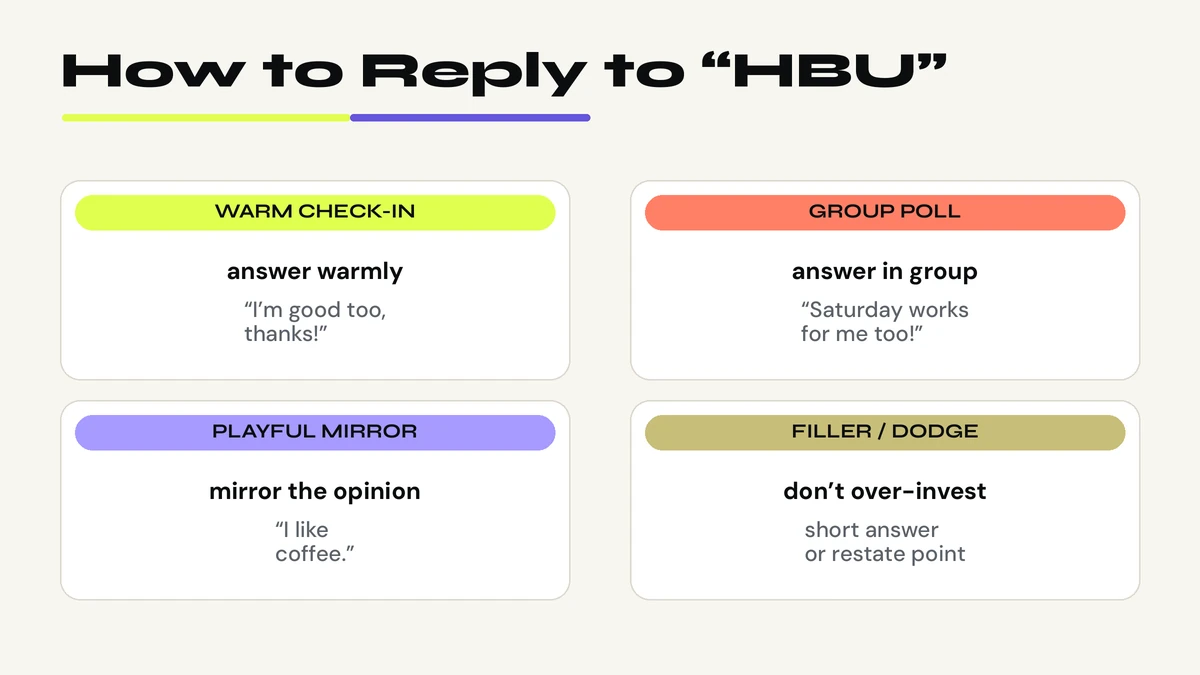
Five replies, matched to the reading:
- Warm check-in — answer warmly: “I’m good too, thanks! A bit tired but can’t complain.” A genuine bounce deserves a genuine answer.
- Casual keep-it-going — match briefly: “Just studying right now.” A small-talk bounce needs a small-talk answer.
- Group poll — answer in the group: “Saturday works for me too!” Brief, public, on-topic. No private spin-off needed.
- Playful mirror — mirror the opinion: “I like coffee.” The bounce is the game; play it back.
- Filler or dodge — don’t over-invest: a short answer, a new topic of your own, or — for a dodge after serious news — a plain restatement of the point. Never answer HBU with another bare “hbu?”: a third straight bounce with no sharing kills the thread.
What never works: answering the letters instead of the inherited question. The golden rule: answer the topic that was just shared, applied to yourself.
Frequently Asked Questions
What does “HBU” mean in a text message?
“How about you?” — a return question. “I’m doing great today, hbu?” shares a status, then asks for yours.
What does “HBU” mean on TikTok, Snapchat, and Instagram?
The same return question everywhere — no platform-specific meaning exists. TikTok stages it as a comment bounce, Snapchat as a disappearing DM check-in, Instagram as a story reply or DM question. Same letters, different stage.
What’s the difference between “HBU” and “WBU”?
Almost none in practice — they are near-interchangeable. Secondary guides note only a soft lean: HBU after a mood or status, WBU after an opinion or plan. Treat it as a tendency, never a rule.
Is a bare “hbu?” rude?
Usually not — bare HBU is normally just shorthand. It reads cold only when it dodges a serious message or follows bad news.
What’s the difference between “HBU” and “WYO”?
WYO (“what you on”) opens a conversation with a fresh question; HBU returns a question that was already shared. One starts the topic, the other hands it back.
Can I use “HBU” at work?
In a casual team chat, yes. In a formal email, spell out “how about you?” instead; HBU is casual shorthand.
Someone just sent me “HBU”. What do I say?
Answer the inherited question, applied to yourself: their mood, plan, opinion, or status, in your version. Keep it brief, and never answer with another bare “hbu?”
The Takeaway
“HBU” is a three-letter return question — it shares nothing new, asks nothing new, and still keeps a conversation alive by handing the topic back. When the letters arrive, run the Bounce-Back Test: shared bit, address, genuine or filler. And when you send one, remember the only rule that matters: a bounce with nothing behind it bounces nothing back.