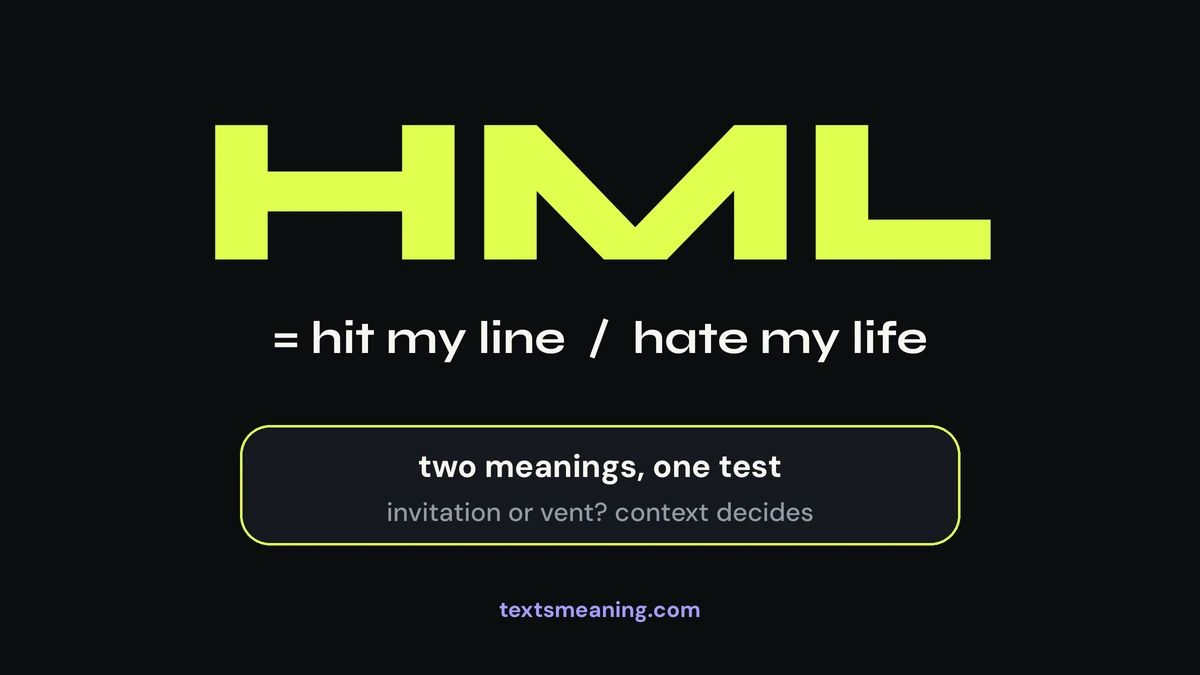
What does HML mean in text? HML means “hit my line” or “hate my life” — two opposite readings of the same three letters. One is an invitation to get in touch; the other is a vent about a bad moment. Context decides which one you just received, and this guide gives you the test that settles it in seconds.
This guide to HML meaning in text covers the HML Direction Test, a four-case misread matrix, HML on TikTok, Snapchat, Instagram, and in texts, how it lands by sender, when a vent stops being slang, its cousins, its history, and reply scripts split by meaning.
What “HML” Means in Text
“HML” carries two live meanings, and both are widely used. The first is “hit my line”: contact me. “Line” here means a phone line or contact channel, so “HML” asks the other person to call, text, or DM you. The second is “hate my life”: an exaggerated vent, almost always about an everyday frustration rather than a real crisis.
Here is the honest part most guides skip: nobody can truthfully tell you which meaning is more common overall. Some guides claim the invitation reading dominates on Snapchat; others claim the vent reading is most often meant. Those claims contradict each other, and neither comes with real usage data, so this guide makes no dominance claim. Instead of a fake statistic, you get a test — and the test works no matter which meaning is trending this month.
Two quick facts before the test. Capitalization does not decide: lowercase “hml” and uppercase “HML” carry the same two meanings. And HML is not a typo of anything: it is not a misspelling of HMU, and it is not a shortened “hm”. The invitation and the vent grew up separately and collided on the same three letters, which is exactly why the collision confuses people.
The HML Direction Test
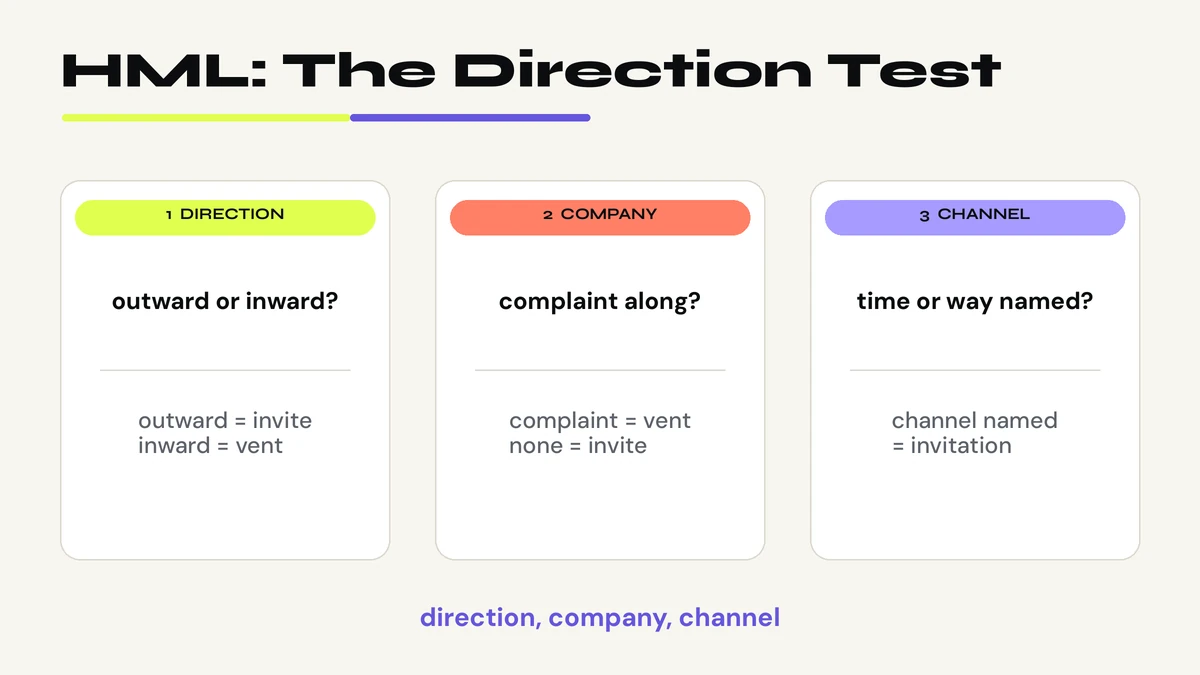
HML has one real ambiguity, and it is a fork in the road, not a shade of tone: is this message pointing outward or inward? Three checks, in order, settle it:
- Check 1 — Direction. Is the message pointing outward or inward? Outward means it aims at someone: a plan, a question, a story caption written for an audience. Outward means “hit my line.” Inward means it sits with a feeling: a mishap, a bad day, a complaint with no one being asked to do anything. Inward means “hate my life.”
- Check 2 — Company. Does a complaint ride along? “Today was the worst, hml” carries a complaint, so it vents. “Bored, hml” carries no complaint, so it invites. When the two checks agree, you are done; when they disagree, Check 3 breaks the tie.
- Check 3 — Channel. Does it name a time, a place, or a way to reach them? “HML when you get home” and “HML on the weekend” both name a channel, so both invite — even if the sender also had a long day. A channel beats a mood.
Worked pair. “HML later” after making plans: outward, no complaint, channel named — invitation. “Ugh, HML” after a phone screen cracks: inward, complaint attached, nobody invited — vent. Same letters, opposite jobs, and the test never once asks you to guess how the sender felt in general. It asks what the message itself does.
“HML” in Real Chats
Illustrative examples written for this guide — not presented as real transcripts:
- The story-caption invite. “Got an extra ticket — hml if you want it” — outward, audience-facing, a clear invitation.
- The flirty DM. “HML when you get home” — outward, channel named, interest without a direct ask.
- The open door. “Bored at the mall, hml” — outward, no complaint, low-pressure invitation.
- The planned catch-up. “HML on the weekend, let’s finally catch up” — outward, time named, invitation.
- The mishap vent. “Phone screen cracked again. HML.” — inward, complaint attached, nobody invited.
- The bad-day vent. “HML, today was the WORST. Can we talk?” — inward, complaint attached, sympathy wanted, not a call.
- The comic exaggeration. “They’re out of ice cream sandwiches. HML.” — inward, but the stakes are tiny, which is the joke.
- The bare mystery. “hml.” alone, no complaint, no channel — genuinely ambiguous. Answer with a question, never a guess.
Reading the Tone: Invitation or Vent?
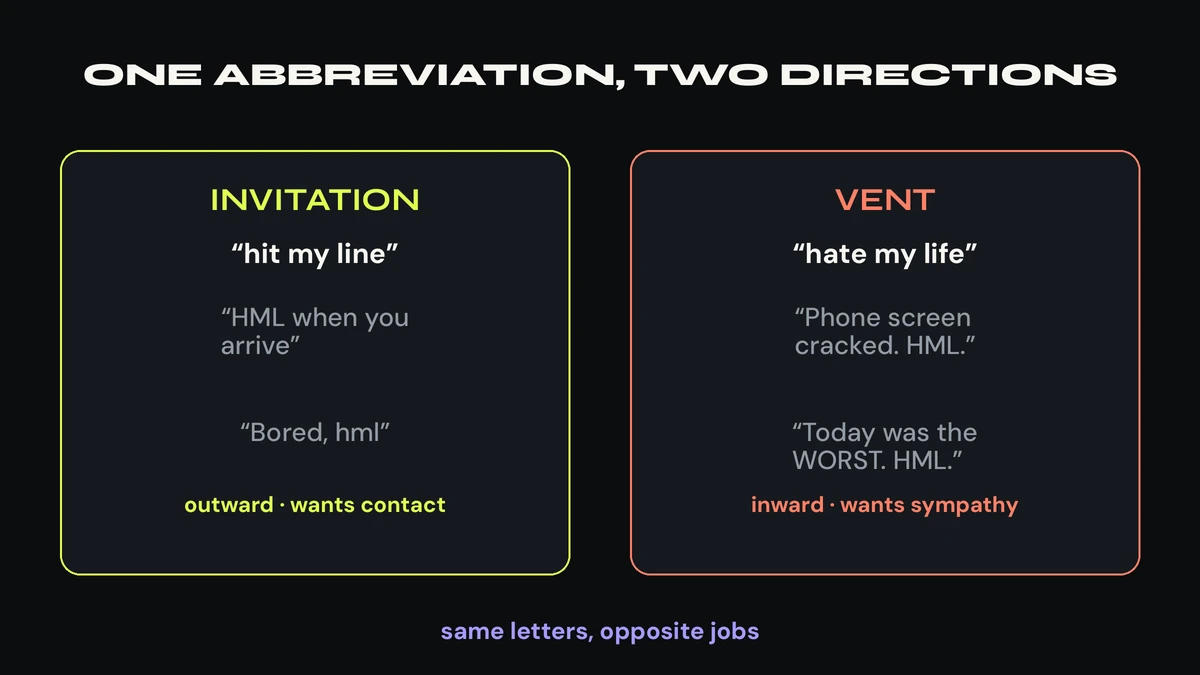
HML’s two meanings carry opposite tones, which is why a misread stings more than a normal misunderstanding. The invitation side runs warm:
- Warm invitation: “HML when you arrive” — genuinely wants contact, no games.
- Casual open door: “Bored, hml” — low-pressure, take it or leave it.
- Flirty nudge: “HML when you get home” with a winking emoji — interest without a direct ask.
The vent side runs from funny to heavy:
- Comic exaggeration: “They’re out of ice cream sandwiches. HML.” — funny because the stakes are tiny.
- Real frustration: “HML, today was the WORST” — wants sympathy, not solutions yet.
- Weary resignation: “HML. Got called on in class and I hadn’t been paying attention” — self-deprecating, shrugging it off.
Emoji steer tone inside a meaning but never switch meanings: a crying emoji on a vent deepens it, a winking emoji on an invitation flirts it up, and no emoji can turn a vent into an invitation. The most dangerous message is the bare one — “hml.” with no complaint and no channel — because both readings fit it perfectly. That message is not a riddle to solve; it is a question to ask.
“HML” on TikTok
On TikTok, HML lives in comments and captions, and the invitation reading leads there. A creator posts two concert tickets with “Got an extra, hml!” and the meaning is unmistakable: message me if you want it. The public stage suits an invitation — the whole point is reaching strangers who might take you up on it.
The vent reading shows up on TikTok too, usually as a caption on a bad-day video or a hashtag after a fail clip: “#HML” under a video of a ruined recipe. The video itself does the Direction Test for you: if the clip shows a mishap, it vents; if it shows an offer, it invites.
“HML” on Snapchat
Snapchat is HML’s home ground, and it is also where the two readings split by placement. On a story, HML almost always invites: “someone HML, I’m bored” is a broadcast to friends saying “message me.” A story is an outward format, so the Direction Test’s first check usually answers itself.
In a private DM, the split evens out. A DM vent — “HML, my car broke down today” — is inward and personal, while a DM invite — “HML when you’re free” — names a channel. Same app, different default, decided by placement. That placement rule is the single most useful Snapchat fact in this guide, and it is the one most guides never state.
“HML” on Instagram
On Instagram, HML follows the same placement rule as Snapchat, with one extra twist: the bio and caption. A caption like “bored hml” under a selfie invites DMs, while a close-friends story vent — “HML, worst week ever” — vents to a trusted circle. The audience size is the tell: the wider the audience, the more likely an invitation; the smaller and closer the audience, the more likely a vent.
In Instagram DMs, the flirty reading shows most. “HML when you get home” between two people already talking is a nudge, not a broadcast, and it works precisely because it is softer than asking outright. The softness is the feature: it lets the other person answer without either side risking a direct rejection.
“HML” in Text Messages
Plain texts are where both readings feel most natural, and where they travel with companions. The reassurance companion DW pairs with the vent reading — “HML, dw, I’ll call when I’m free” softens a bad day with a promise — and the side-note companion BTW pairs with the invitation reading: “HML, btw, got a new number” invites contact and slips in the reason in the same breath. Two companions, two jobs, one fluent chat.
Texts are also where HML should stay out: work messages. “HML if you want edits” to a colleague is a double failure — it is informal, and it is ambiguous, since the colleague cannot tell whether you are inviting contact or announcing a bad day. In any message where clarity matters, write “Message me when you’re free” instead and save HML for friends.
Who’s Sending It: How “HML” Lands by Sender
No source documents a different meaning of HML per sender — the two readings stay fixed; what changes is which one you should expect first:
- Friend: the even split. A friend’s “hml” could be either; run the test, don’t guess from habit.
- Crush: invitation first. A crush’s “HML when you get home” is a nudge, not a complaint — but a bare “hml” from a crush is still ambiguous, so ask.
- Partner: pattern rules. A partner’s vent “hml” after a bad day wants comfort; a partner’s invite “hml” wants a call. Judge the week, not one message.
- Parent: rare and usually literal. A parent’s “hml” most likely means “call me” — and if it reads as a vent, take it seriously, because parents rarely vent in slang.
- Stranger or acquaintance: invitation only, and only in public. A stranger’s story-caption “hml” is an open door; a stranger’s private “hml” with no context deserves no answer at all.
- Boss or group chat: the risky habitat. A boss’s “hml” is unclear by definition, and a group-chat “hml” is usually a story-style invite aimed at everyone, not you specifically.
When “HML” Is a Cry for Help, Not Slang
Most “hate my life” messages are hyperbole — the ice-cream-sandwich kind, where the joke is that life is obviously fine. But a vent pattern can stop being slang, and this section exists because the previous article in this series never had to say this: a pause cannot cry for help, but a vent sometimes can.
Three signs that the slang frame no longer fits. First, repetition: “hml” every day for a week is not a joke wearing thin, it is a mood settling in. Second, escalation: the complaints get heavier, from broken phones to sleepless nights to feeling hopeless. Third, self-harm language of any kind, even joking — jokes about harm are still a signal to check in, not a punchline to match.
What to do is simple and human: drop the slang, answer as a person. “Hey, you’ve seemed really down this week. Are you okay? I’m here if you want to talk.” Do not debate whether they meant it, do not reply with a funnier vent, and do not diagnose anything. If you are worried about someone’s safety, encourage them to reach a trusted person or a crisis helpline in their country right away. A three-letter abbreviation is never more important than the person typing it.
The Misread Matrix: Four Ways “HML” Goes Wrong
Most guides list correct readings. Misreads are more instructive, because each one shows exactly which check was skipped:
- Invite read as vent. “HML when you get home” answered with “aww, sorry to hear that” — the flirt dies on the spot. Skipped check: Direction. The message pointed outward.
- Vent read as invite. “HML, today was the WORST” answered with “ok, calling now!” — tone-deaf, because sympathy was wanted, not a call. Skipped check: Company. A complaint rode along.
- Flirt read as rejection fuel. “Bored, hml” met with silence because the reader assumed it was a vent about boredom — an open door quietly closes. Skipped check: Channel. No complaint, public format, invitation.
- Bare “hml” guessed wrong. A lone “hml.” answered as an invitation when it was a vent, or comforted as a vent when it was an invitation — both fail, because a bare “hml” carries no evidence at all. Skipped step: asking. “You good, or do you want me to call?” costs one sentence and prevents all four misreads.
Checked Claims: Expansions That Don’t Hold Up
Three letters attract folklore. The claims that fail evidence:
- “HML means only hit my line” — rejected. The vent reading is attested across independent guides with its own example sentences; erasing it would mislead every reader who meets a vent.
- “HML means only hate my life” — rejected on the same evidence in reverse. Story captions and DMs full of invitations cannot be explained away.
- “HML means ‘hanging by my lovely’” — rejected openly. It appears in one low-authority listicle as a supposed Snapchat meaning about independence, with no example sentences and no corroboration anywhere else.
- “HML means ‘help me lord’ in chats” — graded niche, not general. It appears in abbreviation lists and one competitor cheat sheet tied to a crying emoji, but no source shows it as a live chat reading; it is not taught here.
- “HML means ‘hit me later’” — graded a folk back-formation. Abbreviation lists carry it, but live examples always resolve to “hit my line” with “later” added as a separate word (“HML later”); not a third meaning.
- “HML is a finance term in texting” — rejected for chat. “High minus low” is a stock-market factor, never a texting reading.
- “HML is just a typo of HMU” — rejected. HML and HMU are distinct, parallel invitations, and HML’s vent reading has no HMU parallel at all.
What SURVIVES: two readings, “hit my line” and “hate my life”, both strongly attested, neither dominant on the available evidence. No dominance statistic is repeated here as fact, because none exists. And one honest gap: no established dictionary entry for chat HML could be verified at research time — the direct dictionary check was blocked and no entry surfaced in search — so this article claims no dictionary attestation and carries no external link rather than citing a source it could not verify.
“HML” vs Its Closest Cousins
HML belongs to two families at once — the invitation family and the vent family — which is why its cousins split down the middle:
- HM (“hmm” written short) — the lookalike cousin. HM is a thinking pause, not an acronym at all; HML is an acronym with two expansions. Same first two letters, nothing else in common — the easiest confusion in this series, and the one to unlearn first.
- FML (“f*ck my life”) — the stronger vent cousin. FML says the same frustration louder and profanely; HML’s vent reading is the milder, everyday version. FML shouts; HML sighs.
- BRB (“be right back”) — the timed-pause cousin. BRB promises a return in minutes; HML’s invitation promises nothing but contact. BRB says “hold on”; HML says “reach me.”
- CYA (“see you”) — the closing cousin. CYA ends a conversation with a promise to return; HML’s invitation opens one. CYA says “until next time”; HML says “let’s start.”
- GN (“good night”) — the night-closing cousin. GN closes the day; HML’s invitation can arrive at any hour. GN says “we’re done for tonight”; HML says “I’m here.”
HML’s invitation reading often travels with a channel — “HML later”, “HML when you’re free” — the cheapest way to keep an invitation from reading as a vent.
Where “HML” Came From
“Hit my line” comes from phone-era speech: “hit my line” meant “call my number” before texting slang existed, and it moved from phone culture into DMs and story captions as the phone itself became a messaging device. One guide suggests a hip-hop lyric path for the phrase, but gives no verifiable citation, so that path is recorded here as a lead, not a fact.
“Hate my life” grew as the negative counterpart to LML (“love my life”) in early-2000s internet slang, according to a 2019 slang guide — again a competitor lead, not a primary source. The two readings then converged on the same three letters independently: one from phone speech, one from vent acronyms. No inventor, no first-use date, and no origin statistic is claimed, because none can be verified.
How to Reply When Someone Sends “HML”
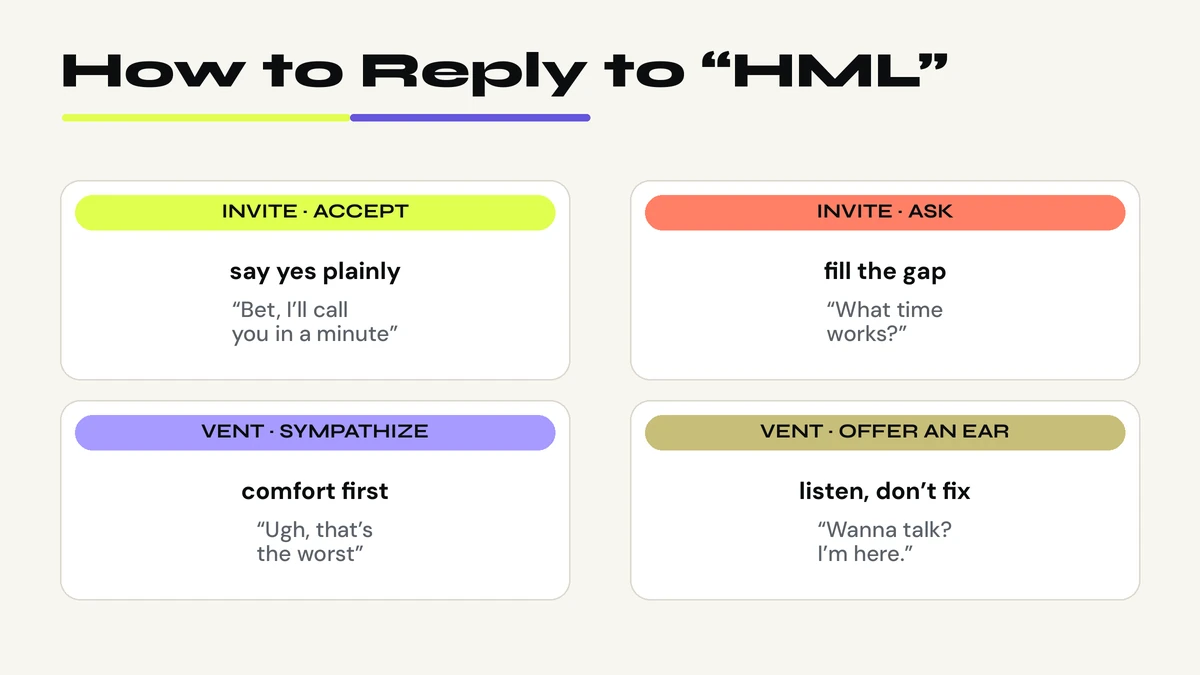
Replies split by the Direction Test’s result. First, the invitation replies:
- Accept plainly: “Bet, I’ll call you in a minute” or “Texting you now!” An open door wants a yes, not a speech.
- Ask the missing detail: “What time works?” or “What’s up?” A channel without a time still needs one.
- Decline kindly: “Can’t tonight, but tomorrow?” A kind no beats silence, which reads as rejection.
Then, the vent replies:
- Sympathize first: “Ugh, that’s the worst” — comfort before advice, always.
- Offer an ear: “Wanna talk about it? I’m here.” A vent that asks to talk wants listening, not fixing.
- Match the scale: a tiny mishap gets a light reply (“RIP, ice cream sandwiches”); a bad day gets a real one. Overshooting a joke or undershooting a bad day both misread the room.
And the ambiguous bare “hml”: ask. “You good, or do you want me to call?” covers both readings in one sentence and is the only reply that cannot misfire.
Frequently Asked Questions
What does “HML” mean in a text message?
Either “hit my line” (contact me) or “hate my life” (an exaggerated vent). Run the Direction Test: outward with a channel means invitation; inward with a complaint means vent.
What does “HML” mean on TikTok, Snapchat, and Instagram?
The same two meanings everywhere — no platform-specific meaning exists. But placement shifts the default: story captions lean invitation, private DMs split evenly, and close-friends stories lean vent.
Is “HML” flirty?
It can be. “HML when you get home” between people already talking is a soft nudge — interest without a direct ask. A story-caption “hml” is usually just an open door, not flirtation.
Is a “hate my life” message serious?
Usually it is hyperbole about an everyday frustration, and a light reply fits. But if the pattern repeats, escalates, or mentions self-harm, drop the slang frame and check in as a person.
What’s the difference between “HML” and “HMU”?
Almost none on the invitation side: both mean “contact me”, with HML naming your line and HMU naming you. The difference is the vent side: HMU has no “hate my life” reading, so HML is the only one of the pair that can vent.
Can I use “HML” at work?
No. It is informal and ambiguous — a colleague cannot tell whether you are inviting contact or announcing a bad day. Write “Message me when you’re free” instead.
Someone just sent me “hml” with no context. What do I say?
Ask, don’t guess: “You good, or do you want me to call?” It covers both readings in one sentence and is the only reply that cannot misfire.
The Takeaway
“HML” is a two-way switch — an invitation in one direction, a vent in the other — and the letters alone will never tell you which way it points. When they arrive, run the Direction Test: outward or inward, complaint or none, channel or none. And when you send one, remember the only rule that matters: an invitation without a channel looks like a vent, and a vent without a complaint looks like an invitation.