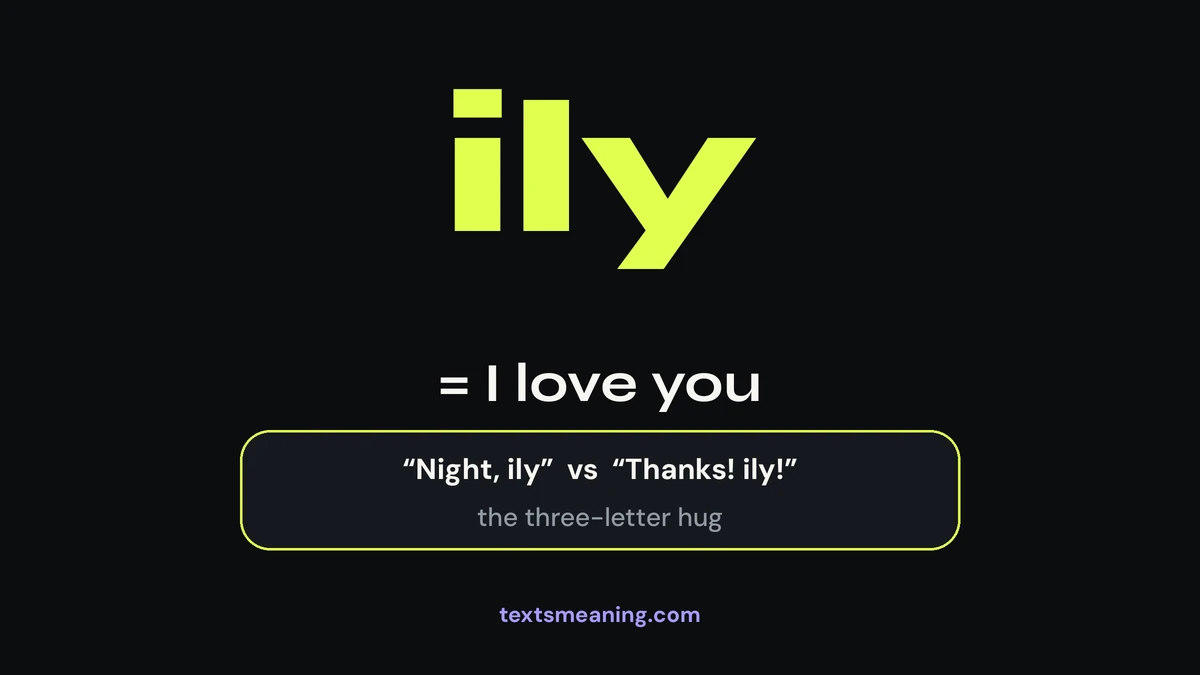
What does ily mean in text? ILY means “I love you” — three letters that carry affection, gratitude, or a warm goodbye in a text. The letters never change; the weight does, and this guide to ily meaning in text teaches you to weigh it.
This guide covers the one dictionary-attested expansion, the ILY Full-Sentence Test, a seven-reading tone list, ily on TikTok, Snapchat, Instagram, and in texts, senders, misreads, graded claims, cousins, history, and a reply bank keyed to the weight you just found.
What “ILY” Means in Text
“ILY” means “I love you.” It is an initialism, built from the first letters of the phrase, and it works as a complete sentence or a sign-off: it can stand alone as a whole reply (“ily”), close a longer message (“Night, ily”), or sit inside one (“Thanks again, ily”). Unlike the shrug terms in this series, ily is not hedging anything. It is saying something, just in the lightest possible packaging.
The dictionary record is unusually clean. Wiktionary lists ily as a phrase initialism of “I love you” in text messaging, with lowercase ily as the usual form, so capitalization does not change the meaning — it changes the volume, which the test below uses. Dictionary.com, as reported by the main competitor, defines ILY the same way, as an abbreviation for “I love you” used in digital communication as an earnest or playful declaration of affection. Every competitor guide read for this article agrees on the same expansion, and no competing texting expansion with any dictionary attestation was found.
That agreement is exactly what makes ily tricky. When the meaning is certain, the puzzle moves somewhere else: not what the letters stand for, but how much they mean this time. A best friend thanking you for a lift, a partner saying goodnight, and a crush typing their first ily are all writing the same three letters, and none of them means quite the same thing. The rest of this guide is about telling those apart — because answering a thank-you like a confession, or a confession like a thank-you, is where ily actually goes wrong.
The ILY Full-Sentence Test
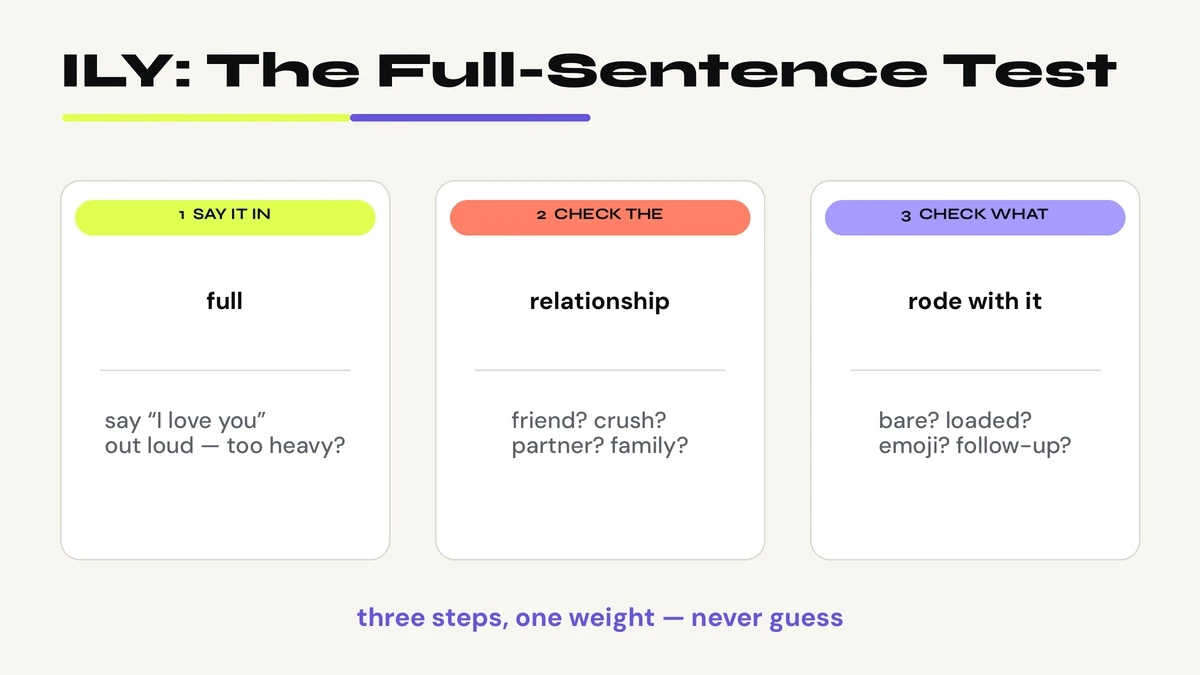
Before you answer an ily — or send one — run three steps. They take about five seconds, and they beat every shortcut the competitors offer, because the competitors all say “context matters” without giving you a procedure for reading it:
- Step 1 — Say it in full. Replace ily with “I love you” and read the message back. If the full sentence would feel far too heavy for the moment — “Thanks for the ride. I love you!” after a lift home — you are holding the light reading: gratitude or a warm sign-off. If the full sentence fits the moment naturally — a partner ending a goodnight text — you are holding the real reading.
- Step 2 — Check the relationship. The same letters from a best friend, a crush on date two, and a partner of three years are three different messages, and no step-1 result survives a wrong step-2 answer. A friend's ily is almost never a confession; a new crush's first ily almost never means what a partner's hundredth ily means.
- Step 3 — Check what rode with it. A bare “ily” is lighter than a loaded one (“ily, thank you for today, really”). Lowercase is the relaxed default; all caps is louder and more emphatic. An emoji, a heart, or a follow-up sentence adds warmth that bare letters cannot carry — and a bare ily after a serious moment is the one that deserves a second look.
Worked trio. “Thanks for picking me up in the rain. ily!” — the full sentence would be absurd after a lift, the sender is a friend, and gratitude rides with it: light reading, answer with warmth. “Night, ily” from a partner — the full sentence fits, the relationship is established, and it closes the day: real reading, answer in kind. “ily” alone from a crush after two dates — the full sentence would be a confession, and the abbreviation is doing the job of testing the waters: do not answer a confession the sender has not quite made.
“ILY” in Real Chats
Illustrative examples written for this guide, not real transcripts:
- The grateful lift. “Thanks for picking me up in the rain. ily!” — gratitude, not a declaration. The favor did the talking; ily just signed it.
- The family sign-off. “Night all, ily” — a hug at the door of a group chat. Nobody in the family thread reads this as news.
- The playful tease. “You brought snacks AND remembered my birthday? ily.” — half joke, half real, and the joke is what makes it safe to send.
- The platonic affirmation. “Anytime, that is what friends are for. ily.” — love for a friend, stated plainly, with nothing romantic meant.
- The romantic goodnight. “Goodnight, sweet dreams. ily.” — the routine version of the real thing, warm precisely because it is regular.
- The testing-the-waters first ily. A crush's first bare “ily” after a good evening — the abbreviation used because the full sentence would be too much, too soon. Read it as an opening, not a verdict.
- The loaded apology. “ily, I am really sorry about yesterday” — the abbreviation straining under a weight it was not built for. Answer the apology, not the letters.
The ILY Tone List
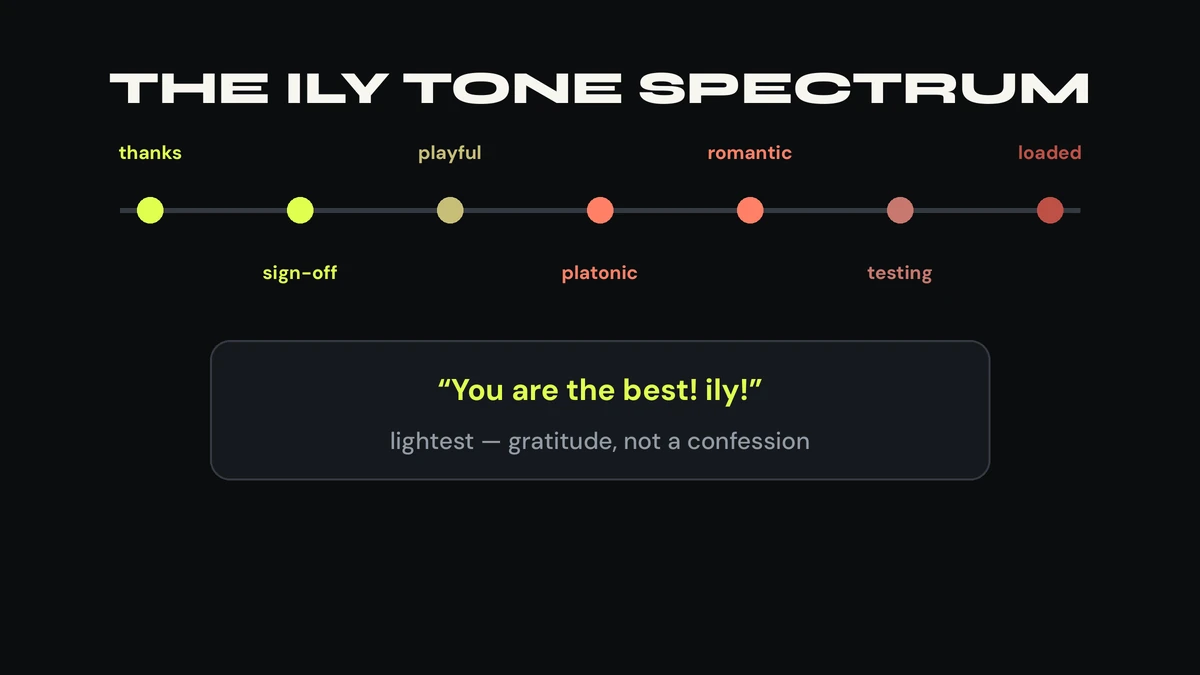
ILY's meaning stays “I love you”; its weight slides. Seven readings, lightest to heaviest:
- Grateful thanks: “You are the best! ily!” after a favor — affection as a thank-you, not a declaration.
- Warm sign-off: “Night all, ily” closing a chat — a hug at the door, not a speech.
- Playful tease: “You brought snacks AND remembered my birthday? ily.” — half joke, half real.
- Platonic affirmation: “Anytime, that is what friends are for. ily.” — love for a friend, nothing romantic meant.
- Romantic reassurance: “Goodnight, sweet dreams. ily.” from a partner — the real thing, made routine by repetition.
- Testing the waters: a first ily from a crush or a new partner — the abbreviation chosen precisely because the full sentence would be too much, too soon.
- Heavy or loaded: ily carrying a first confession, an apology, or a serious moment — the abbreviation under a weight it was not built for. Answer the feeling, not the letters.
What moves a reading up or down this list is never the letters alone: it is the relationship (step 2), the load (step 3), and the moment. The same “ily” that is a throwaway thank-you on Tuesday can be a loaded message on the night of a first date — and the test, not the spelling, tells you which Tuesday you are on.
“ILY” on TikTok
On TikTok, ily is a comment-section and caption affection statement more than a private message: “ily this song” under a video, “ily both, you look so happy” under holiday photos, or a creator captioning a photo of friends with a bare “ily.” The public stage suits the lightest readings best — grateful thanks, playful tease, warm sign-off — because a comment thread is an audience, not a confession booth. Nobody owes a commenter a full sentence, and nobody should read a public ily as a private declaration.
The trap on TikTok is the reverse of the private-chat trap: taking a public ily too seriously. A creator who writes “ily” to a whole comment section is thanking a crowd, not proposing to you, and a commenter who writes “ily” under a stranger's video is applauding, not confessing. If an ily arrives in a TikTok DM, though, run the test as usual — a DM is private again, and the weight rules return with it.
“ILY” on Snapchat
On Snapchat, ily fits the fast, disappearing DM: “ily” as a story reply, “ily, thanks for today” on a streak snap, or a photo caption carrying the affection for a few seconds before it vanishes. The disappearing format suits the warm sign-off and playful readings — affection that lands lightly and is gone. But disappearance also removes your evidence: if an ily felt loaded, you cannot re-read it, so judge from memory what rode with it — an emoji, a follow-up, or nothing at all.
Snapchat is also where the crush ambiguity from the competitors lives most vividly. A crush's ily on Snapchat can read as a confession or as casual text speak, and the format gives you no second look to decide. The test still works from memory: who sent it, what would the full sentence have meant from them, and what else was in the snap? If you cannot answer all three, a warm, non-committal reply is safer than a confession in return.
“ILY” on Instagram
On Instagram, ily shows up in captions, comments, story replies, and DMs, and the stage decides the weight the way it does for every affection term. Captions lean warm and public: “ily” under a photo of friends or family is a declaration to an audience, closer to a toast than a whisper. Comments lean playful: “ily this” under a post is applause with a heart attached. DMs carry the full range, exactly like texts — a partner's goodnight ily and a match's first testing-the-waters ily live in the same inbox, and only the test tells them apart.
Instagram is also where ily meets its closest platform cousin. A bio or cross-post that says “follow my IG” is pointing at the app, not sending affection — our IG guide covers that pointer in full, and confusing the two is the one Instagram-specific misread worth naming: “IG” in capitals as a pointer is a noun, while “ily” as a message is a sentence. Same alphabet, different jobs.
“ILY” in Text Messages
Plain texts are ily's home ground, and the place its companion phrases are easiest to see. It pairs with the side-note companion BTW — “ily, btw, thanks again for today” stacks affection and an afterthought in one breath — and with the pause companion BRB — “ily, brb, dinner is ready” signs off warmly and pauses in the same message, which is why the two so often close a chat together.
Texts are also ily's work limit, stated plainly: never use ily in a professional message. A client, a manager, or a first contact deserves a plain thank-you or the full sentence, not three letters that presume an intimacy you do not have. The same rule covers formal writing, condolences, and any serious topic — affection deserves complete sentences when the moment is serious, and ily is, by design, incomplete.
Who Is Sending It: How “ILY” Lands by Sender
No source documents a different meaning of ily per sender — the expansion stays fixed; what changes is the weight, and therefore what you owe back:
- Friend: the default. A friend's ily is gratitude, a sign-off, or platonic affirmation at face value; answer warmly and do not overread it.
- Crush: overread territory. A crush's first ily feels bigger than it is — usually testing the waters, not a confession and not a joke. Answer warmly without forcing the conversation, and if you feel the same, say so in full words.
- Partner: pattern rules. A partner's ily is usually routine reassurance; judge the pattern across days, not one message — but a sudden stop in a partner's ilys, or a sudden first one after a fight, is a conversation worth having.
- Family: the sign-off habitat. A parent's or sibling's ily is almost always a warm closer (“Night, ily”); return it simply, and do not read romance into a family habit.
- Coworker or boss: context decides. In a friendly team chat a colleague's ily after you covered their shift is gratitude; in any formal thread it is out of place, and never send one upward to a manager or client.
- Group chat: the sign-off habitat at scale. A group's “ily all” closes the evening for everyone; answer briefly in the group, and do not single one sender out for a private reading of a public message.
- Stranger or creator: the applause habitat. A stranger's ily under your post, or a creator's ily to a crowd, is thanks or applause, not affection for you personally. A thank-you is enough; never answer in kind.
When “ILY” Is Not Just Sweet
Four misfires, graded. First, the first-confession trap: sending your first “I love you” as an ily. Competitor guidance is blunt here — using the abbreviation to tell someone for the first time is likely to read as insincere, because the abbreviation is, by every source's agreement, lighter than the full sentence. If you mean it for the first time, type the full sentence; the abbreviation saves keystrokes and costs sincerity at exactly the moment sincerity is the whole message.
Second, the weight-confusion hurt: a partner who expects the full phrase and gets only the abbreviation can feel shortchanged, and the competitors document this plainly. If someone you love tells you your ilys feel light, believe them — the fix is free, and it is spelling it out sometimes. Third, the stranger misread: answering a creator's or stranger's public ily as if it were personal affection. Applause is not intimacy, and a private reply to a public ily embarrasses both sides. Fourth, the heavy-moment misfire: dropping a bare ily after bad news, an apology, or a serious conversation, where a real sentence was owed. A bare abbreviation after a real moment reads as checked-out, not loving.
On appropriateness: ily is not rude and not vulgar in any reading; its risk is social, not moral — lightness where weight was owed, or intimacy where none exists. Keep it out of formal, professional, and first-impression messages, out of condolences and serious topics, and out of any first message to someone you do not know well. And one boundary worth stating plainly, adapted from the main competitor: a message of affection from an adult stranger to a child or teenager who is not family should never use affectionate shorthand at all — if your child receives an ily from someone you do not know, ask calmly who it came from, the way you would for any unexpected message.
Checked Claims: Expansions That Don’t Hold Up
- “ILY means ‘I am leaving you’” — rejected as a working texting meaning. No dictionary attests it; it appears only on abbreviation-list pages, and one full competitor guide states flatly that ily never means that. If a breakup message contains ily, the leaving is carried by the rest of the conversation, never by these letters.
- “ILY means ‘I like you’” — rejected as a separate expansion. No dictionary attests it; softer readings are tone — a light ily — not a second phrase hiding inside the letters.
- “ILY means something different on each platform” — rejected. No source documents a platform-specific meaning; TikTok captions, Snapchat DMs, and texts stage the same affection differently.
- “ILY is just as serious as ‘I love you’ spelled out” — rejected. Grammarly, ProWritingAid, and Englishan all agree the abbreviation is lighter and more casual than the full sentence; that lightness is the whole reason the weight test exists.
- “ILY is always romantic” — rejected. Friends, family, and grateful strangers use it constantly, and ProWritingAid documents the gratitude reading explicitly.
- “ILY is only for Gen Z” — rejected. SMS-era attestation from 2003 predates Gen Z texting, and parents use it as a sign-off.
- “ILY works in formal writing” — rejected. Every competitor confines it to casual chat; formal contexts want the full sentence or a plain thank-you.
- “The ASL hand sign and the text abbreviation are the same thing” — fenced, not rejected. The same three letters and the same phrase sit behind both, but the hand sign is a gesture with its own 1905 history, while the typed abbreviation is an SMS-era shortening; the article keeps them in separate sections.
What SURVIVES: “I love you” (dictionary-attested, Wiktionary plus unanimous competitor agreement), with the seven readings above as weights of the same affection — not different meanings. No competitor percentages are repeated here as fact, and the 2003 date is reported as earliest attestation, not coinage.
“ILY” vs Its Closest Cousins
ILY belongs to the affection family — words that say how you feel about someone, not what you know or whether you care. Its closest cousins:
- ILYSM (“I love you so much”): the amplifier. Same affection, turned up — use it when plain ily would understate the moment, not as the default.
- ILY2 / ILYT (“I love you too”): the return. The standard reciprocal reply, not a new message — it answers an ily, it does not start one.
- ILU (“I love U”): the older twin. Exactly the same meaning, but dated today; modern texting prefers ily, and ILU can read like a message from an earlier internet.
- LY (“love you”): the lighter sibling. One step lighter than ily — a sign-off so casual it barely counts as a declaration, and the right choice when even ily would feel heavy.
- XOXO (“hugs and kisses”): the sign-off cousin. Affection as punctuation at the end of a message, warmer as a closer than as a statement.
- IMY (“I miss you”): the absence cousin. Wistful where ily is present — ily says the feeling is here, IMY says the person is not.
And three contrast cousins from the shrug family, published in this series, that show what ily is not. IDK (“I don't know”) reports not-knowing where ily reports affection; IDC (“I don't care”) says indifference where ily says attachment; and IDEK (“I don't even know”) confesses confusion where ily confesses feeling. Mixing any of the three up with ily turns a feeling into a shrug.
Where “ILY” Came From
The phrase “I love you” is centuries-old ordinary English; the abbreviation belongs to the SMS and early-internet era. Competitors place its emergence in the early 2000s, when character limits and keypad typing rewarded three-letter feelings, and one guide reports an Urban Dictionary entry dated 2003 — user-generated attestation, not a coinage claim, and no inventor is named by any source. Like most texting shorthand, ily was born from a constraint — saying something big in very few keystrokes — and survived the constraint because the lightness turned out to be a feature: sometimes you want the feeling without the full weight of the sentence.
The same three letters have a separate, older life as a hand sign, and it deserves its own paragraph precisely so the two histories are never merged. The American Sign Language ILY sign blends the handshapes for I, L, and Y into a single gesture meaning “I love you”; Deaf Heritage dates its origin to 1905, and it reached mainstream television when Richard Dawson signed off each episode of Family Feud with it from 1976 to 1985. The Unicode hand-sign character followed in June 2018. That is why you will sometimes see the hand emoji next to the typed letters — same phrase, different channel, a century apart.
How to Reply When Someone Sends “ILY”
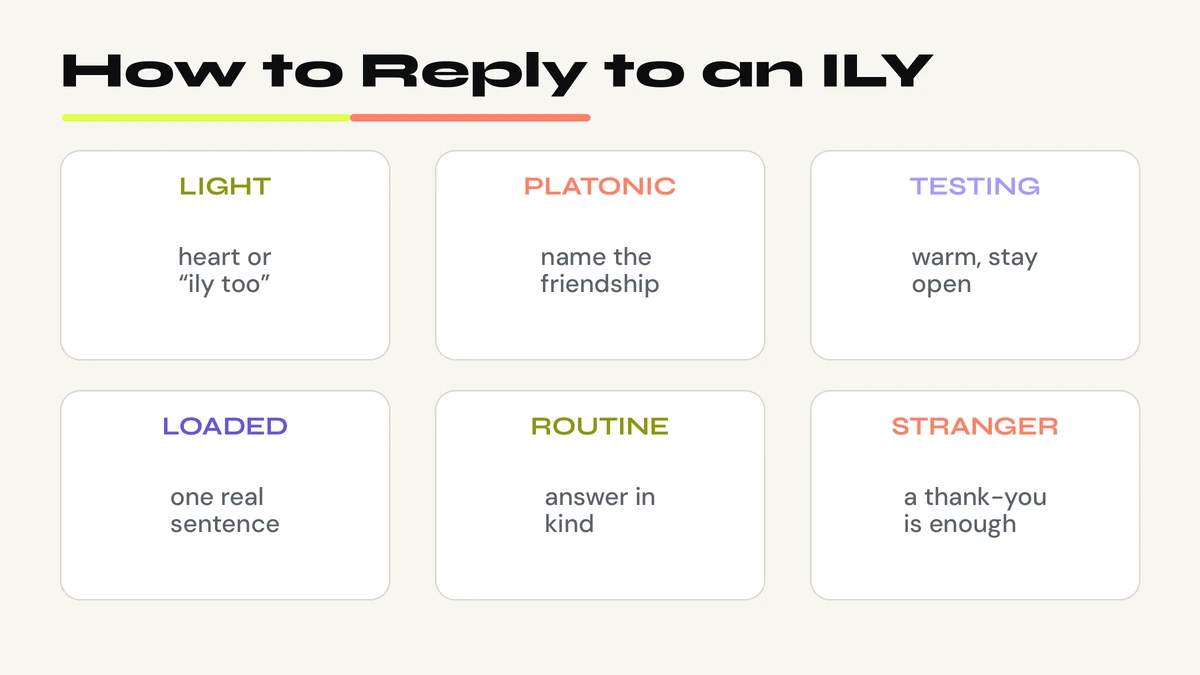
One rule, then six replies: match the weight the Full-Sentence Test found, not the letters. A light ily answered with a speech feels strange; a loaded ily answered with a bare abbreviation feels like dodging:
- Grateful thanks — return the warmth: “You are the best too!” or a heart. No speech required.
- Warm sign-off — close it simply: “ily2” or “ily too.” Routine affection wants a routine answer.
- Platonic affirmation — name the friendship: “ily too, always” or “Love you too, friend” — keeps the register clear.
- Testing the waters — stay warm, stay open: “You are the sweetest” keeps the door open without forcing the conversation; if you do feel the same, say so in full words, not in a returned abbreviation.
- Romantic reassurance — answer in kind: “ily more” or “ily too.” An essay in reply to a routine goodnight ily is more confusing than no answer at all.
- Heavy or loaded — answer the feeling: “Thank you for saying that — I love you too” or, if you are not there yet, “That means a lot, thank you.” A real sentence is the only reply that matches a loaded ily.
Weak versus strong. Weak: a bare “ily” back to a loaded message. Strong: “That means a lot, thank you — I love you too.” Small change, big difference. Golden rule: when the weight is unclear, answer with warmth plus one real sentence — warmth without a sentence can mislead, and a sentence without warmth can wound. You can also hand the chat forward with HMU — “ily, hmu later?” signs off warmly and keeps the door open for the longer conversation the abbreviation could not carry.
Frequently Asked Questions
What does “ILY” mean in a text message?
ILY means “I love you” in a text message. It is a quick, casual way to express affection, gratitude, or a warm goodbye, and its weight depends on who sent it and what rode with it — run the Full-Sentence Test above before you decide how much it meant.
Is ily always romantic?
No. Friends and family use it all the time, and it is often a light-hearted thank-you or sign-off with nothing romantic meant. Romance is one of its seven readings, not its definition.
Does ily mean the same as “I love you” spelled out?
The expansion is the same, but the weight is not. Every source in this guide agrees the abbreviation is lighter and more casual than the full sentence — which is why a first confession should be typed in full, and why a routine goodnight ily needs no more than “ily too” back.
What does ilysm mean?
ILYSM means “I love you so much.” It is ily with the volume turned up: the same affection, with extra feeling. Wiktionary lists it as a related term of ily.
What should I reply when someone sends ily?
Match the weight: a heart or “ily too” for a light ily, a named friendship for a platonic one, a simple return for a partner's routine ily, and a real sentence for a loaded one. The reply bank above has one for each reading.
Is it OK to send ily to a friend?
Yes, it is very common to send it to close friends. It shows you value the friendship, and between friends it reads as platonic affirmation — though if a friend might misread it, adding “friend” to your reply keeps the register clear.
Does ily ever mean “I am leaving you”?
No, not as a working texting meaning. No dictionary attests it, it appears only on abbreviation-list pages, and one full competitor guide states flatly that it never means that. If a breakup message contains ily, the leaving comes from the rest of the conversation, not from these letters.
What is the ILY hand sign?
The ILY hand sign is an American Sign Language gesture that blends the handshapes for I, L, and Y into a single sign meaning “I love you.” It dates to 1905 by Deaf Heritage's account, became widely known through Richard Dawson's Family Feud sign-offs in the late 1970s and early 1980s, and has its own Unicode character since June 2018. It shares a phrase with the typed abbreviation, not a birthday.
The Takeaway
Three letters, one phrase, seven weights. ILY means “I love you” — and whether that is a thank-you, a sign-off, a friend's affirmation, or a real confession is decided by the Full-Sentence Test: say it in full, check the relationship, check what rode with it. Send it lightly when you mean it lightly, spell it out when you mean it fully, and answer the weight you actually received.