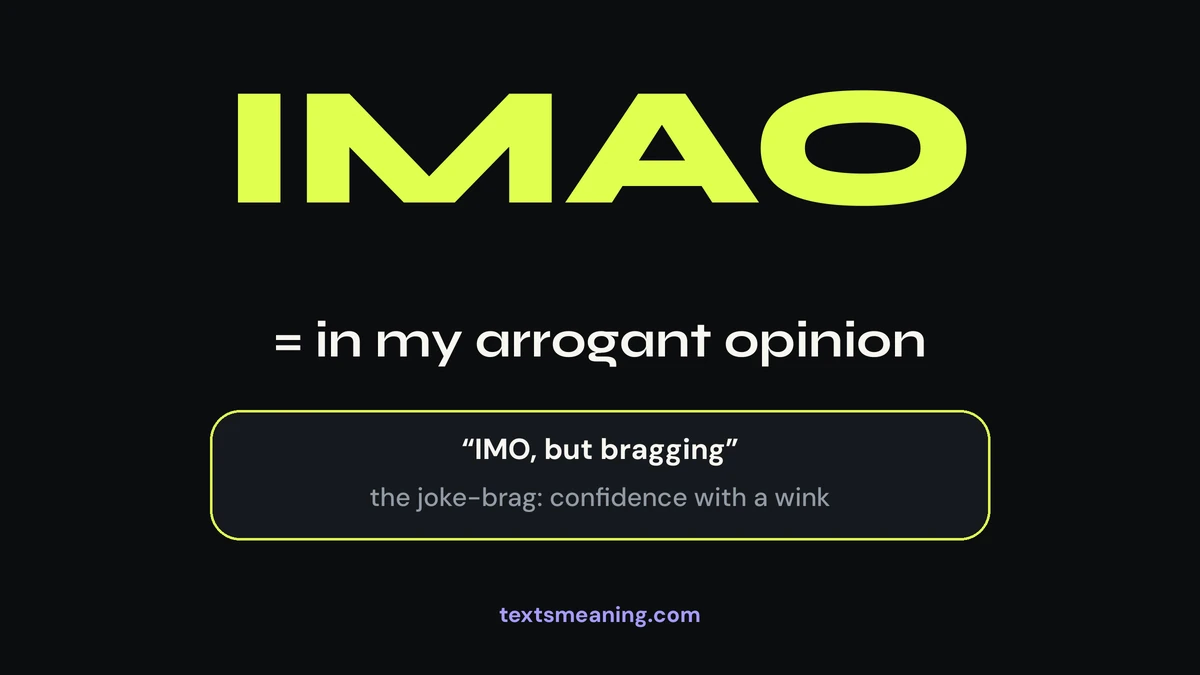
What does imao mean in text? IMAO means “in my arrogant opinion” — a playful, self-aware way to state a bold view without sounding too serious. It is an opinion with a wink attached, and this guide to imao meaning in text teaches you to tell the wink from the brag.
This guide covers the one dictionary-attested expansion, the IMAO Brag-or-Joke Test, a seven-reading tone list, imao on TikTok, Snapchat, Instagram, and in texts, senders, misreads, graded claims, cousins, history, a Drop-the-A rewrite tool, and a reply bank keyed to the reading you just found.
What “IMAO” Means in Text
“IMAO” means “in my arrogant opinion.” It is an initialism, built from the first letters of the phrase, and it works as a warning label you stick on your own opinion before anyone else can: “IMAO, pineapple belongs on pizza.” The opinion is the message; the IMAO is the joke about how confidently it is being delivered. Unlike a plain opinion, it arrives pre-defended — you cannot accuse the sender of being arrogant, because they already said it first, as a joke.
The dictionary record is short and decisive. Wiktionary lists IMAO as “(Internet slang, humorous) Initialism of in my arrogant opinion,” and its etymology line says it was “coined in contrast to IMHO (in my humble opinion).” That contrast is the whole joke in one line: IMHO softens an opinion by claiming humility, and IMAO hardens it by claiming arrogance — except the claim is humorous, so the hardening is itself a joke. Every competitor guide read for this article agrees on the same expansion, and no competing texting expansion with any dictionary attestation was found.
That agreement is exactly what makes imao tricky. When the meaning is certain, the puzzle moves somewhere else: not what the letters stand for, but whether the arrogance is real. A friend joking that their playlist is the best ever made, a commenter bracing for disagreement with “don’t @ me,” and a stranger genuinely talking down to a room are all writing the same four letters, and they do not mean the same thing. The rest of this guide is about telling those apart — because answering a joke like an insult, or an insult like a joke, is where imao actually goes wrong.
The IMAO Brag-or-Joke Test
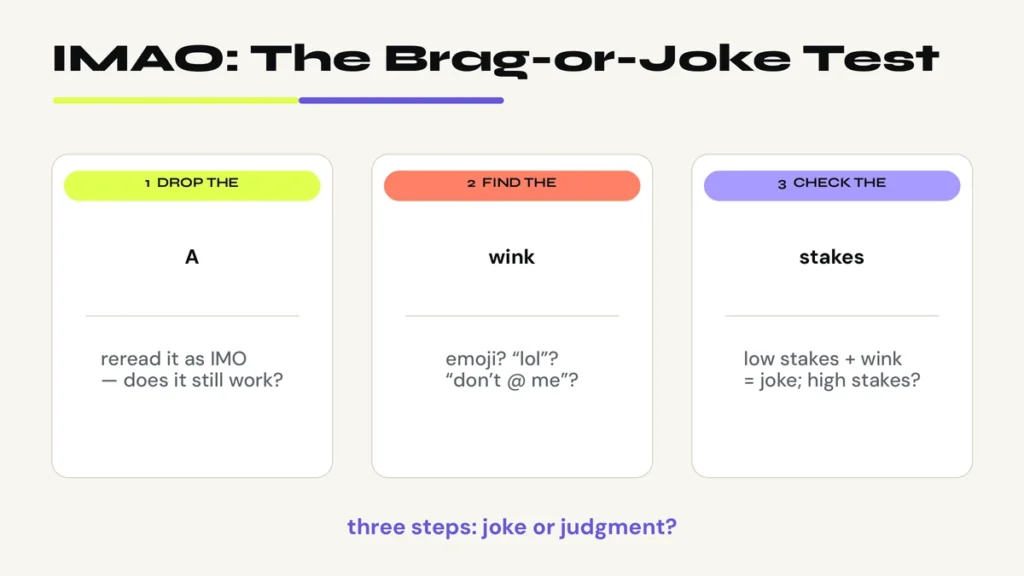
Before you answer an imao — or send one — run three steps. They take about five seconds, and they beat every shortcut the competitors offer, because the competitors all say “it is usually a joke” without giving you a procedure for the times it is not:
- Step 1 — Drop the A. Reread the message as IMO, “in my opinion.” If the opinion still works perfectly without the A — “In my opinion, pineapple belongs on pizza” — then the A was doing joke work, not meaning work. The A adds swagger, not information. If dropping the A changes the message entirely, you are not looking at an opinion at all, and the LMAO trap in section 11 may be in play.
- Step 2 — Find the wink. Look for the joke signal: an emoji, a “lol,” a “don’t @ me,” a “fight me,” or a claim so absurd it cannot be serious (“IMAO, I am the best dancer alive”). A wink means brag-as-joke. No wink does not prove real arrogance — it only means you move to step 3 before deciding.
- Step 3 — Check the stakes. Low-stakes topic plus a wink equals a joke: pizza toppings, movies, playlists. High-stakes topic with no wink — someone’s work, appearance, grief, or a real disagreement — means the brag may be real, and you should answer the opinion, not the joke. Stakes, not letters, decide whether an imao deserves a laugh or a reply.
Worked trio. “IMAO, the old design looked much better” in a friends’ chat about an app update — drop the A and the opinion survives, the chat history supplies the wink, the stakes are a design: joke, answer the opinion lightly. “IMAO, don’t @ me, this album clears everything else this year” under a video — the “don’t @ me” is the wink, bracing for disagreement humorously: joke, disagree if you like. “IMAO, your whole approach is wrong” from a stranger in a work-adjacent thread, no wink, high stakes: treat the brag as real, and answer the claim with evidence, not a laugh.
“IMAO” in Real Chats
Illustrative examples written for this guide, not real transcripts:
- The pizza hot take. “IMAO, pineapple belongs on pizza.” — the classic. Low stakes, obvious wink, disagreement invited and enjoyed.
- The movie verdict. “That was the best episode of the season, IMAO.” — the IMAO at the end signs the verdict like a stamp.
- The don’t-@-me brace. “IMAO, don’t @ me, cats are better than dogs.” — bracing for disagreement before it arrives, which is the joke doing its job.
- The self-mocking crown. “IMAO, I am the best dancer in the world.” — nobody believes it, including the sender. The arrogance is the punchline.
- The confident stance. “IMAO, the older version of the game was more fun.” — a real preference, delivered with swagger so it cannot be mistaken for doubt.
- The sarcastic jab. “IMAO, you need to think about what you are doing with that money.” — the swagger curdles: this one is aimed at someone, and the wink is missing.
- The defensive shield. “IMAO, I am right and everyone knows it.” — the joke worn thin. When the opinion is also a refusal to listen, the brag has stopped being funny.
The IMAO Tone List
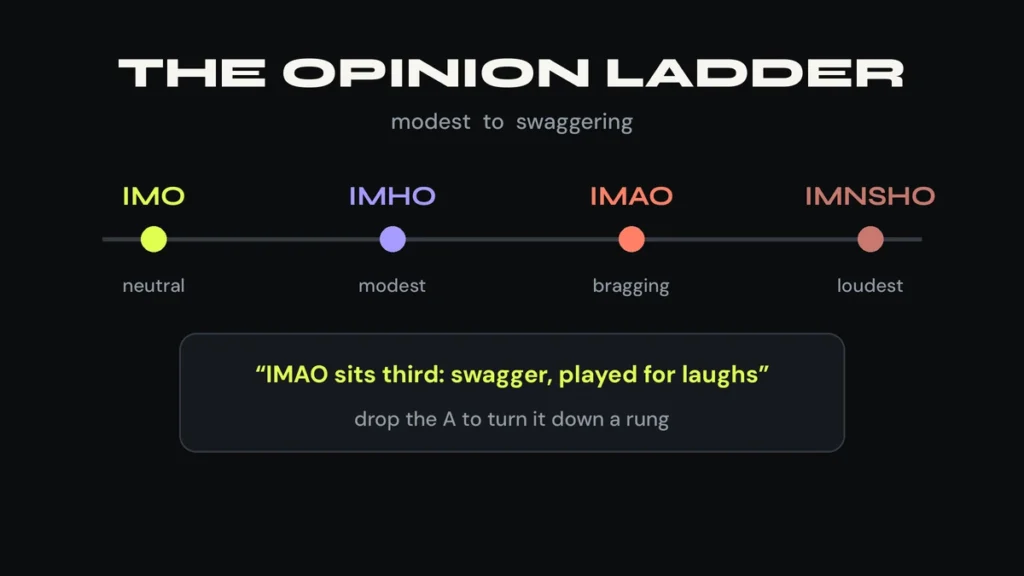
IMAO’s meaning stays “in my arrogant opinion”; its honesty slides. Seven readings, lightest to heaviest — and the image above shows where imao sits on the opinion ladder, between modest IMHO and its louder cousin:
- Playful brag: “IMAO, pineapple belongs on pizza.” The default. A joke about confidence, offered for fun.
- Self-mocking wink: “IMAO, I am the best dancer alive.” The sender is the joke, and knows it.
- Friendly hot take: “IMAO, that movie was a total waste of time.” A real opinion, delivered hot, among people who enjoy the heat.
- Confident stance: “IMAO, the old design looked much better.” Swagger as clarity: this sender is not hedging, and wants you to know it.
- Sarcastic jab: “IMAO, you clearly know best.” The swagger turned outward. The joke is at someone else’s expense now.
- Defensive shield: “IMAO, I am right, don’t bother arguing.” The brag used to end a conversation instead of starting one.
- Genuinely arrogant: the rare literal reading — a sender who means the arrogance, usually visible because the topic is serious, the tone is cold, and no wink appears anywhere. Do not assume this reading; it has to earn itself.
What moves a reading up or down this list is never the letters alone: it is the wink (step 2), the stakes (step 3), and the history between sender and reader. The same “IMAO, don’t @ me” that is a joke among friends is a gauntlet from a stranger — and the test, not the spelling, tells you which room you are in.
“IMAO” on TikTok
On TikTok, imao is a comment-section and caption hot take more than a private message: “IMAO, this song clears the whole album” under a video, “IMAO, don’t @ me” under a ranking, or a creator captioning a strong opinion with a bare “IMAO” up front. The public stage suits the playful-brag and friendly-hot-take readings best — a comment thread is an audience for a take, not a confession booth, and a hot take with a wink plays well there. Nobody owes a commenter a full essay, and nobody should read a public imao as a personal attack.
The trap on TikTok is the reverse of the private-chat trap: taking a public imao too personally. A creator who writes “IMAO” before a ranking is performing confidence for a crowd, not grading you, and a commenter who writes “IMAO, this is overrated” is disagreeing with a video, not with you. If an imao arrives in a TikTok DM, though, run the test as usual — a DM is private again, and the stakes rules return with it.
“IMAO” on Snapchat
On Snapchat, imao fits the fast, disappearing DM: “IMAO, that restaurant is way better” as a story reply, or “IMAO, we should call it a day” on a streak snap. The disappearing format suits the playful readings — a hot take that lands lightly and is gone. But disappearance also removes your evidence: if an imao felt like a jab, you cannot re-read it, so judge from memory what rode with it — an emoji, a “lol,” or nothing at all.
Snapchat is also where the wink matters most, because the format gives you no second look. A friend’s imao on Snapchat is usually a joke you already understand from history; a new match’s imao, with no history and no wink, deserves step 3 before any reply. If you cannot answer all three steps from memory, a warm, opinion-answering reply is safer than laughing at a joke nobody told.
“IMAO” on Instagram
On Instagram, imao shows up in captions, comments, story replies, and DMs, and the stage decides the weight the way it does for every opinion term. Captions lean confident: “IMAO, cats are better than dogs” under a photo is a stance posted for an audience, closer to a toast than a whisper. Comments lean playful: “IMAO, this is the best one” under a post is a hot take with applause attached. DMs carry the full range, exactly like texts — a friend’s pizza take and a match’s cold jab live in the same inbox, and only the test tells them apart.
Instagram is also where imao meets its closest platform cousin. A bio or cross-post that says “follow my IG” is pointing at the app, not delivering an opinion — our IG guide covers that pointer in full, and confusing the two is the one Instagram-specific misread worth naming: “IG” in capitals as a pointer is a noun, while “IMAO” as a message is an opinion. Same alphabet, different jobs.
“IMAO” in Text Messages
Plain texts are imao’s home ground, and the place its companion phrases are easiest to see. It pairs with the side-note companion BTW — “IMAO, btw, the sequel was better” stacks a hot take and an afterthought in one breath — and it travels with the agreement echo in the reply section below, where a hot take collects its audience.
Texts are also imao’s work limit, stated plainly: never use imao in a professional message. A client, a manager, or a first contact deserves a plain opinion or the full sentence, not four letters that presume the reader will enjoy your swagger. The same rule covers formal writing, job applications, and any serious topic — confidence deserves complete sentences when the moment is serious, and imao is, by design, a joke about confidence.
Who Is Sending It: How “IMAO” Lands by Sender
No source documents a different meaning of imao per sender — the expansion stays fixed; what changes is how much swagger the reader should take seriously, and therefore what you owe back. One framing is rejected outright here: the main competitor organizes a sender FAQ by gender (“what does imao mean from a girl?”) while admitting the tone is the same. Gender does not decide an imao’s weight. Relationship and stakes do, so this guide uses those instead:
- Friend: the default. A friend’s imao is a joke or a hot take at face value; answer the opinion, laugh at the wink, and do not overread it.
- Crush: overread territory. A crush’s imao feels bigger than it is — usually a playful display of confidence, not a character verdict. Answer the opinion, not the swagger.
- Partner: pattern rules. A partner’s imao is usually a running joke; judge the pattern across days, not one message — but a sudden run of cold, winkless imaos after disagreements is a conversation worth having.
- Family: the translation habitat. A parent who writes imao has usually learned it from you and means the joke plainly; do not read a parent’s imao as sarcasm unless the joke is obvious.
- Coworker or boss: context decides. In a friendly team chat a colleague’s imao about lunch spots is a joke; in any formal thread it is out of place, and never send one upward to a manager or client.
- Group chat: the hot-take habitat. A group’s “IMAO, don’t @ me” invites the whole room to disagree; answer briefly in the group, and do not single one sender out for a private reading of a public take.
- Stranger or creator: the performance habitat. A stranger’s imao under your post, or a creator’s imao in a caption, is a stance for an audience, not a judgment of you personally. Disagree with the take if you like; never answer the swagger.
When “IMAO” Is Not Just Funny
Four misfires, graded. First, the joke-assumption trap: treating every imao as a joke. A winkless imao about someone’s work or appearance is not a joke that failed — it may be a jab that succeeded, and laughing at it tells the sender the room accepts it. Second, the insult-assumption trap: treating every imao as genuine arrogance. “IMAO, pineapple belongs on pizza” answered with hurt punishes someone for a joke, and the room learns not to play. Third, the LMAO collision, covered in full in the next section: reading an opinion as laughter, or laughter as an opinion, because the letters look alike. Fourth, the shield misfire: using imao to end a conversation — “IMAO, I am right, don’t bother” — where a real reason was owed. A joke that refuses discussion is not a joke anymore.
On appropriateness: imao is not rude and not vulgar in any reading; its risk is social, not moral — swagger where humility was owed, or a joke where a real answer was owed. Keep it out of formal, professional, and first-impression messages, out of condolences and serious topics, and out of any first message to someone you do not know well. And one practical rewrite, the Drop-the-A tool: any imao can be downgraded on demand — IMAO becomes IMO for a neutral take (“in my opinion, the old design was better”), IMHO for a modest one (“in my humble opinion, we could try it your way”), or a plain sentence for anything formal (“I think the old design worked better, because…”). The ladder in the tone image is also a dial: turn it down whenever the room gets serious.
Checked Claims: Expansions That Do Not Hold Up
- “IMAO means ‘laughing my ass off’, or is a typo for LMAO” — rejected as a meaning, kept as a typo warning. LMAO is a different term, a laughter reaction; imao is an opinion. The minority view that treats imao as a playful LMAO variant is reported here as a minority view, not adopted, because Wiktionary and every full competitor guide attest the opinion expansion and none attests a laughter expansion.
- “IMAO means ‘in my anxious / awkward / absolute opinion’” — rejected as working meanings. These appear only on abbreviation-list pages, with no dictionary attestation and no chat examples. Softer readings are tone — a light imao — not second phrases hiding inside the letters.
- “IMAO means something different on each platform” — rejected. No source documents a platform-specific meaning; TikTok captions, Snapchat DMs, and texts stage the same opinion differently.
- “IMAO means something different from a girl, or per sender gender” — rejected. The main competitor’s own gender FAQ answers itself: the tone is the same. Relationship and stakes decide weight, not gender.
- “IMAO is always genuinely arrogant” — rejected. Wiktionary labels the term humorous, and every competitor describes the arrogance as playful, ironic, or self-aware. The literal reading exists, but it is the rare edge, and it has to earn itself with stakes and a missing wink.
- “IMAO comes from a 2008 movie” — unverified, not taught. A single secondary page makes the claim with no corroboration; the article reports the 1989 Usenet attestation instead, and only as earliest documented use, not coinage.
- “IMAO works in formal writing” — rejected. Every competitor confines it to casual chat; formal contexts want the full sentence or a plain opinion, and the Drop-the-A tool above shows how.
- “The pharmacology acronym on the Wiktionary page is a second texting meaning” — fenced, not a texting claim. The Spanish-language pharmacology acronym shares letters only; it never appears in an English chat as an opinion, and the article never teaches it as one.
What SURVIVES: “in my arrogant opinion” (dictionary-attested, Wiktionary plus unanimous competitor agreement), coined in contrast to IMHO, humorous by label, with the seven readings above as weights of the same opinion — not different meanings. No competitor percentages are repeated here as fact, and the 1989 date is reported as earliest documented use, not coinage.
The font test, for the collision itself. If you cannot tell whether you are reading imao or lmao, retype the word in a serif font, where capital I and lowercase l look different, or read the sentence after it: a laugh needs no opinion following it, and an opinion needs a claim. “imao that was hilarious” is almost certainly a mistyped lmao; “IMAO, that movie was overrated” cannot be laughter, because laughter does not take a position on a movie.
“IMAO” vs Its Closest Cousins
IMAO belongs to the opinion family — words that frame how a view should be received, not what the sender knows or feels. Its closest cousins, arranged on the ladder from most modest to most swaggering:
- IMHO (“in my humble opinion”): the modest cousin. The joke imao inverts: humility claimed up front, so the opinion lands softly. Use it when you want the opinion heard, not the confidence noticed.
- IMO (“in my opinion”): the neutral cousin, and the next queue term after this article. No swagger, no humility claimed — just a view, stated. It is what every imao becomes when you drop the A.
- IMNSHO (“in my not-so-humble opinion”): the louder cousin. One step past imao on the ladder: the swagger stated twice, humility explicitly refused. Use it only among people who already enjoy your hot takes.
- TBH (“to be honest”): the honesty cousin. TBH frames a view as candor; imao frames it as confidence. A TBH can be gentle where an imao would be a gauntlet.
- FWIW (“for what it’s worth”): the softener cousin. FWIW lowers the stakes before an opinion; imao raises the swagger. They are opposite tools for the same job: getting a view into the room.
- LMAO (“laughing my ass off”): the lookalike, not a cousin. A reaction, not an opinion — the trap, not the family. If the message contains no claim, it is not imao.
And three contrast cousins from the shrug family, published in this series, that show what imao is not. IDK (“I don’t know”) reports not-knowing where imao reports a view; IDC (“I don’t care”) says indifference where imao says attachment to an opinion; and IDEK (“I don’t even know”) confesses confusion where imao confesses confidence. Mixing any of the three up with imao turns a take into a shrug.
Where “IMAO” Came From
The phrase “in my arrogant opinion” is ordinary English with one word swapped; the abbreviation belongs to the early internet. Wiktionary’s etymology says it was coined in contrast to IMHO, which already existed as the polite opinion frame — and the joke writes itself: keep the frame, replace humility with arrogance, and the politeness device becomes a brag device. Competitors report an early documented use in a May 1989 Usenet discussion about the Grateful Dead — user-forum attestation, not a coinage claim, and no inventor is named by any source. Like most texting shorthand, imao survived because the joke turned out to be useful: sometimes you want to state a strong view and disarm it in the same breath.
The abbreviation stayed rarer than its parents, and that rarity is part of its character. IMO and IMHO are everyday tools; imao is a specialty tool, pulled out when the opinion is strong enough to need a joke around it. That is why the ladder matters more than the history: imao’s past is a single inversion of IMHO, but its present is a choice — how much swagger to put on a view, and whether the room will enjoy it.
How to Reply When Someone Sends “IMAO”
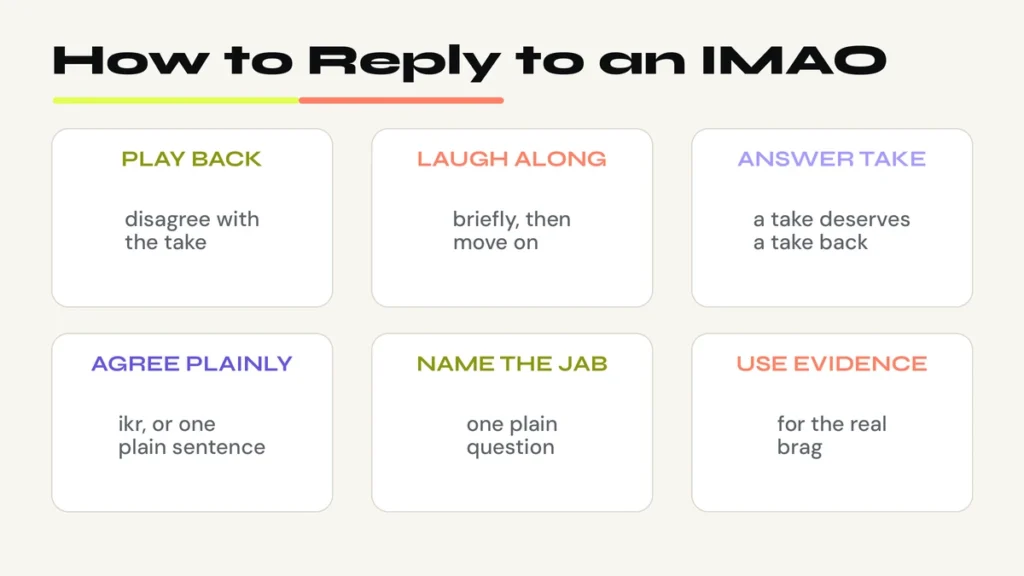
One rule, then six replies: answer the opinion the Brag-or-Joke Test found, not the swagger. A joke answered with hurt feels strange; a jab answered with a laugh feels like surrender:
- Playful brag — play back: “Bold! I disagree, but I respect the confidence.” Disagree with the take, enjoy the joke.
- Self-mocking wink — laugh along, briefly: “Sure you are, champ.” Match the joke, then move on; do not build a speech on it.
- Friendly hot take — answer the take: “I actually liked the new one more — what sold you on the old?” A take deserves a take back, not a verdict on tone.
- Confident stance — agree or disagree plainly: agreeing with a hot take is IKR territory — “ikr, the old design was better” certifies the shared feeling, while a plain disagreement (“I see it the other way”) keeps the room friendly. Either beats answering the swagger.
- Sarcastic jab or defensive shield — name it, once: “That one felt aimed, not joking — did you mean it that way?” One plain question reopens a conversation a shield tried to close.
- Genuinely arrogant — answer with evidence: “I disagree, and here is why.” No laugh, no matching swagger. Evidence is the only reply that does not feed the brag.
Weak versus strong. Weak: a bare “lol” back to a jab. Strong: “That one felt aimed — did you mean it that way?” Small change, big difference. Golden rule: when the reading is unclear, answer the opinion with one real sentence and let the sender correct you — a sentence without warmth can wound, but a laugh at a jab wounds more. You can also hand the chat forward with HMU — “IMAO, the old place was better. hmu if you want to go back sometime?” turns a hot take into a plan, which is the friendliest thing a brag can become.
Frequently Asked Questions
What does “IMAO” mean in a text message?
IMAO means “in my arrogant opinion” in a text message. It fronts an opinion with playful, self-aware swagger — a joke about confidence, not usually real arrogance. Run the Brag-or-Joke Test above before you decide how much of it was serious.
Is imao the same as lmao?
No. IMAO means “in my arrogant opinion” and introduces a view; LMAO means “laughing my ass off” and reacts to something funny. They look alike because lowercase l and uppercase I collide in some fonts, but one takes a position and the other does not — the font test in the claims section tells them apart.
Is imao rude?
Not by itself. The word “arrogant” sounds negative, but imao is usually joking or self-aware, and Wiktionary labels it humorous. It turns rude only when the wink is missing and the topic is serious — a jab wearing a joke’s letters — so context, not the term, decides.
Can I use imao in formal writing?
No. It is informal internet slang, and every source confines it to casual chat. In formal writing use the Drop-the-A rewrite instead: “in my opinion,” “in my view,” or a plain sentence with a reason attached.
What is the difference between IMO, IMHO, and IMAO?
They are one ladder: IMO means “in my opinion” and is neutral; IMHO means “in my humble opinion” and sounds modest; IMAO means “in my arrogant opinion” and is humorous or deliberately confident. Same job — framing a view — with the swagger turned up at each step.
Does imao mean something different from a girl?
No. Sender gender changes nothing about imao — the main competitor’s own gender FAQ says the tone stays playful and joking. What changes the reading is the relationship, the wink, and the stakes, which is why this guide organizes senders that way instead.
What does imao mean on TikTok and Snapchat?
The same thing as everywhere else: “in my arrogant opinion,” used as a playful hot take in comments, captions, and DMs. No source documents a platform-specific meaning; TikTok stages it publicly as a take for an audience, while Snapchat stages it privately as a fast DM joke.
Does imao ever mean “in my anxious opinion” or “in my awkward opinion”?
Not as working meanings. Those alternates appear only on abbreviation-list pages, with no dictionary attestation and no chat examples. A soft or nervous imao is a tone reading of the same expansion, not a second phrase hiding inside the letters.
The Takeaway
Four letters, one phrase, one question: joke or judgment? IMAO means “in my arrogant opinion” — and whether that is a playful brag, a hot take, or a real jab is decided by the Brag-or-Joke Test: drop the A, find the wink, check the stakes. Send it lightly when you mean it lightly, drop the A when the room gets serious, and answer the opinion you actually received.