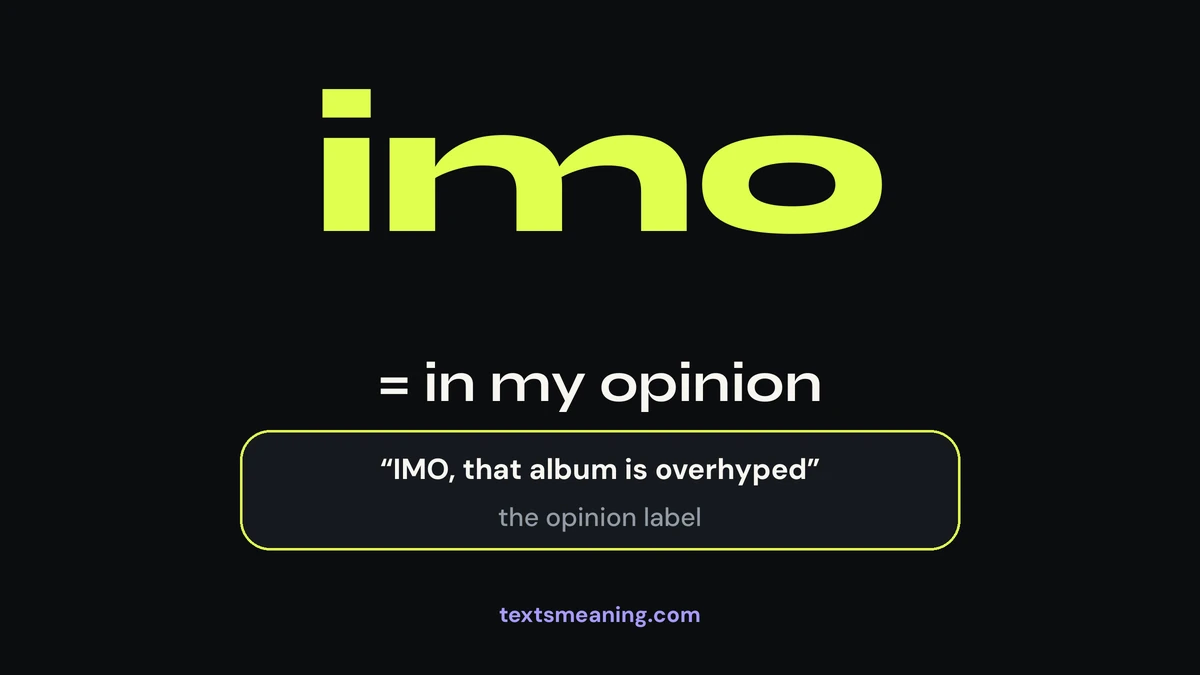
What does imo mean in text? IMO means “in my opinion” — three letters that label what follows as a personal view, not a fact. That label is the whole trick of this guide to imo meaning in text, because a label can be honest, or it can be a disguise.
This guide covers the one universally attested expansion, the IMO Fact-or-Feeling Test, a seven-reading tone list, imo on TikTok, Snapchat, Instagram, and in texts, senders, misreads, graded claims, cousins, history, and a reply bank keyed to the message you just sorted.
What “IMO” Means in Text
“IMO” means “in my opinion.” It is an initialism, built from the first letters of the phrase, and it works as a frame at the start of a sentence (“IMO, that album is overhyped”), as an afterthought at the end (“That album is overhyped, IMO”), or as a standalone shrug of a reply (“imo”). In every position it does the same one job: it tells the reader, this is a view, and views can be disagreed with.
The dictionary record needs one honest sentence before anything else. Wiktionary lists lowercase imo as an alternative form of uppercase IMO, so the two cases are the same word wearing different clothes — which is why capitalization changes the volume of an imo, never its meaning. The expansion itself is carried by something rarer in this series than a dictionary line: total agreement. Every competitor guide read for this article expands IMO the same way, and secondary guides report the same expansion as Merriam-Webster’s. No competing texting expansion with any dictionary attestation was found.
That agreement is exactly what makes imo tricky. When the letters are certain, the puzzle moves somewhere else: not what imo stands for, but what it is standing in front of. A taste (“IMO, that album is overhyped”) and a checkable claim (“IMO, the sequel made less money”) wear the same label, and only one of them is actually an opinion. The rest of this guide is about telling those apart — because answering a fact claim as if it were a taste, or a taste as if it were a fact, is where imo actually goes wrong.
Two usage rules come straight from the sources. First, position changes the job: at the front, imo frames everything after it as opinion; at the end, it softens a sentence that already landed. Second, imo belongs in informal chats only. It is not rude, but it is casual, and in formal writing the spelled-out phrase plus a reason is owed — a client, a manager, or a formal document deserves “in my opinion, because…” with the because attached, not three letters and silence.
The IMO Fact-or-Feeling Test
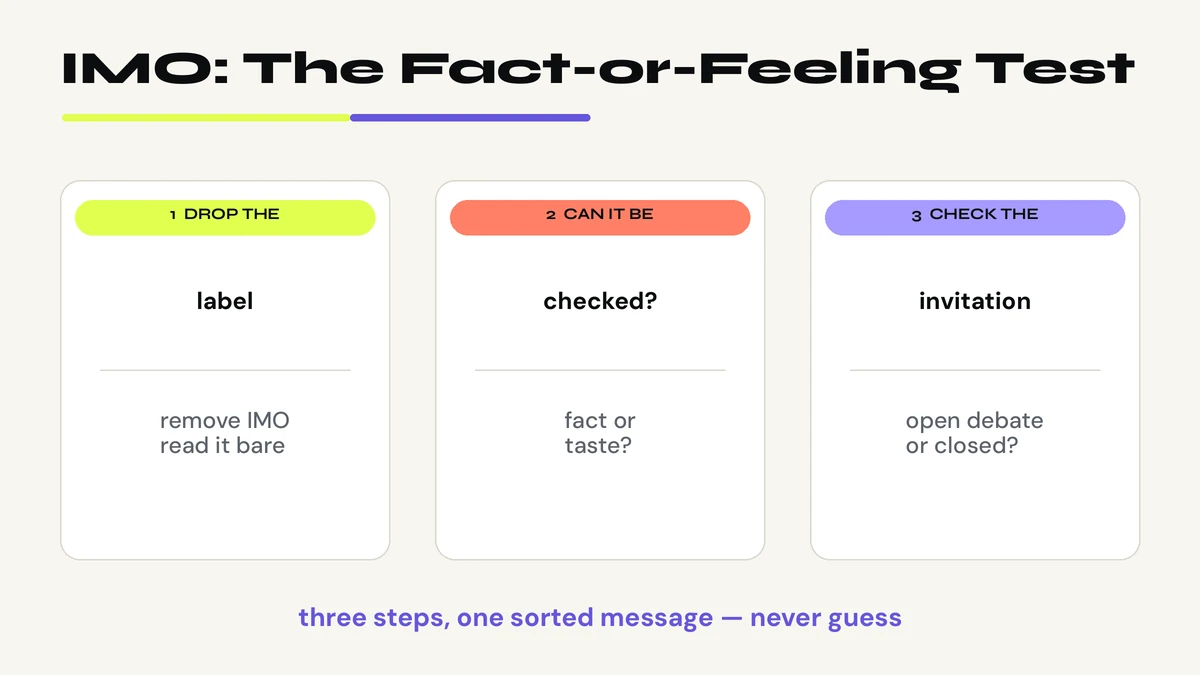
Before you answer an imo — or send one — run three steps. They take about five seconds, and they beat every shortcut the competitors offer, because the competitors all say imo “marks subjectivity” without giving you a procedure for checking whether the subjectivity is real:
- Step 1 — Drop the label. Remove IMO and read the sentence bare. If it becomes a flat claim (“That movie is overrated”), IMO was softening a claim. If it stays a taste (“That movie is my favorite”), IMO was only marking taste.
- Step 2 — Ask: could this be checked? A fact — a number, a date, a rule, an event — can be proven true or false, and IMO does not change that. A taste — best, worst, boring, amazing — cannot be checked, and that is pure opinion territory.
- Step 3 — Check the invitation. Does the message invite disagreement (“what do you think?”, “change my mind”) or shut it down (“IMO, end of story”, a period, no question)? The invitation tells you whether IMO is opening a debate or closing one.
Worked trio. “IMO, that album is overhyped” — drop the label and a taste remains, nothing checkable, invitation open: pure opinion, answer with your own take. “IMO, the sequel made less money” — drop the label and a checkable claim remains: IMO does not make it opinion, so check the numbers before arguing. “IMO, we should leave now” — advice dressed as opinion: answer the plan, not the label.
“IMO” in Real Chats
Illustrative examples written for this guide, not real transcripts:
- The confident take. “IMO, that album is overhyped.” The default imo: a view stated plainly, inviting an answer.
- The gentle disagreement. “imo, I liked the first one more.” The label takes the edge off a no, so the no lands kindly.
- The humble hedge. “imho, I might be wrong, but the ending felt rushed.” Modesty added — genuine here, ironic elsewhere, and the test below tells you which.
- The playful take. “imo, pineapple belongs on pizza, fight me.” The joke is the invitation; the opinion is the excuse.
- The disguised fact. “IMO, the sequel made less money.” Step 2 catches this one: box-office numbers can be checked, so this is a claim wearing a label.
- The advice in disguise. “IMO, we should leave now.” Not a view about the world — a plan for the evening. Answer the plan.
- The debate closer. “IMO, end of story.” The label used as a gavel, not an invitation. One calm sentence answers it, and nothing more needs to be said.
The IMO Tone List
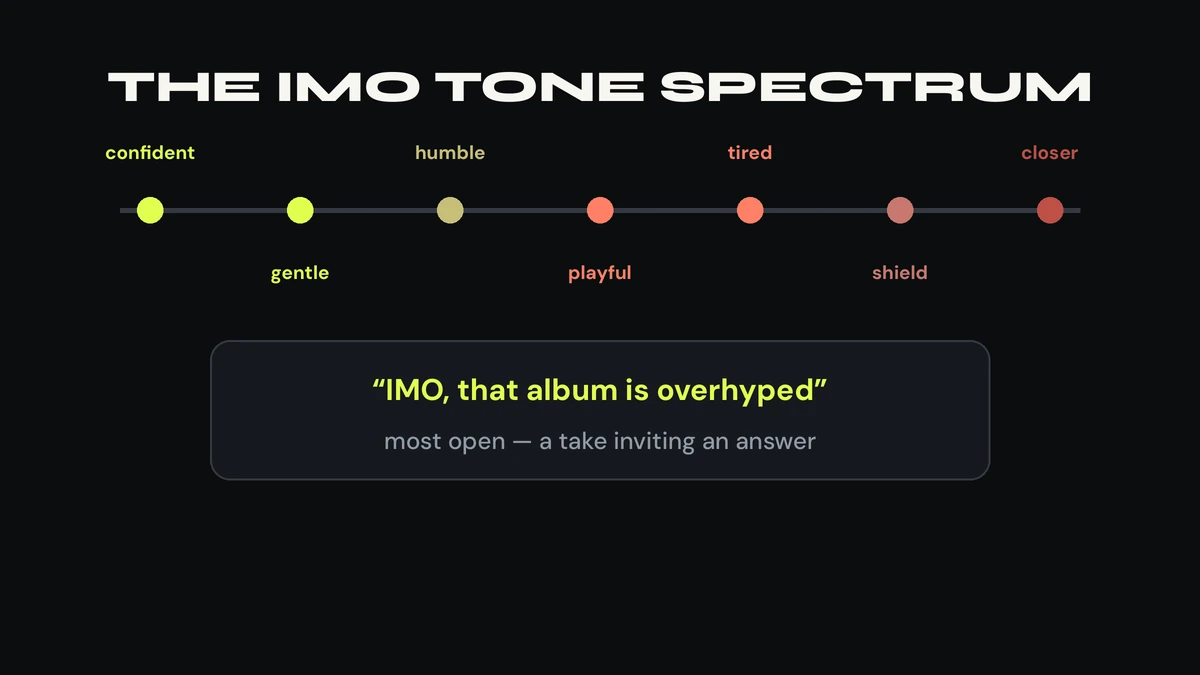
IMO’s meaning stays “in my opinion”; its invitation slides. Seven readings, most open to most closed:
- Confident take: “IMO, that album is overhyped.” A view stated plainly, inviting an answer.
- Gentle disagreement: “imo, I liked the first one more.” The label softens a no.
- Humble hedge: “imho, I might be wrong, but…” Modesty added, sometimes genuine, sometimes ironic.
- Playful take: “imo, pineapple belongs on pizza, fight me.” Low stakes, open invitation.
- Tired shrug: “imo, whatever, I am too tired to argue.” An opinion offered with no energy behind it.
- Passive-aggressive shield: “IMO, some people just do not try.” A judgment hiding behind the label, aimed at someone in the room.
- Debate closer: “IMO, end of story.” The label as a gavel. The conversation is over because the sender declared it over.
What moves a reading up or down this list is never the letters alone: it is position (front frames, end softens), case and punctuation (lowercase softens, caps plus a period hardens), and whether a reason rides with it. An imo with a reason (“IMO, the pacing drags in the middle”) is an argument; an imo without one (“IMO, it is bad”) is a verdict.
“IMO” on TikTok
On TikTok, imo is a comment-section and caption take more than a private message: “imo this is the best song on the album” under a video, “imo the remake was unnecessary” as a reply to a familiar commenter, or a creator captioning a ranking with a bare “imo” at the end. The public stage suits the confident and playful readings best — a take thousands can argue with without anyone owing a reason. That is also why TikTok is where the disguised-fact misfire spreads fastest: a checkable claim in a comment (“imo, this artist sold more than that one”) travels like an opinion because it wears the label, and the thread argues about taste while the numbers sit unchecked. Run Step 2 before you reply to a TikTok imo, because the platform rewards speed and punishes checking — which is exactly when checking matters most.
The trap on TikTok is the reverse of the private-chat trap: taking a public take personally. A creator who writes “imo” in a caption is ranking for an audience, not judging you, and a commenter who writes “imo” under a stranger’s video is joining a debate, not starting a fight. If an imo arrives in a TikTok DM, though, run the test as usual — a DM is private again, and the invitation rules return with it.
“IMO” on Snapchat
On Snapchat, imo fits the fast, disappearing DM: “imo we should go earlier” on a streak snap about weekend plans, or “imo that filter is better” as a story reply. The disappearing format suits the gentle-disagreement and playful readings — a take that lands lightly and is gone. But disappearance also removes your evidence: if an imo felt like a shield (“IMO, some people just do not try” aimed at you), you cannot re-read it, so judge from memory what rode with it — a reason, an emoji, or nothing at all. And because streak culture rewards speed, Snapchat is where the barest imo lives: a lone “imo” on a streak snap is usually a tired shrug, not a verdict on you.
“IMO” on Instagram
On Instagram, imo shows up in captions, comments, story replies, and DMs, and the stage decides the invitation the way it does for every opinion term. Captions lean confident: “imo, this is my best work yet” under a photo is a take posted for an audience, closer to a review than a whisper. Comments lean playful and argumentative: “imo the first season was better” under a post is a debate opened in public. DMs carry the full range, exactly like texts — a friend’s gentle disagreement and a match’s debate closer live in the same inbox, and only the test tells them apart.
Instagram is also where imo meets its closest platform cousin. A bio or cross-post that says “follow my IG” is pointing at the app, not offering an opinion — our IG guide covers that pointer in full, and confusing the two is the one Instagram-specific misread worth naming: “IG” in capitals as a pointer is a noun, while “imo” as a message is a frame. Same alphabet, different jobs.
“IMO” in Text Messages
Plain texts are imo’s home ground, and the place its companion phrases are easiest to see. It pairs with the side-note companion BTW — “imo, btw, did you see the new episode?” stacks a take and an afterthought in one breath — and with the pause companion BRB — “imo, brb, let me check the numbers” pairs an opinion with a promise to verify it, which is the honest version of the disguised-fact message: the sender is checking before the debate continues.
Texts are also imo’s work limit, stated plainly: never use imo in a professional message. A client, a manager, or a first contact deserves a view plus a reason (“In my view, the later date works better because…”), not three letters that presume the reader will fill in the argument. The same rule covers formal writing, complaints, and any serious topic — an opinion deserves a sentence when the moment is serious, and imo is, by design, a shortcut.
Who Is Sending It: How “IMO” Lands by Sender
No source documents a different meaning of imo per sender — the expansion stays fixed; what changes is how open the invitation is, and how much a closed one can sting. One correction first, because a competitor gets this wrong: one guide organizes its sender section by gender (“from a guy” versus “from a girl”) while admitting the term is not gender-specific. Gender does not decide an imo’s meaning. Relationship and stakes do, so this guide uses those instead:
- Friend: the default. A friend’s “imo” is a take at face value; answer with your own take and the debate stays friendly.
- Crush: overread territory. A crush’s “imo, I liked it too” feels bigger than it is — it is agreement, not a confession. Answer the take, not the hope.
- Partner: pattern rules. A partner’s “imo” is usually just a view; judge the pattern across days, not one message — but a sudden run of debate closers (“IMO, end of story”) after real disagreements is a conversation worth having.
- Parent: usually literal. A parent’s “IMO” is almost always a plain opinion, typed carefully — the least slang-fluent sender is also the least likely to use it as a shield.
- Coworker: context decides. In a casual channel a coworker’s “imo” is a view you can answer; in a work thread, answer the work first — and never send one to a client.
- Group chat: the debate habitat. A group’s “imo” opens a poll of takes; answer briefly in the group, and do not take a group take personally.
- Stranger or creator: the public-take habitat. A stranger’s “imo” under your post is a take for an audience, not a message to you. A reply is optional; a reply in kind is a debate you did not ask for.
When “IMO” Is Not Just Humble
Four misfires, graded. First, the fact-laundering trap: letting IMO turn a checkable claim into an opinion. “IMO, the sequel made less money” is not an opinion, it is a claim with a label on it, and the fix is free — check the numbers, then answer the numbers. Second, the shield misread in reverse: assuming every blunt imo is passive-aggressive. Between close friends a bare “imo” is often just a tired shrug, and the shield reading needs a judgment plus a target plus a cold history together. Third, the closer trap: answering a debate closer (“IMO, end of story”) with a longer argument. A closer cannot be argued with, only outlasted — one calm sentence, then stop. Fourth, the professional misfire: the opinion label in a customer message, where a view without a reason reads as dismissiveness, because the reader cannot tell whether you are sharing a take or dodging an answer.
On appropriateness: imo is not rude and not vulgar in any reading; its risk is social, not moral — a fact dressed as opinion, a judgment dressed as humility, or a debate closed before it started. Keep it out of formal, professional, and first-impression messages, out of complaints and serious topics, and out of any message where the other person is owed a reason, not just a label.
Checked Claims: Expansions That Do Not Hold Up
- “IMO means something different on each platform” — rejected. No source documents a platform-specific meaning; TikTok captions, Snapchat DMs, and texts stage the same opinion label differently.
- “IMO turns any statement into an opinion” — rejected. A checkable claim stays checkable with or without the label; IMO marks the speaker’s stance, it does not certify one.
- “IMO always softens” — rejected. Caps, a period, or a closing position (“IMO, end of story”) can harden an opinion into a verdict.
- “IMHO means only ‘in my humble opinion’” — rejected as exclusive. Sources attest both “humble” and “honest”, and the ironic IMHO (confident while pretending modest) is documented.
- “IMO means International Maritime Organization in a text” — fenced as a domain homonym. Real for shipping, never the reading in a chat; the same fencing covers the International Mathematical Olympiad and “in memory of” in tributes.
- “IMO means ‘I’m Mexican, Okay’” — rejected as a texting meaning. One list page only, no dictionary attestation, no chat example.
- “IMO means something different from a guy than from a girl” — rejected. The one competitor that splits senders by gender admits the term is not gender-specific; relationship and stakes decide, never gender.
- “IMO is only for Gen Z” — rejected. Internet-era usage predates Gen Z texting, and mainstream guides describe it as widely understood across ages.
What SURVIVES: “in my opinion” (universally attested across every competitor guide read, with a Merriam-Webster attribution reported by secondary guides and a Wiktionary alternative-form line read directly), with the seven tone readings above as jobs of the same label — not different meanings. No competitor percentages are repeated here as fact, and no coinage year is claimed, because no dated first-use citation was found in this run.
“IMO” vs Its Closest Cousins
IMO belongs to the opinion-and-reaction family — words that say what the sender thinks or feels, not just what they know. Its closest cousins split by what they do with a view. IDK (“I don’t know”) admits a gap where IMO states a view: IDK says “I have no answer”, IMO says “I have an answer, and it is mine.” IDC (“I don’t care”) refuses a view where IMO offers one: IDC says “this does not matter to me”, IMO says “this is how I see it.” IKR (“I know, right?”) echoes a feeling where IMO originates a view: IKR agrees with what someone else already said, IMO says something first. The published cousins:
- IMHO (“in my humble opinion” or “in my honest opinion”) — the softer cousin. IMO states a view; IMHO states one with modesty attached, genuine or ironic. Swap in IMHO when the room needs softening, and watch for the ironic one.
- IMNSHO (“in my not-so-humble opinion”) — the joke cousin. The modesty of IMHO, openly cancelled: a confident view wearing a humility costume. Use it only where the joke is obvious.
- TBH (“to be honest”) — the candor cousin. TBH promises honesty; IMO promises only subjectivity. “TBH, I did not like it” claims truth-telling, while “IMO, I did not like it” claims only a view.
- FWIW (“for what it’s worth”) — the offering cousin. FWIW hands over a view for the reader to take or leave; IMO labels a view as the sender’s own. Both soften, but FWIW softens the offering, IMO softens the claim.
- YMMV (“your mileage may vary”) — the disclaimer cousin. YMMV warns that experiences differ; IMO warns that views differ. The pair is one system: “IMO, this is the best one — YMMV” labels the view and invites the exception in the same breath.
IMO often travels with a bounce-back — “imo, what do you think?” — but never answer an imo with another bare imo: two labels do not make a debate.
Where “IMO” Came From
The phrase “in my opinion” is centuries-old ordinary English; the acronym belongs to the early-internet era. Secondary guides place it in forum and chat-room culture, with one list source dating it to the 1980s on Usenet and BBS while stating plainly that no dated citations exist yet — so this guide reports early-internet-era usage and claims no coinage year, no inventor, and no first-use date. The abbreviation then rode every platform shift — forums, instant messaging, SMS, social comments — without changing its expansion, which is why it now feels older than most slang: it is older than most slang. The related IMHO and the joke form IMNSHO grew from the same forum culture as softer and then ironic variants, and the same three letters have lived a separate, official life the whole time as the International Maritime Organization — a homonym that belongs to shipping, never to a chat.
How to Reply When Someone Sends “IMO”
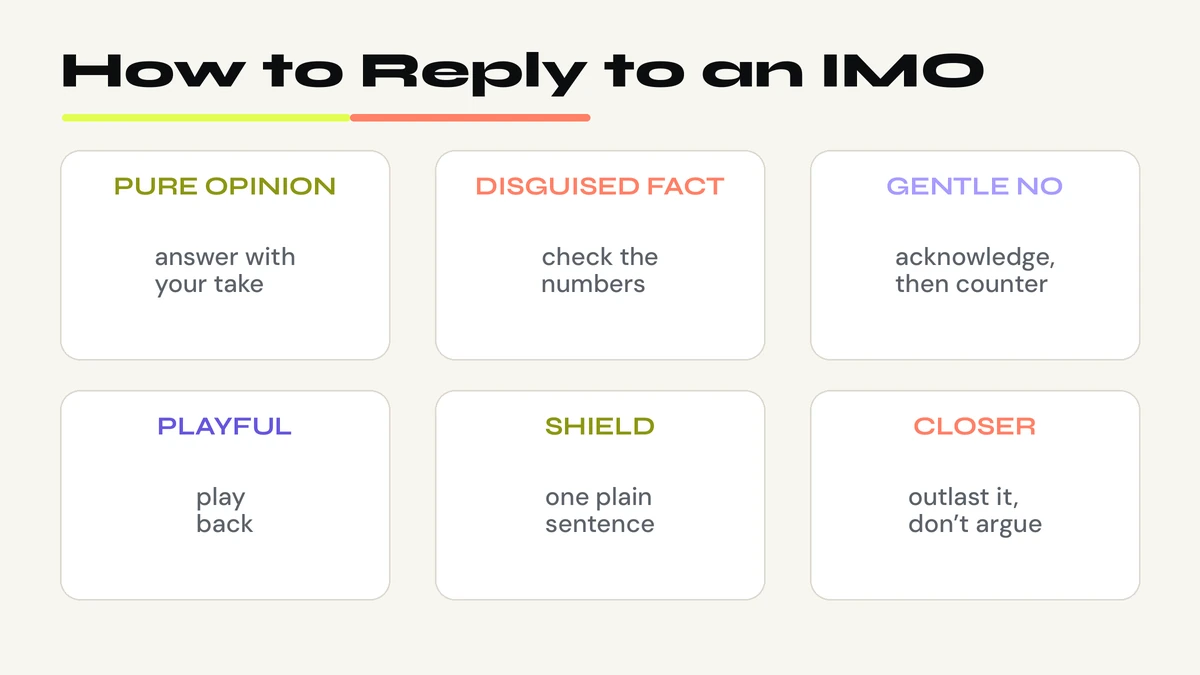
Golden rule: answer the sorted message, not the label. Run the Fact-or-Feeling Test first, then pick from the bank:
- Pure opinion, invitation open: “Honestly? I liked the second one more.” A debate opened deserves a debate, not a shrug.
- Disguised fact: “Actually the numbers say the sequel made more — want the link?” Answer the claim, not the label.
- Gentle disagreement: “Fair, I see why you would say that — I still prefer the first.” Acknowledge before countering.
- Humble hedge: “You might be right, actually.” Take modesty at face value unless the irony is obvious.
- Playful take: “Fight accepted.” Play back; the joke was the invitation.
- Passive-aggressive shield: “Noted.” One plain sentence, or silence. Do not take the bait in public.
- Debate closer: “Noted — I see it differently.” A closer cannot be argued with, only outlasted.
- Opinion plus open door: “imo, HMU when you have seen it.” An opinion plus an invitation keeps the conversation alive past the take.
What you never owe anyone: an apology for disagreeing, a fact-check delivered as an attack, or an answer to a debate closer. When the sorting is unclear, one plain question settles it: “Is that your take, or is there a fact behind it?” It costs nothing, and it has never embarrassed anyone.
Frequently Asked Questions
What does “IMO” mean in a text message?
IMO means “in my opinion” in a text message. It labels what follows as a personal view, not a fact — and the Fact-or-Feeling Test above shows you how to check whether the label is honest.
Does IMO mean the same as “in my opinion” spelled out?
Almost, but not quite. The spelled-out phrase carries more weight and invites a reason; the abbreviation is lighter, faster, and more casual. In formal writing, spell it out and add the reason.
What does IMHO mean, and is it the same as IMO?
IMHO usually means “in my humble opinion”, and sometimes “in my honest opinion”. It is IMO with modesty attached — softer, more careful, and sometimes ironic, when a confident view pretends to be modest.
Does IMO turn a fact into an opinion?
No. A checkable claim stays checkable with or without the label. “IMO, the sequel made less money” is a claim wearing an opinion label, and the honest reply checks the numbers.
Is IMO rude?
The letters are never rude; the message can be. A bare IMO after bad news, a judgment hiding behind the label, or a debate closer can all sting — but the sting comes from the opinion and the moment, not the abbreviation.
Can I use IMO at work?
In a casual team chat, yes, sparingly. In a client message, a formal email, or anywhere a reason is owed, no — write “in my view” plus the reason instead.
Does IMO mean International Maritime Organization?
Outside chat, yes — it is a real United Nations agency for shipping. Inside a text, no: context selects “in my opinion” every time, and nobody texts you about shipping regulation with a lowercase imo.
What should I reply when someone sends imo?
Sort it first with the Fact-or-Feeling Test, then answer the sorted message: your own take for a pure opinion, the numbers for a disguised fact, one calm sentence for a debate closer. The reply bank above has the full set.
The Takeaway
IMO is a three-letter label: “in my opinion”, nothing more, nothing less. Before you answer one, run the Fact-or-Feeling Test — drop the label, ask if it can be checked, check the invitation. And when you send one, remember what the label cannot do: it cannot turn a fact into an opinion, it cannot soften a judgment into kindness, and it cannot close a debate that the other person still wants to have. Label the stance, then give the reason. That is how a tiny acronym becomes an honest message.