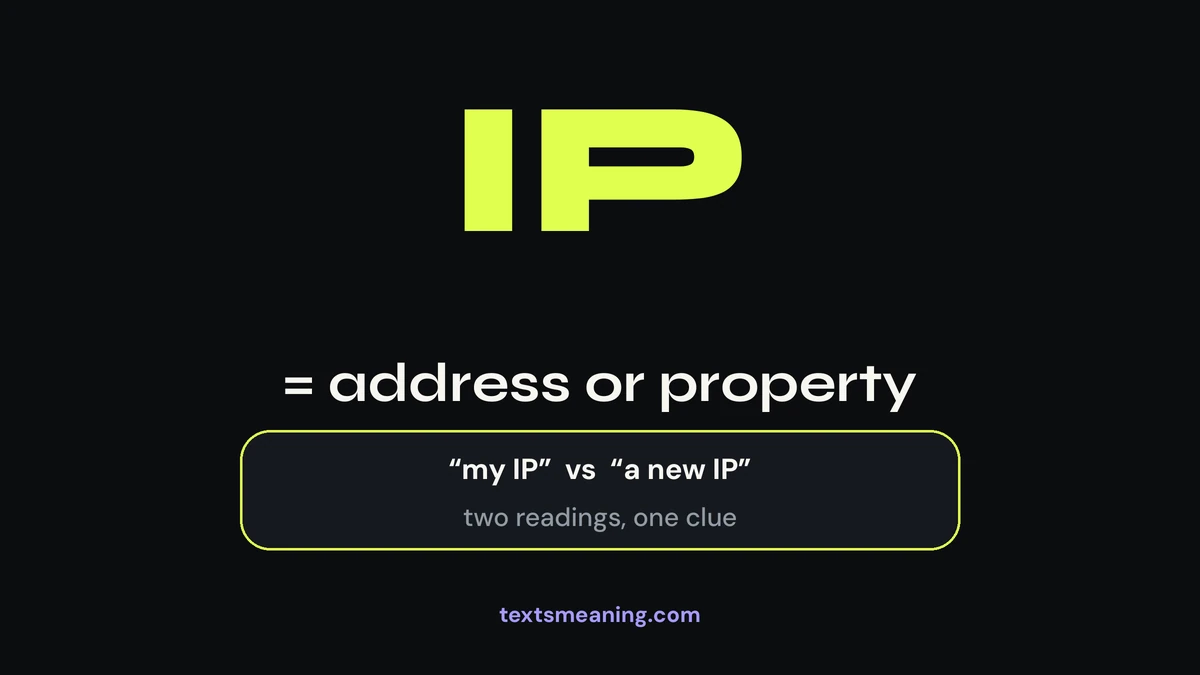
What does ip mean in text? IP in a text usually means one of two technical things: Internet Protocol, almost always shortened to an IP address, or intellectual property, a game, film, or other owned creation. This guide to ip meaning in text shows you how to tell which one you are reading.
Here is the honest headline first, because it changes how you should read everything else: IP is not slang. No dictionary gives IP a texting-slang sense of its own. It is a technical initialism that wandered into chat from networking and law, and the two readings it carries there are both technical. This guide covers both readings, the IP Three-Clue Test, a seven-situation tone list, IP on TikTok, Snapchat, Instagram, and in texts, senders, the privacy half no competitor covers, graded claims, cousins, history, and a reply bank keyed to the reading you just found.
What “IP” Means in Text
“IP” has two live readings in chat, and they have nothing to do with each other except the letters. Reading one: Internet Protocol, the set of rules that lets devices talk to each other over the internet, almost always appearing as an IP address — the number that identifies a device on a network, written in dotted groups like 192.168.0.1. Reading two: intellectual property, a creative work or body of owned creations — a game franchise, a film series, a character, a world. “A new IP” means a brand-new franchise; “the same old IP” means another sequel in a series you already know.
The dictionary record is unusually clear, and unusually empty in one place. Wiktionary lists IP as an initialism of Internet Protocol under Internet and networking, and as an initialism of intellectual property under law, and it lists IP as an ellipsis of IP address — the short form people use when they mean the number itself. What Wiktionary does not list, anywhere in its long IP entry, is a text-messaging or slang sense. Merriam-Webster agrees on the two readings, leading with intellectual property and listing Internet protocol, with a first known use of the abbreviation in 1979 — decades before texting slang existed. That date is the whole story in one number: IP did not grow up in chat, it moved into chat.
So when someone types IP, they are not using slang the way the rest of this series uses it. They are borrowing a technical word, and your job is not to decode a secret meaning but to pick the right technical reading. The test below does that in three clues, and it is the only procedure any guide currently offers — the competitors either list the two expansions and stop, or invent a third slang meaning that no source supports.
The IP Three-Clue Test
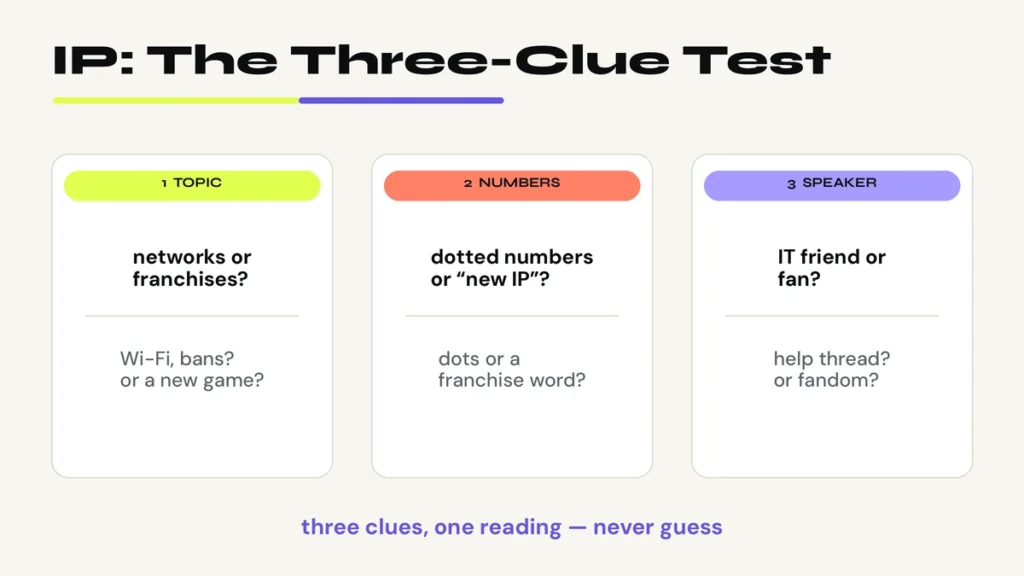
Before you answer an IP — or worry about one — run three clues in order. They take about five seconds, and they beat every shortcut the competitors offer, because the competitors all say “context matters” without giving you a procedure for reading it:
- Clue 1 — Topic. What is the sentence about? Networks, routers, Wi-Fi, bans, VPNs, lag, or “what is my IP” means the address reading. Games, films, books, characters, sequels, studios, or “a new IP” means the property reading. The topic alone settles most messages.
- Clue 2 — Number-shape. Does IP travel with dotted numbers (192.168.0.1), with the word “address”, or with “banned”, “leaked”, or “changed”? Address reading. Does it travel with “new”, “old”, “original”, or a franchise name? Property reading. And if IP is followed by two digits — IP67, IP68 — you are looking at a product spec, the ingress protection rating, not a chat reading at all.
- Clue 3 — Speaker. Who is talking? An IT friend, a gamer complaining about a ban, or a help thread points to the address. A gamer, creator, or film fan talking about a series points to the property. When clues 1 and 2 agree, you can stop; clue 3 is the tiebreaker for the rare message where they do not.
Worked trio. “What is my IP? The Wi-Fi keeps dropping” — topic networks, “my IP” plus a connection problem, speaker a friend asking for help: address reading, answer with how to find it, and never post it publicly. “They finally announced a new IP and it looks unreal” — topic a game announcement, “new IP” plus a franchise frame, speaker a gamer: property reading, answer about the game. “That studio keeps milking the same IP” — topic a studio, “the same IP” plus a franchise complaint, speaker a fan: property reading, answer about sequels, not about networks.
“IP” in Real Chats
Illustrative examples written for this guide, not real transcripts:
- The tech-help ask. “What is my IP? The Wi-Fi keeps dropping.” — address reading, plain and practical. The sender wants a number, not a conversation.
- The ban complaint. “My IP got banned for nothing.” — address reading, frustrated. The number, not the person, was blocked, and that distinction is the whole complaint.
- The privacy worry. “Someone said they have my IP, what do I do?” — address reading, worried. This is the one IP message that deserves a calm, practical answer, and it gets one in the safety section below.
- The fan hype. “They finally announced a new IP and it looks unreal.” — property reading, excited. The warmest IP there is, and it is about a creation, not a number.
- The franchise complaint. “That studio keeps milking the same IP.” — property reading, tired. Sequel fatigue wearing two letters.
- The creator-business question. “Who owns the IP for that character?” — property reading, formal even in a casual chat. A rights question, not a tech question.
- The threat-adjacent line. “I have your IP.” — address reading, weaponized. Never a joke to answer lightly, and never a debate to win in the thread. Save it, block, report.
The IP Tone List
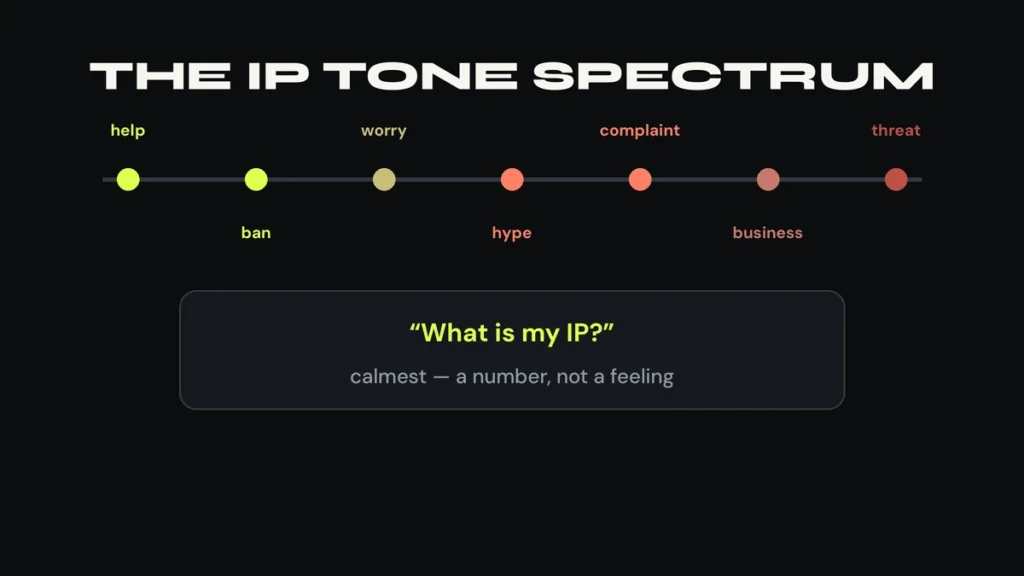
IP has no slang tone of its own; its tone comes from which reading is live and what is at stake. Seven situations, from the calmest to the one that needs action:
- Tech-help neutral: “What is my IP?” — a plain request for a number. No feeling attached, and none needed.
- Frustrated tech: “My IP got banned for nothing.” — annoyance at a system, not at a person. Sympathy plus the practical route is the right reply.
- Worried privacy: “Someone has my IP, what do I do?” — the only reading with real fear in it. It deserves calm facts, not panic, and the safety section has them.
- Fan excitement: “A new IP from that studio!” — hype, the warmest reading. Match it and ask about the game or show.
- Fan complaint: “They keep milking the same IP.” — sequel fatigue. Agree or disagree about the franchise, not about the letters.
- Creator-business neutral: “Who owns the IP?” — a rights question. Formal even in a casual chat, and worth a straight answer.
- Threat-adjacent: “I have your IP.” — the address reading weaponized. Do not engage, do not confirm anything, save the message, block and report.
What moves a reading up or down this list is never the letters alone: it is the topic (clue 1), the number-shape (clue 2), and the speaker (clue 3). The same two letters that are boring in a help thread are frightening in a threat, and the test, not the spelling, tells you which message you are holding.
“IP” on TikTok
On TikTok, IP leans hard toward the property reading — and that lean is the trap in reverse. Comments and captions talk about “a new IP”, “the best IP ever”, and studios “ruining the IP”, because TikTok is where game and film fandom lives out loud. A comment that says “this new IP looks unreal” is hype about a franchise, not a network problem, and answering it with tech help would be nonsense.
The platform-policy wrinkle matters here, and it is where the main competitor goes wrong. TikTok’s own rules talk about intellectual property — creators must respect other people’s IP rights — and that policy language is not chat usage. When a creator’s caption says “respect the IP”, they usually mean the rights, not the network. Run the test on TikTok comments before you assume the address, because TikTok stages the property reading far more often than the address reading. One more honesty note: no source documents a TikTok-specific meaning of IP, and this guide does not invent one — the platform changes which reading shows up most, not what the letters mean.
“IP” on Snapchat
On Snapchat, IP is rare in private chats and almost always the address reading when it does appear — usually in a tech-help moment between friends: “what is my IP, the Wi-Fi is dead”, or a gamer friend complaining that an IP ban locked them out. The disappearing format suits neither reading well: a franchise debate wants a thread you can return to, and a tech-help answer wants a number you can copy, and Snapchat deletes both.
Snapchat’s own intellectual-property policy is the same trap as TikTok’s: the app’s rules about respecting IP rights are legal language, not slang, and quoting them as chat usage would mislead a reader. If an IP message on Snapchat felt worrying — especially anything like “I have your IP” — screenshot it before it vanishes, because the disappearing format also removes your evidence. Judge from memory what rode with it, and use the safety section below.
“IP” on Instagram
On Instagram, IP shows up in two places, and the stage decides the reading the way it does for every term in this series. In captions, comments, and creator bios, the property reading rules: “new IP dropping soon”, “my favorite IP of all time”, a creator defending “their IP” against copycats. In DMs, the address reading takes over, exactly like texts — a friend asking for help with a connection, or a gamer friend venting about a ban.
Instagram is also where IP meets its closest platform cousin, and confusing the two is the one Instagram-specific misread worth naming. A bio or cross-post that says “follow my IG” is pointing at the app, not at an IP reading — our IG guide covers that pointer in full. “IG” in capitals as a pointer is a noun naming a platform; “IP” in a message is a technical term naming an address or a franchise. Same alphabet, different jobs, and the test settles any message where the two get tangled.
“IP” in Text Messages
Plain texts are IP’s home ground for the address reading, and the place its companion phrases are easiest to see. It pairs with the side-note companion BTW — “btw, did the IP change after the router reset?” stacks a tech question onto whatever came before — and with the pause companion BRB — “brb, resetting the router, IP changed” pauses the chat and reports the fix in the same breath, which is why the two so often travel together in help threads.
Texts are also IP’s work limit, stated plainly: never send your IP address in a text to someone you do not trust, and never ask a stranger for theirs. A text rides a phone number, not an app account, so an address sent by text can be forwarded, screenshotted, and kept in a way a disappearing snap cannot. The same rule covers group chats, where one careless paste shares a number with everyone in the thread. If support genuinely needs the address, a private channel to a verified support account is the route — never a public thread, never a group chat, never a comment.
Who Is Sending It: How “IP” Lands by Sender
No source documents a different meaning of IP per sender — the two readings stay fixed; what changes is which reading is likely, and how much the message costs you:
- Friend: the default for both readings. A friend’s “what is my IP?” is a help request at face value; a friend’s “new IP!” is hype. Answer the reading, not the sender.
- Crush: overread territory, but not in the romantic way. A crush’s IP message is almost never about you — it is about their Wi-Fi or their game. Do not read affection into a tech question, and do not read rejection into a franchise complaint.
- Partner: pattern rules. A partner’s IP messages are usually logistics — the router, the game, the show you both watch. Judge the pattern across days, not one message.
- Family: the help-desk habitat. A parent’s “what is my IP?” is the most common family IP message there is, and it wants a patient, step-by-step answer, not a lecture about networking.
- Coworker or boss: context decides. In a tech channel a colleague’s IP question is ordinary work; in any formal thread, spell it out — “IP address” or “intellectual property” — because an abbreviation in a formal message invites exactly the confusion this guide exists to prevent.
- Group chat: the franchise habitat at scale. A group’s “new IP!” is hype for everyone; answer briefly in the group. A group’s “what is my IP?” is a help request — answer privately, not in the group, so the number does not travel.
- Stranger or creator: the caution habitat. A stranger’s IP message about an address — especially anything like “I have your IP” — is not a conversation; it is a report-and-block moment. A creator’s IP message about a franchise is hype or rights talk, and a thank-you or a comment about the work is enough.
When “IP” Is Not Just Technical
Four situations, graded. First, the exposure: an IP address posted in a public chat, a group thread, or a comment. An address alone usually reveals only an approximate location and an internet provider, not a home address — but “only approximate” is not “harmless”, because the same address can be used to target a connection, impersonate a user, or launch the kind of attack the main competitor itself describes. If you posted yours, delete it, restart the router for a new dynamic address, and check your account security. Second, the demand: someone asking for your IP address, especially a stranger. You owe them nothing, and a legitimate support account will never ask for it in a public thread — our DM guide makes the same point about private channels: private from the public is not the same as secure, and a DM to a stranger is not a safe place for a number that identifies your connection.
Third, the threat: “I have your IP.” Do not engage, do not confirm anything, save the message, block and report. If it feels like a real threat, treat it as one and tell a trusted adult or the platform — the same rule this series gives for any threatening message, and the one case where the correct reply is no reply at all. Fourth, the ban: “my IP got banned.” This one is frustrating but ordinary — games and platforms ban addresses, not just accounts, and the route back is an appeal, a wait, or support, not a workaround tutorial, which this guide deliberately does not provide.
On appropriateness: IP is not rude and not vulgar in any reading; its risk is practical, not moral — exposure where privacy was owed, or a threat where a conversation was expected. Keep IP addresses out of public chats, group threads, comments, and bios, and keep the property reading out of formal writing unless you spell it out: “intellectual property” in a contract or a client message, “IP” only where the reader already knows which reading you mean.
Checked Claims: Expansions That Do Not Hold Up
- “IP is slang for hook up” — rejected. It appears only in the main competitor’s texting section, with no example sentence, no citation, and no dictionary support. No dictionary lists a hook-up sense for IP, and “hook up” is a verb phrase, not something the letters IP abbreviate. The rejection matters for safety, not just accuracy: a reader who took it seriously could misread a technical message as a sexual one.
- “IP means in progress in texts” — fenced, not fully rejected. It appears on abbreviation lists and in project and work shorthand, but no chat example and no dictionary texting sense was found. If a work-channel message says “IP” about a task, the Three-Clue Test catches it — topic work, no number-shape, speaker a colleague — but it is never the default reading in a private chat.
- “IP means in person” — rejected as a chat reading. An abbreviation-list entry only, with no chat example found; in ordinary chat, “in person” is spelled out, not shortened to IP.
- “IP means something different on each platform” — rejected. No source documents a platform-specific meaning; TikTok stages the property reading most, texts stage the address reading most, and the readings themselves do not change.
- “IP is a Gen Z slang word” — rejected. Merriam-Webster dates the abbreviation to 1979, and the Internet Protocol was standardized in 1981 — IP entered chat from networking and law, not from youth slang, and parents asking about a router are using it as correctly as any teenager.
- “IP67 means IP is about waterproof phones” — fenced. IP followed by two digits is the ingress protection rating, a real specialist sense, but it is a product spec, not a chat reading, and the digits are the tell: no digits, no rating.
- “IP is rude or dangerous by itself” — rejected as a property of the letters. IP is neutral; the danger lives in what people do with an address — sharing it, demanding it, or threatening with it — and the safety section above handles those acts, not the abbreviation.
- “An IP address reveals your home address” — rejected as stated. An address alone usually reveals only an approximate location and a provider, not a home address. That does not make it safe to share — it makes panic the wrong response and practical steps the right one.
What SURVIVES: Internet Protocol, almost always as an IP address, and intellectual property, a franchise or owned creation — both dictionary-attested, read by the Three-Clue Test. No competitor percentages are repeated here as fact, and the 1979 and 1981 dates are reported as first known use and standardization, not as chat coinage.
“IP” vs Its Closest Cousins
IP belongs to no slang family — it is a technical term with technical neighbors. Its closest cousins, and the line that keeps each one separate:
- IP address: the number itself. IP is the protocol; the IP address is the number the protocol assigns. When someone says “my IP”, they almost always mean the address, and Wiktionary lists exactly that ellipsis sense.
- VPN: the mask. A VPN hides or changes the address a site sees; it does not change the protocol, and it does not make sharing an address safe. Discussed by name only.
- TCP/IP: the suite. The Transmission Control Protocol plus the Internet Protocol, named together so often that people treat them as one thing. IP is the addressing half; TCP is the delivery half.
- IP67 / IP68: the rating. Ingress protection against dust and water, for phones and devices. The digits are the tell, and no chat message without digits means this.
- Copyright / trademark / patent: the parts of the property reading. Intellectual property is the umbrella; copyright covers creative works, trademark covers brand identifiers, patent covers inventions. When someone says “the IP” about a game, they usually mean the whole umbrella, not one rib of it.
- Franchise / series: the everyday word for the property reading. “A new IP” and “a new franchise” are the same announcement in different clothes; the first is industry talk, the second is plain English.
And two contrast cousins from this series, published and linked, that show what IP is not. IDK (“I don’t know”) is a real slang shrug, born in chat, with a dictionary texting sense — the exact thing IP does not have. AFK (“away from keyboard”) is the gaming-chat companion: an AFK player is a status, an IP-banned player is an address problem, and confusing a status with a ban is how a team argument starts. IP often travels with a not-knowing — “idk my IP” — but the shrug and the number are doing different jobs in the same sentence.
Where “IP” Came From
IP has two birthdays, because it has two histories, and merging them is the one origin mistake this article refuses to make. The protocol history starts with the Transmission Control Program work of Vint Cerf and Bob Kahn in 1974, which split into the Transmission Control Protocol and the Internet Protocol; IPv4, the version that still carries most of the internet, was defined in RFC 791 in September 1981, and IPv6, its successor, was standardized in 1998 and has been in increasing deployment since around 2006. Merriam-Webster dates the abbreviation IP itself to 1979. None of this happened in chat: it happened in networking, and chat borrowed the letters later, the way it borrows any useful technical word.
The property history is younger and louder. Intellectual property — patents, copyrights, trademarks, trade secrets — became everyday vocabulary as games and films turned franchises into the main unit of conversation: a studio announces “a new IP” the way it used to announce a new film, and fans argue about whether a series is a beloved IP or a milked one. In gaming writing, the distinction is explicit: a new IP is a new world and cast, while an old IP is a new entry in a world you already know. The two histories meet in your messages only because both shortened to the same two letters — and the Three-Clue Test is the tool that keeps them apart.
How to Reply When Someone Sends “IP”
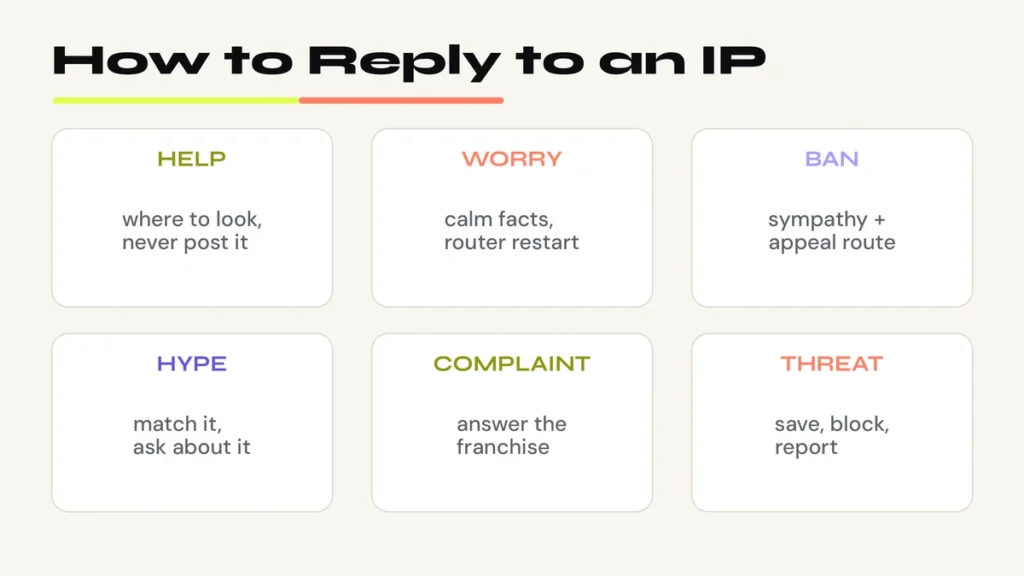
One rule, then six replies: name the reading first, then answer that reading. An answer to the wrong reading is worse than no answer, because it proves you were not listening:
- Address, help request — tell them where to look: “Check your Wi-Fi settings, or search ‘what is my IP’ on your own device — and do not paste it here.” Private help, public caution, in one line.
- Address, worry — stay calm and practical: “An address alone usually shows only a rough location and a provider, not your home. Restart the router for a new one, check your accounts, and report them if they threatened you.”
- Address, ban — sympathy plus the route back: “That is frustrating. Appeal it or wait it out — support is the way back, not a workaround.”
- Property, excitement — match the hype: “I saw that too, it looks unreal — what did you think of the trailer?”
- Property, complaint — answer about the work: “Yeah, another sequel. Did the last one at least earn it?” The franchise is the topic, not the letters.
- Threat-adjacent — no reply at all: save the message, block, report. And if you are unsure which reading you just received, ask one plain question: “Do you mean your internet address or the game/show?” If you need a hand with the tech half, HMU when you are ready — “hmu if you get stuck finding it” is the open door this reply leaves, and it costs the sender nothing to walk through.
Weak versus strong. Weak: answering “I have your IP” with an argument about whether they really do. Strong: silence, a save, a block, a report. Small change, big difference. Golden rule: when the clues disagree, ask the one plain question instead of guessing — guessing wrong about an address is a privacy mistake, and guessing wrong about a franchise is just embarrassing.
Frequently Asked Questions
What does “IP” mean in a text message?
IP in a text message usually means Internet Protocol, almost always shortened to an IP address — the number identifying a device on a network — or intellectual property, a game, film, or other owned creation. Run the Three-Clue Test above: topic, number-shape, speaker.
Is IP slang?
No, not in the way the rest of this series uses the word. No dictionary gives IP a texting-slang sense of its own; it is a technical initialism from networking (1979, standardized 1981) and law that wandered into chat. Treat it as a borrowed technical word, not a slang coinage.
What does “my IP” mean?
Your IP address: the number your device or network uses on the internet, written in dotted groups like 192.168.0.1. Wiktionary lists IP itself as an ellipsis of IP address in the Internet sense, which is why “my IP” needs no “address” after it to be understood.
What does “a new IP” mean in gaming?
A brand-new franchise: a new world, cast, and story from a studio, rather than a sequel in an existing series. A new game in an old series is an old IP; a game in a world nobody has seen before is a new IP.
Does IP ever mean “hook up”?
No, not as a real meaning. The claim appears in one competitor FAQ page with no example, no citation, and no dictionary support, and no dictionary lists a hook-up sense for IP. If a message contains IP, read it as an address or a property — never as a sexual invitation.
Should I share my IP address with someone?
Not in a public chat, a group thread, or a comment, and not with a stranger. If verified support genuinely needs it, use a private channel to that verified account, and never post it where a thread can forward or screenshot it.
What should I do if someone says “I have your IP”?
Do not engage, do not confirm anything, save the message, block and report. An address alone usually reveals only an approximate location and a provider, not a home address — so stay calm, restart your router for a new dynamic address if you are worried, check your account security, and treat a real-feeling threat as a real threat.
What does IP67 mean?
IP followed by two digits is the ingress protection rating: how well a device resists dust and water. IP67 and IP68 are phone and device specs, not chat readings — the digits are the tell.
The Takeaway
Two letters, two technical readings, one test. IP in text means Internet Protocol — almost always an IP address — or intellectual property, a franchise or owned creation, and it is not slang in its own right. Run the Three-Clue Test: topic, number-shape, speaker. Answer the reading you found, guard the address like the identifier it is, and never let an abbreviation list talk you into a third meaning nobody actually uses.