
What does lms mean in text? In a private chat, LMS usually means “let me see” — show me the photo, the outfit, the proof. On a public post, it usually means “like my status” — tap like on what I just posted. Same three letters, opposite jobs: one asks to be shown something, the other asks to be given a like. This guide to lms meaning in text gives you the LMS Ask-or-Like Test, so you can tell in seconds which one just landed in your chat.
This guide covers both live texting readings, the three-check test, seven real chats, seven tones, LMS on TikTok, Snapchat, Instagram, and in texts, how it lands by sender, when it is too much for work, school, and family, graded claims, cousins, history, and a reply bank keyed to the reading you just identified.
What “LMS” Means in Text
LMS is an initialism, built from the first letters of a phrase, and it carries two live texting readings that share nothing but their letters. The first is the private reading: “let me see.” The second is the public reading: “like my status.” One asks for a picture; the other asks for a tap. Confusing them is easy and embarrassing in opposite directions: sending a photo to someone who only wanted a like, or liking a post from someone who was waiting for a picture.
Honesty first, because this term is unusual for the series: the primary dictionary source does not list either texting reading. , read directly for this article, lists LMS as a learning management system in education, as last man standing in video games, and under several other domain senses — but it gives no English entry for “like my status” or “let me see.” The two texting readings below are therefore documented the way slang usually is before dictionaries catch up: across many independent slang glossaries and competitor guides that agree on the same two readings, with the same split between private chats and public posts. This guide says so plainly rather than inventing a dictionary citation that does not exist, and it grades every further claim the same way.
The private reading, “let me see,” is a request for visual proof. It shows up one-to-one, right after someone mentions something worth seeing: a new haircut, a concert ticket, a screenshot of a score. “LMS the pic” is not a question about whether the thing exists; it is a nudge that says show me, now, in this thread. It can also stretch a little, into “let me check” — “LMS when I get home” means I will look into it when I can — but the core is always the same: eyes on something.
The public reading, “like my status,” is an engagement prompt, not a request for a picture. It shows up on posts and stories, often as a trade: “LMS for a TBH” promises an honest comment to everyone who likes the post, “LMS for a rating” promises a score out of ten, “LMS for a question” promises a personal question back. The like is the ticket; the reply is the prize. Nobody tapping that like is being asked to send a photo.
Two facts from the record do most of the work. First, neither reading is a typo or a joke spelling: both appear across independent glossaries with the same private-versus-public split, so neither can be dismissed as “wrong.” Second, the room decides the reading far more reliably than the letters do. A private thread points at seeing; a public post points at liking; a school or work portal points at neither, because there LMS is a system, not slang. The test in the next section turns that observation into a procedure, because “context matters” is true and useless on its own.
The LMS Ask-or-Like Test
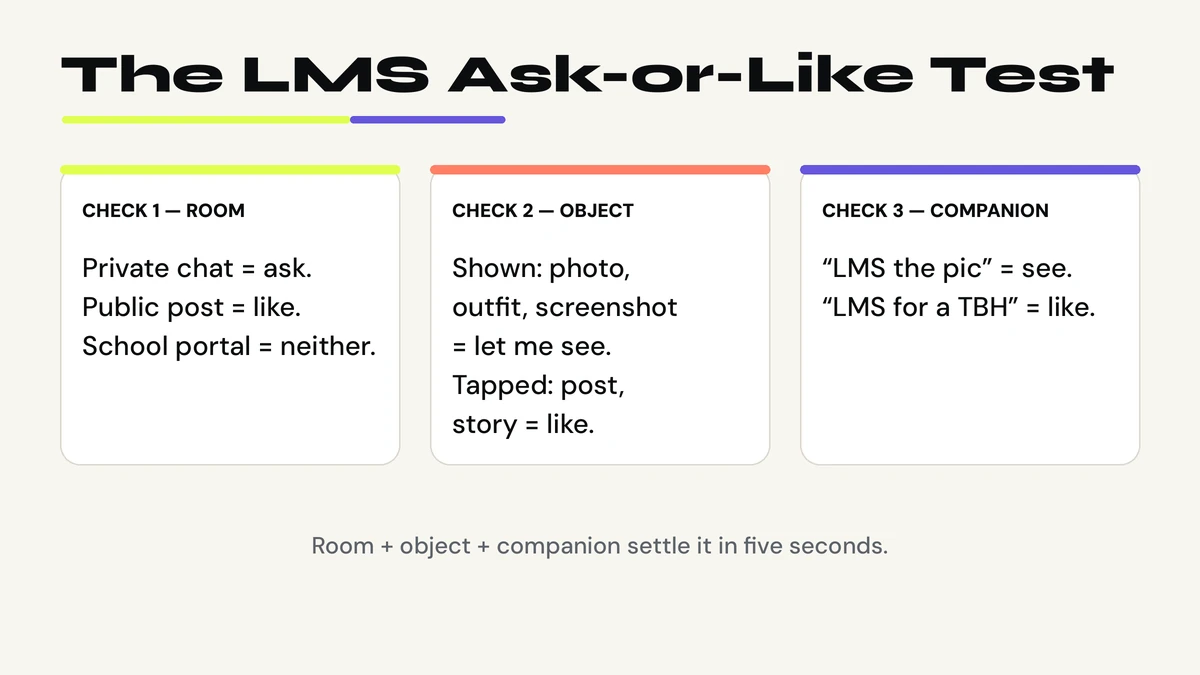
Before you answer an LMS — or send one — run three checks. They take about five seconds, and they beat every shortcut the competitors offer, because the competitors all say “context matters” without giving you a procedure for reading it:
- Check 1 — The Room Check. Where did it arrive? A private one-to-one chat means ask: someone wants to see something. A public post, story, or caption means like: someone wants engagement. A school or work portal, email, or course page means neither: that LMS is the learning system, and this test does not apply.
- Check 2 — The Object Check. What is the LMS attached to? Something to be shown — a photo, an outfit, a screenshot, a ticket, a score — means “let me see.” Something to be tapped — a post, a story, a status, a picture already posted — means “like my status.” If there is no object at all, read the sentence around it: a thing mentioned just before the LMS is usually the object.
- Check 3 — The Companion Check. What travels with the letters? “LMS” plus a thing (“LMS the pic,” “LMS that fit”) means let me see, because you cannot like a thing that has not been shown yet. “LMS for a…” (“LMS for a TBH,” “LMS for a rating”) means like my status, because the “for a” promises something back in exchange for the like.
Worked trio. “You got the tickets? LMS!” in a private chat — Room: private; Object: tickets to be shown; Companion: none, but the tickets were just mentioned. Answer: let me see; send the photo. “New post! LMS for a TBH” on a story — Room: public; Object: the post itself; Companion: “for a TBH.” Answer: like my status; tap like if you want the honest comment. “Please upload your essay to the LMS by Friday” in a course email — Room: school portal; Object: an assignment system. Answer: neither slang reading; log in and upload.
“LMS” in Real Chats
These examples are written for this guide to show the patterns — not presented as real transcripts:
- The outfit check. A: “just tried on the jacket” / B: “LMS! put it on first.” Private chat, thing to be shown: let me see, with a condition attached.
- The proof request. A: “I got an A on the final” / B: “LMS the score, no way.” The disbelief is playful; the request is real: show the screenshot.
- The ticket tease. A: “you will never guess who I got tickets for” / B: “LMS!!” Two exclamation marks, same job: curiosity asking for a picture.
- The check-later promise. A: “can you check if my package arrived?” / B: “LMS when I get home.” The stretched reading: let me see, delayed, not refused.
- The TBH game. Story caption: “LMS for a TBH.” Public post, trade promised: like my status, and the honest comment comes to whoever liked.
- The rating game. Caption: “new fit, LMS for a rating.” Same trade, different prize: a score out of ten for every like.
- The school trap. Email: “your grades are posted in the LMS.” No slang at all: the learning system, and answering it with a photo or a like would be a category error.
The LMS Tone List
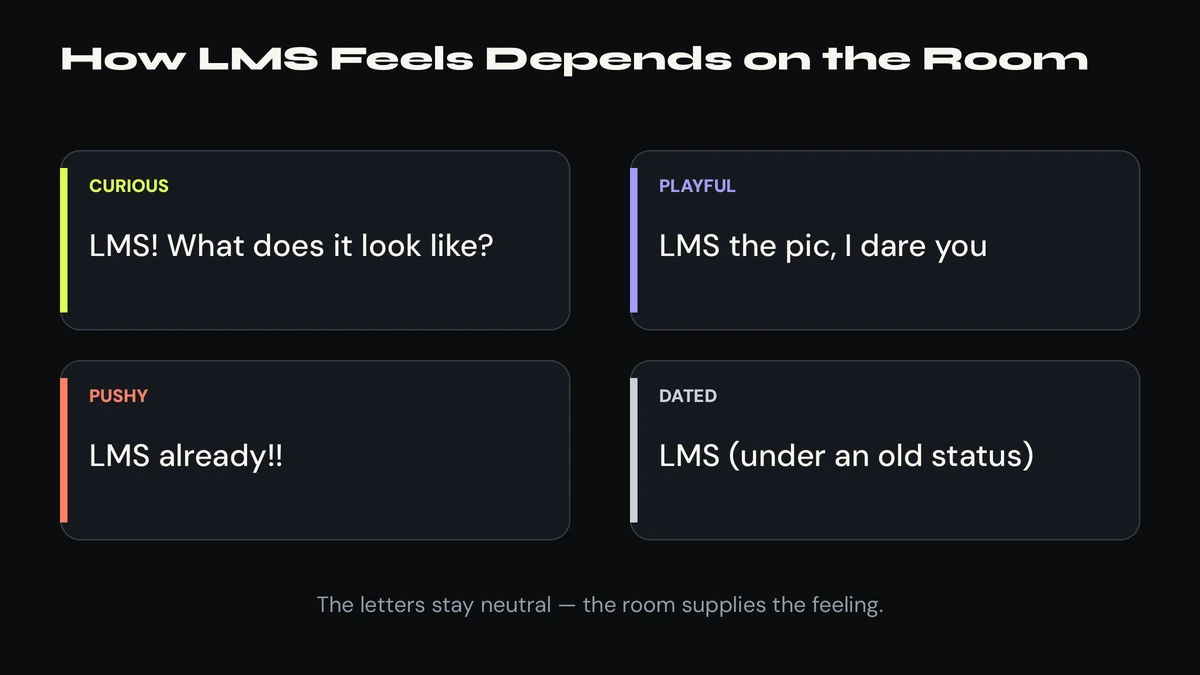
LMS itself is neutral — it names a request, not an attitude. The tone you feel comes from the room, the object, and the sender, never from the letters alone. Seven readings:
- Curious: “LMS! what does it look like?” — genuine interest, the default private reading. The sender wants in on the moment.
- Playful: “LMS the pic, I dare you” — teasing, light, between friends. The dare is the joke; the request is real.
- Impatient: “LMS already!!” — curiosity with a foot tapping. Usually affectionate; with a stranger, it reads as pushy.
- Doubtful: “yeah right, LMS” — prove it. The sender doubts the claim and is asking for evidence, not just a picture.
- Flirty: “LMS that fit” late at night from a crush — the photo request carries a charge the words alone do not. Context, not letters, makes it flirty.
- Transactional: “LMS for a rating” on a public post — a trade, stated plainly. No feeling is being shared; a deal is being offered.
- Dated: a bare “LMS” under a 2013-style status update — nostalgic or try-hard, depending on who posts it. The like-my-status reading peaked with the status era, and it shows.
What moves a reading between these tones is never the letters alone: it is the room (private versus public), the object (shown versus tapped), and the relationship. A doubtful LMS from a best friend is a joke; the same LMS from a stranger after a personal photo is a boundary question, and the next section on appropriateness says how to answer it.
“LMS” on TikTok
On TikTok, LMS lives mostly in its public reading, because TikTok is a public stage. A caption or comment that says “LMS for a TBH” or “LMS if you agree” is asking for taps, not photos: the like is the entry ticket to the reply, the rating, or the game. Creators use it the way Facebook users once used it on statuses, except the “status” is now a video, and the tap is a heart, not a thumbs-up.
The private reading still appears, but it moves off the stage: in a TikTok DM, “LMS the fit from your video” is a let-me-see request like any other, because a DM is a private room again. And one guardrail, stated plainly: no source documents a TikTok-only meaning of LMS. TikTok stages the public reading most often; it does not invent a third one. If a TikTok LMS looks confusing, run the Room Check first — comment section means like, DM means see.
“LMS” on Snapchat
On Snapchat, both readings live side by side, split by exactly the Room Check. In a private chat or a one-to-one snap, LMS means let me see: “LMS the snap you just took” is a request for the picture itself, and Snapchat’s photo-first format makes that request feel natural — the app is built for showing things.
On a public story, the reading flips: a story captioned “LMS for a TBH” is asking viewers to engage, reply, or send a chat, not to send a photo of their own. The disappearing format adds one wrinkle the competitors underplay: a story LMS expires with the story, so a like-my-status game on a story has a clock on it, and a let-me-see request in a disappearing chat leaves no record of what was asked or sent. If an LMS felt pushy, judge it from memory — what rode with it, a photo request or a game — because the evidence is already gone.
“LMS” on Instagram
On Instagram, LMS follows the same split, with one local twist: the “status” in like-my-status is usually a story or a post now, and users sometimes spell the variant out as “like my story” or “like my stuff.” Those are graded here as the same job with a newer noun, not new meanings — the ask is still a tap on something already posted, and the trade (“LMS for a TBH,” “LMS for a rating”) is unchanged.
In captions and story stickers, LMS is an engagement prompt: “LMS if you love this fit” wants hearts, and the sender’s reply game decides what a like buys. In DMs, it reverts to let me see: “LMS that sunset pic” is a private photo request, full stop. Instagram is also where the two readings collide most visibly, because a DM reply to a story can carry either job — a viewer replying “LMS” to your story might mean “let me see more” or might be echoing your own like-ask back at you. When a story reply is ambiguous, the Companion Check settles it: “LMS the rest of the pics” is seeing; a bare “LMS” under your own “LMS for a TBH” post is joining the game.
“LMS” in Text Messages
Plain texts are the let-me-see reading’s home ground. With no public feed in the room, a texted LMS almost always means show me: “LMS the new apartment,” “LMS your ticket,” “LMS, I do not believe you.” The like-my-status reading needs a post to point at, and a text thread has none, so the Room Check answers most texted LMS before the other checks are even needed.
Texts are also where the photo request meets its delivery channel: if the picture is private, the reply often moves out of the group thread and into a one-to-one thread, which is exactly the job our DM guide describes — a private message inside the app, not a public post. And if a like-ask in a text turns into real plans instead of a game, it stops being an LMS at all and becomes an invitation, which is the job our HMU guide covers: contact me when you are ready, no game attached.
One texting limit, stated plainly: never send a bare LMS to someone you barely know right after they mention something personal. In a private thread, let me see is a request for access to their camera roll, their home, or their appearance, and from a stranger that reads as intrusive even when the sender meant it lightly. With close friends it is harmless; with anyone else, add the object and the reason — “LMS the jacket if you get a chance” — or do not send it.
Who Is Sending It: How “LMS” Lands by Sender
No source documents a different meaning of LMS per sender — the fork stays the same; what changes is how much weight each reading carries, and what you owe back:
- Friend: the default. A friend’s LMS is a photo request or a game invite at face value; run the test, answer the reading, move on.
- Crush: overread territory. A crush’s “LMS that fit” feels bigger than it is — usually curiosity, sometimes flirty, never a confession. Answer the photo or the game, not the fantasy.
- Partner: pattern rules. A partner’s LMS is usually routine curiosity; judge the pattern across days, not one message — but a sudden run of photo requests after a calm stretch is a conversation worth having, not a fight worth starting.
- Parent: usually literal and plain, and often the other LMS entirely. A parent writing about “the LMS” usually means the school system; a parent texting “LMS” has likely learned the slang from you and means let me see plainly. Do not read either as a game.
- Coworker or boss: context decides, and the school reading wins here. In a work thread, LMS means the learning system unless the thread is plainly social; never send slang LMS upward to a manager or a client.
- Group chat: the game habitat at scale. A group’s “LMS for a TBH” invites the whole room to play; a group’s “LMS the pics” asks one person to share with everyone, which deserves more caution than a one-to-one request.
- Stranger or creator: the public habitat. A stranger’s LMS under your post is joining your game, not asking for your photos; a creator’s “LMS” is an engagement prompt for the crowd. A short answer, or silence, both end it without rudeness.
When “LMS” Is Too Much: Work, School, and Family
LMS is informal, not rude — but it has three rooms where it lands wrong, and the school room is the one no other term in this series has. First, work and school: in any thread about courses, training, or assignments, LMS already means the learning management system, and slang LMS there is not just casual, it is confusing. A message to a teacher that says “LMS” when you mean let me see will be read as a question about the course platform. In formal writing, spell both out: “please show me” for the photo, “the learning platform” for the system.
Second, family: parents and older relatives may know only the school meaning, or neither, and a bare LMS to a grandparent will likely draw a confused reply rather than a photo. With family, spell it out — “can I see a picture?” costs nothing and removes the whole ambiguity. Third, the pressure problem, which belongs to both slang readings: a like-my-status game pressures friends to tap for attention, and a let-me-see request pressures someone to share a photo they may not want to share. Both are voluntary by design — a like is never owed, and a photo is never owed — and the sender who treats silence as rudeness has misunderstood the term. If someone says no to a photo, or scrolls past your game, that is a complete answer.
Checked Claims: Expansions That Do Not Hold Up
Three letters attract folklore, and LMS attracts more than most because its dictionary entry points somewhere else entirely. Each claim below was graded against the sources read for this article:
- “Laughing myself silly” — rejected. One secondary list floats it, with no corroboration anywhere else and no dictionary attestation. Laughter already has its own well-attested terms; LMS does not need this job, and no source shows it doing it.
- “Let me stop” — graded weak, not established. One competitor list gives it as a humorous self-correction (“I have been rambling, LMS”). It appears in no dictionary entry and no second independent glossary read for this article, so treat it as a joke usage at most, never the default.
- “Love myself” — graded weak, not established. Same story: one list, no corroboration, no dictionary entry. A sincere or sarcastic self-love post would need far more evidence than a single listicle line before this guide taught it.
- “Let’s meet soon” — rejected. One list, no corroboration, and it contradicts the object evidence: LMS in chats attaches to things to be shown or posts to be liked, never to a meeting plan. Meeting plans have their own invitation words.
- “Like my stuff” and “like my story” — graded variants, same job. These are real phrasings on Instagram and TikTok, but they are the like-my-status reading with a newer noun, not separate meanings. Teach them as variants and the article stays honest.
- “Looks Money Status” — fenced, not a texting meaning. Wiktionary does list this expansion, but explicitly as incel slang: a framework for rating desirability, not a message anyone sends in a chat. It is real in that subculture’s vocabulary and irrelevant to texting; do not use it in a conversation, and do not confuse it with either slang reading.
- “Learning Management System” as a texting meaning — rejected as a chat reading, real outside chats. Wiktionary’s first sense, and the correct reading in every school or work context. But nobody texting “LMS the pic” is talking about course software, and teaching the school system as a texting meaning would misread every private chat in this guide.
- “Last Man Standing” as a texting meaning — fenced to gaming. Wiktionary attests it for video games, and competitors confirm it as a game mode where players are eliminated until one survives. In a lobby it is correct; in a text thread it is a category error, the same way the school system is.
What survives: “let me see” in private chats and “like my status” on public posts, decided by the Room, Object, and Companion checks, with the school system and the game mode fenced to their own rooms. No frequency or dominance claim is made for either slang reading, because no frequency study exists and the competitors’ “most common” claims cite no data — this guide reports the split, not a winner.
“LMS” vs Its Closest Cousins
LMS belongs to the request-and-reaction family — the words that ask someone to do something small, right now. Its cousins each narrow the job:
- LMK (“let me know”) — the verbal cousin. LMK asks for words: information, a decision, a yes or no. LMS asks for eyes or taps: a photo, or a like. LMK says tell me; LMS says show me or tap this.
- FR guide (“for real”) — the public-reaction cousin. FR co-signs a take in public; LMS asks the public for the co-sign itself. FR is the agreement; LMS is the request for one.
- IKR guide (“I know, right?”) — the agreement cousin. IKR echoes a feeling someone already shared; an LMS-for-a-TBH game trades a like for an honest take. IKR agrees after the fact; LMS sets the trade up beforehand.
- GTG guide (“got to go” / “good to go”) — the exit-and-ready cousin. GTG closes a conversation or green-lights a plan; LMS opens a small transaction inside one. GTG says I am leaving or I am ready; LMS says show me or like this.
- ISTG guide (“I swear to God”) — the emphasis cousin. ISTG underlines a sentence; LMS asks something of the reader. ISTG adds force to what you said; LMS asks the other person to act.
- TBH (“to be honest”) — the trade cousin. TBH is not a rival to LMS; it is its dance partner. “LMS for a TBH” only works because TBH promises the honest comment the like buys. Learn them together and the game reads itself.
- ASMR — the watch-this cousin. Our ASMR guide covers autonomous sensory meridian response — the tingling sensation, or the videos and sounds that trigger it. LMS asks to be shown something; ASMR videos are the thing people ask to see. One is the ask, the other is the watch.
- IP — the address cousin. Our IP guide covers Internet Protocol — almost always an IP address — or intellectual property, an owned creation. LMS asks to see a post; IP is the address it lives at. One asks for the thing, the other names where it lives.
One rule across the family: if the message asks for a picture, it is LMS-let-me-see; if it asks for a tap, it is LMS-like-my-status; if it asks for words, it is probably LMK. The verb in the request is the giveaway.
Where “LMS” Came From
LMS grew up with the status update. In the early 2010s, when Facebook statuses were the main way teens and young adults talked online, users posted “LMS for a TBH” and “LMS for a rating” as public games: like the status, get an honest comment or a score back. Competitors place that peak around 2011 to 2013, and one secondary guide reports the first slang-dictionary entries around 2012 — user-generated attestation, not a primary dictionary, and this guide reports it that way rather than dressing it up as a founding date.
From there the like-my-status reading followed the feed as feeds changed: from Facebook statuses to Instagram posts and stories, from stories to TikTok captions, swapping “status” for “story” and “stuff” along the way without changing the trade. The let-me-see reading grew in parallel, in the opposite direction: as messaging moved into private, photo-first apps, the same three letters became the fastest way to ask for a picture in a one-to-one thread. Neither reading replaced the other; they split by room, which is why the Room Check is the first check in the test and not the last.
The school reading, meanwhile, is older than both and entirely separate: learning management systems took the same three letters in education and workplace training long before the slang games began, and they never gave them back. That collision is not a flaw in the slang; it is the reason this article fences rooms so carefully. Three worlds, three letters, one test to tell them apart.
How to Reply When Someone Sends “LMS”
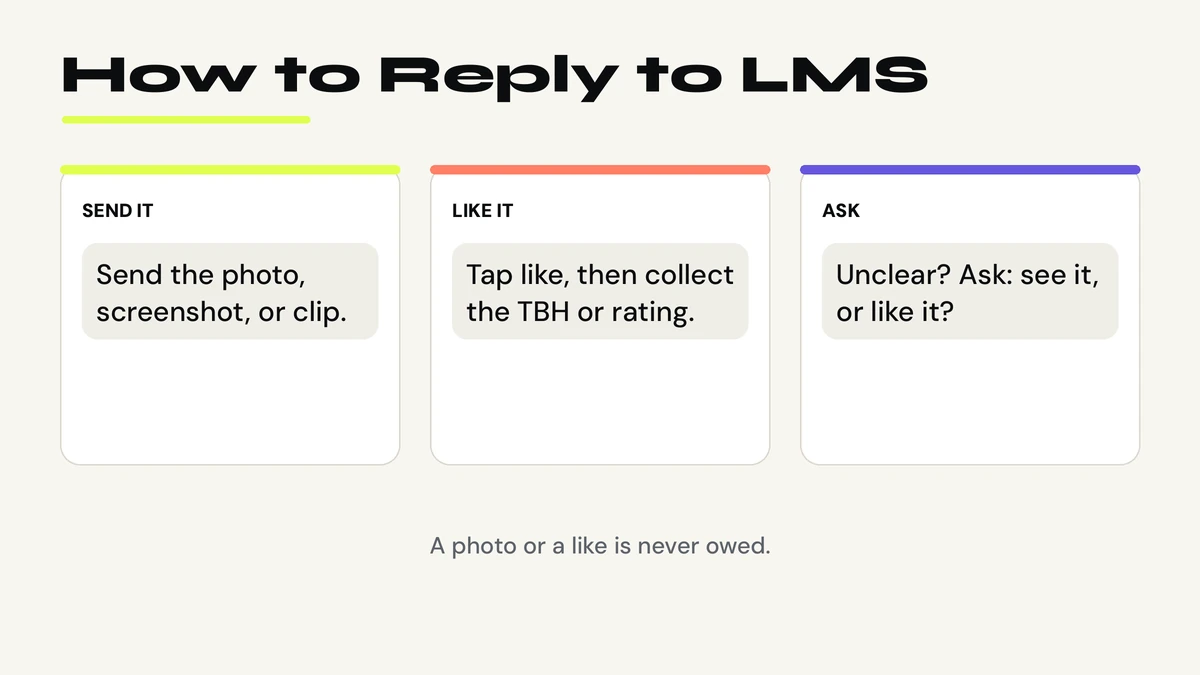
Match the reading first, then match the need:
- Let me see, and you are happy to share: send the photo, the screenshot, or the clip. A picture is the whole answer; a caption is optional.
- Let me see, and you cannot right now: describe it and promise the picture later — “can’t grab one now, but it is navy with silver buttons, I will send one tonight.” A description keeps the curiosity warm without faking the photo.
- Let me see, and you would rather not: decline plainly and warmly — “I would rather not share photos of that, but I can tell you about it.” No photo is ever owed, and a good friend accepts the boundary without a second ask.
- Like my status, and you want in: tap like and wait for the trade. If you liked for a TBH or a rating, the sender owes you the reply — but only the reply, not a conversation.
- Like my status, and you do not: scroll past. Public games are voluntary, and ignoring one carries no penalty; nobody owes a like to a post they did not enjoy.
- Unclear which reading it is: ask before acting — “see it, or like it?” One short question prevents both misfires: the unwanted photo and the wasted like. If the LMS arrived in a school or work thread, answer the system instead: log in, do the module, and ignore the slang entirely.
Frequently Asked Questions
What does LMS mean in a text message?
In a private text, LMS usually means “let me see” — a request to be shown something, like a photo, an outfit, a screenshot, or proof of a claim. With no public post in the room, the like-my-status reading has nothing to point at, so the Room Check answers most texted LMS on its own.
What does LMS mean on social media?
On a public post or story, LMS usually means “like my status” — a request to tap like on the post, often as a trade: “LMS for a TBH” promises an honest comment, “LMS for a rating” promises a score. The like is the ticket; the reply is the prize.
What does LMS mean on Snapchat?
Both readings, split by room. In a private chat or one-to-one snap, LMS means let me see — show me the picture. On a public story, it usually means like my status — engage with the story or join the game. A story LMS also expires with the story, so the game has a clock on it.
What does LMS mean on TikTok?
Mostly the public reading: a caption or comment saying “LMS for a TBH” or “LMS if you agree” is asking for taps, not photos. In a TikTok DM, though, the private reading returns — “LMS the fit from your video” is a let-me-see request like any other.
What does LMS mean at school or work?
A learning management system: the software platform where courses, assignments, and grades live, such as Canvas, Moodle, or Blackboard. That is Wiktionary’s first sense and the only correct reading in a school or work thread. Never answer a school LMS with a photo or a like.
What does LMS mean in gaming?
Last man standing: a game mode where players are eliminated until one survives. Wiktionary attests it for video games, and it is correct in a lobby — but it is not a texting meaning, and it never explains an LMS in a private chat or on a post.
What is the difference between LMS and LMK?
LMS asks for eyes or taps: let me see a photo, or like my post. LMK (“let me know”) asks for words: information, a decision, or a yes or no. If the request needs a picture, it is LMS; if it needs an answer, it is LMK.
Is LMS rude, and can I use it at work?
LMS is informal, not rude — but keep slang LMS out of work and school messages, where LMS already means the learning system and your message will be misread. It is also worth keeping out of first messages to strangers, where a photo request reads as intrusive. With friends, both readings are fine; anywhere formal, spell the request out.
The Takeaway
LMS is two requests wearing the same three letters: “let me see” in a private chat, “like my status” on a public post — and a learning system at school or work that is neither. When the letters arrive, run the Ask-or-Like Test: check the room, check the object, check the companion. And when you send one, remember the only rule that matters: a private room asks to be shown, a public post asks to be liked, and a photo or a like is never owed.