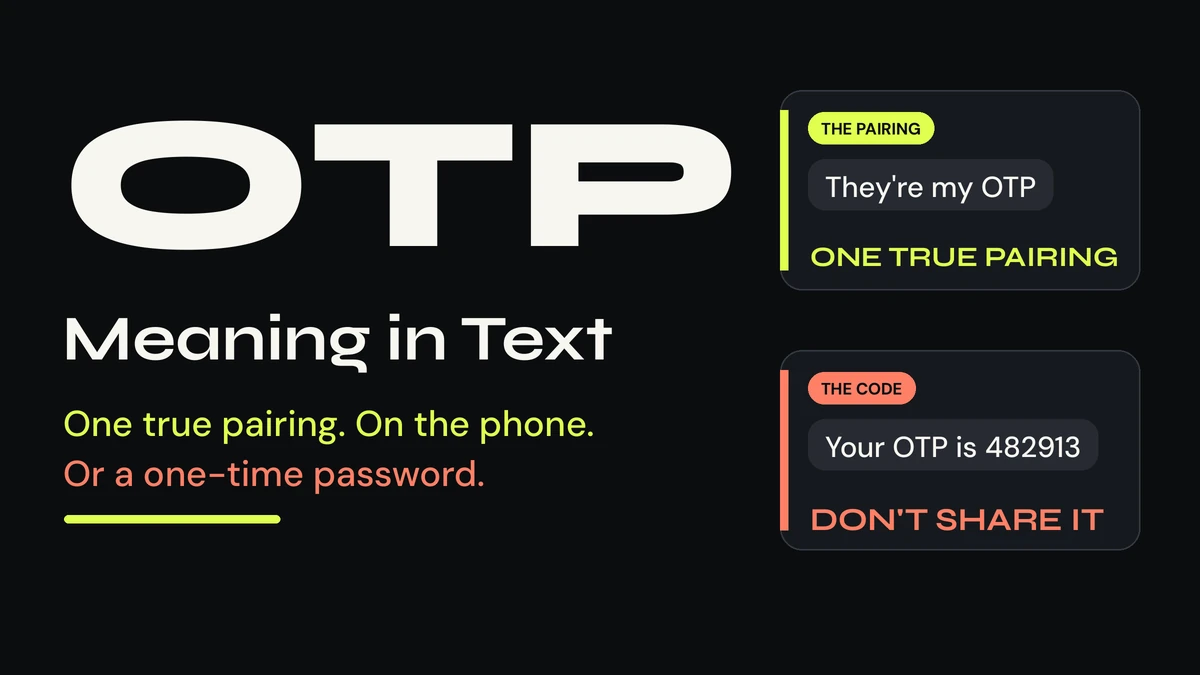
What does otp mean in text? OTP means “one true pairing” — a fan’s favorite couple — but the same three letters can also mean “on the phone” or “one-time password.” This guide to otp meaning in text gives you the OTP Three-Way Test, so you can tell in seconds which OTP you just got.
This guide covers all three live meanings and the fenced gaming one, the three-check test, seven tones of the pairing meaning, OTP on TikTok, Snapchat, Instagram, and in texts, how it lands by sender, when shipping real people or sharing a code crosses a line, graded claims, cousins, a dated history from a 1984 fanzine to a 1996 internet standard, and a reply bank keyed to the meaning you just identified.
What “OTP” Means in Text
OTP is an initialism: take the first letters of a three-word phrase and squeeze out the spaces, and you get O, T, P. The trouble is that three different phrases squeeze down to the same three letters. In fandom, OTP means “one true pairing,” the couple a fan supports above every other. In a casual text, OTP can mean “on the phone,” a quick way to say you are busy on a call. And from a bank, an app, or a login screen, OTP means “one-time password,” a temporary code that works once and then dies. It is pronounced letter by letter — “oh-tee-pee” — never as one spoken word, and nobody says it out loud in a real conversation; you type it, and when you read it aloud you just say the phrase it stands for.
The dictionary record is unusually complete for a slang term, and both lead dictionaries agree on the same senses. Wiktionary, read directly for this article, lists OTP as an initialism of “one-time password,” a password valid for only one login session or transaction; as fandom slang for “one true pair (or pairing),” the romantic pairing preferred by a reader of fan fiction, with published citations from 2007, 2013, and 2018; as “one-trick pony” in gaming; and, under instant messaging, as “on the phone.” It also lists the technical senses “one-time pad” and “one-time programmable,” plus “offer to purchase” in South Africa and “outside the perimeter” in Atlanta — real senses, but none of them is a texting meaning. Dictionary.com, also read directly, lists the same three lead senses in the same order: one-time password first, one-time pad second, and, as informal fandom language, “one true pairing or one true pair,” the two characters a fan considers an ideal romantic match. Oxford Advanced Learner’s Dictionary defines “one-time password” with the abbreviation OTP, and Collins lists OTP as an abbreviation for one-time password. Merriam-Webster has no dedicated OTP page — a direct visit to its OTP entry returned a 404 — and a secondary page quotes Merriam-Webster defining OTP as “one true pair/pairing,” which this guide grades as secondhand, not as a direct read. No dictionary in this build ranks one meaning above the others for every context, and this guide does not invent a ranking either.
Three meanings, then, and the sentence around the letters decides which one you are reading. A character’s name next to the letters means a pairing. The word “I’m” next to the letters means a phone call. A six-digit code next to the letters means security. The lowercase form, otp, is the relaxed, everyday spelling, and it is the one you will see most in fast texts; the capitals, OTP, read a touch louder and are the form a bank or an app will use for a code. Neither spelling changes the meaning — only the room — and the test in the next section is what actually sorts the readings, because no single rule about spelling or position can sort three unrelated phrases.
The OTP Three-Way Test
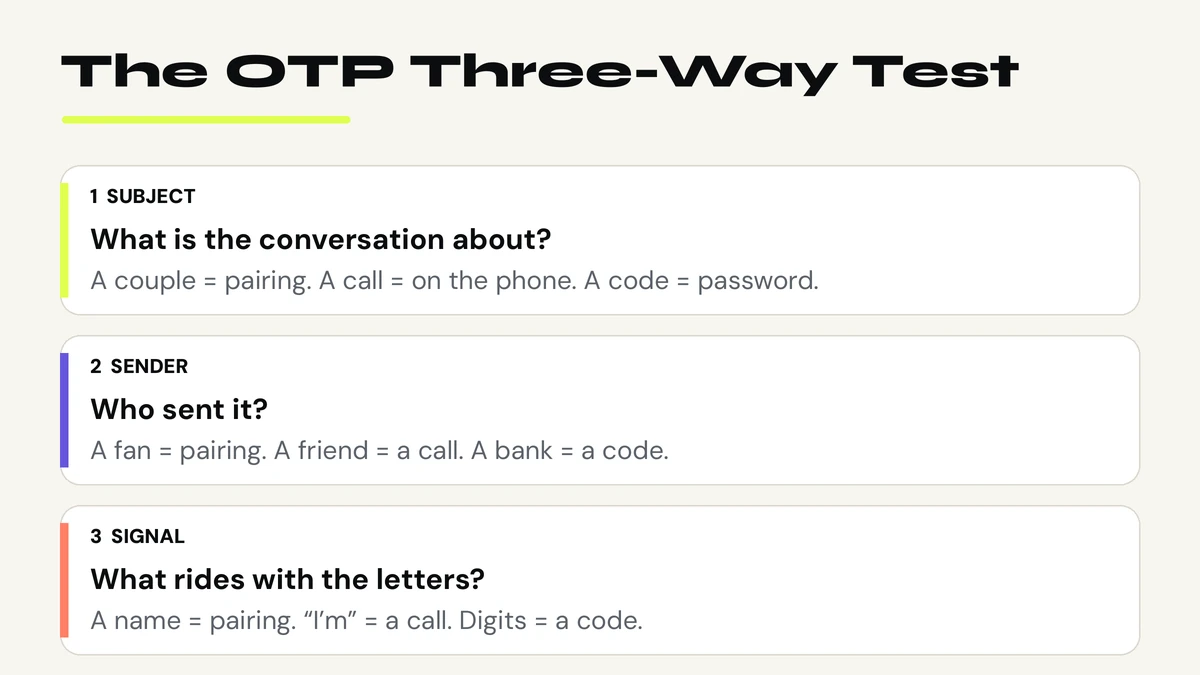
Before you answer an OTP — or send one — run three checks. They take about five seconds, and they beat every shortcut the competitors offer, because the competitors disagree about which meaning is “most common” and then leave you to guess anyway:
- Check 1 — The Subject Check. What is the conversation about? Characters, couples, chemistry, episodes, ships, or fan edits point to one true pairing. A call, a callback, or being busy right now points to on the phone. A login, a bank, a payment, a reset, or a code points to one-time password. The subject is the fastest single clue, because the sender did not choose the letters in a vacuum — the topic chose them.
- Check 2 — The Sender Check. Who sent it? A fan account, a friend talking about a show, or a group chat full of shippers points to a pairing. A friend who was supposed to call you back points to on the phone. A bank, an app, or a login screen points to a password — and if a person you do not know asks you for the code you just received, that is a security problem, not a slang question, and the answer is always no.
- Check 3 — The Signal Check. What rides with the letters? A name — “they’re my OTP” — means a pairing. The word “I’m” plus right now — “I’m OTP rn” — means on the phone. Digits, or the words “enter” and “verify” — “your OTP is 482913” — mean a password. The signal is the grammar made visible, and when the subject and the sender agree with it, the reading is settled.
Worked trio. “They’re my OTP.”: subject a couple, sender a fan, signal a name. One true pairing, no doubt anywhere. “Sorry, I’m OTP rn, call you later.”: subject availability, sender a friend, signal “I’m” plus right now. On the phone — nobody is shipping anyone. “Your OTP is 482913. Do not share it with anyone.”: subject a login, sender a bank, signal six digits. One-time password — and the “do not share it” is the whole point. Three messages, one abbreviation, three readings — and the test, not the spelling, sorted them.
“OTP” in Real Chats
Illustrative examples written for this guide, not real transcripts:
- The shipper’s declaration. “They’re my OTP. I don’t make the rules.” A fan’s favorite couple, stated like a law. The subject is a show, the signal is a name, and the pairing reading is the only one that fits.
- The busy friend. “Can you call me?” “Can’t rn, I’m OTP.” Nobody is talking about a couple. The sender is on another call, and the letters are a status update, not a confession about a ship.
- The bank code. “Your OTP is 482913. Do not share it with anyone.” A code from a bank is a password, not slang. The digits are the signal, the sender is a service, and the message is a credential, not a conversation.
- The playful couple. “We actually look pretty good together.” “‘Pretty good’ is all I get?” “Fine. We’re OTP.” Two real people borrowing fandom language as a joke. The pairing meaning is borrowed, not literal — nobody here is a fictional character.
- The sarcastic ship. “I still think those two should be together.” “After everything that happened?” “Absolutely.” “Sure, because apparently chaos is your OTP.” The pairing meaning is being used playfully, not literally — the joke is that the couple is a disaster, and the letters are the punchline.
- The gamer. “He only plays one champion — total OTP.” In a gaming lobby the letters mean “one-trick pony,” a player who plays almost exclusively one character. Same letters, fourth room — and the subject, a champion, is what gives it away.
- The family login. “Did you get the login code?” “Yeah, it just came through.” “What does it say?” “It says to enter the OTP to continue.” A father and son talking about a code, not a couple. The password reading is the only one that fits — and the code itself stays private, because that is what a password is for.
The OTP Tone List
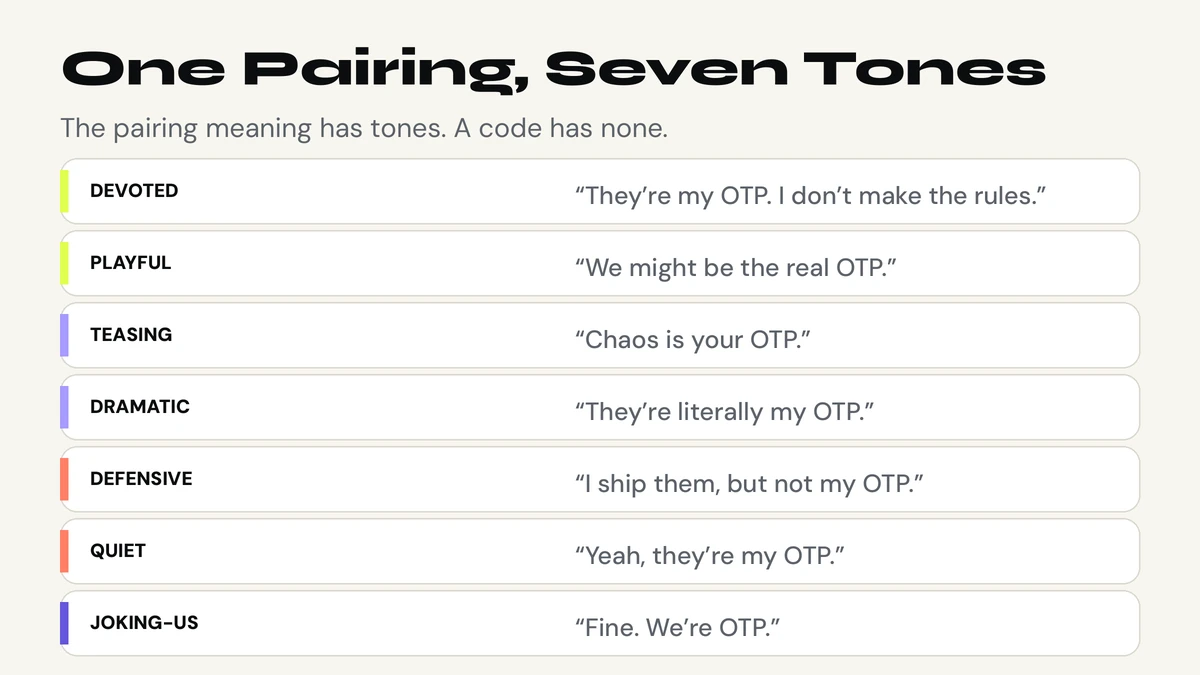
The tone list belongs to the pairing meaning only. A code has no tone, and a missed call has no tone either — “I’m OTP” is a fact, not a feeling. But when OTP means one true pairing, its feeling slides across seven readings, devoted to joking:
- Devoted: “They’re my OTP. I don’t make the rules.” The favorite pairing, stated as a fact. The sender has picked a side, and the side is final.
- Playful: “Okay, but I think we might be the real OTP.” Flirting with fandom language. The pairing is a joke the other person is invited to join, not a claim about a show.
- Teasing: “Sure, because apparently chaos is your OTP.” The pairing is the punchline. The sender likes the couple the way you like a disaster movie — for the mess, not the romance.
- Dramatic: “They’re literally my OTP.” The “literally” is the drama. The feeling is bigger than the sentence, and the sender wants you to know it.
- Defensive: “I ship them, but they aren’t my OTP.” The line-drawing reading. The sender likes the couple, but the favorite slot is taken, and they want the record clear.
- Quiet: “Yeah, they’re my OTP.” Low-key, unhurried, unbothered. The sender agrees with the pairing and does not need the agreement to be a big moment.
- Joking-us: “Fine. We’re OTP.” A real couple, or two friends, wearing the fandom word for a minute. The joke lands because everyone in the chat knows the letters usually belong to fictional people.
What moves a reading between these tones is never the letters alone: it is the subject (which show, which couple), the sender (a fan, a crush, a friend), and the signal (a name, an exclamation, a laugh). The same “they’re my OTP” that is devoted in a fan chat on Saturday can be teasing in a group chat on Monday — and the test, not the spelling, tells you which day you are on. And if the message has digits in it, stop reading tones entirely: a code is a code, and no tone list applies.
“OTP” on TikTok
On TikTok, OTP lives in fan edits, TV-show discussions, anime content, K-pop fandoms, and couple edits, and the pairing meaning rules there. A comment that reads “they’re literally my OTP” under a ship edit means the commenter strongly supports that pairing, and TikTok’s own business material has used the phrase “#OTP (‘one true pairing’ in anime)” — direct evidence, reported by the main competitor, that the fandom meaning is at home on the platform. The public stage suits the devoted and dramatic tones best, because a comment thread is an audience, not a private conversation, and a pairing declared in public is a flag planted for the whole fandom to see.
TikTok is also the one platform where the other meanings can ambush you. A video about account security can talk about a one-time password, and a creator answering DMs can be on the phone — but the platform itself gives OTP no special universal definition, and the subject still decides. If the video is about a couple, read a pairing. If it is about a login, read a code. If an OTP arrives in a TikTok DM, run the test as usual — a DM is private again, the pairing reading falls away unless the conversation is about a show, and the on-the-phone reading returns with it, because a private “I’m OTP rn” is a status update, not a ship.
“OTP” on Snapchat
On Snapchat, OTP fits the fast, private, disappearing DM, and all three meanings can live there. A friend discussing a show writes “you two are my OTP” and means a favorite pairing. A friend who cannot talk writes “sorry, OTP rn” and means on the phone right now. And a Snapchat account-security message involving a verification code uses the technical meaning, one-time password. There is no special Snapchat-only definition, and the disappearing format does not change the meanings — it only removes your evidence.
That disappearance is the real Snapchat trap. If an OTP felt like a ship or a brush-off, you cannot re-read it, so judge from memory what rode with it — a character’s name, the words “I’m” and “right now,” or a string of digits. A bare “otp” with no company is the one case where you should ask, not guess: one short question — “wait, do you mean you’re on the phone?” — settles in a second what a screenshot never could. And because streaks run on speed, OTP is a streak-saver in all three readings: a pairing, a status, or a code each fit in three letters when a full sentence would slow the whole exchange down.
“OTP” on Instagram
On Instagram, OTP shows up in comments, captions, story replies, and DMs, and the pairing meaning leads in every public spot. A comment that reads “they are my OTP” under a couple’s photo is a fan’s declaration, and a caption under a ship edit is the same. DMs carry the full range, exactly like texts — a friend’s pairing talk, a friend who is on the phone, and a security code from an app can all land in the same inbox, and only the test tells them apart. The stage decides the odds, not the meaning: public means pairing, private means check the subject.
Instagram is also where OTP meets its closest platform trap: shipping real people. Calling fictional characters your OTP is straightforward, and calling two celebrities your OTP is a fan habit as old as fandom. But applying shipping language to real people in your own life — two friends, two classmates, two coworkers — can get uncomfortable fast if it ignores their privacy or treats a private relationship as entertainment. The letters are harmless; the people being discussed matter. A thank-you, a matching laugh, or silence all end a public OTP comment cleanly; a long explanation about a real couple’s relationship embarrasses both sides, and the comment was never asking for one.
“OTP” in Text Messages
Plain texts are where the three meanings collide hardest, because all three arrive in the same inbox. The on-the-phone meaning is at home here: “otp, call you later” is the classic texting use, a status update typed with one thumb while the other ear is busy. The pairing meaning travels here too, whenever a friend texts about a show: “they’re my OTP” needs no platform to make sense. And the password meaning arrives here most of all, because banks and apps send their codes by text — “your OTP is 482913” is the message most people meet first, and the one that must never be forwarded, read aloud to a caller, or pasted into a chat.
Texts are also where a pairing talk turns into a longer conversation, and the conversation usually moves somewhere private. A friend who texts “they’re my OTP” often follows up with the episode, the edit, or the link — and our DM guide covers that move in full, because the channel changes what the next message can say. And texts are OTP’s honesty test in miniature: if the message has digits and a warning, it is a credential, not slang, and the only correct reply is to use it yourself on the real service and tell no one. A code shared with a stranger is a door opened, not a message answered.
Who Is Sending It: How “OTP” Lands by Sender
No source documents a different meaning of OTP per sender — the pairing stays a pairing and the code stays a code; what changes is which reading you should expect first, and therefore what you owe back:
- Friend: the default. A friend’s OTP about a show is a pairing at face value; a friend’s “I’m OTP” is a missed call, not a ship. Run the test and answer that, not the letters.
- Crush: overread territory. A crush’s OTP feels bigger than it is — usually “I like this couple” or “I’m busy on a call,” not a confession about you. Answer the plan or the show, not a romance you invented, and never read a code as flirting.
- Partner: pattern rules. A partner’s OTP about a show is usually routine fandom talk; a partner asking for a code you just received is a security question, not a trust test — share the code only by typing it into the real service yourself, never by sending it in a message.
- Parent: usually literal and plain. A parent who writes OTP has usually learned it from you and means the pairing plainly; a parent who asks “what does it say?” about a login code means the password, and the answer is to enter it yourself, not to read the digits aloud.
- Coworker or boss: context decides. In a friendly team chat a colleague’s OTP about a show is fandom talk; in any work thread about accounts, an OTP is a code, and a code is never shared in a group chat. Never send a security code upward, downward, or sideways — codes go into the service, not into messages.
- Group chat: both habitats at scale. A group’s “they’re my OTP!!” cheers for a pairing for everyone; a group’s “I’m OTP, give me five” is a status update for everyone. Answer briefly in the group either way, and never post a code in a group chat, even your own.
- Stranger or creator: the public habitat. A stranger’s OTP under your post, or a creator’s OTP in a caption, is almost always a pairing — a public reaction, not a verdict on you personally. A thank-you or a matching laugh is enough. And a stranger who messages you asking for your OTP code is not a fan: that is a scam, and the answer is silence plus a report.
When “OTP” Is Too Much: Work, School, and Family
OTP is not profanity, a slur, or inherently offensive — the fandom meaning is harmless, and the password meaning is just technical language. The risks are different, and they are real. The first is shipping real people: calling fictional characters your OTP is straightforward, but applying the word to two real people who did not ask to be paired can embarrass them and ignore their privacy. The second is the code: a one-time password is a credential, and treating it like slang — reading it aloud, forwarding it, or sending it to someone who asks — hands a stranger the keys to an account. The letters are safe; what you do with the thing they stand for is where the line sits.
Four rooms, four rules. At work: the fandom meaning is generally safe in a casual chat when the audience understands the slang, but a code is never shared in any work channel, and formal writing should just say “favorite pairing” instead. At school: the pairing meaning is fine among friends who know the word, but never use shipping language about real classmates, and never share a code with anyone who asks for one — not a friend, not a “customer support” caller, not even someone claiming to be from a bank. In family chats, read the room person by person: a sibling group may love the shortcut, a grandparent group may not know the letters, and a parent who asks about a code needs you to enter it yourself, not to send it. The general rule covers every room at once: if someone tells you OTP bothers them, simply stop; and if someone asks you for your code, simply say no. Switching words is easy, and it shows respect. The swap menu is free and it loses nothing: “my favorite couple” for a pairing, “I’m on a call” for a status, and nothing at all — silence — for a code request.
Checked Claims: Expansions That Do Not Hold Up
Three letters attract folklore, and a word with three lives attracts more than most. Each claim below was graded against the dictionaries read in full and the competitors read in full; nothing is repeated here as fact on a single blog’s say-so:
- “OTP only means one true pairing” — rejected. The pairing is a major meaning, not the only one. Wiktionary and Dictionary.com both list one-time password first, and Wiktionary lists on the phone as an instant-messaging sense. A bank’s code and a friend’s missed call are both live OTPs.
- “OTP means one-time password in texts” — rejected as the only meaning. The code meaning is real, but it is the technical reading, not slang. In a chat about a show, OTP is a pairing; in a chat about a call, it is a status. The digits decide, not the app.
- “OTP was invented on TikTok, or by Gen Z” — rejected. TikTok spread the word; it did not invent it. The fandom phrase reaches back to a 1984 Star Trek fanzine summary calling Kirk and Spock “our one true pairing,” the acronym circulated in online fandom in the 2000s, and the security use was standardised in an internet RFC in 1996. The term predates today’s platforms by decades, and calling it Gen Z-only is inaccurate.
- “‘One true pair’ is wrong and ‘one true pairing’ is right” — rejected. Both forms are listed. Wiktionary gives “one true pair (or pairing),” and Dictionary.com gives “one true pairing or one true pair.” The two forms are the same meaning in different clothes, and correcting one to the other is correcting nothing.
- “Lowercase otp and uppercase OTP mean different things” — rejected. Every source in this build agrees: case changes volume and mood, not meaning. Lowercase reads softer and faster, capitals read louder and are the form a bank uses for a code, but a lowercase code is still a code and a capital pairing is still a pairing.
- “OTP is the same as ship” — rejected as an equation. Ship is the broader term: you can ship several couples, but an OTP is traditionally your favorite pairing above the others. Saying “I ship them” is casual support; saying “they’re my OTP” is a stronger preference. The words overlap; they are not the same.
- “In everyday texting, OTP almost always means on the phone” — rejected as a universal ranking. Two competitors in this build disagree openly: one ranks on the phone first in everyday texts, another ranks one true pairing first in slang and fandom. No dictionary ranks the meanings, and no frequency study exists. The honest answer is that the subject decides, which is why this guide refuses a universal ranking and gives you a test instead.
- “OTP means one-trick pony in texts” — fenced, not a texting meaning. The gaming sense is real — Wiktionary lists it, and a player who plays almost exclusively one champion is an OTP in a lobby — but it lives in games, not in chats. Nobody replying “otp, call you later” is talking about a champion.
What SURVIVES: in fandom and social-media slang, OTP means “one true pairing,” the couple a fan supports most strongly, documented from a 1984 fanzine through Wiktionary’s published citations of 2007, 2013, and 2018; in casual texts it can mean “on the phone,” documented by Wiktionary as instant-messaging shorthand; in banking, login, and security situations it means “one-time password,” listed first by both lead dictionaries and standardised in an internet RFC in 1996; and in gaming it means “one-trick pony,” fenced to lobbies. The subject-sender-signal test is the one sorting claim every competitor in this build agrees on, even when they disagree about which meaning is most common.
“OTP” vs Its Closest Cousins
OTP belongs to the fandom family, the agreement family, and the security family at once — which is why its cousins split three ways:
- FR (co-sign cousin). Our FR guide covers the sincerity stamp that certifies a claim. A comment that reads “fr, they’re my OTP” uses FR to swear the pairing is true: one word certifies the feeling, the other names the couple.
- IKR (agreement cousin). Our IKR guide covers the echo that agrees with a feeling. A reply of “ikr, they’re my OTP” agrees with the comparison and declares the pairing; IKR shares the judgment, OTP names the favorite.
- FYI (information cousin). Our FYI guide covers the heads-up that delivers news. FYI informs, OTP verifies: “FYI, your OTP is on its way” brings the news that a code is coming — one word delivers information, the other is the credential itself.
- GNG (plan cousin). Our GNG guide covers the going word that states a plan. “I’m OTP, gng later” pairs the status with the movement: OTP says busy now, GNG says where next — and the two together are the most common busy-then-plan pair in the series.
- “Ship” (fandom cousin). The broader word OTP sits inside. You can ship several couples in a fandom, but only one of them is usually your OTP — ship is the support, OTP is the favorite, and the difference is a ranking, not a synonym.
- “Endgame” (fandom cousin). The pairing a story is expected to end with. An OTP is the pairing you want; endgame is the pairing the story is heading for. They often agree, and when they do not, the gap between them is the whole argument in the fandom.
Where “OTP” Came From
The fandom meaning came first in print, and it came from paper. The phrase “one true pairing” reaches back to fan culture and shipping, and the earliest example the main competitor reports comes from 1984, when a summary for the Star Trek fanzine Alternaties #2 referred to Kirk and Spock as “our one true pairing.” That matters because so many modern guides say TikTok or Gen Z invented the word: the phrase predates today’s social-media environment by decades. Later examples show the acronym circulating in online fandom spaces in the 2000s — a 2002 LiveJournal use is documented by Know Your Meme, and Wiktionary’s citation record carries published references from 2007, 2013, and 2018. No single person coined it: a community that argued about couples needed a word for a favorite, and the abbreviation was the answer.
The security meaning grew up on a completely separate track, and it is older than the internet most people use. A one-time password is a temporary code, valid for one login session or transaction, and the Internet Engineering Task Force published RFC 1938, “A One-Time Password System,” in 1996, followed by RFC 2289 in 1998. That is the technical use of OTP, established in internet standards decades ago — not a newer social-media interpretation that appeared after texting. The on-the-phone meaning is the youngest and the loosest: instant-messaging shorthand for a status update, the kind of thing people type with one thumb while the other ear is busy, and the one the dictionaries list last and the competitors argue about most.
The three meanings survived side by side because three different rooms each needed the same shortcut for a different reason: fandom needed a name for a favorite couple, chatters needed a faster way to say they were busy, and engineers needed a name for a code that dies after one use. The letters never merged into one meaning, because each room had its own job for them — and that is why the Three-Way Test works at all. The history of the abbreviation is a history of three separate rooms, and the room you are standing in still tells you which OTP you are reading.
How to Reply When Someone Sends “OTP”
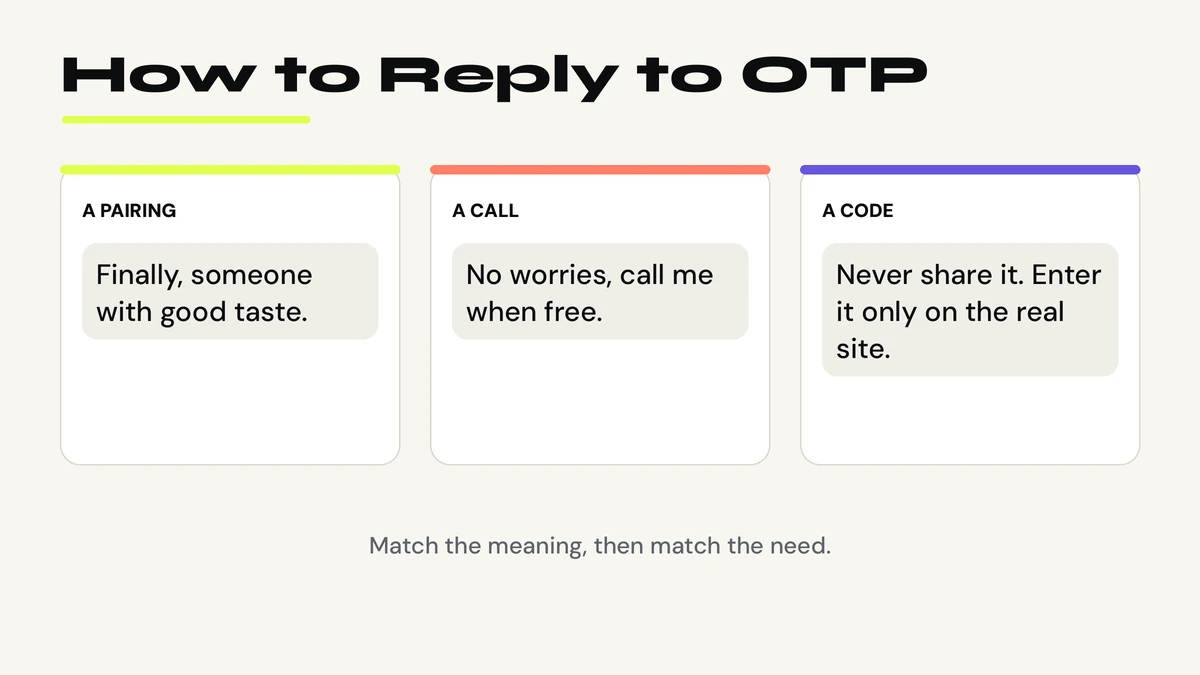
Golden rule: answer the meaning the test found, not the letters. A reply bank keyed to the meaning:
- A pairing you agree with — match the devotion: “Finally, someone with good taste” or “Yeah, I can see why you like them together.” The pairing was the whole message; agreement is the whole reply. Do not argue a ship in one message — nobody ever changed their OTP in a single reply.
- A pairing you do not share — tease, do not fight: “Haha, fair enough — mine’s the other one.” A ship is a taste, not a fact, and a tease keeps the chat warm where a correction turns it cold. If the pairing is about real people, one plain line — “let’s not ship real people, yeah?” — is kinder than a lecture.
- On the phone — keep it short: “No worries, call me when you’re free.” The sender is busy, and the reply should respect that. Do not send three follow-up questions to a person who just told you they are on a call.
- A one-time password — never share it, never send it: If it is your own code, enter it only on the real service, through the real app or site, and tell no one the digits. If someone asks you for a code you just received, the answer is no — no matter who they claim to be, and no matter how urgent they sound. A code is a credential, not a message.
- A gaming OTP — respect the grind: “Respect — one champion, every game.” The player has picked a lane and stayed in it. A joke about the pick is fine; a lecture about variety is not the reply anyone asked for.
- You want to add warmth or a plan — turn the message into something more: A warm “otp, good luck today!” is a status with a wish attached, and our GL guide covers the good-luck wish in full. And a pairing talk is an opening, not just an answer — our HML guide covers the open invitation, because “they’re my OTP, hit me up when you’re free” turns a fandom chat into a plan, and plans beat bare declarations every time.
Frequently Asked Questions
What does OTP mean in a text message?
In a text message, OTP usually means one of three things, and the sentence around it decides: “one true pairing” when the chat is about a couple or a show, “on the phone” when the sender says they are busy on a call, or “one-time password” when the message concerns a login, a bank, or a code. Run the Three-Way Test — subject, sender, signal — before you decide which one you just got.
What does OTP mean on TikTok?
On TikTok, OTP usually means “one true pairing” in fan edits, TV-show discussions, anime content, K-pop fandoms, and couple edits — a fan’s favorite couple, declared in public. TikTok’s own business material has used the phrase “#OTP (‘one true pairing’ in anime),” so the fandom meaning is documented on the platform itself. A video about account security can still mean a one-time password, so check the subject first.
What does OTP mean on Snapchat?
On Snapchat, OTP can mean one true pairing when the chat is about a couple, on the phone when a friend writes “OTP rn” and cannot talk, or one-time password when a security message involves a verification code. There is no special Snapchat-only definition, and because snaps disappear, judge from memory what rode with the letters — a name, the words “I’m” and “right now,” or a string of digits.
What does OTP mean from a guy?
OTP from a guy has no special male-specific meaning. If he says “they’re my OTP,” he probably means a favorite pairing; if he says “I’m OTP,” he may mean he is on the phone; if he says “send me the OTP” in a banking or account-security context, he means the verification code. Gender does not determine the meaning — the surrounding message does.
What does OTP mean from a girl?
OTP from a girl works the same way. It can mean one true pairing, on the phone, or one-time password depending on context, and the abbreviation itself does not indicate romantic interest or flirting. If you are wondering whether an OTP from someone you like is a romantic hint, do not read romance into the abbreviation alone — the rest of the conversation has to provide that meaning.
Is OTP rude?
No. OTP is not profanity, a slur, or inherently offensive. The fandom meaning is harmless enthusiasm, the on-the-phone meaning is a plain status update, and the password meaning is technical language. The cautions are different: do not ship real people who did not ask to be paired, and never share a one-time password with anyone who asks for it.
Can I use OTP at work or school?
The fandom meaning is generally safe in a casual chat when the audience understands the slang, but formal writing should just say “favorite pairing” instead. Never use shipping language about real classmates or coworkers, and never share a security code in any work or school channel — a code goes into the service, not into a message.
Does lowercase otp mean something different from OTP?
No. Capitalization changes volume, not meaning: capital OTP reads a touch louder and is the form a bank or an app uses for a code, lowercase otp reads softer, faster, and more relaxed, but a lowercase code is still a code and a capital pairing is still a pairing. What changes the reading is the subject, the sender, and the signal — never the case alone.
The Takeaway
OTP means one true pairing, on the phone, or one-time password — three meanings, one shortcut, and the sentence around the letters decides which one you are reading. A name means a pairing, the words “I’m” and “right now” mean a call, and digits mean a code. When an OTP lands, run the Three-Way Test: check the subject, check the sender, check the signal. And when you send one, remember the only rule that matters: a pairing is a taste worth declaring, a status is a fact worth keeping short, and a code is a secret worth keeping entirely — so if you mean it warmly, say so with a follow-up sentence, and if you mean a code, say nothing at all, because three letters are the fastest shortcut in the language, and the fastest shortcut deserves the clearest reading.