
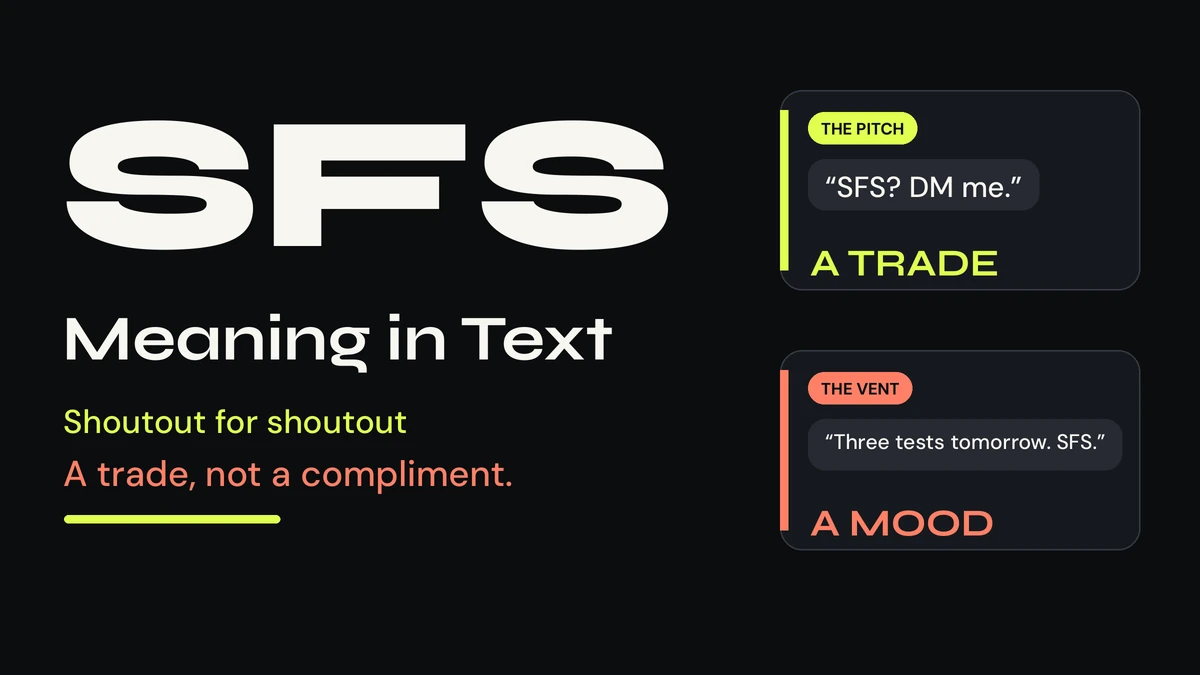
What “SFS” Means in Text
SFS means shoutout for shoutout. If someone texts you “SFS?” they are asking to trade promotion: you feature their account, they feature yours, and both of you reach new followers — that is the sfs meaning in text in one sentence, and it is also the most misunderstood three letters in this series, because the same three letters can mean five different things depending on the room you read them in. SFS is not a feeling and it is not a joke. It is a deal, offered in three letters.
The deal is the whole point, and it is what separates SFS from nearly every other term in this series. Most slang reports a feeling — a laugh, a shrug, a mood — but SFS proposes a transaction. One person promotes another person’s page, and that person promotes back. OTech Magazine, the main guide this build was measured against, calls it a mutual promotion deal, and puts it plainly: someone asking for SFS is not being rude, and they are not flirting — they are asking whether you want to trade exposure. The letters are a handshake, not a hello.
That handshake is also why SFS needs a test before it needs a definition. The same three letters mean “shoutout for shoutout” on Instagram, “snap for snap” on Snapchat, “spam for spam” in an engagement trade, “sorry for spam” after a burst of stories, and “so f***ing stressed” in a private text about exams — and that is before the retail, marketplace, and school meanings arrive. No other term in this series changes its meaning this completely from one room to the next, and no other term punishes a wrong guess this fast: answer a shoutout trade like a stressed vent, or a stressed vent like a shoutout trade, and the conversation breaks in one message.
The dictionary record, for once, cannot settle it — because there is almost no dictionary record at all. Wiktionary lists no English slang sense for SFS: the lowercase entry covers only the ISO language code for South African Sign Language, and the capitalised entry covers only the Swedish Code of Statutes. Merriam-Webster lists no SFS slang entry that this build could read, and Dictionary.com’s slang senses reach this guide second-hand, through a rival guide that reports them. That gap matters, because the last term in this series had the dictionaries agreeing with the internet, and SFS has the opposite: the slang lives entirely in guides, in Urban Dictionary attestations, and in the DMs where the trades actually happen. This guide says so openly, and grades every meaning by the sources that document it instead of pretending a dictionary settled the question.
One more thing before the test: the plain vulgar expansion appears exactly once in this guide, in this section, because the term requires it. In a private text, SFS can mean “so fucking stressed” — a vent about exams, deadlines, or a bad day, where the letters are doing the work of a sigh. Everywhere else in this guide — titles, image text, FAQs, and every other section — the asterisked form “so f***ing stressed” is used instead, and the other vulgar expansions are written with asterisks only. The letters are the same in every case; the room decides which expansion you are reading.
The SFS Trade Test
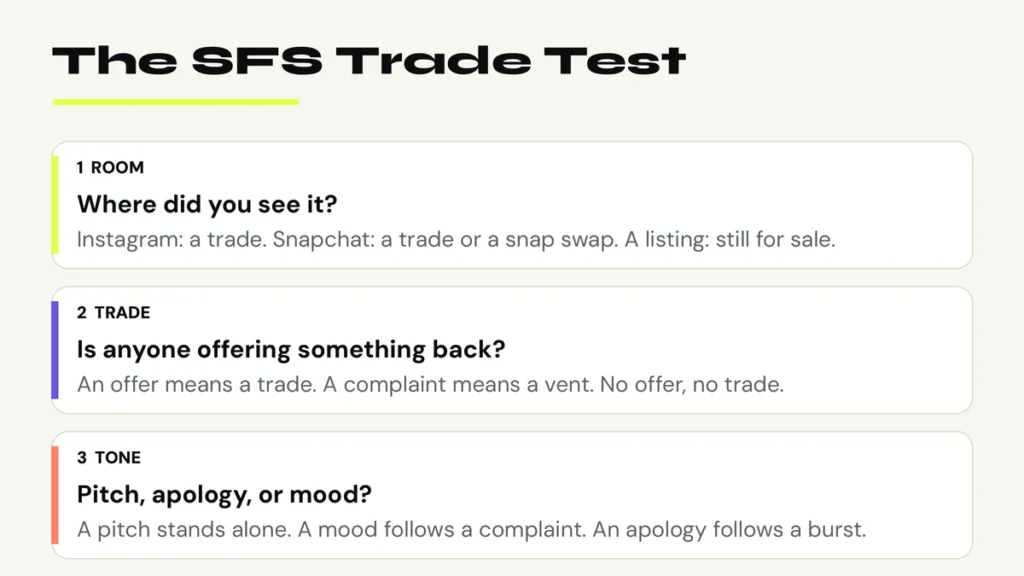
Most slang in this series is sorted by grammar, by volume, or by room. SFS is sorted by the deal — by whether anyone is offering you anything back — because the letters are a proposal first and a meaning second. That is why this guide’s test is built differently from the last one. The ROFL Floor Test asked whether you meant the letters; The SFS Trade Test asks what room you are standing in, because the room decides the expansion before the sender does. It takes about five seconds, and it works on a DM, a story caption, a marketplace listing, and a retail email alike, because the test follows the trade instead of the letters.
- Check 1 — Room. Ask where you saw it. On Instagram, TikTok, or X, it almost always means “shoutout for shoutout.” On Snapchat, it usually means “snap for snap” or “shoutout for shoutout,” and the words around it settle which one. In a private text with no platform in sight, it can mean “so f***ing stressed.” On a marketplace listing, it means “still for sale.” In a retail email or an order update, it means “ship from store.” If the room is a school email, it is probably Student Financial Services. The room answers first, and it answers correctly more often than the letters do.
- Check 2 — Trade. Ask whether anyone is offering you something back. “SFS? DM me” is a trade: a shoutout for a shoutout, a snap for a snap, a like for a like. “SFS, three tests tomorrow” is not a trade — nobody is offering you anything, and the letters are a vent, not a deal. “SFS” under a marketplace listing is not a trade either; it is a status report, the seller telling you the item is still there. If there is no trade on the table, the shoutout meaning is wrong, whatever the platform says.
- Check 3 — Tone. Ask whether the message is a pitch, an apology, or a mood. A pitch stands alone: “Anyone up for SFS?” A mood follows a complaint: “Three tests tomorrow. SFS.” An apology follows a burst: five stories in a row, then “sfs.” The same three letters do three different jobs, and the job is written in the message around them — the pitch has no complaint attached, the mood has no offer attached, and the apology has a flood of posts attached. Read the neighbors, not just the letters.
Run it on the hardest case in this guide: a bare “SFS?” in a DM from an account you barely know. The Room check says Instagram, so the shoutout meaning leads. The Trade check confirms it — the question mark is an offer, and the account wants something back. The Tone check agrees, because the message is a pitch with no complaint and no flood attached. The test says “shoutout for shoutout,” and the test is right: the stranger wants a trade, not a conversation about your exams.
What the test cannot do is read a stranger’s intentions, and it does not try. If someone sends SFS and the checks disagree — the room says Instagram, but the message reads like a vent — ask one question before you answer, because the cheapest reply in this whole guide is “shoutout trade, or are you stressed?” and it is also the one that never trades a shoutout with a person who needed a friend. The test is for your own messages, not for policing anyone else’s. Its job is to stop you from accepting a deal you never meant to make, not to tell anyone else what their letters mean.
“SFS” in Real Chats
SFS shows up wherever a trade is proposed, a streak is kept, a burst is apologised for, or a bad day is vented — and the examples below are written for this guide from the documented uses, so you can recognize each job the moment you meet it. One thing ties them together: in every example, the letters are the offer, the apology, or the vent — never the conversation itself. The message around the letters does the real work; SFS just names the job.
- The shoutout pitch. “SFS? DM me.” The classic job, and the one OTech Magazine opens with: a small creator in a DM, offering to feature your account if you feature theirs. No explanation is needed, because the letters are the explanation — and the question mark is doing half the work, because it turns a statement into an offer you can accept or decline.
- The story caption. “SFS? Comment below!” A creator posts a story asking for shoutout trades, and the comments fill with usernames. Each comment is a small application, and the creator shares the usernames on their story while the commenters share the creator’s page in return. The letters are the job posting, and the comments are the resumes.
- The snap trade. “SFS, add me.” The Snapchat job: an offer to trade snaps back and forth, often to start or keep a Snapstreak. The words around it settle the meaning — “add me” and “streaks” point to snap for snap, while “I’ll post you on my story” points to shoutout for shoutout, and the same three letters do both jobs on the same app.
- The spam trade. “SFS on our latest posts?” The engagement job: two people agree to like and comment on a large number of each other’s posts, to boost the numbers. If the message mentions likes or comments rather than stories or features, this is the meaning — the trade is measured in taps, not in followers.
- The burst apology. “sfs, sorry for the spam lol.” The apology job: five stories in a row, a flood of photos, a string of texts — and then the letters, small and lowercase, saying sorry for the flood. The apology only works because the burst came first; a “sorry for spam” with no spam behind it is a pitch wearing an apology’s clothes.
- The stressed vent. “Three tests tomorrow. SFS.” The mood job: a private text, no platform, no offer, no flood — just a bad day, reported in three letters. The expansion here is “so f***ing stressed,” and the letters are doing the work of a sigh. Answer with comfort, not with a shoutout, because the sender is not proposing a trade.
- The marketplace bump. “SFS.” One word under a listing, from the seller, bumping an old post back to the top. The letters mean “still for sale” here, and the room is the whole clue — a marketplace is not a social app, and nobody trades shoutouts over a used bike. Read the listing, not the letters.
Notice what nearly all of these examples do: they put SFS where the deal, the apology, or the vent belongs, at the moment the trade is proposed or the flood is finished. The letters are a label, not a conversation — nobody answers an SFS pitch with a question about the weather, because there is nothing else to answer. If you read every SFS as a small report from the room — “this is a trade,” “this is an apology,” “this is a vent” — you will read nearly all of them correctly, and the one that breaks the pattern, an SFS with no trade and no complaint and no flood, will stand out precisely because it has no job at all.
The SFS Tone List
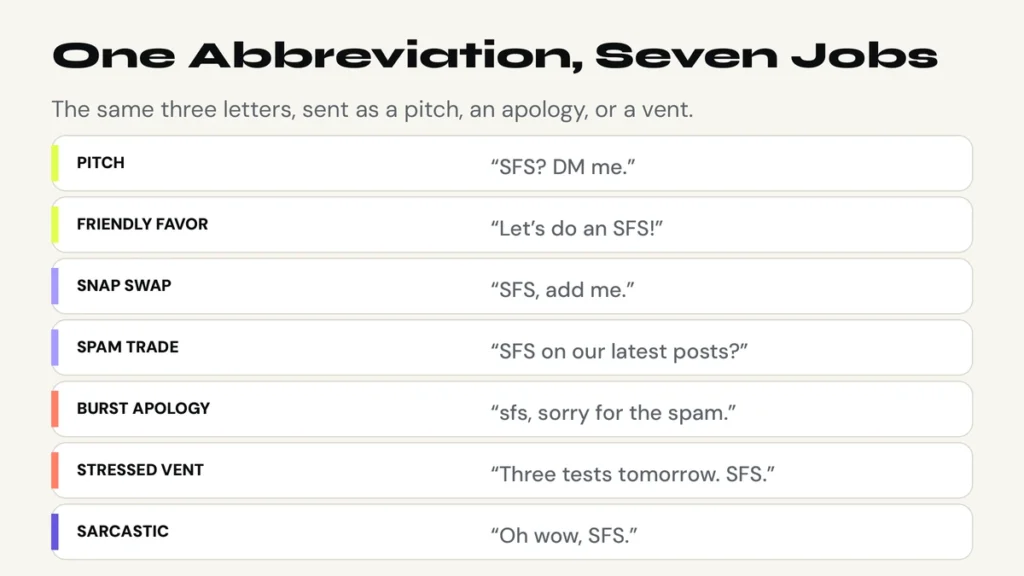
Seven readings, one abbreviation. Unlike the last term in the series, whose readings were seven sizes of the same laugh, these are seven jobs for the same three letters — the same SFS, sent as a pitch, an apology, a vent, or a status report. Read the list as a set of jobs, not as a set of meanings, because the meaning moves with the room and the job moves with the message around it.
- The pitch. Businesslike, direct, a question mark at the end. “SFS? DM me.” The letters are doing the work of a proposal, and the tone is the tone of a small creator who wants to grow without paying for ads. This is the default SFS, and the one every guide in this build describes first.
- The friendly favor. Warm, casual, between people who already know each other. “Let’s do an SFS for your new post!” The same trade, sent as a favor instead of a deal — the tone is support, not sales, and nobody is keeping score. Mean2You says friends use it just to support each other, and the trade is the excuse, not the point.
- The snap swap. Quick, playful, streak-keeping. “SFS, add me.” The tone is the tone of a Snapchat user keeping a streak alive — fast, light, and gone in a day. The letters are a game move, not a business deal, and the reply is a snap, not a contract.
- The spam trade. Hustling, numbers-driven, a little shameless. “SFS on our latest posts?” The tone is the tone of someone counting likes — the trade is measured, the posts are counted, and both sides know exactly what they are getting. It is the least romantic SFS in the guide, and the most honest about what it is.
- The burst apology. Small, sheepish, lowercase. “sfs, sorry for the spam lol.” The tone is the tone of someone who knows they just flooded your feed and wants you to forgive it. The lowercase letters are doing the apologising, and the “lol” is doing the hoping — hoping you will laugh instead of mute.
- The stressed vent. Heavy, tired, no question mark. “Three tests tomorrow. SFS.” The tone is the tone of someone at the end of a long day, and the letters are a sigh with a swear word in it. Answer with comfort, because the sender is not proposing anything — they are reporting how the day went.
- The sarcastic one. Flat, dry, almost a dare. “Oh wow, SFS — real generous of you.” The reading Mean2You documents: SFS sent jokingly, mocking a shoutout request that felt unnecessary, or a “shoutout” that was clearly one-sided. This is the one reading where the letters mean the opposite of what they say — and it is rare, because the trade is usually sincere, which is exactly what makes the sarcastic one land so hard when it appears.
Five of these are safe to send anywhere casual — the pitch, the friendly favor, the snap swap, the spam trade, and the burst apology — because proposing a trade offends nobody, and apologising for a flood offends nobody either. The stressed vent belongs to people who know your week, because a vent sent to a stranger reads as a cry for help, and a stranger is not the right audience for it. The sarcastic one belongs nowhere you need to be believed, because an SFS that means “that was not a real trade” will be misread by half your audience. If you are unsure which tone you are hearing, answer the message around the letters, not the letters — ask about the trade, or ask about the day — and the conversation will correct you gently if you picked wrong.
“SFS” on TikTok
On TikTok, SFS lives in comments, and the comment is its home ground — but a smaller home ground than on Instagram, because TikTok rewards videos, not trades. A small creator comments “SFS?” under another creator’s video, offering to feature each other, and the trade happens in the replies, not in the video itself. The meaning is the same as on Instagram — no source in this build documents a distinct TikTok-only meaning — but the platform changes the shape: on TikTok, SFS points at a video instead of a story, and the video has to earn the trade.
The feed that surfaces these videos is the same one our FYP guide explains, and the SFS comments riding on it are passengers, not drivers — nobody follows an account for the letters, they follow it for the video, the joke, or the creator. The one TikTok habit worth naming is the comment trap: a creator captions a video “SFS” themselves, and half the comments ask what is supposed to be traded, because the letters promised a deal and the video did not explain one. If you offer SFS on TikTok, say what you are trading — a feature, a duet, a stitch — or the comment will be scrolled past.
Replying on TikTok rewards the same shortness the platform rewards everywhere else. A “what does sfs mean” comment under a video wants the one-sentence answer — shoutout for shoutout, a trade where you feature each other — and nothing else. A longer explanation will be scrolled past, and a pitch will be read as dodging the question. If you are the creator, pin the definition: it will save you answering the same comment fifty times.
“SFS” on Snapchat
Snapchat is where SFS varies most, and every guide in this build says so. Many users mean “snap for snap,” an offer to trade snaps back and forth, often to start or keep a Snapstreak. Others use it the Instagram way, meaning “shoutout for shoutout,” where each person promotes the other’s username on their story so both gain friends. The same three letters do two different jobs on the same app, and the words around them are the only thing that settles which one you are reading.
The surrounding words usually settle it fast. “SFS, add me” or “SFS to keep streaks” points to snap for snap. “SFS, I’ll post you on my story” points to shoutout for shoutout. Mean2You adds a third Snapchat reading, “solo for solo” — users post a solo picture of a friend on their story with a caption tagging that friend, and the friend does the same in return — a trend that became popular because it helps Snapchat users show appreciation for close friends. That reading is fenced in this guide, because only one guide documents it, but it is a real Snapchat habit, and it belongs in the same family: a trade, measured in stories instead of snaps.
One habit makes Snapchatting SFS painless: keep the trade in the chat, where it can be answered, rather than in a snap that disappears before the other person sees it. An “SFS” sent as a snap can vanish before the other person ever knows a trade was offered; the same offer sent as a chat message waits to be seen, and the reply can name the terms. Nothing about Snapchat changes the meaning; the app only changes how long your offer lasts, so put the trade where it can be read — and if the trade is a streak, say so, because “streaks” is the one word that ends the guessing.
“SFS” on Instagram
On Instagram, SFS means “shoutout for shoutout” in nearly every case, and every guide in this build agrees on that. You will see it in story captions (“SFS? DM me”), in bios, in comments under popular posts, and in DMs from accounts you do not know. The hashtag #SFS is used to find other accounts open to trading shoutouts. The usual arrangement is that both accounts post each other to their stories for a set time, often 24 hours, and tag the other person so viewers can tap through.
Our IG guide covers the shorthand itself; the point here is narrower — on Instagram, the trade is the whole job, and the details are the whole negotiation. The “SFS pic” is usually a screenshot of your profile that the other person will post, and the picture is the currency: a clear profile photo, a readable username, and a bio that tells the other person’s followers why they should tap. Our PFP guide covers the profile picture itself, and the SFS trade is the reason that picture matters — a blurry or confusing profile picture is a trade that never closes, because nobody taps through to a page they cannot read.
Less often, SFS on Instagram means “spam for spam” — a deal where two people like and comment on a large number of each other’s posts to boost engagement. If the message mentions likes or comments rather than stories or features, this is probably the meaning. The practical rule follows from that split: if the message names a story, a feature, or a tag, it is a shoutout trade; if it names likes, comments, or post counts, it is a spam trade. A bare “SFS?” with nothing attached is almost always the shoutout trade, and on Instagram the half that might misread it is the half that did not read the message around it.
“SFS” in Text Messages
Text messages are the room where SFS is hardest to read, and the reason is simple: a text has no platform to lean on. On Instagram the room answers first, and on Snapchat the words around it answer second — but in a plain text, the letters arrive with nothing but the conversation, and the conversation has to do all the work. That is why this section matters more than the three platform sections above it: the text message is the room where the Trade Test earns its keep, and where the vent meaning lives.
In a private text, SFS can mean “so f***ing stressed” — a vent about exams, deadlines, or a bad day, where the letters are doing the work of a sigh. Dictionary.com records the informal expressions behind this reading, and the guides that report it agree on the shape: a complaint first, then the letters, with no offer and no flood attached. “Three tests tomorrow. SFS.” is the shape, and the shape is the whole clue — a shoutout trade never follows a complaint, and a vent never carries a question mark. If the message is a complaint, answer with comfort, not with a shoutout, because the sender is not proposing a trade.
The other text-message job is logistics: organising a shoutout trade that lives on another app. “Can we do SFS on our WhatsApp status?” means both people will feature each other’s business or page on their status update for a set number of hours — a trade that happens in a text because the trade itself happens on a status. If the conversation needs to move somewhere private or longer, that is what a DM guide move is for: take the trade out of the group chat and into a one-to-one thread, where the terms — who posts first, how long it stays up, what picture goes with it — can be agreed without an audience.
Who Is Sending It: How “SFS” Lands by Sender
The letters do not change with the sender. The weight you give them does, and so does the reply they deserve. An “SFS?” from a friend is a favor; the same letters from a stranger are a sales pitch; from a crush, they are almost never about you at all. Read the sender first, then the letters — and read the room second, because the room outranks the sender every time.
- Friend. Default, low stakes. A friend sending SFS is usually offering a favor — a shoutout for your new page, a snap trade to keep a streak, a story feature for your side project. No performance required on either side — just say yes or no, and follow through if you said yes, because a friend who posts their half and gets nothing back will stop asking.
- Crush. Overread territory, but gently. A crush sending SFS is almost always asking for a shoutout trade, not flirting — OTech Magazine says so plainly, and Mean2You agrees: there is no hidden romantic meaning behind SFS on its own. Answer the trade, not the crush, and let the crush part happen somewhere else. The one exception is context: if someone you have been talking to on a dating app sends SFS, they may be suggesting you move the conversation to Snapchat or Instagram, which can be a sign of interest — but even then, the letters themselves are not flirty, and the person and the conversation around them tell you more than the acronym does.
- Partner. Pattern rules. A partner sending SFS is usually hyping you in public — “SFS for my babe’s new business!” — a post that tells their followers the couple backs each other’s goals. It feels warm rather than transactional, because the trade is the excuse and the support is the point. A partner who sends “SFS?” and nothing else at a project you worked hard on might just be busy — the history between you answers faster than the letters do.
- Parent. Usually a mix-up, and a kind one. A parent sending SFS in a family chat usually means one of two things: they saw the letters on a grandchild’s story and are repeating them, or they meant something else entirely and the letters are a typo. The kind answer is one question — “shoutout trade, or did you mean something else?” — not a definition, because a parent who wanted a definition would have asked for one.
- Teacher or classmate. Homework room, mostly harmless. A classmate sending SFS in a study group is usually trading shoutouts for a meme page, a small business, or a gaming clip — and the reply that helps is a yes or a no, and then the next problem. A teacher sending SFS is rare, and when it happens it usually means a school account is being promoted — enjoy the trade, then get back to work.
- Coworker or boss. Read twice. A coworker sending SFS about a work-adjacent page — a side project, a small business, a team fundraiser — is normal, friendly, and safe. A boss sending SFS is a surprise, and it usually means the trade is sanctioned and the room is relaxed — but do not take it as an invitation to pitch trades all day. The letters are casual here only because the moment is, and the moment will pass.
- Stranger. The opening move. A stranger sending SFS in a DM you did not ask for is opening a conversation you did not agree to — a pitch, not a greeting — and a stranger is owed a short, factual answer and nothing personal: no details about where you are, what your schedule is, or whether you are alone. Before you agree to any trade, check the other account: a trade works best when both accounts are a similar size and their followers would care about your content, and an account with ten times your followers rarely offers a fair swap. A real shoutout trade never requires your password, a login code, or clicking a verification link — if someone asks for any of those, or pushes you to pay before they will promote you, block and report the account.
The sender rule that covers all seven is short: answer the trade, not the letters. A friend wants a favor kept, a crush wants a trade answered, a partner wants public support, a parent wants one kind question, a classmate wants a yes or a no, a boss wants the work to continue, and a stranger wants nothing you have not chosen to give. Get the job right and the letters take care of themselves.
When “SFS” Is Too Much: Work, School, and Family
SFS is welcome almost everywhere casual, because proposing a trade offends nobody and the letters are the friendliest way to ask for help growing an account. An “SFS?” in a creators’ group, an “SFS?” under a meme page, an “sfs, sorry for the spam” after a flood of stories — none of these will offend anyone, and none of them need a content warning. The risk in this article is not rudeness. It is the wrong room: a trade proposed where no trade belongs, or a vent read as a pitch.
At work, keep SFS in the casual chat and out of the formal one. An “SFS?” in a team group chat about a side project is normal, and a coworker will read it as friendly. An “SFS” in a formal email, a report, or a message to a client reads as careless in a room where care is the job — and an SFS sent during a serious meeting, about a mistake that cost someone their afternoon, will read as mockery even if you meant it as a vent. At school, the letters are harmless in a class group, but a formal essay or an email to a teacher deserves plain words, and a “so f***ing stressed” vent sent to a teacher will read very differently from the same vent sent to a friend. In family chats, read the room person by person — a grandparent who sends SFS is probably repeating something they saw, and nobody needs a lecture on texting slang at the dinner table.
The stop-when-asked rule applies here the way it applies to every term in this series. If someone says your “SFS?” felt like spam rather than a trade, believe them and soften it next time — “would you like to trade shoutouts?” costs nothing, and it is also the version a stranger can actually answer. And the swap menu is easy: say “want to trade shoutouts?” in any formal room, say “I’m stressed” when you want the vent without the swear word, and say nothing at all when the room is grieving, angry, or serious — sometimes the kindest reply to a message is not a trade but a pause. Plain language is never the wrong choice with a term this easy to misread.
Checked Claims: Expansions That Do Not Hold Up
SFS collects expansions the way a marketplace collects listings: most of them are real, a few are guesses, and the job is sorting which is which. The rule for this section is the series rule — grade every claim, fence the real-but-narrow ones, and reject the invented ones openly, with the reason stated. The “show for show” claim sits near the top of this list on purpose, because it is the misunderstanding every new reader arrives with, and it deserves a straight answer.
- FENCED — “Snap for Snap is the Snapchat meaning.” Real, but not the whole story. OTech Magazine, FamiSpy, and FlashGet all document it: on Snapchat, SFS often means an offer to trade snaps back and forth, often to start or keep a Snapstreak. But OTech Magazine also says others use it the Instagram way on the same app, meaning “shoutout for shoutout,” and the words around it — “add me” and “streaks” versus “I’ll post you on my story” — are the only thing that settles which one you are reading. Use the words, not the app, to decide.
- FENCED — “Spam for Spam is an Instagram meaning.” Real, and documented by OTech Magazine, FamiSpy, and the similesverse guide alike: a deal where two people like and comment on a large number of each other’s posts to boost engagement. It is less common than the shoutout trade, and it only fits when the message mentions likes or comments rather than stories or features. If the message names a story, it is a shoutout trade; if it names a like count, it is a spam trade.
- FENCED — “Sorry for Spam is an SFS meaning.” Real, and documented by SpeakAwesomely and Mean2You: people attach “sorry for spam” after posting a lot of content in a short window, usually stories, sometimes a string of texts or a flood of photos. The tell is the burst that comes first — a standalone “sfs” with no preceding content dump is a pitch, not an apology, and a bio that says “SFS? DM me” is not an apology waiting to happen.
- FENCED — “So f***ing stressed is an SFS meaning.” Real, but narrow. Dictionary.com records the informal expressions behind this reading, and the guides that report it agree on the shape: a private text, a complaint first, then the letters, with no offer and no flood attached. It lives in personal texts about exams and deadlines, not on public posts, and it is the only SFS reading that is a mood rather than a deal. The plain form appears exactly once in this guide, in the meaning section, and the asterisked form is used everywhere else.
- FENCED — “Seriously funny s*** is an SFS meaning.” Real, but rare and context-bound. The similesverse guide lists it as a private-text reading for strong amusement — “that video was SFS” — and the shape matches the stressed reading: a reaction, not a proposal, in a private text with no trade on the table. It is written with asterisks everywhere in this guide, and the plain form never appears. Do not use it in a public comment, because half your audience will read the shoutout trade instead.
- FENCED — “Sexual Frustration Syndrome is an SFS meaning.” Real as a joke, and almost never as a serious reading. OTech Magazine reports that some slang sources list it as a joking way of saying someone is sexually frustrated, and that the use is uncommon — when it appears, the conversation around it usually makes it obvious. In the vast majority of messages, especially on Instagram, Snapchat, and TikTok, SFS has no such meaning and simply refers to trading shoutouts or snaps. Treat it as a punchline that needs a room full of friends, not as a meaning to assume.
- REJECTED — “SFS means ‘show for show.'” No. One low-quality page — a scraped guide on a concert hall’s domain — claims SFS stands for “show for show,” where one person offers to share content with the expectation that the other person will reciprocate. No other source in this build corroborates it, and the idea itself is a confused retelling of the shoutout trade: the trade is a feature, not a show, and no creator, guide, or dictionary uses “show for show” for it. The claim is reported here so it can be rejected, not repeated.
- REJECTED — “SFS means the same thing on every app.” No. Mean2You’s own FAQ says it plainly: SFS can mean “shoutout for shoutout” on Instagram, “solo for solo” on Snapchat, and “ship from store” in retail contexts — and OTech Magazine adds that Snapchat is where the meaning varies most, while the similesverse guide adds that a private text can mean stress or amusement instead. The letters stay the same; the room decides the expansion. Anyone who tells you one meaning covers every app has not read the messages.
Two more claims deserve a grade, and they do not fit neatly in the list. “Straight from the source” — Mean2You’s other-meanings list, for sharing verified or original information — is unverified in this build: no other source corroborates it, and no guide shows it in a real message, so this article does not adopt it. “Something for something” — Mean2You’s relationship table, for a mutual favor between partners — is unverified for the same reason: one guide’s table, no corroboration, and the shoutout reading already covers the partner case better. “Serious for serious” and “stare for stare,” listed by FlashGet for live-streaming and video-chat rooms, are unsupported in this build: a single low-quality source, no corroboration, and no real message shown. Two habits follow from this list. First, when someone offers you an expansion of SFS, ask which room it lives in before you believe it — a real expansion always has a room, and an invented one never does. Second, when a claim arrives as an absolute — always, never, only — test it against the Trade Test, because the absolute that survives “SFS, add me” and “three tests tomorrow, SFS” in the same guide is the one worth keeping.
“SFS” vs Its Closest Cousins
SFS is a member of a family, not a lone invention, and meeting the relatives makes the term itself easier to hold. The cousins below sort into two groups: the trade words, which say what you are swapping, and the agreement words, which say yes to the swap. Two of them are linked; the rest are named only, because no TextsMeaning article exists for them yet — and one of them, FS, is named in passing here as the yes you give to a trade, without a link of its own.
- NFS — not for sale. The marketplace twin, and the linked one: our NFS guide covers the letters that mean the opposite of the marketplace SFS. On a listing, SFS means “still for sale” and NFS means “not for sale” — and since the two look alike, reading the listing carefully is the whole job. If you see NFS, do not bother making an offer; if you see SFS, the item is available and you can go ahead and message the seller.
- F4F — follow for follow. The smaller trade. F4F means follow for follow: you follow my account, I follow yours, and nobody features anybody. SFS is the bigger exchange, in which each person actively features the other’s account to their audience. A follow is a tap; a shoutout is a post — and the difference is the whole reason SFS exists. Name only — no TextsMeaning article exists.
- L4L — like for like. The smallest trade. L4L means like for like: you like my post, I like yours, and the exchange ends there. SFS is a bigger exchange than L4L the same way it is bigger than F4F — a feature reaches an audience, while a like reaches a counter. Name only — no TextsMeaning article exists.
- LMS — like my status. The engagement-trade cousin, and the second linked one: our LMS guide covers the call to like a status, which is the same family as the spam-for-spam reading of SFS — a trade measured in taps, not in followers. Both of them live in the same corner of the internet, where the numbers are the point and the trade is the way to move them.
- S4S — shoutout for shoutout, spelled with a 4. The twin, and the alternate spelling: OTech Magazine notes that in the creator world, SFS is sometimes written S4S, and the deal is the same either way. Same trade, same handshake, one digit instead of a word. Name only — no TextsMeaning article exists.
- FS — for sure. The yes. FS is the one-word answer to an SFS pitch — “SFS?” “FS, let’s do it” — and it is the smallest complete trade in texting: the offer, then the agreement, in five letters total. Name only in this section, by design: the reply section’s OFC link already carries the agreement family, and FS is named here so the reader meets it, not so the article can count it twice.
The pattern across the cousins is the point of the section: SFS is not special because it is confusing, it is confusing because it is a trade — three letters doing the work of a proposal, a negotiation, and a handshake at once, while sharing the family with smaller swaps that only move a follow or a like. Learn the trade, and the cousins sort themselves.
Where “SFS” Came From
SFS is young by internet standards, younger than the smartphone in your pocket and younger than most of the people who send it daily — but no source in this build can say exactly how young, and this guide says so instead of inventing a birthday. No dictionary lists the slang sense, no guide in this build dates a first use, and no inventor is claimed anywhere. What the sources do agree on is the shape of the story: SFS grew out of the creator economy, where small accounts needed a way to grow without paying for ads, and a three-letter trade was the cheapest way to ask for help.
The trade itself is older than the letters. “Shoutout for shoutout” is the social-media version of a much older habit — neighbors recommending each other’s shops, bands sharing each other’s flyers, newsletters swapping mentions — and the letters just shrank that habit to a DM. The hashtag #SFS turned the habit into a searchable marketplace: accounts open to trading shoutouts could find each other without knowing each other first, and the trade stopped needing a friendship before it could start. That is the moment SFS stopped being a favor between friends and became a tool between strangers, and it is also the moment the letters started needing a test — because a tool between strangers is exactly the kind of message that gets misread.
The spread followed the apps, one by one. From Instagram stories to Snapchat streaks, from Snapchat to TikTok comments and WhatsApp statuses, from WhatsApp to X replies and creator groups on Telegram — each new app inherited the letters along with the habit of trading attention. The other readings followed the same path: the snap trade grew on Snapchat because Snapchat had streaks to keep, the spam trade grew on Instagram because Instagram had like counts to move, the apology grew wherever stories could flood a feed, and the stressed vent grew in private texts because a private text is the one room with no audience to impress. When a term can be a trade, an apology, and a vent in the same week, it has finished its journey from shorthand to ordinary language — and SFS finished it years ago, even if no dictionary has caught up yet.
How to Reply When Someone Sends “SFS”
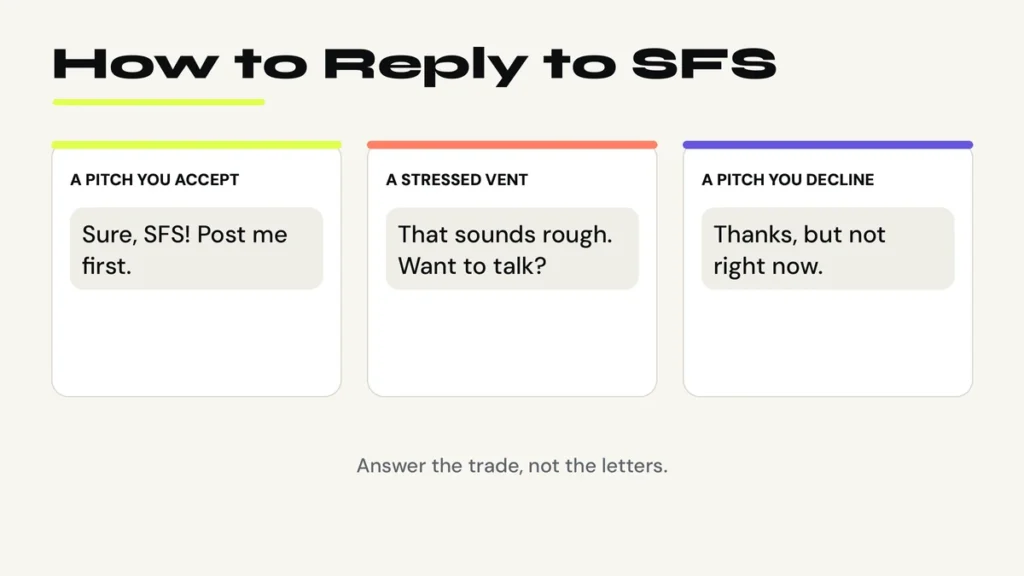
The reply follows the test. Check the room, check the trade, check the tone — then answer the offer, not the letters. Six replies cover nearly every SFS message you will ever receive, and each one names its moment out loud so the other person can correct you if you picked wrong.
- To a shoutout pitch you accept. “Sure, SFS! Post me first and I’ll post you right after.” The fastest honest reply in this guide, because it accepts the trade and names the order in one line — and the order matters, because a trade with no order is a trade where one side can vanish. Our OFC guide covers the one-word yes — “ofc, let’s do it” — for when the pitch comes from a friend and the full sentence would feel formal.
- To a snap trade. “SFS, add me back and I’ll keep the streak going.” Names the terms — the add, the streak, the return snap — so both sides know what the trade is. A snap trade with no terms is a streak that dies in a day, and the kind reply is the one that keeps it alive.
- To a spam trade. “SFS on our latest posts? I’ll start with your newest three.” Counts the trade out loud, because a spam trade is measured in taps and both sides should know the number before they start. The reply that names the count is the reply that gets honoured.
- To a burst apology. “No worries, post away.” Matches the small, sheepish tone with a small, generous reply, and adds nothing — the apology needed forgiveness, not a lecture, and the kindest answer to “sorry for the spam” is the one that ends the conversation about it.
- To a stressed vent. “That sounds rough. Want to talk about it, or want a distraction?” Answers the mood, not the letters — because the sender is not proposing a trade, and a shoutout offer in reply to a vent reads as not listening. Comfort first, trade never.
- To a pitch you decline. “Thanks, but I’m not doing SFS right now.” The polite no, short and complete, with no explanation owed. Our HBU guide covers the return question — “hbu?” — for when the trade ends and the conversation begins again, because a declined trade is not a closed door unless you close it.
The reply to avoid is the empty yes: a bare “sure” to an SFS pitch, with no terms and no order attached, which reads as agreement with nothing behind it. Both mistakes in this guide come from skipping the Trade Test — accepting a deal you never checked, or answering a vent like a pitch — and both are fixed the same way: one honest sentence about what you are actually agreeing to, sent before you reach for the letters.
Frequently Asked Questions
What does SFS mean in a text message?
In most texts it means “shoutout for shoutout” — a request to trade a public mention or feature with another social media user. In a private text with a complaint attached, it can mean “so f***ing stressed,” and the message around the letters decides which one you are reading. If the text names a story, a feature, or a tag, it is the trade; if it names exams, deadlines, or a bad day, it is the vent.
What does SFS mean on Instagram?
On Instagram, SFS means “shoutout for shoutout” in nearly every case. You will see it in story captions, in bios, in comments, and in DMs, and the usual arrangement is that both accounts post each other to their stories for about 24 hours and tag each other so viewers can tap through. Less often it means “spam for spam,” a deal to like and comment on each other’s posts — and if the message mentions likes or comments rather than stories, that is probably the meaning.
What does SFS mean on Snapchat?
On Snapchat, SFS most often means “snap for snap,” an offer to trade snaps back and forth, often to start or keep a Snapstreak — but others use it the Instagram way, meaning “shoutout for shoutout,” and the words around it settle which one. “SFS, add me” or “SFS to keep streaks” points to snap for snap; “SFS, I’ll post you on my story” points to shoutout for shoutout. Snapchat is where the meaning varies most, so read the words, not just the app.
What does SFS mean on TikTok?
The same thing it means on Instagram: “shoutout for shoutout,” usually in a comment from a small creator offering to feature each other. No source documents a distinct TikTok-only meaning, and the trade is less common there than on Instagram and Snapchat, because TikTok rewards videos rather than trades. If a comment asks what sfs means under a video, the one-sentence answer is “shoutout for shoutout — you feature me, I feature you.”
Is SFS rude?
No. SFS is a neutral request to trade promotion, and the term itself is not rude. Some people find unsolicited SFS messages a little spammy, especially from strangers, but the term is not an insult and it is not a come-on. The one reading that can sting is the vent — “so f***ing stressed” carries a swear word — and the one reply that can sting is a trade offer answered with silence. A short, polite decline costs nothing.
Is SFS flirting?
Almost never. It is about growing an account or keeping a streak, and only the wider conversation — not the acronym — would suggest romantic interest. OTech Magazine says so plainly, and Mean2You agrees: when a girl or a guy sends SFS, they almost always want to trade shoutouts or snaps, and the letters themselves are not flirty. If someone you have been talking to on a dating app sends SFS, they may be suggesting you move the conversation to Snapchat or Instagram, which can be a sign of interest — but even then, the person and the conversation tell you more than the letters do.
What does SFS mean when buying something online?
On Facebook Marketplace, eBay, Craigslist, and car-selling groups, SFS often means “still for sale” — a seller confirming the item is available, or bumping an old listing back to the top. Its opposite is NFS, which means “not for sale.” In retail and shipping, SFS means “ship from store,” a fulfillment method where an online order is picked, packed, and shipped from a nearby physical store. The room decides: a listing means still for sale, an order update means ship from store.
Does lowercase sfs mean something different from SFS?
No, not by itself. The case is a tone knob, not a different word — capital SFS with a question mark is the pitch, and lowercase sfs after a flood of stories is the apology, but the letters mean the same thing in both cases. The message around the letters decides how the trade is offered, and the Trade Test outranks the capitalisation every time. A bare “sfs” with no trade, no complaint, and no flood attached is the one case where the case cannot help you — ask one question before you answer.
The Takeaway
SFS is the trickiest lesson in this series and the simplest one to carry: three letters that mean a trade, an apology, or a vent, depending on the room you read them in. In most messages it means “shoutout for shoutout” — a proposal to feature each other, sent at the exact moment two small accounts decide to help each other grow. Run the Trade Test: check the room, check the trade, and check the tone. The meaning that fits is the meaning you answer.
Keep the two habits this guide is built on. Never accept a trade you have not checked — agree on who posts first, how long it stays up, and what picture goes with it, before you post anything, because a trade with no terms is a trade where one side can vanish. And when an SFS message arrives bare — no offer, no complaint, no flood — ask one question before you answer, because the cheapest reply in this whole guide is “shoutout trade, or are you stressed?” and it is also the one that never trades a shoutout with a person who needed a friend.