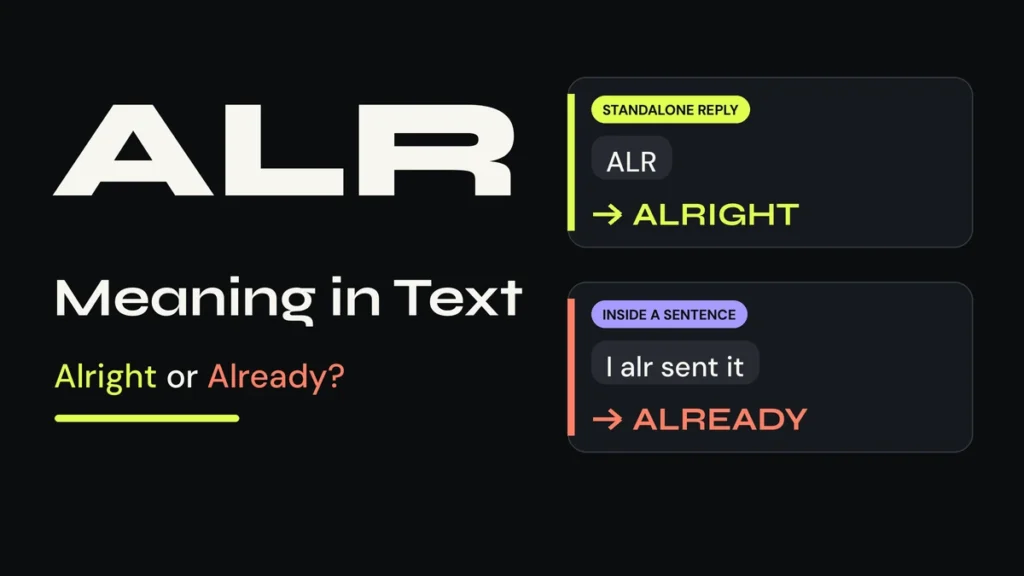
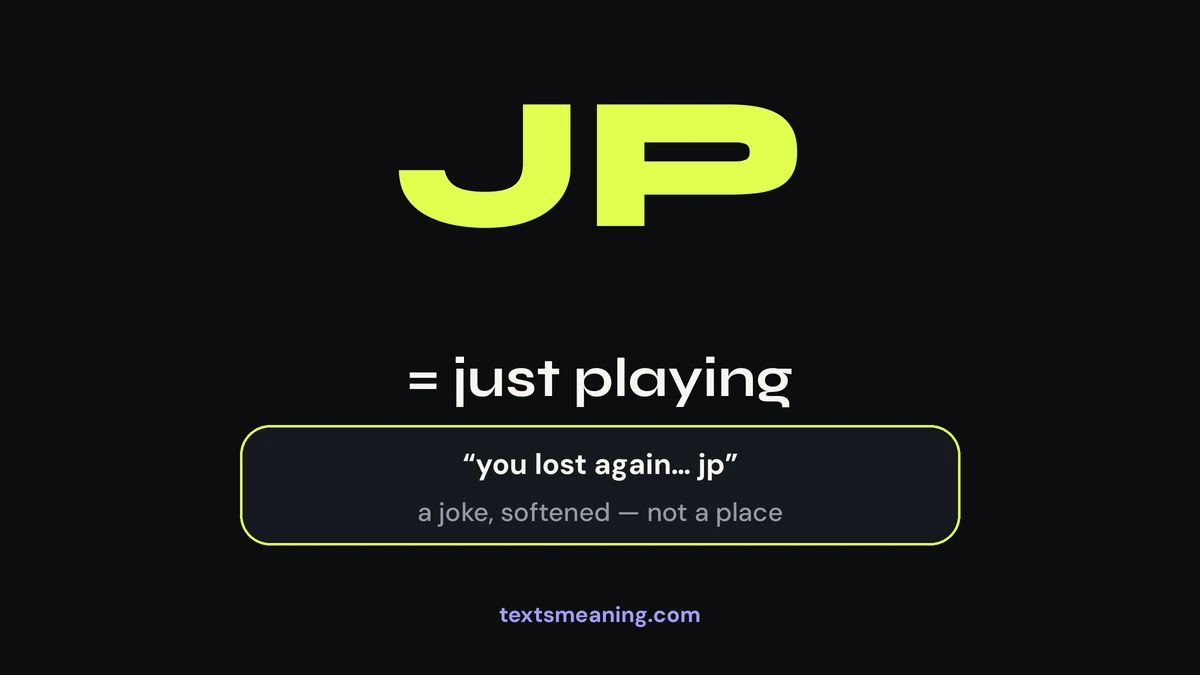
What does jp mean in text? JP means “just playing” — two letters that turn a tease into a joke. “You lost again… jp 😂” does not mean the sender changed their mind; it means they were never serious in the first place. This guide to jp meaning in text teaches you to tell a playful tease from a take-back, and a joke from a place name.
This guide covers the one texting meaning honestly graded, the JP Play-or-Place Test, a seven-reading tone list, jp on TikTok, Snapchat, Instagram, and in texts, senders, misreads, graded claims, cousins, history, and a reply bank keyed to the reading you just found.
What “JP” Means in Text
“JP” means “just playing.” It is an initialism, built from the first letters of the phrase, and it works as a softener pinned to the end of a teasing line: it tells the reader, do not take the line before this seriously. “I am stealing your fries, jp” is not a confession about fries; it is a joke wearing a warning label. Without the jp, the same sentence could read as rude, greedy, or oddly intense. With it, the sentence is a grin.
The dictionary record needs one honest sentence before anything else, because it runs in the opposite direction from most articles in this series. No established dictionary entry for the slang sense “just playing” surfaced in search for this article, so no dictionary attestation is claimed for it. What the dictionaries do attest is the formal reading: Cambridge lists JP as the abbreviation for Justice of the Peace, and Wiktionary lists JP (and J.P.) as a synonym abbreviation of “Justice of the Peace,” a judicial officer. Those are real, dictionary-attested readings — and neither of them is the texting meaning. The texting meaning rests instead on usage-guide consensus: every full competitor guide read for this article (EnglishPairs, TheBobs, Fevo Magazine, Ingleash, ExpertBeacon, Textscode, EnglishWista) expands JP in casual chat as “just playing,” with the same job described in the same words: a tone marker that says the previous line was a joke. Consensus is not a dictionary entry, and this guide does not pretend otherwise — but seven independent guides agreeing on one expansion, one job, and one position (at the end of the tease) is strong attestation for a piece of chat slang, and it is the ground this article stands on.
That split — dictionary-attested formal readings, consensus-attested chat reading — is exactly what makes jp tricky. The letters never change, but the room decides the meaning. In a friend’s text, JP is a joke softener. On a gaming server list, JP is Japan. In a court document, JP is a Justice of the Peace. In a recruiter’s email, JP is a job posting. The rest of this guide is about telling those rooms apart before you answer — because answering a place name like a joke, or a joke like a legal title, is where jp actually goes wrong.
Two usage rules come straight from the sources. First, position is the tell: chat-JP almost always sits at the end of the teasing line it softens (“your aim is trash, jp”), or as a short follow-up (“jp, I am kidding” is rare; the end position is the default). A JP that opens a sentence about servers (“JP servers are laggy”) is not softening anything — it is naming a place. Second, JP is rarer than its famous cousin JK (“just kidding”). Most readers know JK on sight; a fair number will pause at JP. That rarity is not a flaw in the word, but it is a reason to spell it out the first time you use it with someone new: “jp — just playing” costs four words and removes the whole question.
The JP Play-or-Place Test
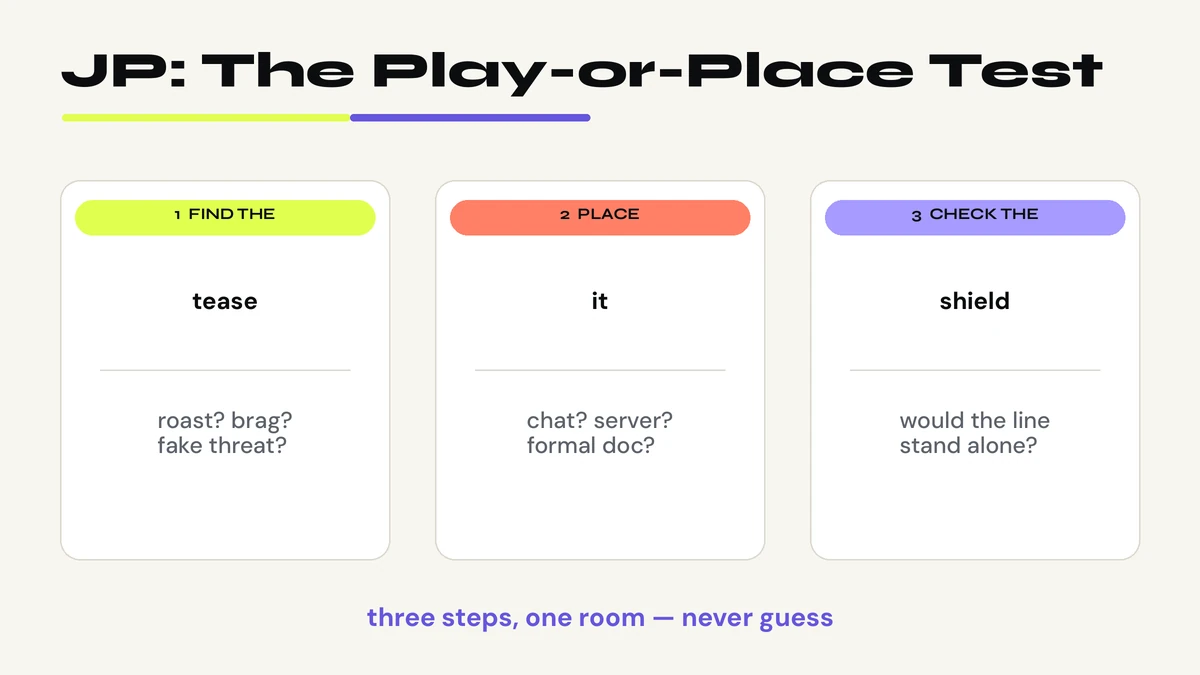
Before you answer a jp — or send one — run three steps. They take about five seconds, and they beat every shortcut the competitors offer, because the competitors all say “context matters” without giving you a procedure for reading it:
- Step 1 — Find the tease. Point to the joke, roast, fake threat, or brag that JP is softening. “You lost again… jp” has a tease (losing). “I am stealing your fries, jp” has a fake threat. If there is no tease anywhere in the message — no joke, no roast, no brag — then chat-JP is probably not what you are looking at, and Step 2 decides what it is instead.
- Step 2 — Place it. Ask what room you are in. A private chat or a comment thread with friends? That is the play room: JP means “just playing.” A server list, a game lobby, or a travel thread (NA / EU / JP)? That is the place room: JP means Japan or a Japanese server. A formal document, a court notice, or a signature block? That is the formal room: JP means Justice of the Peace. A recruiter thread or a hiring channel? That is the work room: JP means a job posting. The room, not the letters, picks the meaning.
- Step 3 — Check the shield. Ask whether the sender would still stand by the line without the JP. If yes — the joke was obviously a joke, and JP only underlined it — then it is honest softening: laugh, roast back, move on. If no — the line was genuinely hurtful, and JP arrived only after the damage — then JP is being used as a shield, not a softener: answer the line, not the letters. A softener decorates a joke; a shield tries to un-say an insult. Step 3 is the difference.
Worked trio. “Your aim is trash, jp 😂” in a friends’ game chat — tease found (the roast), room: play, shield check: the roast was obviously banter, so JP is honest softening: roast back. “Switching to JP, the ping is better” in a Discord server channel — no tease, room: place (a server region): answer about servers, not jokes. “Nice haircut, jp” from a stranger after a real insult — tease claimed but the line stung, shield check fails: the JP is a shield, so answer the insult plainly (“that was not funny”) instead of laughing it off. Three rooms, three answers, one test.
“JP” in Real Chats
Illustrative examples written for this guide, not real transcripts:
- The roast defuser. “you are the worst teammate ever… jp 😂” — the classic. The roast lands, the JP catches it before it bruises. Roast back; that is the game.
- The fake-threat canceler. “I am eating your leftovers tonight, jp 🍕” — a threat nobody believed, canceled before it could be misread. Play along: “touch my pizza and we are done.”
- The brag softener. “beat you again, jp 🏆” — showing off with the volume turned down. The brag is real; the seriousness is not. A laughing reply keeps the rivalry friendly.
- The fake-dare bailout. “I am deleting your playlist, jp 😭” — an outlandish claim retracted in the same breath. Nobody’s playlist is in danger, and everybody knows it.
- The stacked softener. “you wish, jk, jp” — two softeners stacked for emphasis. Stacking is not a new word; it is the same joke underlined twice. Match the energy with a laugh, not a lecture.
- The shield attempt. “you look terrible, jp” — Step 3 fails here. The line was cruel before the JP arrived, and two letters do not un-say it. Do not laugh to keep the peace; say so plainly.
- The place name, not a joke. “lag is insane on JP servers” — no tease, room: place. Our IMAO guide covers a different kind of joke (a brag with a wink); this sentence has no joke at all, so do not go looking for one.
The JP Tone List
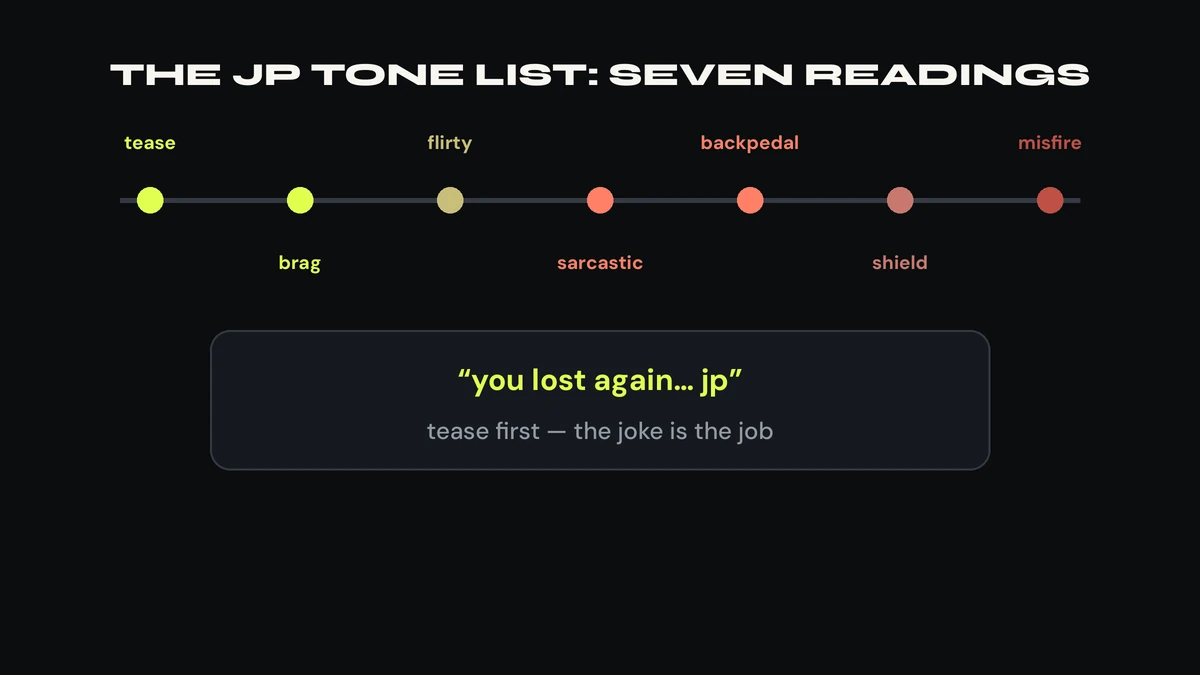
JP’s meaning stays “just playing” in the play room; its warmth slides. Seven readings, warmest to riskiest:
- Affectionate tease: “you lost again… jp 😂” between close friends — the default, and the one to aim for when you send it. The tease is the affection.
- Playful brag: “beat you again, jp” — showing off, softened. The brag is the joke, and everybody is in on it.
- Flirty tease: “I bet I would beat you in Mario Kart… jp (unless you want to prove me wrong 😉)” — the JP keeps a cheeky line light while leaving a door open. Answer the invitation, not just the joke.
- Sarcastic jab: “I totally love Mondays… jp” — the joke is the opposite of the words. Only works when both people know it is a joke.
- Nervous backpedal: “wait, jp, I did not mean it like that” — the sender felt the line land wrong and reached for the softener a beat late. Forgive fast if the history is warm; ask what they meant if it is not.
- Passive-aggressive shield: “you are so sensitive, jp” — the insult is the message and the JP is the alibi. Step 3 catches this one: the sender would not stand by the line without the letters.
- Flat misfire: “the meeting is canceled, jp” — JP softening a fact, not a joke. Was the meeting canceled or not? JP cannot answer that, because facts do not have a play setting. Use a plain correction instead.
What moves a reading up or down this list is never the letters alone: it is the warmth of the history, what rides with the JP (an emoji, a laugh, or nothing at all), and whether Step 3 passes. A laughing emoji pulls any JP toward warm; a bare JP after a cold history pulls it toward shield.
“JP” on TikTok
On TikTok, jp is a comment-section and caption softener more than a private message: “you are cooked, jp 😭” under a roast video, “new profile pic who dis, jp 📸” on a friend’s post, or a creator captioning a joke with a trailing jp so the audience knows not to take it seriously. The public stage suits the affectionate-tease and playful-brag readings best — a comment thread is an audience for banter, not a confessional, and a softened roast plays well there. JP often arrives stacked with laugh shorthand (“jp lol”), which doubles the softening: the laugh says it was funny, the JP says it was not serious.
The trap on TikTok is the reverse of the private-chat trap: taking a public jp too personally, or missing that a public jp is a shield. A creator who writes “jp” under their own video is softening a joke for a crowd, not apologizing to you, and a commenter who writes “jp” after roasting a stranger is using a softener without the history that makes softening work. If a jp arrives in a TikTok DM, though, run the test as usual — a DM is private again, and the shield rules return with it.
“JP” on Snapchat
On Snapchat, jp fits the fast, disappearing DM: “your streak is dead, jp ⚰️” delivers the scare and the apology in one breath, and a story reply that says “jp, you looked asleep in that pic” softens a tease before it can sit wrong. The disappearing format suits the affectionate and playful readings — a joke that lands lightly and is gone. But disappearance also removes your evidence: if a jp felt like a shield, you cannot re-read it, so judge from memory what rode with it — a laughing emoji, a follow-up, or nothing at all.
Snapchat is also where the rarity problem bites hardest, because the format gives you no second look. A friend’s jp on Snapchat is usually a joke you already understand from history; a new match’s jp, with no history and no emoji, deserves Step 1 before any reply. If you cannot find the tease, ask one plain question (“wait, were you joking?”) instead of guessing — it costs nothing and it has never embarrassed anyone.
“JP” on Instagram
On Instagram, jp shows up in caption jokes, comment replies, and DMs, and the stage decides the weight the way it does for every tease word. Captions lean playful: “quitting my job tomorrow… jp 😂” under a selfie is a joke posted for an audience. Comments lean roast-and-repair: “you are cooked, jp” under a friend’s reel is banter the whole thread can join. DMs carry the full range, exactly like texts — a friend’s affectionate tease and a match’s shield attempt live in the same inbox, and only the test tells them apart.
Instagram is also where jp meets its closest letter-trap. A bio, caption, or cross-post that says “JP server” or “JP region” is pointing at Japan, not softening a joke — and a gaming post that says “grinding JP” is usually talking about Job Points in a role-playing game, not about playing around. Read the whole sentence, never just the familiar letters: a JP with a server, a region, or a stat next to it is a place or a number, not a punchline.
“JP” in Text Messages
Plain texts are jp’s home ground, and the place its companion phrases are easiest to see. It pairs with the agreement echo IKR — “jp, ikr, that reply was brutal” stacks a softener and an agreement in one breath — and it travels with laugh shorthand (“jp lol”) the way a joke travels with a grin. It also stacks with its own cousin JK (“you wish, jk, jp”), which is emphasis, not a new meaning: two softeners saying the same thing twice.
Texts are also jp’s work limit, stated plainly: never use jp in a professional message, and never use it to soften a fact. A client, a manager, or a first contact deserves a plain sentence, not two letters that presume the reader knows your sense of humor. The same rule covers serious topics: a condolence, a complaint, or a real disagreement deserves complete sentences, and jp is, by design, a shortcut for jokes. If the message is not a joke, JP has no job there.
Who Is Sending It: How “JP” Lands by Sender
No source documents a different meaning of jp per sender — the expansion stays fixed; what changes is how much history the softener can borrow, and how much a shield attempt can sting:
- Friend: the default. A friend’s jp is a joke at face value; laugh, roast back, and do not overread it.
- Crush: overread territory. A crush’s “jp (unless you want to prove me wrong)” feels bigger than it is — it is a flirty tease with a door left open, not a confession. Answer the invitation, not the hope.
- Partner: pattern rules. A partner’s jp is usually a running joke; judge the pattern across days, not one message — but a sudden run of shield-style jps after disagreements is a conversation worth having.
- Parent: usually literal and plain. A parent who writes jp has usually learned it from you and means the joke plainly; do not read a parent’s jp as sarcasm unless the joke is obvious.
- Coworker: context decides. In a friendly team chat a colleague’s jp about lunch is a joke; in any formal thread it is out of place, and never send one upward to a manager or client.
- Group chat: the roast habitat. A group’s “you lost again, jp” roasts one member for the room’s amusement; answer briefly in the group, and do not single one sender out for a private reading of a public joke.
- Stranger or creator: the thin habitat. A stranger’s jp after a roast has no history to borrow, so it reads as an insult with an excuse attached. A short answer, or silence, both end it without rudeness.
When “JP” Is Not Just Playful
Four misfires, graded. First, the shield misfire: using JP to un-say something genuinely hurtful. “You look terrible, jp” still stings, because a softener cannot rescue a line that was never a joke. The fix is not a better abbreviation; it is an apology. Second, the fact-softening misfire: “the meeting is canceled, jp” confuses everyone, because facts do not have a play setting — use a plain correction, or a cousin built for facts, instead. Third, the stranger misfire: a joke-softener only works when the other person knows you joke. “Nice haircut, jp” from a stranger reads as an insult with an excuse attached, and the excuse makes it worse, not lighter.
Fourth, the place-name misfire in both directions: answering a server-JP like a joke (“JP servers are laggy” is not banter), or answering a joke-JP like a place name (nobody who writes “you lost, jp” is talking about Japan). The Play-or-Place Test fixes both, because Step 2 names the room before Step 3 judges the shield.
On appropriateness: jp is not rude and not vulgar in any reading, and no source calls it offensive. Its risk is social, not moral — a joke that lands as an insult, a shield that dodges an apology, or a place name misread as a punchline. Keep it out of formal, professional, and first-impression messages, out of condolences and serious topics, and out of any first message to someone you do not know well. And one boundary worth stating plainly: never use jp to dress up a real threat. A mock threat among friends (“I am stealing your fries, jp”) is a joke; a real threat with jp stapled to it is still a real threat, and the abbreviation makes it worse, not lighter.
Checked Claims: Expansions That Do Not Hold Up
- “JP means ‘joking please’” — rejected as a working expansion. It appears in a single competitor guide, with no dictionary attestation and no chat example in any other source read. One guide’s guess is not a meaning.
- “JP means ‘just pranking’” — rejected. A near-miss on an abbreviation-list page only; no dictionary attestation, no chat example, and every full guide expands it as “just playing.”
- “Surveys prove most people read JP as just playing” — rejected as stated. Two competitors quote percentages (75%, 78%, 82%, 87%) from unnamed surveys, with no survey named, no sample given, and no source linked. Percentages without a source are decoration, not evidence, and none are repeated here as fact.
- “JP comes from the late 2010s” (or, equally, “from the early 2000s”) — reported, not resolved. Competitors disagree: one dates the chat usage to the late 2010s rise of texting culture, others to early-2000s instant messaging. No dated first-use evidence was found in any source read, so this guide claims no origin decade — only that the abbreviation belongs to the instant-messaging era.
- “JP always means Japan” — rejected as a chat reading. Japan is the ISO country code and the server-region label, and it is the right reading in a server list or a travel thread — but in a friend’s teasing text, the room is play, not place.
- “JP means jackpot or jump in gaming chat” — rejected as working meanings. Both appear only as single mentions on list-style pages, with no dictionary attestation and no chat example. List pages collect letter-matches, not usage.
- “JP means something different on each platform” — rejected. No source documents a platform-specific meaning; TikTok comments, Snapchat DMs, and texts stage the same softener differently, and the server-room reading is a room change, not a platform change.
- “JP is only for Gen Z or teens” — rejected. The abbreviation belongs to the instant-messaging era that predates Gen Z texting, and adults use it in casual chat; a colleague’s jp may read borrowed, but it is still the same word.
What SURVIVES: “just playing” as the chat reading (seven independent usage guides in agreement, no dictionary entry claimed), with the seven tone readings above as uses of the same softener — not different meanings; plus three fenced homonyms that are real elsewhere and never the chat reading without their room: Japan (ISO code and server region), Justice of the Peace (dictionary-attested via Cambridge and Wiktionary), and Job Points in role-playing games (competitor-reported, Final Fantasy XI). No competitor percentages are repeated here as fact, and nothing is claimed about a dictionary entry that was not read directly.
“JP” vs Its Closest Cousins
JP belongs to the joke-management family — words that decide how seriously a line should be taken, not words that report a feeling about a person. Its closest cousins split by what they manage:
- JK (“just kidding”): the famous cousin. Our JK guide covers it in full. JK cancels a statement’s truth (“I did not mean that”); JP cancels a statement’s seriousness (“I was only messing around”). In practice most people use them interchangeably — but on a fact (“the meeting is canceled”), JK is the safer choice, because it corrects the claim instead of just softening the tone.
- IMO (“in my opinion”): the frame cousin. Our IMO guide labels a view so it can be disagreed with; JP labels a joke so it is not taken seriously. IMO frames a claim, JP defuses one.
- IRL (“in real life”): the opposite cousin. Our IRL guide points at the physical world outside the screen; JP points at play inside the chat. IRL says this is real; JP says this is not serious. Same screen, opposite directions.
- ISTG (“I swear to God”): the sincerity cousin. Our ISTG guide swears a claim is true; JP swears a line is a joke. ISTG turns the volume up on belief, JP turns it down on seriousness. Stacking them (“istg, jp”) is a contradiction, not a joke.
- LOL: the laugh cousin, by name only. LOL says something was funny; JP says something was not serious. A line can be both (“jp lol”), but the jobs differ: laughter reacts, JP reclassifies.
- /s: the forum cousin, by name only. /s marks sarcasm in forums and on Reddit; JP marks play in chats. Same family, different rooms — /s is a label for strangers, JP is a wink for friends.
And one name-only neighbor worth fencing: JPA (“just playing around”) is reported by one guide as a longer variant of the same joke. It is not a separate word, and this guide does not adopt it as one — it is JP with an extra syllable, the way a shrug with both shoulders is still a shrug.
Where “JP” Came From
The phrase “just playing” is ordinary English, older than any chat room; the abbreviation belongs to the instant-messaging era, when character limits and keypad typing rewarded two-letter feelings, and it rode the same character-saving wave as JK, BRB, and LOL. Competitors disagree on the decade — one guide dates the chat usage to the late 2010s rise of texting culture and online gaming, others to early-2000s AIM, MSN Messenger, and forum threads — and no dated first-use evidence was found in any source read, so this guide claims no origin decade. What is certain is the recipe: JP pulls its two letters from the phrase’s keywords (J from just, P from playing), the same initials-based recipe as JK, built for the same need — telling someone you are messing around without typing a whole sentence to do it.
The letters already had older lives before chat adopted them, which is why the Play-or-Place Test exists at all. JP is the ISO country code for Japan, a use that predates texting by decades; JP (usually written J.P.) is the long-standing abbreviation for Justice of the Peace, attested by Cambridge and Wiktionary; and gamers gave the same letters a second life as Job Points, a stat in role-playing games like Final Fantasy XI, alongside the Japan server label (NA / EU / JP). The chat softener did not replace those readings — it moved into the same two letters in a different room, and the rooms have shared the abbreviation ever since. Usage spread from private chats into comment sections and captions, where the softener’s job — defusing a roast before it lands — turned out to be even more useful in public, because a public roast has a bigger audience to misread it.
How to Reply When Someone Sends “JP”
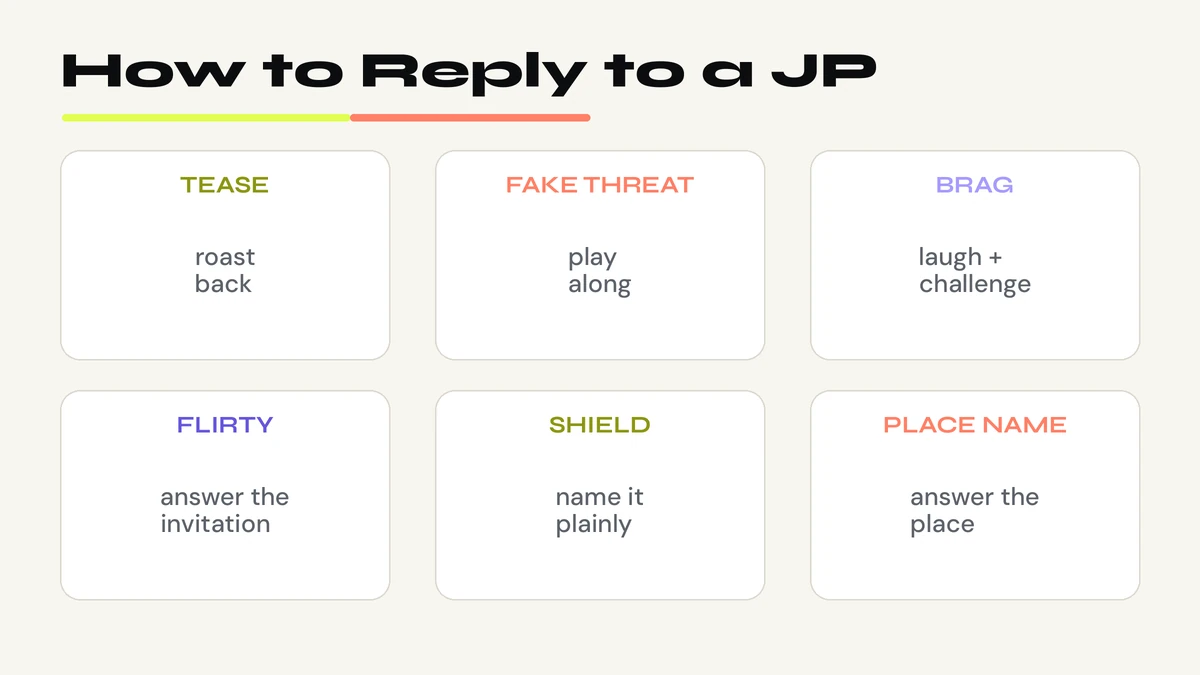
One rule, then six replies: answer the reading the Play-or-Place Test named, not the letters. A joke answered seriously is the only reliably wrong answer — unless the JP was a shield, in which case a joke answer is the wrong one too:
- Affectionate tease — roast back: “says you 😂” or a roast of your own. A tease wants a tease back; that is the game.
- Fake threat — play along: “try me 😤” keeps the bit going. A fake threat answered with a real defense ends the joke.
- Playful brag — laugh and challenge: “we will see about that” or a laughing emoji. A brag wants applause with a dare attached.
- Flirty tease — answer the invitation: take up the dare or decline it kindly. The JP left a door open; walk through it or close it, but do not pretend you did not see it.
- Shield attempt — answer the line: “that one actually hurt a little” is always okay. JP does not make a real insult harmless, and saying so is not ruining the joke — it is naming that there was no joke.
- Place name — answer the place: “JP servers” wants a server answer, not a laugh. Reply about ping, region, or the game, and leave the joke shelf empty.
Weak versus strong. Weak: a bare “ok” back to a loaded tease. Strong: “haha, got me — your turn.” Small change, big difference. Golden rule: when the reading is unclear, read the previous messages before assuming a shield — most jp misreads are shields assumed where the job was play. You can also hand the chat forward with IGHT — “jp, ight, truce then” closes a round of roasts the way a handshake closes a match.
Frequently Asked Questions
What does “JP” mean in a text message?
JP means “just playing” in a text message. It is a softener pinned to the end of a teasing line to signal the line was a joke, not a serious statement. “You lost again… jp” means “I am joking around.” Run the Play-or-Place Test above before you decide which room you are in.
Is jp the same as jk?
They are close cousins, not twins. JK (“just kidding”) cancels a statement’s truth — “I did not mean that.” JP (“just playing”) cancels a statement’s seriousness — “I was only messing around.” Most people use them interchangeably, but on a fact, JK is the safer choice because it corrects the claim.
Can jp mean Japan?
Yes, in the right room. JP is the ISO country code for Japan and the label for Japanese game servers (NA / EU / JP). In a server list, a travel thread, or a game lobby, JP means Japan. In a friend’s teasing text, it means “just playing.” Step 2 of the test — place it — tells you which room you are in.
Does jp mean Justice of the Peace?
As an abbreviation, yes — but not in a chat. Cambridge lists JP as the abbreviation for Justice of the Peace, and Wiktionary lists it the same way. That is the formal reading, for court documents and signature blocks. Nobody texting “you lost, jp” is appointing a magistrate.
Is jp rude?
No — jp exists to be the opposite of rude. It is a tone-softener that tells the reader a teasing line was affectionate, not mean. The rudeness, if any, lives in the message before it: a genuinely cruel line stays cruel even with “jp” tacked on, and using it as a shield after an insult is the one use that reads as rude.
Can I use jp at work?
Not for the chat meaning. Writing out “just kidding” or dropping the joke entirely is clearer, suits every colleague, and carries none of the misread risk. The one work exception is the other room: in a hiring thread, JP as a job posting is ordinary shorthand — but that is a different JP, and your reader has to be in that room too.
What should I reply when someone sends jp?
Answer the reading, not the letters: roast back a tease, play along with a fake threat, laugh at a brag, answer the invitation in a flirty tease, name it plainly if it was a shield, and answer the place if it was Japan. The reply bank above has one for each reading.
Does lowercase jp mean something different from JP?
No, the meaning is the same; only the volume changes. Lowercase jp reads casual and fast, all-caps JP stands out slightly more in a scrolling chat, and neither version shouts the way all-caps can elsewhere. Case is volume, not a new definition — but remember that a capital JP in a server list is a place label, not a louder joke.
The Takeaway
Two letters, four rooms, one test. JP means “just playing” in a text — and whether that is a tease, a brag, a flirt, a shield, or a place name is decided by the Play-or-Place Test: find the tease, place the room, check the shield. Send it when a joke genuinely needs softening, spell it out for anyone who might not know it yet, and never let it un-say a line you would not stand by without it.