What does lmao mean in text? LMAO is a laugh reaction turned up past a polite chuckle: it says something was genuinely, helplessly funny. This guide to lmao meaning in text gives you the LMAO Real-Laugh Test, so you can tell in seconds whether the laugh you just got was real, dry, sarcastic, or just softening a message.
This guide covers the one dictionary-attested expansion, the three-check test, seven tones, LMAO on TikTok, Snapchat, Instagram, and in texts, how it lands by sender, when it is too much for work, school, and family, graded claims, cousins, history, and a reply bank keyed to the reading you just identified.
What “LMAO” Means in Text
LMAO is an initialism, built from the first letters of a phrase, and it carries exactly one texting meaning, not two: a strong laugh reaction. It says the sender found something very funny — funnier than a polite chuckle, funnier than a plain LOL, and funny enough to exaggerate about. That single meaning is the whole puzzle, because when the meaning never changes, the puzzle moves somewhere else: not what the letters stand for, but how hard the laugh really was, and what job the laugh is doing in that particular message.
The dictionary record is short and decisive. , read directly for this article, lists LMAO as Internet slang and text messaging, marked mildly vulgar, defined as an initialism used to indicate great amusement, usually exaggerated. That expansion is spelled out here, once, because the term requires it: laughing my ass off. Everywhere else in this guide it appears only in asterisked form, as “laughing my a** off,” following the series vulgar-term policy. No other texting expansion of LMAO has dictionary attestation, and the claims section below grades the rest openly.
Two facts from that record do most of the work. First, the exaggeration is built in: Wiktionary says “usually exaggerated,” which means nobody sending LMAO is filing a medical report about their own laughter. The letters claim a huge laugh; the real laugh behind them can be anything from a snort to a genuine belly laugh, and the test in the next section is how you tell which one you got. Second, the mild vulgarity is the whole social story of the term. The letters hide a word that is mild among friends and wrong in formal rooms, and that hidden word — not the laughter — is what decides where LMAO may go and where it may not.
The LMAO Real-Laugh Test
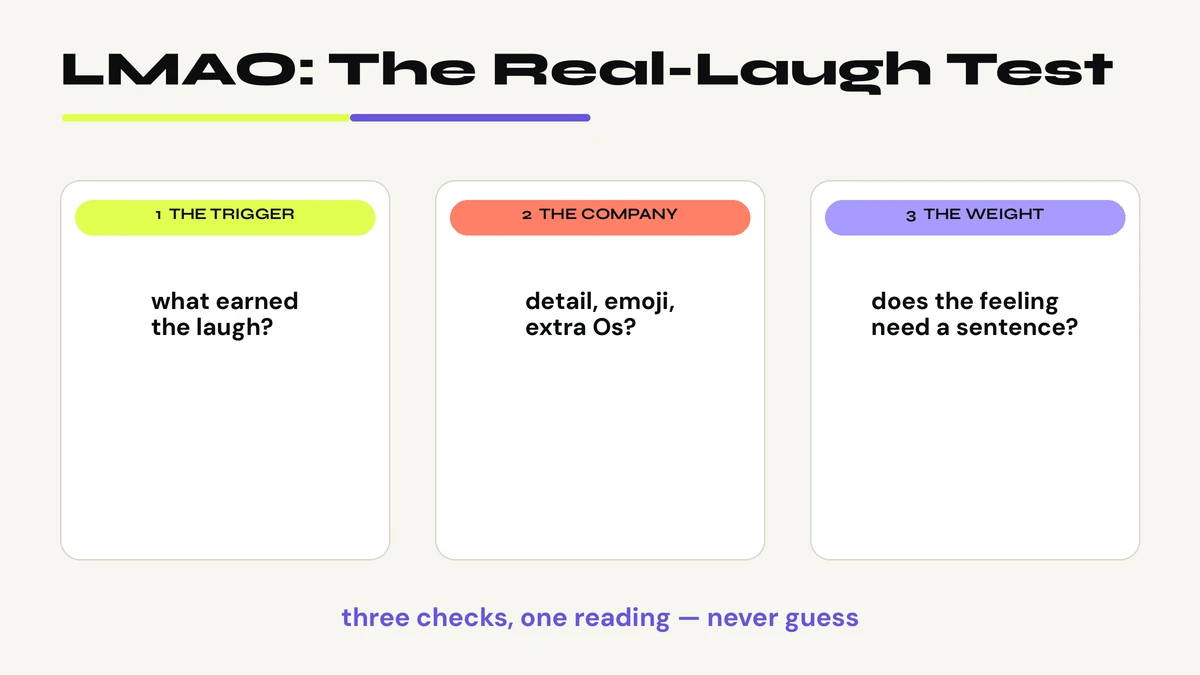
Before you answer an LMAO — or send one — run three checks. They take about five seconds, and they beat every shortcut the competitors offer, because the competitors all say “it means a big laugh” without giving you a procedure for the times it does not:
- Check 1 — The Trigger Check. What earned the laugh? A joke, a story, a video, a mishap, a perfect comeback? If you can point to the funny thing, the laugh is probably real. If nothing funny precedes the letters, the LMAO is doing other work — softening a message, joining a joke, or filling a silence — and the Trigger Check just caught it.
- Check 2 — The Company Check. What rides with the letters? A detail (“I can’t breathe”), an emoji, extra Os (LMAOOO), or nothing at all? Detail plus emoji plus capitals means a real laugh. Bare lowercase letters after a flat sentence mean a softener, not a howl. Company is the fastest single clue: real laughs bring evidence, softeners travel light.
- Check 3 — The Weight Check. Does the feeling deserve a sentence? If the message carries real weight — bad news, vulnerability, a serious question, someone else’s disappointment — then a bare LMAO is too thin, however funny the sender meant it to be. When the weight fails, answer the feeling, not the laugh.
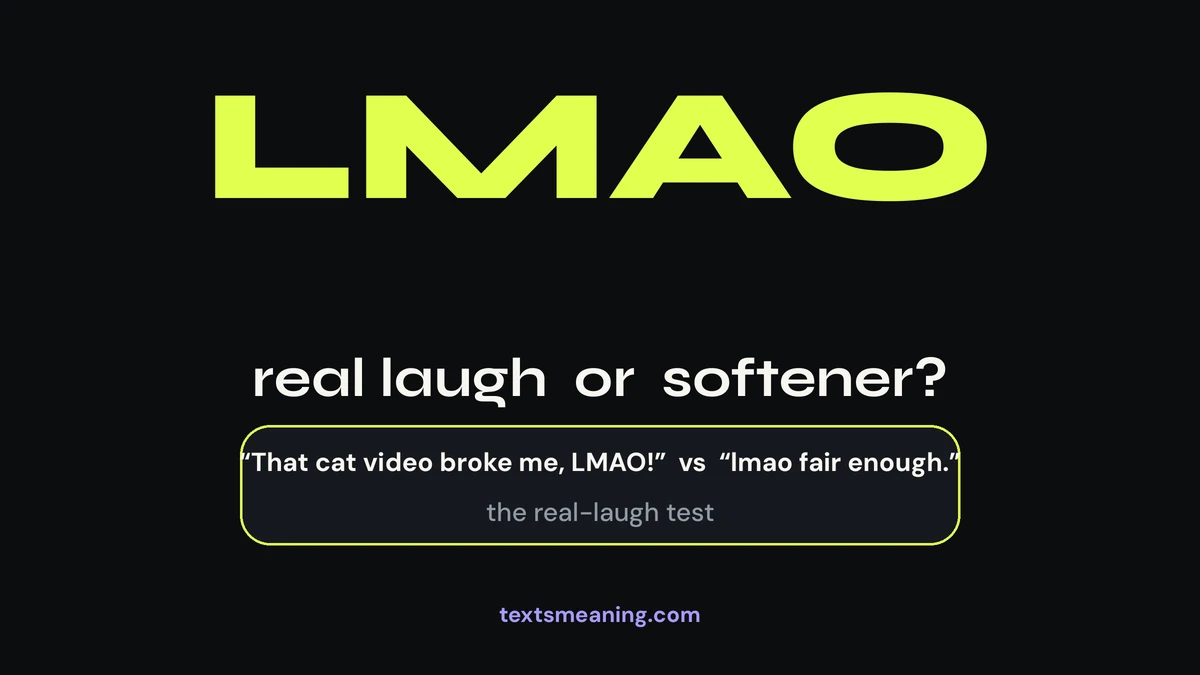
Worked trio. “That cat video broke me, LMAO” — trigger: a video; company: a detail and capitals; weight: light. Real laugh. “lmao fair enough” after a mild disagreement — trigger: nothing funny; company: bare lowercase letters; weight: light. Dry softener, not a laugh at all. “My flight got cancelled lmao” — trigger: bad news, not a joke; company: bare letters; weight: heavy, so the Weight Check fails. Gallows softener: the sender is laughing at their own bad luck so you will not have to be solemn about it, and the right reply answers the cancelled flight, not the laugh. Three messages, three jobs, one test.
“LMAO” in Real Chats
Illustrative examples written for this guide, not real transcripts:
- The cat video. “That cat video broke me, LMAO” — trigger, detail, and capitals all agree. A real laugh, and the only reply it needs is a detail of your own.
- The kitchen disaster. “I tried to make pizza and set the oven on fire lmaoooooo” — extra Os stretch the laugh, and the laugh is aimed at the sender, not at you. Self-mockery is the safest LMAO there is.
- The dry concession. “lmao fair enough.” — calm, lowercase, and barely a laugh at all. This is acknowledgement wearing a laugh’s clothes: the sender is saying “ha, fine, you win this one,” not reporting hilarity.
- The cinema recap. “I was LMAOing in the cinema and got shushed.” — the verb form, used after the fact. Recaps describe a laugh that already happened; they are not asking you to laugh now.
- The gallows softener. “My flight got cancelled lmao” — bad news, softened with a laugh so the message does not land like a crisis bulletin. Answer the flight, not the laugh.
- The sarcastic echo. “Oh great, another Monday meeting lmao” — the laugh joins the joke, and the joke is that the meeting is not great at all. Read the sentence around the letters, not the letters alone.
- The bare reaction. “LMAO.” alone under a friend’s story — a whole reaction in four letters. It adds no information and needs none; it says “this got me,” and stops there.
The LMAO Tone List
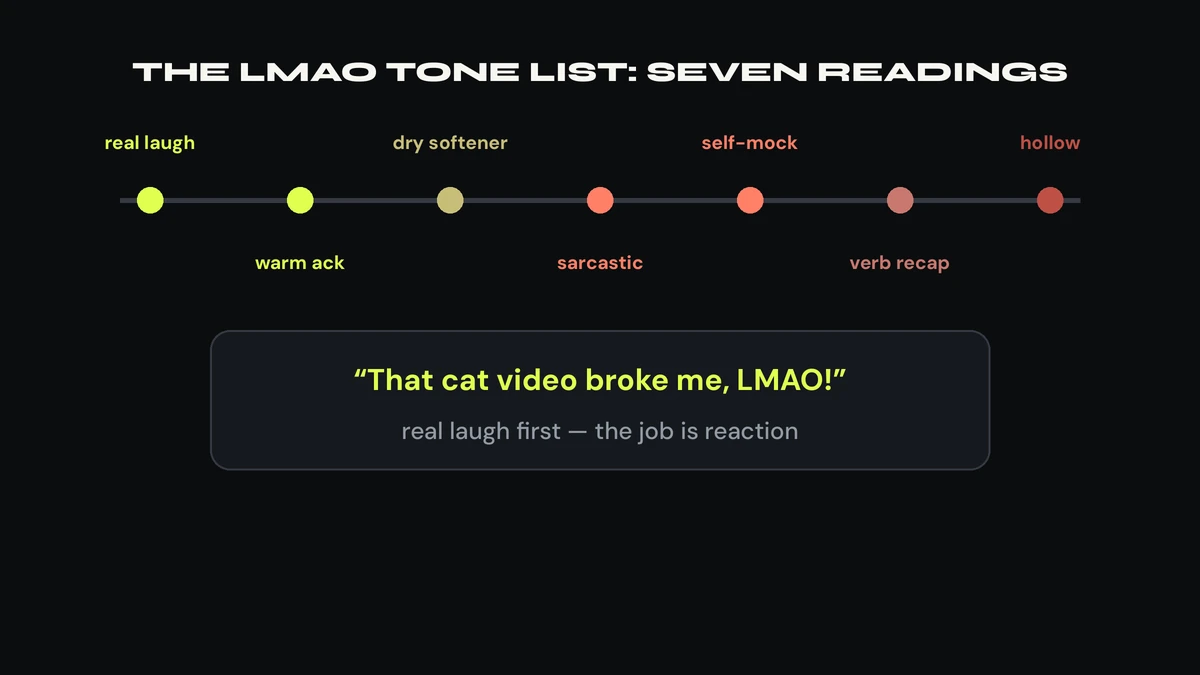
LMAO’s meaning never changes; its job slides across seven readings, warmest to riskiest. The dictionary gives one expansion; real chats give it seven jobs:
- Sincere belly laugh: “LMAO that cat video!” — the default. A real, big laugh at something genuinely funny, usually with a detail or an emoji riding along.
- Warm acknowledgement: “lmao, I have had it on repeat all day” — agreement plus a laugh. The sender is saying “that got me, and here is my version of it.”
- Dry softener: “lmao fair enough” — lowercase, calm, and barely laughing. The letters soften a concession, an awkward moment, or a message that might otherwise read as blunt.
- Sarcastic laugh: “Oh great, another surprise quiz lmao” — the laugh joins a joke about something nobody enjoys. The sarcasm lives in the sentence around the letters, not in the letters.
- Self-mocking laugh: “I set the oven on fire lmaoooooo” — the sender is the joke, and knows it. Extra Os are the tell: the laugh is stretched because the embarrassment is real.
- Verb-form recap: “I was LMAOing at that video last night” — a laugh reported after the fact, not performed live. Recaps are storytelling, and they want a reaction to the story, not a laugh in return.
- Hollow or forced laugh: “lmao” after bad news or a vulnerable message — a laugh where a sentence was owed. The letters are present and the feeling is absent, and readers can tell: a laugh with nothing behind it reads as checked-out, not amused.
What moves a reading between these tones is never the letters alone: it is the trigger (Check 1), the company (Check 2), and the weight (Check 3), plus the punctuation (extra Os raise the volume, a period flattens it), the emoji (a crying-laughing face confirms a real laugh, no emoji after bad news confirms a softener), and the relationship. The same “lmao” that is a warm acknowledgement on Saturday can be a hollow echo on Monday — and the test, not the spelling, tells you which day you are on.
“LMAO” on TikTok
On TikTok, LMAO is a comment-section and caption reaction more than a private message: “lmao this is so real” under a relatable video, “LMAO I can’t breathe” under a comedy clip, or a creator captioning their own fail with a bare “lmao.” The public stage suits the sincere and self-mocking readings best — a comment thread is an audience for a reaction, not a confession booth, and a big laugh plays well there. Lowercase lmao is the house style of the comment section: calm, dry, and quick, the written equivalent of a nod while scrolling.
The trap on TikTok is the reverse of the private-chat trap: taking a public lmao too personally, or too literally. A creator who captions their own video “lmao” is laughing at themselves for a crowd, not at you, and a commenter who writes “lmao” is reacting to the video, not grading your comment. If an LMAO arrives in a TikTok DM, though, run the test as usual — a DM is private again, and the Weight Check returns with it.
“LMAO” on Snapchat
On Snapchat, LMAO fits the fast, disappearing story reply: “lmao no way” on a friend’s story, “LMAO stop” on a streak snap, or a caption over a photo of a mishap that vanishes in a day. The disappearing format suits the dry and self-mocking readings — a laugh that lands lightly and is gone. But disappearance also removes your evidence: if an LMAO felt hollow or sarcastic, you cannot re-read it, so judge from memory what rode with it — an emoji, a detail, or nothing at all.
Snapchat is also where the photo does half the work. A picture of a burnt pizza plus “lmao” needs no explanation: the image names the disaster, and the letters only say how hard the sender laughed at it. That is the Company Check working in real life — remove the LMAO and the snap still tells the story, which is how you know the job was reaction, not softening. And because streak culture rewards speed, Snapchat is where the barest lmao lives: a lone “lmao” on a streak snap is usually a dry acknowledgement, not a verdict on you.
“LMAO” on Instagram
On Instagram, LMAO shows up in comments, story replies, and DMs, and the stage decides the job the way it does for every reaction term. Comments lean public and performative: “lmao this is so real” under a relatable post is a reaction the whole thread can join. Story replies lean private and quick: “LMAO stop it” to a friend’s story is a laugh aimed at one person. DMs carry the full range, exactly like texts — a friend’s belly laugh and a match’s dry softener live in the same inbox, and only the test tells them apart.
Instagram is also where LMAO meets its newest neighbours. The skull emoji and the phrase “I’m dead” now do some of the same laugh work in comments, and some guides claim they have replaced LMAO outright. They have not — the claims section grades that story in full — but the neighbours explain why an Instagram lmao can feel quieter than it used to: when a commenter chooses letters over an emoji, the choice itself is part of the message, a slightly older, slightly drier way of saying the same thing.
“LMAO” in Text Messages
Plain texts are LMAO’s home ground, and the place its companion phrases are easiest to see. It pairs with the joke-marker in the cousins section below — “lmao jk” stacks a laugh and a joke claim in one breath, and the two do different work: the laugh reacts, the tag unsays. It also works as punctuation: tacked onto the end of a sentence, “lmao” can soften the whole message the way a smile softens a spoken sentence, which is why a text that is not funny at all can still end in LMAO without anyone being confused.
Texts are also where a laugh turns into a plan, and the plan usually moves somewhere private. A funny exchange that gets a real laugh often continues in a private thread — our DM guide covers that move in full, because the channel changes what the next message can say. And texts are LMAO’s work limit in miniature: never send it, even abbreviated, in a professional message. A client, a manager, or a first contact deserves “that’s hilarious” spelled out, not four letters that presume an intimacy and a casualness you do not have.
Who Is Sending It: How “LMAO” Lands by Sender
No source documents a different meaning of lmao per sender — the expansion stays fixed; what changes is how much laugh you should take seriously, and therefore what you owe back. One framing is rejected outright here: guides that organize this by gender (“from a girl,” “from a guy”) while admitting the tone is the same. Gender does not decide a laugh’s weight. Relationship and stakes do, so this guide uses those instead:
- Friend: the default. A friend’s LMAO is a real laugh or a dry softener at face value; run the test and answer that, not the letters.
- Crush: overread territory. A crush’s lmao feels bigger than it is — usually shared amusement, not a confession about you. Answer the funny thing, not a romance you invented.
- Partner: pattern rules. A partner’s LMAO is usually a running joke; judge the pattern across days, not one message — but a sudden run of bare, lowercase lmaos after a warm stretch may mean the conversation has gone flat, not that the jokes got worse.
- Parent: usually literal and plain. A parent who writes LMAO has usually learned it from you and means the laugh plainly; do not read a parent’s laugh as sarcasm unless the joke is obvious.
- Coworker or boss: context decides. In a friendly team chat a colleague’s lmao about a shared mishap is a laugh; in any formal thread it is out of place, and never send one upward to a manager or client.
- Group chat: the crowd laugh. A group’s “LMAO” under a story laughs for everyone; a group’s “lmao fair enough” concedes for everyone. Answer briefly in the group either way, and do not single one sender out for a private reading of a public laugh.
- Stranger or creator: the applause habitat. A stranger’s LMAO under your post, or a creator’s LMAO in a caption, is a public reaction, not a message to you personally. A thank-you or a matching laugh is enough; never answer a public laugh with personal details.
When “LMAO” Is Too Much: Work, School, and Family
This section is mandatory for LMAO in a way it is not for most terms in this series, because the letters hide a mild swear word inside them, even abbreviated. Four rooms, four rules. At work: never send LMAO in a professional message, a client thread, or a formal channel. A laugh among close peers in a casual chat is one thing; the same letters to a manager, a client, or a hiring thread read as careless, because the reader may expand the abbreviation in their head, and the expansion is the problem. If the room would flinch at the full phrase, the letters do not fix it.
At school: the same rule, with a younger audience. Teachers, school groups, and class chats are not laugh rooms, and a student who sends LMAO to a teacher has sent a mildly vulgar phrase in code, whether they meant to or not. The clean swap, “that’s hilarious,” is still warm for a teacher, so the safer swap for anything formal is a full sentence: “that made me laugh.” In family chats, read the room person by person: a sibling group may love it, a grandparent group may not know it, and a parent who dislikes casual swearing will dislike the abbreviation exactly as much as the phrase, once they learn what it stands for. Abbreviation is not permission. The series handles vulgar-term policy the same way everywhere — our LFG guide spells its own phrase out once and asterisks it everywhere else, and this guide does the same.
The general rule covers every room at once: if someone tells you LMAO bothers them, simply stop. Switching words is easy, and it shows respect. The swap menu is free and it loses nothing: “that’s hilarious” for the laugh, “I’m laughing so hard” for the belly laugh, a laughing emoji for the reaction, or a plain LOL, which carries no hidden word at all. And one boundary worth stating plainly: never use LMAO to laugh at someone, rather than with them. A laugh aimed at a person’s expense is not a reaction; it is a jeer wearing a reaction’s clothes, and the Weight Check catches it, because the room that receives a jeer is not a laugh room at all.
Checked Claims: Expansions That Do Not Hold Up
Four letters attract folklore. Each claim below was graded against the dictionary record and the competitors read in full; nothing is repeated here as fact on a single blog’s say-so:
- “LMAO means you are literally laughing that hard” — rejected as a full account. Wiktionary itself says “usually exaggerated,” and the dry-softener and punctuation uses in this guide prove the point: a lowercase “lmao fair enough” reports no laughter at all. The letters claim a huge laugh; the real laugh behind them is a question for the test, not a fact from the letters.
- “Lowercase lmao means something different from LMAO” — rejected. Case is volume, not a new definition. Lowercase lmao reads calmer and drier, all-caps LMAO reads louder, extra Os read loudest, and none of them changes the reading — the Trigger Check and Company Check do that.
- “LMAO is a typo for IMAO, or means an opinion” — rejected. The letters look alike and the jobs do not overlap at all: IMAO is an opinion with a wink, LMAO is a laugh reaction. The typo-twin trap is real — one letter apart, opposite families — and the cousins section below keeps them separated.
- “LMAO means ‘laughing my apples off’” — graded as a polite rewrite, not a separate meaning. One competitor notes that some people prefer the “apples” version when they want the shape of the phrase without the mild swear word. That is a clean variant for polite company, the way “let’s freaking go” is a clean variant elsewhere. It changes the register, not the meaning, and nobody reading “LMAO” in a chat should expand it that way.
- “A famous novelist invented LMAO in 1951” — rejected. A beloved 1951 novel does use the spelled-out laugh phrase, and one competitor repeats that fact carefully: the phrase is old, the acronym is not. The novel proves the phrase predates the internet by decades; it does not prove the four letters existed in 1951, and no source claims they did.
- “The first use was a 1990 gaming-forum post” — graded as weak, reported but unverified. One competitor reports a 1990 online game-forum post as the first recorded acronym use, while admitting in the same breath that it comes from sources that “pop up in a quick internet search.” That is a lead, not a finding: no primary record is quoted, no archive is cited, and this guide repeats it only as a report, graded weak, not as a date.
- “LMAO means something different from a girl than from a guy” — rejected. The guides that organize LMAO by gender admit, as they go, that the tone is the same in every case: a big laugh is a big laugh, whoever sends it. Gender does not decide a laugh’s weight; relationship and stakes do, which is why the sender section above uses those instead.
- “The skull emoji killed LMAO” — rejected. New laugh reactions join old ones; they do not delete them. One competitor’s report of a mainstream dictionary entry shows LMAO quoted in national newspapers as recently as 2024, which is not what a dead term looks like. The skull emoji and “I’m dead” are neighbours in the same comment sections, not replacements, and choosing letters over an emoji is itself a tone choice now.
What SURVIVES: one dictionary-attested expansion, a laugh reaction that is usually exaggerated, decided by trigger, company, and weight. Everything else failed evidence, was fenced as a polite variant, a typo-twin, or a weak report, or was refused a certainty it cannot support.
“LMAO” vs Its Closest Cousins
LMAO belongs to the reaction family, and its closest cousins split by what job they do with a funny moment. Each one differs from LMAO in exactly one place, which is why they get confused:
- IMAO — the typo-twin cousin. Our IMAO guide covers an opinion with a wink, not a laugh at all. One letter apart, opposite families: IMAO judges, LMAO laughs. If the message contains a view, it is the twin; if it contains a laugh, it is this term.
- LOL — the lighter cousin. Laughing out loud, with no hidden word inside it. LOL is the polite chuckle LMAO turned up: lighter, safer for every room, and often just friendly rather than funny. When the room fails LMAO’s Weight Check, LOL is the first swap.
- ROFL — the cartoon cousin. Rolling on the floor laughing, a bigger physical comedy than LMAO and, like LOL, carrying no hidden word. ROFL paints a scene; LMAO reports a feeling. The cartoon is funnier on paper and weaker in a real chat, which is why LMAO outlasted it.
- IKR — the reaction cousin. Our IKR guide covers shared feeling: “I know, right?” agrees with a feeling, while LMAO reacts to something funny. The two travel together constantly (“ikr lmao”), and they still do different work: IKR certifies, LMAO laughs.
- JK — the joke-marker cousin. Our JK guide covers the tag that unsays a line: JK claims the line before it was a joke, while LMAO reacts to a joke someone else told. A “lmao jk” stacks both jobs in one breath, and only the order tells you which one did what.
- The stronger cousin — the ruder upgrade. The same laugh with a stronger swear word added in the middle: stronger, ruder, and the one to keep furthest from formal rooms. It is described here without being named, because it is the subject of its own guide in this series, and this guide does not borrow its letters. When the room fails even LMAO, this cousin fails harder.
- LMFAO — the stronger laugh cousin. Our LMFAO guide covers extreme, exaggerated laughter — the strongest laugh reaction in everyday texting. LMFAO is LMAO turned up one more notch: same laugh, bigger exaggeration. When a plain LMAO would undersell it, LMFAO is the upgrade.
- IYKYK — the inside-joke cousin. Our IYKYK guide covers “if you know, you know” — five letters that point at a joke without explaining it. IYKYK points at the joke; LMAO is the laugh it gets. One hides the punchline, the other delivers the reaction.
LMAO often travels with a funny thing — a video, a story, a mishap, a comeback — and that companion is what makes the reading readable at a glance. Read the companion first, and the letters second.
Where “LMAO” Came From
The spelled-out laugh phrase is older than the acronym by decades. A beloved 1951 novel uses the spelled-out phrase in dialogue, which is why one competitor dates the phrase to the 1950s while dating the acronym to the 1990s internet, when chat rooms and instant messaging needed short ways to report laughter. A similar, softer abbreviation circulated on an early computer network before LMAO, built on a politer middle word, and LMAO arose alongside a whole family of laugh abbreviations — LOL, ROFL, and the rest — as the stronger, cheekier member of the set.
The acronym then did something most slang never manages: it became a verb. Wiktionary, read directly, records the verb forms with print examples going back to a 2009 college newspaper, and a mainstream dictionary entry reported by the main competitor quotes LMAO in national newspapers from 2014 through 2024, which is how a chat abbreviation becomes ordinary written English. A meme branch grew alongside it — Wiktionary lists a two-word alien-meme phrase in its see-also entries — and the newest neighbours, the skull emoji and “I’m dead,” joined rather than replaced it. No inventor is claimed, and the reported 1990 first-use post stays graded weak in the claims section: spreaders and first reporters are not inventors.
How to Reply When Someone Sends “LMAO”
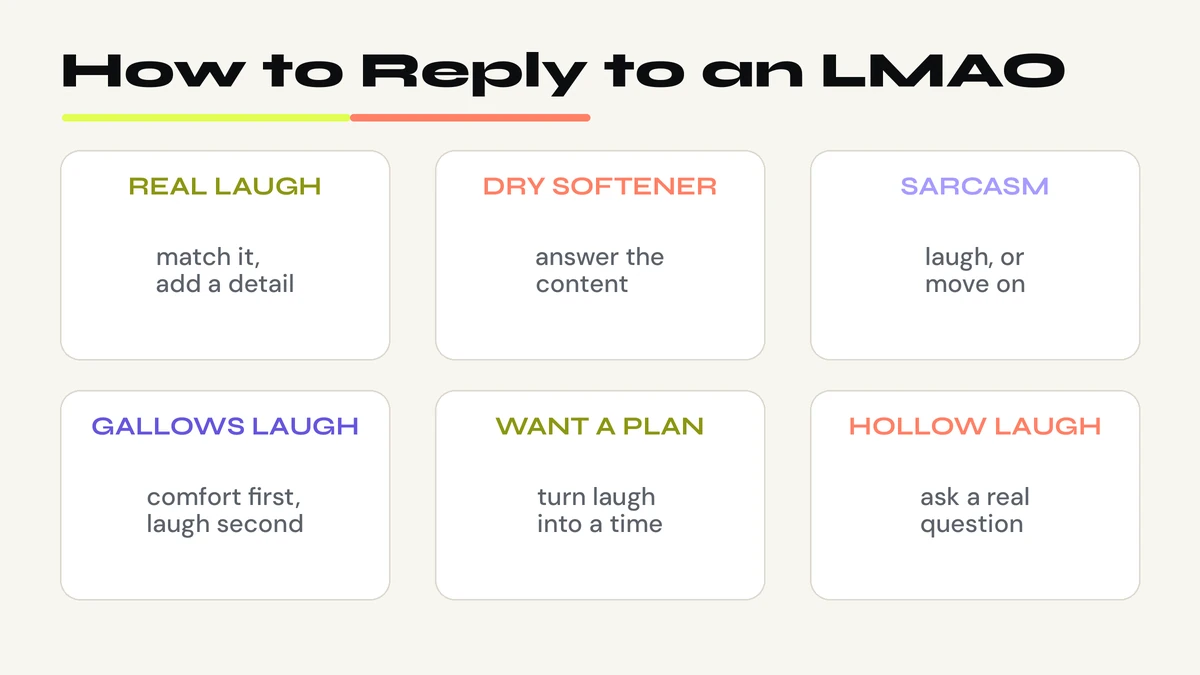
Six replies, matched to the reading and the tone. Name the reading first, or every reply below can misfire:
- Shared real laugh: “LMAO right?? That part got me too” — match the energy, then add a detail, so the laugh becomes a conversation instead of an echo.
- Dry softener: “Fair enough — so, did you want to go?” — answer the content of the message, not the laugh. A softener is asking you to move on, so move on.
- Sarcastic laugh: “Ha, exactly” for the joke, or silence for the forced one. A laugh answers sarcasm; nothing answers noise better than moving on.
- Self-mock or gallows laugh: “Oh no, are you okay? What happened?” — comfort first, laugh second. The sender laughed at their own bad luck; your job is to answer the luck, not the laugh.
- A laugh you want to turn into a plan: turn the laugh into a next step — our HMU guide covers the open invitation that does exactly that: “LMAO, okay, so when are we watching it together?” Energy without a plan fades; energy plus a time becomes a memory.
- Hollow or forced laugh: “You okay? That did not sound like a laugh” — a sentence where a sentence was owed. Do not feed a hollow laugh with a louder one; a real question is the only reply that helps.
What never works: answering a gallows softener with a bigger laugh when someone needed comfort, answering a dry softener with a joke nobody told, or answering a laugh at work with a laugh of your own. The golden rule: match the reading, then match the need.
Frequently Asked Questions
What does “LMAO” mean in a text message?
A strong laugh reaction: “laughing my a** off” in asterisked form. It says something was genuinely funny — funnier than a polite chuckle — and it is usually exaggerated, so run the Real-Laugh Test before deciding how hard the sender really laughed.
Is LMAO a swear word?
The letters themselves are not a swear word, but the expansion hides a mild one, which is why Wiktionary marks the term mildly vulgar and why this guide spells that expansion out only once and asterisks it everywhere else. In polite, professional, school, or family rooms, use “that’s hilarious” or a laughing emoji instead.
What does lowercase lmao mean?
The same thing, calmer and drier. Lowercase lmao reads like a relaxed chuckle or a softener, all-caps LMAO reads louder, and extra Os read loudest — but case changes the volume, not the meaning. The Trigger Check and Company Check decide the reading.
What is the difference between LMAO and LOL?
Strength, and one hidden word. LOL is a lighter, polite laugh with nothing vulgar inside it; LMAO claims a bigger laugh and hides a mild swear word, which is why LMAO is stronger among friends and wrong in formal rooms where LOL is merely casual.
How do you pronounce LMAO?
Two ways, both in use. Wiktionary, read directly, lists pronunciations for saying it letter by letter, “el-em-ay-oh,” and for saying it as one word rhyming with “cow.” The letter-by-letter version is the safer default; the one-word version is common in videos and podcasts.
Can I use LMAO at work or school?
Not in formal messages, and not to a manager, client, or teacher. A casual team chat among close peers may tolerate it, but the hidden word is the problem: if the room would flinch at the full phrase, the letters do not fix it. Use “that’s hilarious” spelled out instead.
What should I reply when someone sends LMAO?
Match the reading: answer a real laugh with matching energy plus a detail, answer a dry softener by moving the conversation on, and answer a gallows or hollow laugh with a real question or comfort. The reply bank above has one for each reading and tone.
Has the skull emoji replaced LMAO?
No. The skull emoji and “I’m dead” are newer neighbours that do some of the same laugh work, especially in comments, but LMAO is still quoted in national newspapers as recently as 2024 and still fills group chats daily. New reactions join old ones; they do not delete them.
The Takeaway
Four letters, one laugh, seven jobs. LMAO means a strong, usually exaggerated laugh reaction — and whether the message you just got was a real belly laugh, a dry softener, a sarcastic echo, or a hollow laugh where a sentence was owed is decided by the Real-Laugh Test: check the trigger, check the company, check the weight. Send the big laugh when the moment genuinely deserves it, send the softener when the moment needs softening, swap to clean words when the room requires them, and answer the reading you actually received.