What does mfm mean in text? In most texting contexts, MFM means male-female-male — shorthand for a threesome or an arrangement involving two men and one woman. But MFM is not an everyday texting word: the same three letters can name a true-crime podcast, a pregnancy doctor, or a flash of anger, so this guide to mfm meaning in text starts with the room you are in, not the letters.
This guide covers the four readings that actually show up, the three-check Context Test that sorts them in seconds, seven real-chat examples built only from documented uses, the reading list, MFM on TikTok, Snapchat, Instagram, and in texts, how it lands by sender, when it is too much for work, school, and family, graded claims, cousins, history, and a reply bank keyed to the reading you just identified.
What “MFM” Means in Text
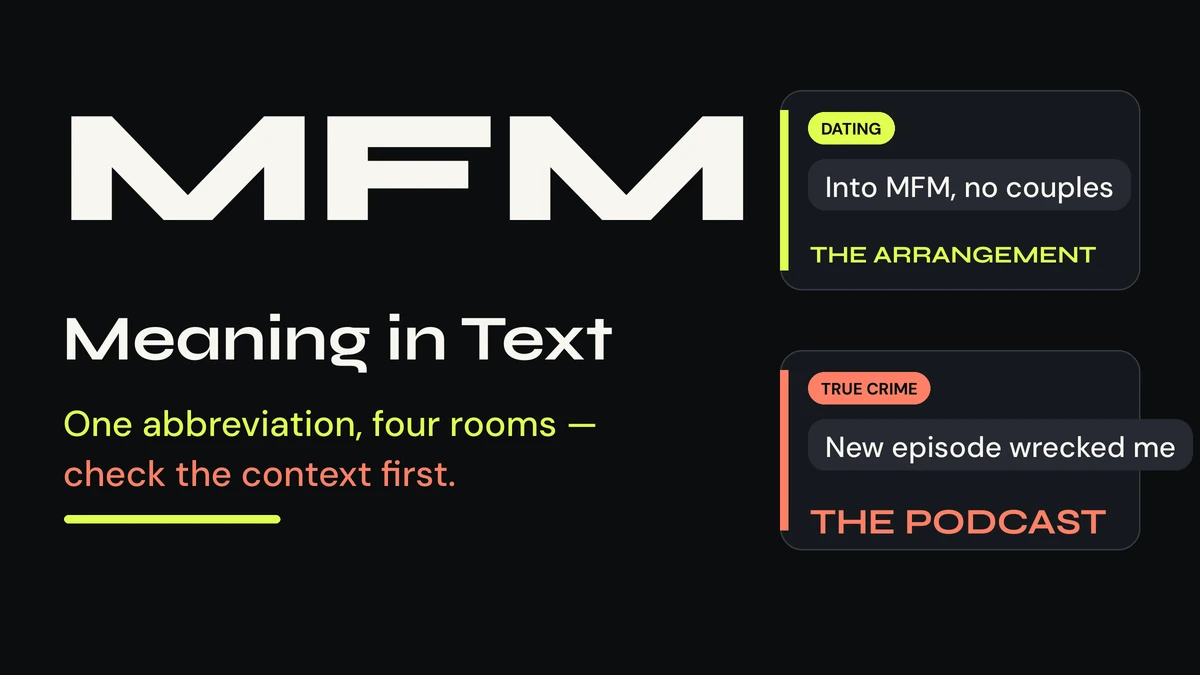
MFM is an initialism, and the letters spell out different phrases in different rooms. In dating and relationship chats, the letters stand for male-female-male: two men and one woman, in that order, and the order is the whole point — it signals that each man is there for the woman, not for each other. In true-crime fandom, the same letters stand for My Favorite Murder, the podcast, and fans call themselves Murderinos. In a hospital, MFM is maternal-fetal medicine, the specialty for high-risk pregnancies. And in one corner of Urban Dictionary, MFM is an anger flash — a “Mother F***er Moment,” the second a person goes from annoyed to furious. Four readings, one spelling, and no way to tell them apart from the letters alone.
The dictionary record is unusually honest about what it does not contain, and this guide leans on exactly that. , read directly for this article, lists MFM only as maternal and fetal medicine, magnetic force microscopy, modified frequency modulation, and — as a proper noun — Mountain of Fire and Miracles, a Nigerian Pentecostal denomination. It lists no slang sense at all: no dating sense, no podcast sense, no anger sense. Dictionary.com, which gave the last article in this series its MBN entry, has no MFM acronym page at all — the address returns a 404. So unlike most terms in this series, MFM arrives with no established dictionary record for any of its slang readings, and this guide says so plainly instead of borrowing authority it did not read. The dating reading is carried by several independent guides and a sexual-health charity, the podcast reading by the show itself, and the anger reading by Urban Dictionary alone — and the plain form of that anger reading’s key word, motherfucker, appears exactly once in this guide, in this sentence, because the reading cannot be explained without naming it; everywhere else it is asterisked.
Two facts from that record do most of the work. First, the letter order is a code, not a coincidence: in dating shorthand, the sequence of M and F spells out who is interested in whom, which is why MFM and MMF are different arrangements and not interchangeable spellings. On a dating profile, MFM works like insider shorthand — our IYKYK guide covers how that kind of if-you-know-you-know signal works, and MFM is a textbook case: the people it is for read it instantly, and everyone else scrolls past. Second, MFM is a specialist’s word, not a general texting word. Nobody drops MFM into a casual chat the way they drop LOL or BRB; it shows up inside a specific conversation — a dating profile, a podcast thread, a hospital letter, a furious rant — and outside that conversation it is usually a misfire or a mystery. The test in the next section turns that observation into a procedure, because “it depends on context” is true and useless on its own.
The MFM Context Test
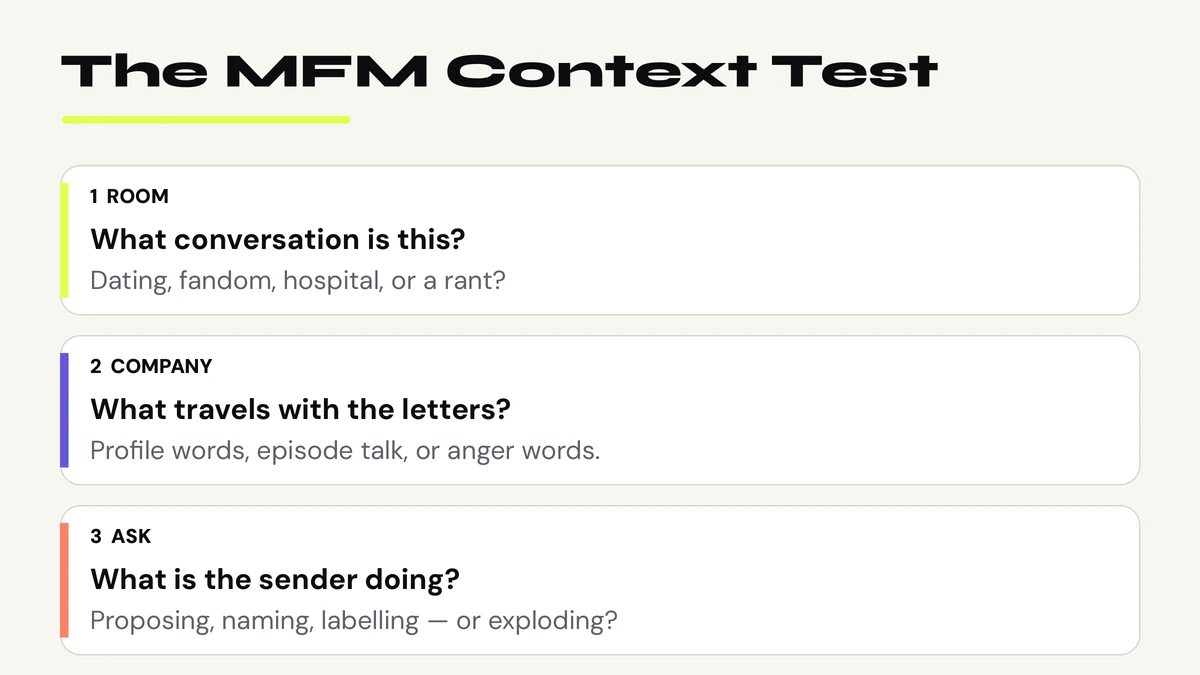
Before you answer an MFM — or send one — run three checks. They take about five seconds, and they beat every shortcut the competitors offer, because the competitors all list meanings without giving you a procedure for choosing between them:
- Check 1 — The Room Check. What conversation is this in? A dating profile, a dating-app chat, or a romance-novel tag points to the male-female-male reading. A true-crime thread, a podcast comment, or a Murderino group points to My Favorite Murder. A hospital letter, a pregnancy forum, or a doctor’s referral points to maternal-fetal medicine. A rant about disrespect points to the anger reading. The room decides the reading more often than any other clue — get the room right and the rest usually follows.
- Check 2 — The Company Check. What travels with the letters? A profile full of dating language, a “looking for” line, or a winking emoji points to the dating reading. Podcast talk, episode numbers, or the word “Murderino” points to the podcast. Medical words, appointment dates, or a doctor’s name points to the hospital. And an anger word riding alongside — a flat “fr” co-sign, a swear, a caps-lock sentence — points to the anger reading: our FR guide covers that sincerity stamp, the little word that certifies “I mean this exactly as it sounds.”
- Check 3 — The Ask Check. What is the sender doing with the letters — proposing, naming, labelling, or exploding? A proposal (“are you into MFM?”) is the dating reading. A name (“I love MFM, new episode today”) is the podcast. A label on a referral or an appointment (“seeing my MFM on Tuesday”) is the hospital. An explosion (“MFM, I swear, if he says one more thing”) is the anger reading. Propose, name, label, explode: four jobs, four readings, and the job is the fastest single clue when the room is unclear.
Worked trio. “Into MFM, no couples please” on a dating profile — room dating, company profile language, job proposal: the male-female-male reading, and the “no couples” tells you the writer knows exactly what the letters mean. “MFM new episode absolutely wrecked me” in a group chat — room fandom, company episode talk, job naming: My Favorite Murder, and the verb “wrecked” is praise, not damage. “MFM referral came through, appointment Tuesday” — room hospital, company referral language, job label: maternal-fetal medicine, and no slang reading survives that company. Three messages, one abbreviation, three readings — and the test, not the spelling, sorted them.
“MFM” in Real Chats
Illustrative examples written for this guide from documented uses only — no invented reading appears below, and the last example is a misfire on purpose:
- The dating profile. “Into MFM, respectful and discreet only” on a dating profile: the arrangement reading, stated as a preference. The profile is the room, the preference is the job, and there is nothing to decode — the writer is using the letters as a filter, the way dating profiles use shorthand to say quickly what would take a paragraph to spell out.
- The podcast fan. “MFM merch drop today, Murderinos rise up” in a true-crime group chat: the podcast reading, named with its fandom word. Nobody in that room is confused, because the room did the work before the letters arrived.
- The anger flash. “MFM, I swear, if he cuts me off one more time” — the Urban Dictionary reading: a flash of anger over disrespect, told as a moment rather than a label. Note what it is not: it is not calling someone the word. It is naming the moment the anger arrived.
- The hospital letter. “My MFM wants extra scans at 28 weeks” in a pregnancy forum: maternal-fetal medicine, plainly. The forum is the room, the scans are the company, and any slang reading would be absurd here — which is exactly why the Room Check comes first.
- The romance tag. “MFM romance recs? No MMF please” in a book group: the arrangement reading again, this time as a fiction tag — and the “no MMF” proves the writer knows the letter order matters, because the two tags describe different dynamics.
- The “3 way” shorthand. “Looking for a 3 way, MFM” in a dating-app message: the same arrangement reading in its plainer cousin’s clothes. The sender writes both, because MFM alone is too easy to misread — a good instinct, and one this guide recommends.
- The misfire. “MFM lol” as a bare reply to a meme in a general group chat: no room, no company, no job — and the only honest reply is “what do you mean by that?” A bare MFM outside any of its rooms is not a meaning, it is a mystery, and asking is better than guessing.
The MFM Reading List
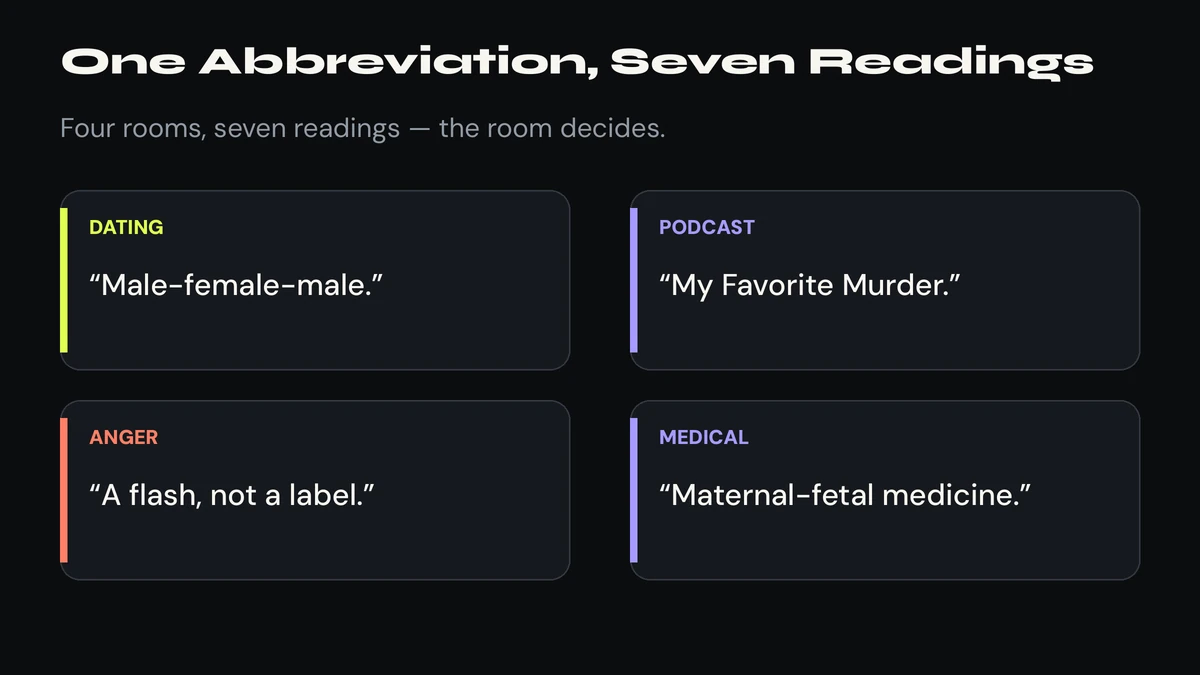
MFM’s readings do not slide along a tone scale the way MBN’s do — they live in separate rooms, and each one is a different word wearing the same letters. Seven readings, plainest to most specialist:
- Male-female-male (the dating reading): two men and one woman, in that order, with the men there for the woman and not for each other. The best-supported slang reading: several independent guides and a sexual-health charity describe it the same way, and dating profiles use it as a filter.
- My Favorite Murder (the podcast reading): the true-crime podcast hosted by Karen Kilgariff and Georgia Hardstark, and its fandom, the Murderinos. A proper noun, not slang — and the most common MFM you will meet on TikTok and Instagram.
- “Mother F***er Moment” (the anger reading): Urban Dictionary attestation only: the second a person goes from annoyed to furious over disrespect. No established dictionary records it, no guide read in full shows a real example of it in use, and this guide grades it as attested, not established.
- Maternal-fetal medicine (the hospital reading): the Wiktionary-listed sense: the obstetrics subspecialty for high-risk pregnancies. The most formally documented reading of the four — and the one no slang guide mentions, because slang guides never visit hospitals.
- Modified frequency modulation (the tech reading): a Wiktionary-listed technical sense from computing and signal processing. Real outside chat, irrelevant inside it — nobody replying “MFM” to a meme is naming a modulation scheme.
- Magnetic force microscopy (the lab reading): another Wiktionary-listed technical sense, from microscopy. Same verdict as the tech reading: real, documented, and never the meaning in a text message.
- Mountain of Fire and Miracles (the proper-noun reading): a Nigerian Pentecostal denomination, listed as a proper noun on Wiktionary. The reminder that three capital letters can be a name as easily as a phrase — and that a church is the last thing anyone means in a dating chat.
What moves a message between these readings is never the letters alone: it is the room (dating, fandom, hospital, rant), the company (profile language, episode talk, referral words, anger words), and the job (proposing, naming, labelling, exploding). The same “MFM” that is a podcast on TikTok is a medical specialty in a pregnancy forum — and the test, not the spelling, tells you which room you are in.
“MFM” on TikTok
On TikTok, MFM is mostly the podcast. True-crime clips, episode reactions, and Murderino jokes fill the tag, and a comment that reads “MFM girlie here” is a fandom badge, not a dating proposal — the platform’s true-crime community adopted the letters years before dating shorthand reached the same feed. The dating reading shows up too, but quietly: a creator hinting at an arrangement uses MFM the way dating profiles do, as a filter the right audience reads instantly and everyone else scrolls past.
The trap on TikTok is importing the wrong room. A dating-profile MFM read as podcast fandom is harmless; a podcast MFM read as a dating proposal is embarrassing; and an anger-flash MFM read as either is a misfire twice over. Read the creator, read the comments, read the room — and if the video is true crime, the letters are almost certainly the podcast.
“MFM” on Snapchat
On Snapchat, MFM lives in fast, private, disappearing DMs — and privacy changes which reading shows up. The dating reading is the natural one here: a private chat is where an arrangement gets proposed, negotiated, or declined, and the disappearing format suits a conversation both sides may want to keep private. A bare “into MFM?” as a story reply is a proposal, and it deserves a plain answer, not a joke — the sender is asking a real question in the only room where it can be asked quietly.
Snapchat is also where the evidence problem is worst. A disappearing MFM leaves no record of its room or its company, so if a message felt like a proposal and you are not sure, screenshot the context or ask in the moment — you cannot re-read a snap that is gone, and guessing wrong about this particular abbreviation costs more than guessing wrong about most slang.
“MFM” on Instagram
On Instagram, MFM splits by surface the way it splits by room. Captions and comments lean podcast: “MFM episode wrecked me” under a true-crime reel is fandom, and a creator’s MFM merch post is a brand, not a proposition. Dating-profile language lives in bios and DMs instead: a bio that reads “MFM friendly” is a filter, and a DM that opens with “into MFM?” is a proposal — same letters, different surface, different job.
Instagram is also where MFM meets its closest platform trap: reading a public badge as a private message. A stranger’s “MFM” in a comment thread is fandom until proven otherwise, and answering a fandom badge with a dating reply embarrasses both sides. A thank-you, a matching laugh, or silence all end it cleanly; the comment was never asking for more.
“MFM” in Text Messages
Plain texts are where MFM is rarest — and riskiest. It is not an everyday texting word, so a bare MFM in a one-to-one text is usually either a proposal from someone who knows you know the dating reading, or a misfire from someone who assumes you do. The reply each one deserves is completely different, which is why the Ask Check comes before the reply: a proposal deserves a plain yes or no, and a misfire deserves a plain “what do you mean by that?”
Texts are also where a dating MFM turns into a plan, and the plan usually moves somewhere private. A conversation that starts with “into MFM?” and gets a yes often follows up with logistics — and our DM guide covers that move in full, because the channel changes what the next message can say. And texts are MFM’s work limit in miniature: never send MFM in a professional message. A client, a manager, or a first contact deserves plain words spelled out, not three letters that presume an intimacy and a shared vocabulary you do not have.
Who Is Sending It: How “MFM” Lands by Sender
No source documents a different meaning of MFM per sender — the reading still comes from the room. What changes is which reading you should expect, and therefore what you owe back:
- Friend: the default. A friend’s MFM is usually the podcast — “MFM episode today, we have to talk about it” — or a joke about the dating reading between people who share the vocabulary. Run the test and answer that, not the letters.
- Crush: overread territory. A crush’s MFM feels bigger than it is — usually a fandom badge or a clumsy joke, not a proposal about you. Answer the reading, not a romance you invented, and if it was a proposal, it will survive being asked about plainly.
- Partner: pattern rules. A partner’s MFM is usually a shared joke or a real question about the relationship, and the two are easy to tell apart: a joke comes with laughter, a question comes with a follow-up. If it is a question, it deserves a real conversation, not a texted yes — and our ILY guide covers the difference between affection given directly and an arrangement proposed sideways, because the two are not the same conversation.
- Parent: almost always the hospital. A parent who writes MFM has usually just come from a clinic and means maternal-fetal medicine, plainly. Do not read a parent’s MFM as slang unless the sentence around it is unmistakably a joke.
- Coworker or boss: context decides. In a hospital or clinic, a colleague’s MFM is the specialty, full stop. Anywhere else, a coworker’s MFM is out of place in every reading — never send the dating reading upward, and never send the anger reading to anyone you work with.
- Group chat: both habitats at scale. A group’s “MFM new episode!!” is fandom applause; a group’s single flat “MFM” after a dating story is a proposal the whole room can see. Answer briefly in the group either way, and do not single one sender out for a private reading of a public message.
- Stranger or creator: the badge habitat. A stranger’s MFM under your post, or a creator’s MFM in a bio, is a public signal — fandom or filter — not a message aimed at you personally. A thank-you or a matching laugh is enough; never answer a public badge with a private confession.
When “MFM” Is Too Much: Work, School, and Family
This section is mandatory for MFM in a way it is not for most terms in this series, because MFM’s risk is not one wrong word — it is three at once: an explicit sexual reading, a vulgar anger reading, and a medical reading that sounds alarming out of context. Four rooms, four rules. At work: never send MFM in a professional message, a client thread, or a formal channel, in any reading. The dating reading is a sexual proposal, the anger reading is a profanity, and the medical reading in a work chat will make people think someone is pregnant and in danger. If the room would want plain words, the letters do not fix it.
At school: the same rule, with a younger audience. Teachers, school groups, and class chats are not MFM rooms in any reading, and a student who sends MFM about a classmate has sent either a sexual proposal or a profanity whether they meant to or not. In family chats, read the room person by person: a sibling group may share the podcast joke, a grandparent group may hear the medical reading and worry, and a parent who dislikes casual profanity will dislike the abbreviation exactly as much as the phrase, once they learn what it stands for. Abbreviation is not permission.
The general rule covers every room at once: if someone tells you MFM bothers them, simply stop — and if someone sends you the dating reading uninvited, you owe them nothing, not even an explanation. Switching words is easy, and it shows respect. The swap menu is free and it loses nothing: “a threesome with two men and one woman” for the dating reading, “the true-crime podcast” for the fandom, “my pregnancy specialist” for the hospital, “I am furious right now” for the anger. And one boundary worth stating plainly: never use MFM to dress up a proposition as a joke. A proposal aimed at someone who did not ask is not teasing; it is pressure wearing a joke’s clothes, and the Ask Check catches it, because a joke that needs the letters to hide is not a joke at all.
Checked Claims: Expansions That Do Not Hold Up
Three letters attract folklore. Each claim below was graded against the dictionary sources read in full and the competitors read in full; nothing is repeated here as fact on a single blog’s say-so:
- “MFM means motherf***er” — rejected as a texting expansion. That is MF, the two-letter abbreviation, not MFM. Adding a letter does not add a meaning: MF names a person with a profanity, MFM names an arrangement, a podcast, a specialty, or a moment. Typing MFM at someone you are angry with does not insult them; it confuses them.
- “MFM is a common everyday texting word” — rejected. No source shows MFM in everyday casual texting. It is a specialist’s word that lives in dating profiles, podcast fandom, hospitals, and rants — and the main competitor’s own page admits girls “may not use MFM in their everyday conversations.” A word that needs a room is not an everyday word.
- “MFM means my favorite movie” — rejected. No dictionary, no competitor, and no example supports it. It is a back-formation: someone read the letters and invented a phrase that fits them. Fitting the letters is not evidence; the letters fit dozens of phrases, and most of them were never used by anyone.
- “MFM is always sexual” — rejected. The podcast reading is a fandom, the hospital reading is a specialty, and the anger reading is a feeling. Only one of the four readings is sexual, and treating the letters as always sexual is how a podcast fan gets an embarrassing reply.
- “MFM and MMF are the same thing” — rejected. The letter order is the whole point: in MFM the two men are there for the woman, with little or no interaction between them; in MMF at least one man is interested in both the man and the woman. A sexual-health charity states the distinction plainly, and swapping the letters swaps the arrangement.
- “MFM is not a bad word” — rejected as stated. The main competitor says exactly this, on a page that lists a vulgar anger reading two paragraphs earlier. One reading of MFM is a profanity and another is explicit: the letters are not a bad word in the hospital or the podcast thread, and they are a bad word in the anger reading. The claim is true room by room and false as a blanket statement.
- “MFM has a Wiktionary slang entry” — not found, and not claimed. Direct checks for this build read the Wiktionary MFM page in full: it lists maternal and fetal medicine, magnetic force microscopy, modified frequency modulation, and a church. No slang sense appears, and this article leans on multi-source corroboration instead of inventing a dictionary record that was not read.
- “MFM means Money Family Music” as a general meaning — graded as a proper noun only. It is the name of a Toronto rap group, reported by one competitor. A band name is not a texting meaning: nobody texts “MFM” to mean a rap group unless they are already talking about that rap group, and the room does that work, not the letters.
What SURVIVES: male-female-male in dating contexts, My Favorite Murder in true-crime fandom, maternal-fetal medicine in hospitals — three readings with independent support — plus the Urban Dictionary anger flash, graded as attested rather than established. Technical and proper-noun collisions (modified frequency modulation, magnetic force microscopy, Mountain of Fire and Miracles) are real outside chat and irrelevant inside it: nobody replying “MFM” to a dating profile is naming a microscope.
“MFM” vs Its Closest Cousins
MFM belongs to the arrangement family — words that name who is with whom, not words that start a conversation. Its closest cousins split by what they change:
- MMF (letter-order cousin). The same three letters in a different order, and a different arrangement: in MMF at least one man is interested in both the man and the woman. One swapped letter changes the whole dynamic, which is why dating profiles write the order carefully and why “no MMF please” appears in the examples above.
- FFM (mirror cousin). Two women and one man, the mirror image of MFM. Same job — naming an arrangement by letter order — with the genders reversed, and the same rule: the order is the meaning.
- FMF (second-mirror cousin). Two women and one man where the women are not involved with each other, each focused on the man. The MFM pattern with the letters flipped: adjacency is the code, and the code is the same in both directions.
- MF (letter-trap cousin). The two-letter abbreviation of the same strong profanity behind the anger reading. One missing letter changes the whole job: MF names a person, MFM names an arrangement, a podcast, a specialty, or a moment. Typing MF in a dating profile proposes nothing, and typing MFM at someone you are angry with insults no one.
- “Threesome” and “3 way” (plain-English cousins). The spelled-out versions of the dating reading. They are the swap menu: when MFM feels too ambiguous, these words say the same thing with no code to crack, and no test required.
- ISTG (emphasis cousin). Our ISTG guide covers the swear-word emphasis that rides alongside strong feeling; MFM’s anger reading travels with the same kind of emphasis, but ISTG certifies a claim while MFM’s anger reading names a moment. One swears that something is true, the other names the second the anger arrived.
Where “MFM” Came From
The letters came from different places at different times, which is why there is no single origin story to tell. The medical reading is the oldest in print: maternal-fetal medicine became a named obstetrics subspecialty as high-risk pregnancy care formalized, and its abbreviation followed the usual medical path. The podcast reading has a birthday — My Favorite Murder launched in 2016, and its fans shortened the title the way fandoms always do. The dating reading grew out of personal ads and dating forums, where letter codes like MFM and MMF let people state a preference in three characters before profiles had filters for it.
Dating the dating reading precisely is where honest guides stop. One competitor dates its own page to October 2023 and calls the origins “not clear beyond these slang definitions”; another reports the arrangement language spreading through dating apps without a year; a third, a sexual-health charity, describes the labels as working vocabulary from porn, sex work, and dating apps, with no origin year at all. Those are three different kinds of evidence — a competitor’s admission, a dating guide’s narrative, and a charity’s field description — and this guide does not blend them into a single origin year. What the sources agree on is the direction: separate rooms, separate histories, one collision of letters. No inventor is claimed, and no single year is asserted as the birth of MFM.
How to Reply When Someone Sends “MFM”
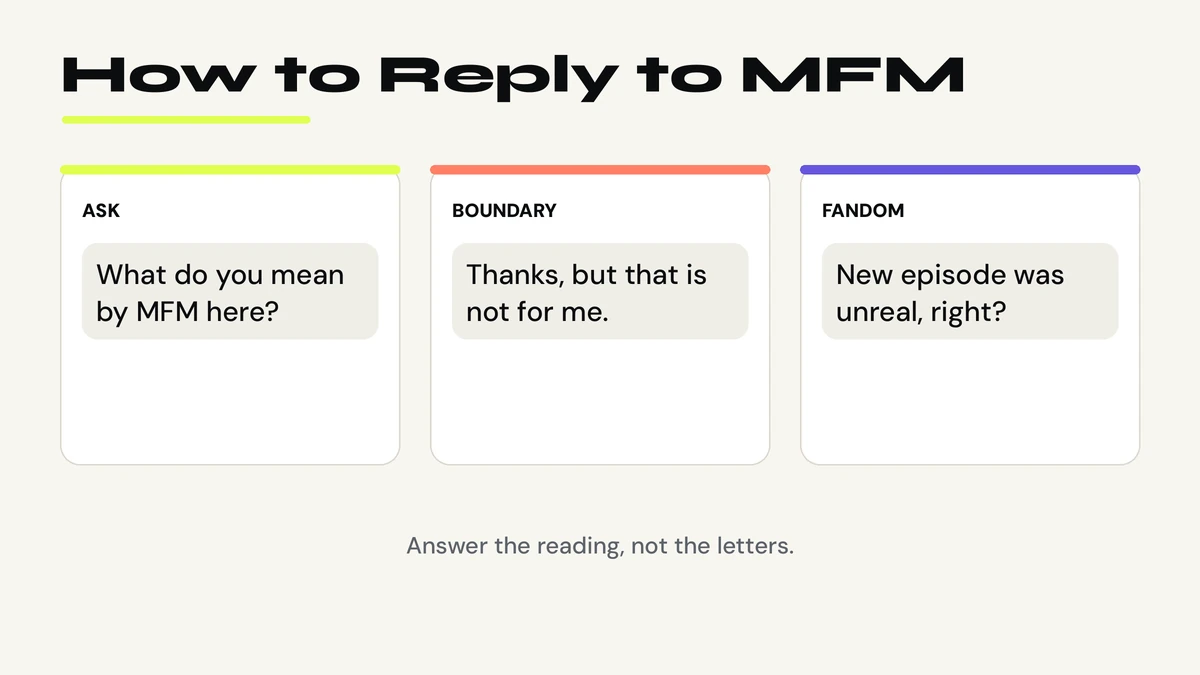
Golden rule: answer the reading the test found, not the letters. A reply bank keyed to the reading:
- Dating proposal — answer plainly: “Thanks, but that’s not for me” or “Yes, tell me more — what are you thinking?” A proposal deserves a plain answer either way, and a plain no is a complete sentence. Do not answer a proposal with a joke unless you mean yes and they know it.
- Podcast fandom — join in: “New episode was unreal, right?” or “Murderino here too.” Fandom is the easiest reading to answer, because the only thing it wants is company.
- Hospital reading — answer the news, not the letters: “Hope the appointment goes well” or “Let me know what they say.” The letters are a label on a medical visit; the visit is the news, and the news is what deserves the reply.
- Anger flash — do not match the heat: “I hear you — what happened?” defuses once; silence ends it. Never answer an anger flash with a bigger one unless the friendship runs on that, and if the anger is aimed at you, one plain question beats ten defensive replies: “Hey, did I do something?”
- You are not sure — ask: “What do you mean by MFM here?” is the best reply in the guide. Asking costs one message and saves a misread that could cost a friendship — and anyone who meant the dating reading will respect a plain question more than a wrong guess.
- You want to keep talking — turn the chat into a plan: A podcast MFM is an opening, not just a badge — our HMU guide covers the open invitation in full, because “we should watch the new episode together” turns fandom into a plan, and plans beat reactions every time.
Frequently Asked Questions
What does MFM mean in a text message?
In a text message, MFM most often means male-female-male — a threesome or arrangement involving two men and one woman — when the conversation is about dating. But it is not an everyday texting word: the same letters can name the true-crime podcast My Favorite Murder, the medical specialty maternal-fetal medicine, or, in Urban Dictionary’s attestation, a flash of anger. Run the Context Test — room, company, ask — before you decide which one you just got.
Is MFM always about a threesome?
No. That is the most common misunderstanding about the term. The threesome reading is the best-supported slang reading, but only one of four: the podcast reading is a fandom, the hospital reading is a medical specialty, and the anger reading is a feeling. A podcast fan’s MFM has nothing to do with a threesome, and treating the letters as always sexual is how a fan gets an embarrassing reply.
What does MFM mean on TikTok?
On TikTok, MFM usually means My Favorite Murder — the true-crime podcast — in comments, captions, and fan videos. The dating reading shows up too, but quietly, as a filter the right audience reads instantly. If the video is true crime, the letters are almost certainly the podcast.
What does MFM mean on Snapchat?
On Snapchat, MFM usually means the dating reading — male-female-male — in a private DM or a story reply, because the private, disappearing format is where an arrangement gets proposed. But disappearance removes your evidence, so if a message felt like a proposal and you are not sure, ask in the moment: you cannot re-read a snap that is gone.
Is MFM a bad word?
Room by room. In the hospital and the podcast thread, no: the letters name a specialty and a show. In the dating reading, they name an explicit sexual arrangement, so they are adult language, not playground language. In the anger reading, they carry a profanity — Urban Dictionary’s “Mother F***er Moment” — so yes, there it is a bad word. The letters are not one thing, and the room decides.
Can I use MFM at work or school?
Generally, no — in any reading. At work the dating reading is a sexual proposal, the anger reading is a profanity, and the medical reading in a work chat will make people think someone is pregnant and in danger. At school the same rule holds, with a younger audience. In a hospital or clinic, the medical reading is ordinary professional language — everywhere else, spell it out.
What should I reply when someone sends MFM?
Answer the reading the test found. A dating proposal gets a plain yes or no; podcast fandom gets company (“New episode was unreal, right?”); a hospital mention gets care for the visit; an anger flash gets a calm ear, not matching heat. If you are not sure which reading you got, ask: “What do you mean by MFM here?” is the best reply in this guide.
Does lowercase mfm mean something different from MFM?
No. Capitalization changes volume, not meaning: capital MFM reads a touch louder, lowercase mfm reads softer and faster, but both mean the same thing in the same room. What changes the reading is the room, the company, and the job — never the case alone.
The Takeaway
MFM means male-female-male in dating chats — and a podcast, a pregnancy specialty, and a flash of anger everywhere else. The letters never change; the room does. When an MFM lands, run the Context Test: check the room, check the company, check the job. And when you send one, remember the only rule that matters: MFM is not an everyday word, so never send it bare into a room that does not already know which MFM you mean — if the room does not know, spell it out, because a plain sentence never needs a test.