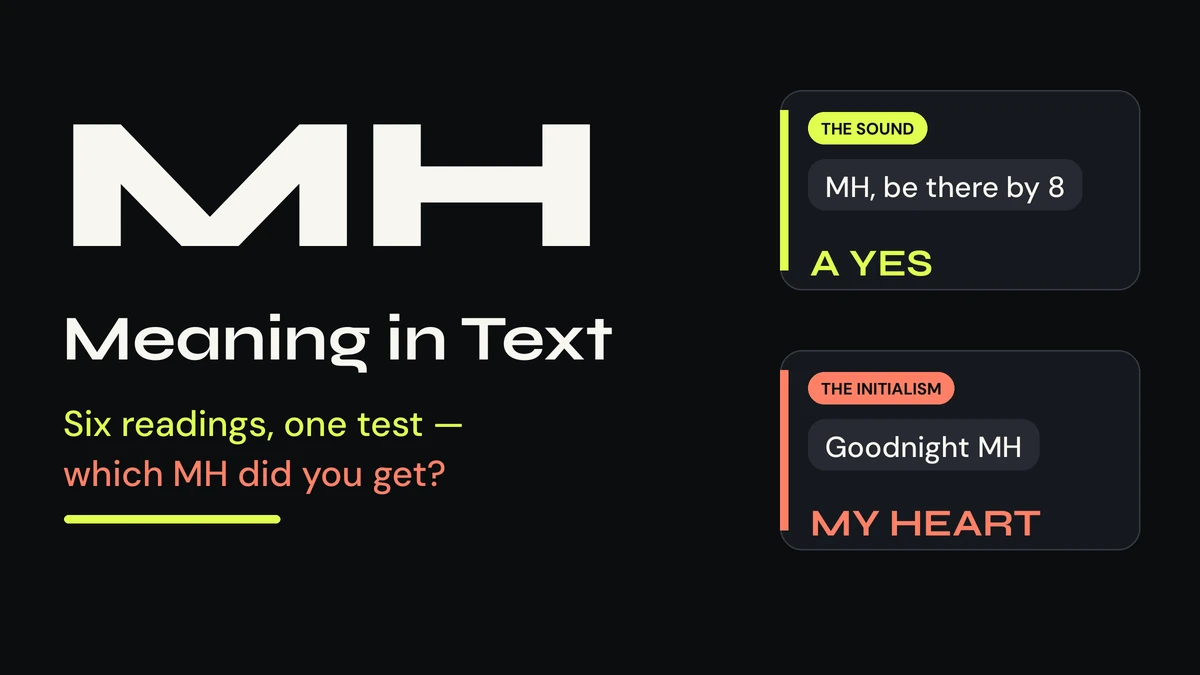
What does mh mean in text? MH most often means “mhmm” — a quick yes, okay, or I agree — but it can also mean “my heart,” “mental health,” or “my husband,” and in gaming chats it means Monster Hunter. This guide to mh meaning in text gives you the MH Which-MH Test, so you can sort the six readings in seconds instead of guessing.
This guide covers all six live readings, the three-check test, seven real-chat examples, the full reading list, MH on TikTok, Snapchat, Instagram, and in texts, how it lands by sender, when it is too much for work, school, and family, graded claims, cousins, history, and a reply bank keyed to the reading you just identified.
What “MH” Means in Text
MH is two things at once, and that is the whole puzzle: it is a written sound and an initialism, and nothing in the spelling tells you which job it is doing. As a sound, MH is the agreement hum “mhmm” clipped to two letters — the noise you make when you agree without opening your mouth properly, typed out and sent as a reply. As an initialism, MH is the first letters of a phrase: “my heart,” “mental health,” or “my husband.” A third use sits between the two: a flat “mh” that borrows the spelling of “meh” and means indifference, not agreement at all. And in gaming rooms, MH is a title: Monster Hunter. Six readings, two letters, no spelling difference between them.
The dictionary record is unusually narrow, and this guide says so plainly instead of hiding it. , read directly for this article, lists English mh as “(jargon, social media) Initialism of mental health” — one reading, and only one. It attests no “my heart,” no agreement sound, and no “my husband,” and this guide claims no dictionary support for those readings: they rest on competitor guides read in full and on the usage examples those guides document, graded openly in the checked-claims section below. No Dictionary.com MH acronym page exists at all — its /e/acronyms/mh/ address returns a 404 — and no Merriam-Webster MH texting entry was relied on; no such entry is claimed. The one reading with a dictionary behind it is mental health, and the article treats it as the anchored reading, not as the most common one.
Capitalization is a clue for MH in a way it is not for most terms in this series, and it is the first thing to check after the test. Lowercase “mh” on its own is almost always the sound: a quick yes, a soft okay, a low-energy acknowledgment. Capital “MH” inside a sentence is almost always an initialism: “my MH” is a person or a state of mind, never a noise, and “MH forgot our anniversary again” is a husband, not a hum. A capital “MH” standing alone as a whole reply can still be the sound — people capitalize for emphasis, not for grammar — which is why case is a clue and not a verdict. The test in the next section turns these observations into a procedure, because “context matters” is true and useless on its own.
One more fact before the test: no source ranks one reading as the most common across all of texting, and this guide does not invent that ranking. One competitor leads with the agreement sound as the most common meaning; another leads with “my heart” as the one you will run into most in personal conversations. Both can be right at once, because they are counting different rooms: the sound dominates quick replies, the pet name dominates romantic threads, the wellness reading dominates support communities, and the gaming reading dominates Discord. The room decides the reading, and the test asks which room you are in.
The MH Which-MH Test
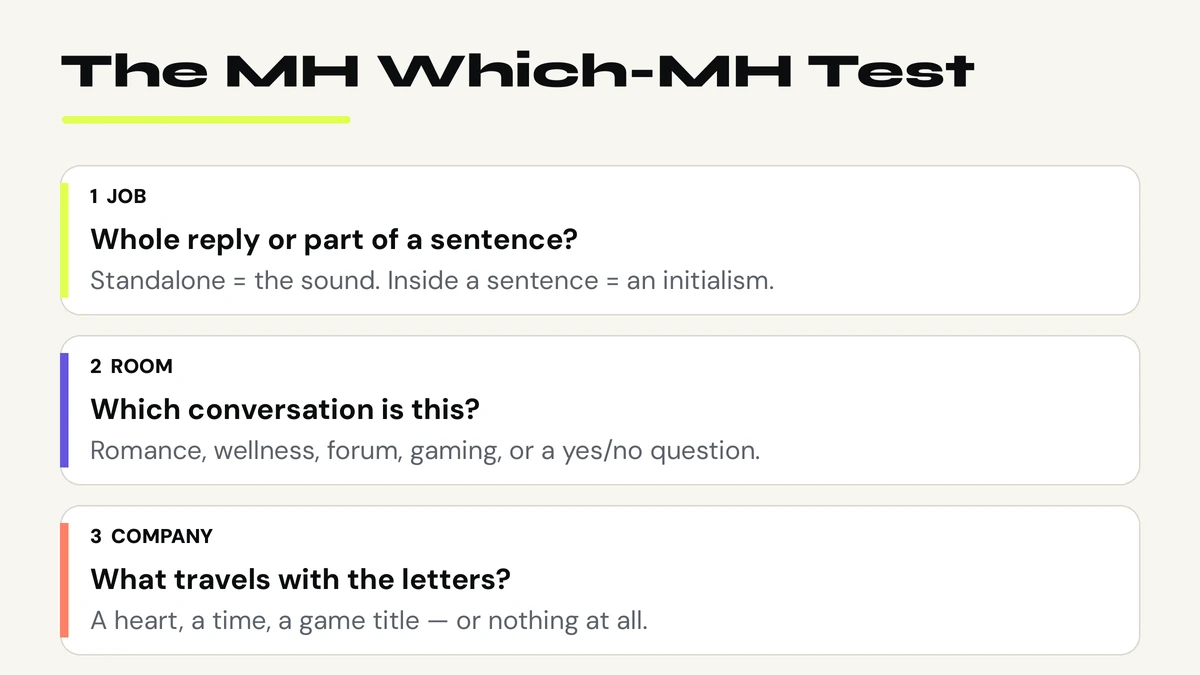
Before you answer an MH — or send one — run three checks. They take about five seconds, and they beat every shortcut the competitors offer, because the competitors all say “context decides” without giving you a procedure for reading it:
- Check 1 — The Job Check. Is MH the whole reply, or part of a sentence? A standalone reply to a yes-or-no question is the sound: “Are you coming tonight?” — “MH, be there by 8” is a yes. MH inside a sentence is an initialism: “my MH”, “MH and I”, “working on my MH” are a person, a partner, or a state of mind. MH at the start of a warm message with a heart attached is the pet name. If MH is doing a job inside a sentence, it cannot be the sound, because sounds do not take possessives.
- Check 2 — The Room Check. Which conversation is this? A romantic thread points to “my heart.” A wellness, therapy, or self-care thread points to “mental health.” A parenting or marriage forum points to “my husband.” A gaming server or a Discord chat points to Monster Hunter. A yes-or-no question points to the agreement sound. A “how was it?” question points to the flat meh reading. The room is the single strongest clue, because each reading has a home and rarely leaves it.
- Check 3 — The Company Check. What travels with the letters? A heart emoji or a goodnight points to “my heart.” A time, a plan, or a detail (“MH, on my way”) points to agreement. A flat follow-up (“MH, it was fine, nothing special”) points to meh. A game title, a boss, or a squad points to Monster Hunter. Words about rest, therapy, or boundaries point to mental health. Company is the tiebreaker when the room is unclear: the sentence around the letters is doing the real talking.
Worked trio. “You coming tonight?” — “MH, be there by 8”: job standalone reply, room a plan, company a time attached. Agreement, and the only sensible reply is a plan. “Good morning MH, hope you slept okay?”: job nickname inside a sentence, room romantic, company a morning wish and a heart. “My heart,” used like babe, and answering it like a yes would miss the whole message. “Taking a few days off work for my MH”: job possessive plus noun, room work and wellness, company days off and rest. Mental health, and it deserves care, not a joke. Three messages, two letters, three readings — and the test, not the spelling, sorted them.
“MH” in Real Chats
Illustrative examples written for this guide, not real transcripts:
- The quick yes. “Are you coming tonight?” — “MH, be there by 8”: agreement, done in two letters and a time. Answer with the plan, not a second question.
- The pet name. “Goodnight MH ❤️”: “my heart,” used exactly the way “babe” is used, at the end of a loving message. Answer the affection, not the letters.
- The wellness note. “Bad MH day, going to rest instead of pushing through”: mental health, stated plainly and seriously. The only right reply is care.
- The forum husband. “MH forgot our anniversary again lol”: “my husband,” in the voice of a parenting-forum post. Answer the story, not the abbreviation.
- The flat meh. “How was the movie?” — “MH, it was fine, nothing special”: indifference by spelling overlap, not agreement. Do not read enthusiasm into it.
- The gaming call. “Anyone up for MH tonight? Trying to farm materials”: Monster Hunter, and the room — a gaming server — makes it obvious before the sentence ends.
- The same letters, two rooms. One thread in the morning: “MH, sounds good” (agreement). Another thread the same day: “Missing my MH today 🥺” (my heart). The letters never changed; the room did. If you only remember one thing from this guide, remember that pair.
The MH Reading List
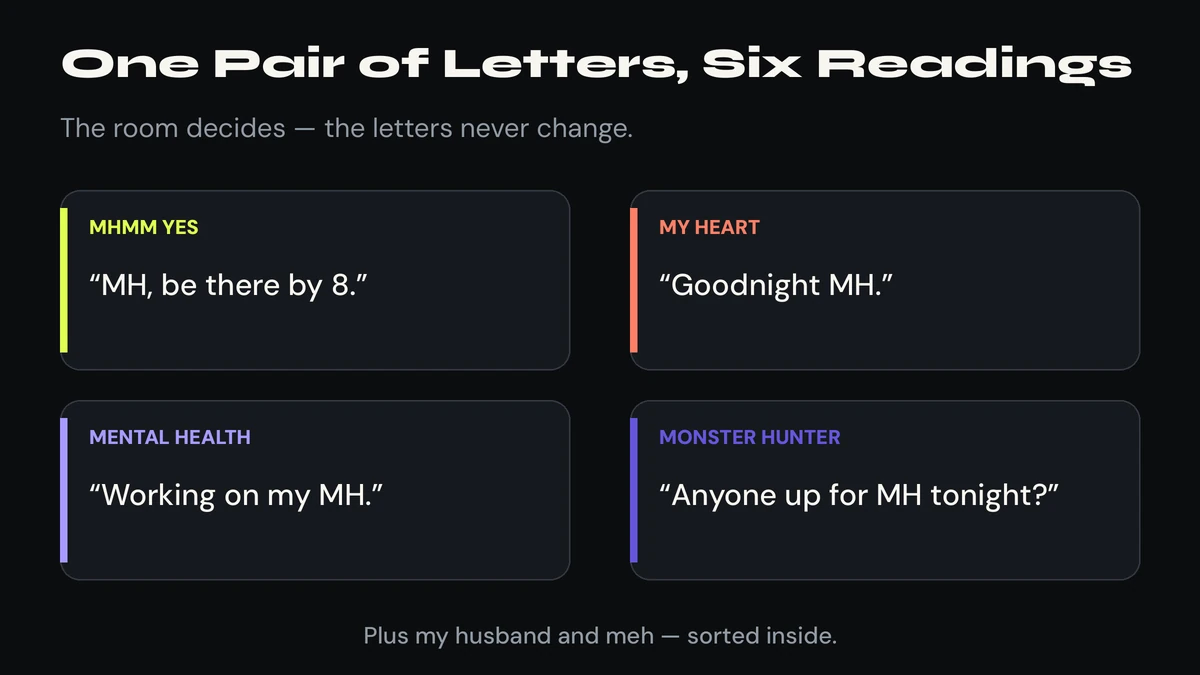
MH’s two letters carry six live readings, and the sound reading splits into two tones, so the list runs to seven. Warmest to flattest, the readings are:
- Warm agreement: “MH, that sounds great” — the mhmm sound at full strength, a yes with a smile in it. The default reading for a standalone reply to a yes-or-no question.
- Low-energy acknowledgment: “mh ok” — heard, not engaged. The dry-texting zone of the sound reading: a yes so small it almost is not one. If this is the whole reply, every time, the pattern is the message.
- “My heart”: a pet name, used like babe or love, almost always at the start or end of a warm message. The romantic reading, and the one that most often gets misread as a yes by people who only know the sound.
- “Mental health”: the one Wiktionary-attested reading. Wellness, therapy, self-care, and rest contexts, always serious, never a joke. The reading with a real-world weight the others do not carry.
- “My husband”: forum shorthand from marriage and parenting communities. Lives in sentences — “MH and I”, “MH is out of town” — and almost never as a standalone reply.
- Meh: indifference by spelling overlap. A flat answer to “how was it?”, not a yes and not a no. The reading that punishes anyone who assumes every MH is agreement.
- Monster Hunter: the gaming reading, dominant in Discord and Reddit game talk. In a gaming server it is the first reading to try, not the last — context there is usually obvious from the game talk around it.
What moves a message between these readings is never the letters alone: it is the job (whole reply or part of a sentence), the room (romantic, wellness, forum, gaming, or a plain question), and the company (emoji, punctuation, attached words). The same “MH” that is a yes on Monday can be a pet name on Tuesday and a game title on Friday — and the test, not the spelling, tells you which day you are on.
“MH” on TikTok
On TikTok, MH lives in comments and captions, and the video’s subject picks the reading before you do. In comments under an opinion or a debate clip, the agreement sound dominates: “MH, I thought the same” is a yes aimed at the post, not at you. In captions, the reading follows the video: a wellness or self-care clip captions its MH as mental health, and a couple’s anniversary clip captions its MH as my heart. The public stage suits the sound reading best, because a comment thread is an audience, not a private conversation — nobody there is owed a sentence, and a two-letter yes lands exactly right.
The trap on TikTok is taking a public reading personally. A stranger’s “MH” under your video is agreement, applause, or irony aimed at the post, not a verdict on you, and a creator who captions their own video with “my MH” is usually talking about their mental health or their partner, not sending you a message. If an MH arrives in a TikTok DM, though, run the test as usual — a DM is private again, and the pet-name and mental-health readings return with it.
“MH” on Snapchat
On Snapchat, MH fits the fast, private, disappearing DM: a bare “MH.” as a story reply, or a quick “MH, on my way” between close friends. The disappearing format suits the agreement sound — a yes that lands lightly and is gone — and it suits the pet name too, because a private snap between partners is exactly where “my heart” lives. But disappearance also removes your evidence: if an MH felt flat or strange, you cannot re-read it, so judge from memory what rode with it — a heart, a time, a flat period, or nothing at all.
Snapchat is also where the photo does half the work. A picture of a plan plus “MH” needs no explanation: the image names the question, and the letters only say yes. That is the Job Check working in real life — remove the MH and the snap still asks something, which is how you know the job was agreement, not information. And the same disappearing format that makes a quick yes easy makes a careless meh easy too: a flat “mh” on a snap your friend cared about stings precisely because they cannot re-read it and decide you meant well.
“MH” on Instagram
On Instagram, MH shows up in comments, captions, story replies, and DMs, and the stage decides the reading the way it does for every multi-meaning term. Comments lean public and quick: “MH, it’s really nice” under a friend’s post is agreement the whole thread can join. Captions lean toward the initialisms: an anniversary photo captions its MH as my heart, and a wellness post captions its MH as mental health. DMs carry the full range, exactly like texts — a partner’s pet name and a stranger’s flat meh live in the same inbox, and only the test tells them apart.
Instagram is also where MH meets its closest platform trap: reading a public comment as a private message. A stranger’s “MH” under your post is not a conversation opener, and answering it with a life story embarrasses both sides. A thank-you, a matching laugh, or silence all end it cleanly; the comment was never asking for more. And a creator’s caption that reads “working on my MH lately” is a wellness statement, not an invitation to diagnose them — answer with support, or keep scrolling.
“MH” in Text Messages
Plain texts are MH’s home ground, and the one-to-one setting makes the distinction sharpest. A warm text wants a witness: “MH, sounds good, see you at eight.” A flat text wants a decision from you: is this a tired yes, or is this meh? The reply each one deserves is completely different, which is why the Room Check comes before the reply — answering meh with excitement you do not feel, or a pet name with a logistics answer, is the classic MH misfire. Texts are also where a yes turns into a plan, and the plan usually moves somewhere private. A friend who replies “MH, be there by 8” and means it often follows up with an invitation — our DM guide covers that move in full, because the channel changes what the next message can say.
Texts are also where MH’s work limit lives, and it is stricter than for most terms in this series, because MH can be misread in two directions at once. A client, a manager, or a first contact deserves a plain yes spelled out, not two letters that might be agreement, might be indifference, and might be a pet name. In a work thread, “mh” reads as checked-out even when you meant yes, and “my MH” in a work message is oversharing in shorthand. Spell it out, or do not send it.
Who Is Sending It: How “MH” Lands by Sender
No source documents a different meaning of MH per sender — the six readings stay fixed; what changes is which reading you should expect first, and therefore what you owe back:
- Friend: the default. A friend’s MH is the agreement sound or the meh reading at face value; run the test and answer that, not the letters.
- Crush: overread territory. A crush’s “MH ❤️” feels bigger than it is, and a bare “mh” from a crush is usually just a yes, not a signal. Answer the reading, not a romance you invented.
- Partner: pattern rules. A partner’s MH is usually the pet name, and it is the home reading — but a sudden run of flat “mh” replies after warm ones is worth one plain question, not a fight.
- Parent: usually literal and plain. A parent who writes “mh” usually means the agreement sound, learned from you; a parent in a family group who writes “MH is picking me up” means their husband, and the sentence makes that obvious.
- Coworker or boss: context decides. In a friendly team chat a colleague’s “MH, sounds good” is a yes; in any formal thread it is out of place, and never send one upward to a manager or client.
- Group chat: both habitats at scale. A group’s “MH, sounds good” is agreement for everyone; a partner’s “my MH” in a group chat is a pet name said in public — notice it, do not tease it.
- Stranger or creator: the applause habitat. A stranger’s MH under your post, or a creator’s MH in a caption, is a public reaction, not a message aimed at you personally. A thank-you or a matching laugh is enough; never answer a public reaction with a private confession.
When “MH” Is Too Much: Work, School, and Family
This section is mandatory for MH in a way it is not for most terms in this series, because MH’s risk is not vulgarity — the letters are clean — but misreading: one abbreviation that can be a yes, a pet name, a health statement, or a shrug. Three rooms, three rules. At work: never send MH in a professional message, a client thread, or a formal channel. A yes that looks like a shrug costs you credibility, and a health statement in shorthand costs you privacy. If the room would want a plain yes, the letters do not fix it.
At school: the same rule, with a younger audience. Teachers, school groups, and class chats are not MH rooms, and a student who answers a teacher’s question with “mh” has sent a shrug whether they meant to or not. The clean swap is a full word: “yes” or “got it.” In family chats, read the room person by person: a sibling group may love the shorthand, a grandparent group may not know the letters, and a parent who dislikes casual indifference will dislike the abbreviation exactly as much as the flat reply, once they learn what it stands for. Abbreviation is not permission.
The mental-health rule stands on its own, and it is the most important rule in this article. The mental-health reading of MH is never a joke, never a punchline, and never a way to mock someone’s struggle: do not send “my MH” as a shrug at your own bad day if the room will read it as a joke, and never answer someone’s real “working on my MH” with a flat “mh.” If someone tells you MH bothers them, simply stop — switching words is easy, and it shows respect. The swap menu is free and it loses nothing: “yes, sounds good” for agreement, “my love” for the pet name, “my mental health” spelled out for wellness, and “not really feeling it” for the flat reading. And one boundary worth stating plainly: never use MH to dress up indifference as agreement. A shrug wearing a yes’s clothes is not a yes.
Checked Claims: Expansions That Do Not Hold Up
Two letters attract folklore. Each claim below was graded against the dictionary source read in full and the competitors read in full; nothing is repeated here as fact on a single blog’s say-so:
- “MH always means ‘my heart’” — rejected. One competitor leads with the pet name as the most common reading in personal conversations, but the same competitor’s own guide lists five other readings, and the dictionary source attests a different one entirely. A reading that owns one room does not own the letters.
- “MH always means ‘mental health’” — rejected. Wiktionary attests the mental-health reading and nothing else, which makes it the anchored reading, not the only one. Attestation is not exclusivity: a dictionary entry proves a reading exists, not that no other reading exists.
- “MH means ‘my head’” — rejected. A competitor’s alternate-meanings list carries this expansion with no dictionary support, no example of anyone actually using it that way, and no room where it lives. If someone means their head, they write that; they do not write MH.
- “MH means ‘man hours’” — rejected as a texting meaning. A real business term, and a real expansion of the letters — but it lives in timesheets and project plans, not in chats. Nobody replying “MH” to “Are you coming tonight?” is logging billable time.
- “MH means ‘message here’” — rejected. A back-formation with no source, no example, and no room. The letters can be forced into many phrases; a forced phrase is not a meaning, and this guide does not repeat it as one.
- “MH is one acronym with one expansion” — rejected. MH is not one thing at all: it is a written sound and an initialism with several expansions, and the sound reading is not an acronym in the first place. Asking “what does MH stand for?” already assumes the wrong shape.
- “MH and HM mean the same thing” — rejected. Our own HM guide covers the thinking sound “hmm”: HM buys time, MH gives a yes. One letter swapped, opposite jobs — HM says “I am still thinking,” MH says “I agree.” Confusing them turns a yes into a stall.
- “MH is always a yes” — rejected. The meh reading is not a yes, the pet-name reading is not a yes, and the gaming reading is not a yes. Three of the six readings are not agreement at all, and treating every MH as a yes is the single most common misread this guide exists to fix.
What SURVIVES: six readings, graded. The mhmm agreement sound (competitor-documented, the lead reading in quick replies); “my heart” (competitor-documented, the lead reading in romantic threads); “mental health” (Wiktionary-attested, the only dictionary-backed reading); “my husband” (competitor-documented, forum shorthand); the meh reading (competitor-documented spelling overlap); and Monster Hunter (competitor-documented, dominant in gaming rooms). Proper-noun and technical collisions are real outside chat and irrelevant inside it: the Marshallese language code mh, the medical-history and malignant-hyperthermia abbreviations, the Medal of Honor, and the megahertz unit (MHz, not MH) never decide what a text means. One older gaming use, “Map Hack,” is graded as historical, not current: it appears in retro-forum discussions and has largely faded, and no current guide treats it as live.
“MH” vs Its Closest Cousins
MH belongs to two families at once — the agreement sounds and the affection initialisms — and its closest cousins split by which family they belong to:
- HM (thinking cousin). Our HM guide covers the thinking sound “hmm” written short; MH is the agreement sound “mhmm” written short. HM buys time, MH gives a yes. One letter swapped, opposite jobs, and the punctuation test tells them apart: HM stretches with an ellipsis, MH lands with a plan.
- HMM (longer-thinking cousin). Our HMM guide covers the stretched thinking sound; MH answers, HMM waits. A message that reads “hmm, let me think” is still thinking, and a message that reads “MH, be there by 8” has already decided.
- IKR (agreement cousin). Our IKR guide covers an echo that agrees with a feeling; MH agrees with a fact or a plan. IKR says “I feel that too”; MH says “yes, that works.” One shares feeling, the other confirms.
- ILY (affection cousin). Our ILY guide covers love stated directly; MH-as-“my heart” is a pet name, not a declaration. ILY says “I love you”; MH says “you are my heart.” A declaration and a nickname are not the same job, even when both are warm.
- “Meh” (plain-English cousin). The indifference word itself, spelled out. When MH feels too ambiguous, “meh” says the flat reading with the tone built in and no test required — and when you meant agreement, saying “yes” instead of “MH” does the same job.
- “My love” and “babe” (plain-English pet-name cousins). The spelled-out versions of MH-as-“my heart.” They are the swap menu: when the abbreviation could be misread as a yes or a shrug, these words say the affection with no test required.
- HN (grunt cousin). Our HN guide covers the lowercase grunt in the huh and hmm family — or, in capitals, a blunt refusal. MH is the hum; HN is the grunt. Both are sounds instead of words, and the room decides which one you just heard.
- MHM (nod cousin). Our MHM guide covers the sound of a nod, typed out — yes. MH is usually “mhmm,” a quick yes; MHM is the nod itself. One hums the agreement, the other nods it.
Where “MH” Came From
The sound came first, by decades. “Mhmm” is the written form of the agreement hum people have made in conversation for as long as anyone has been agreeing out loud: a noise that says yes without spending a whole word on it. The initialism readings came later, and they came from different rooms at different times, which is exactly why they do not share an origin story. The pet name grew out of the wider habit of shrinking terms of endearment into abbreviations. The mental-health reading grew out of wellness communities that needed a quick shorthand for a phrase they typed all day. The husband reading grew out of marriage and parenting forums, where posters write about their families dozens of times a day and standardize every repeated phrase. The gaming reading grew out of a game title that needed shortening in fast chat. Four rooms, four histories, one pair of letters.
Dating the abbreviation precisely is where honest guides stop. The main competitor says the exact origin is not completely clear, that most experts believe it developed from the spoken “mhmm” sound, and that no single person or website is credited with creating it. The second competitor traces each reading to its own room — endearment-shrinking, awareness growth, forum shorthand — without dating any of them. Wiktionary’s mental-health entry, the only dictionary anchor in this article, carries no first-use date. Those are three different kinds of evidence — a competitor’s honest uncertainty, a competitor’s room-by-room history, and a dictionary entry without a date — and this guide does not blend them into a single origin year. What the sources agree on is the direction: spoken sound first, written shorthand second, separate rooms third. No inventor is claimed, and no single year is asserted as the birth of MH.
How to Reply When Someone Sends “MH”
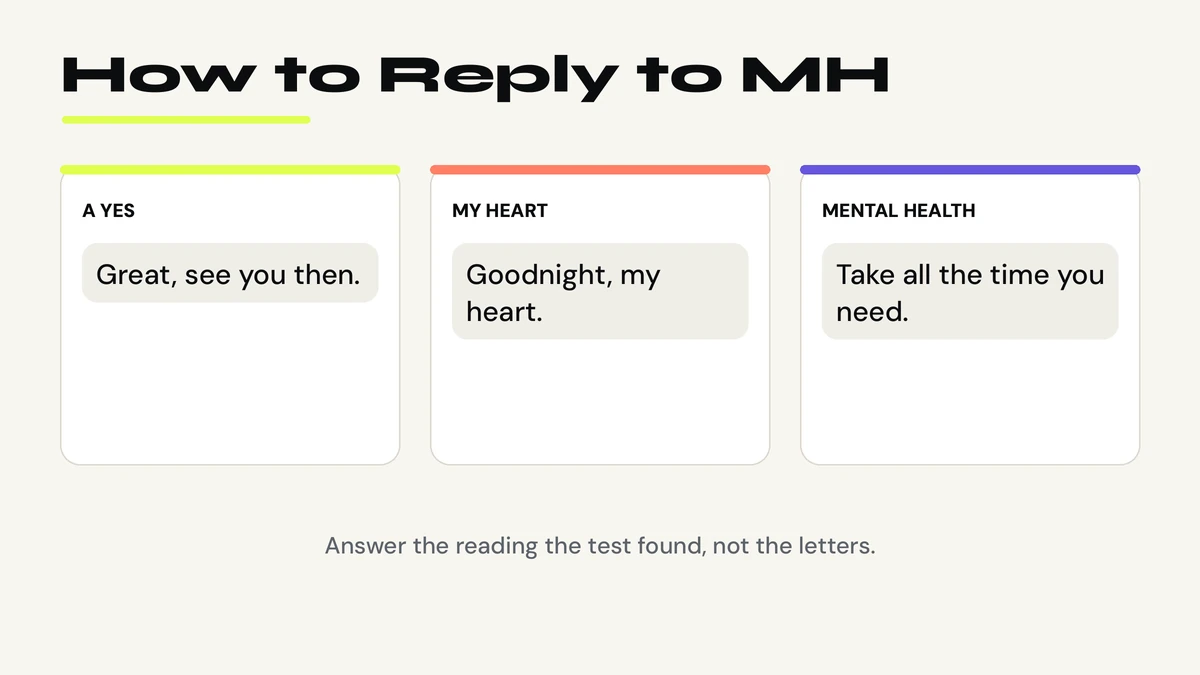
Golden rule: answer the reading the test found, not the letters. A reply bank keyed to the reading:
- Agreement — confirm the plan: “Great, see you then” or “Perfect, locked in.” A yes deserves a plan back, and a warm MH is an opening, not just a reply — our HMU guide covers the open invitation in full, because “next time, you are coming too” turns agreement into a plan, and plans beat reactions every time.
- “My heart” — answer the affection: “Goodnight, my heart ❤️” or “Love you too.” Match the warmth, not the length: a pet name answered with logistics is a missed message.
- “Mental health” — answer with care: “Take all the time you need” or “Here if you want to talk.” Never a joke, never a shrug, never advice they did not ask for. Care is the only reply that fits.
- “My husband” — answer the sentence: “Lol, classic” or “Tell him I said hi.” The abbreviation is furniture in the sentence; the story is the message, so answer the story.
- Meh — do not chase it: A light “Fair enough” and then move on. If the pattern repeats, one plain question beats ten anxious replies: “Hey, did that land weird?”
- Monster Hunter — answer the game: “I’m in, what time?” or “World or Rise?” The room already told you the reading; the only wrong answer is treating a game invitation like a yes-or-no question about your day.
Frequently Asked Questions
What does MH mean in a text message?
MH most often means “mhmm” — a quick yes, okay, or I agree — but it has six live readings: the agreement sound, “my heart,” “mental health,” “my husband,” the flat meh reading, and Monster Hunter in gaming chats. Run the Which-MH Test before you decide which one you just got.
Is MH always “my heart”?
No. That is one of the biggest misunderstandings about the term. “My heart” is the lead reading in romantic threads, but the same two letters mean agreement in a quick reply, mental health in a wellness thread, a husband in a parenting forum, indifference after “how was it?”, and a game title in a Discord server. The room decides, not the letters.
What does MH mean on TikTok?
On TikTok, MH usually means the mhmm agreement sound in comments — “MH, I thought the same” under an opinion clip — while captions follow the video’s subject: a wellness clip captions its MH as mental health, and a couple’s clip captions its MH as my heart. A stranger’s MH under your video is a public reaction aimed at the post, not a private message.
What does MH mean on Instagram?
On Instagram, MH usually means agreement in comments, “my heart” or “mental health” in captions depending on the post, and the full range in DMs, exactly like texts. An anniversary photo captions its MH as my heart; a wellness post captions its MH as mental health; a DM can carry any of the six readings.
Is MH rude?
Not by default. Among friends it is often just a quick yes. It turns rude when the flat meh reading answers something that mattered, when a bare “mh” is the whole reply every time, or when the mental-health reading is treated as a joke. When in doubt, choose clearer words: “yes, sounds good” leaves no ambiguity at all.
Can I use MH at work or school?
Generally, no. MH belongs in casual digital conversations. In work emails, formal chats, or school messages it can read as checked-out or indifferent, and under a manager’s question it looks like a shrug. In a casual peer chat about a plan, it is fine; anywhere formal, spell the yes out.
What should I reply when someone sends MH?
Answer the reading the test found. Agreement gets a plan back (“Great, see you then”); “my heart” gets affection back (“Goodnight, my heart”); mental health gets care (“Take all the time you need”); “my husband” gets an answer to the story; meh gets a light reply and no chase; Monster Hunter gets a game answer. The full reply bank is in the section above.
Does lowercase mh mean something different from MH?
Partly, yes — and this is the one term in the series where case is a real clue. Lowercase “mh” on its own is usually the agreement sound; capital “MH” inside a sentence is usually an initialism (“my heart,” “mental health,” “my husband”). But case is a clue, not a verdict: a capital “MH” standing alone as a whole reply can still be the sound, so run the Job, Room, and Company checks before you decide.
The Takeaway
MH means “mhmm” agreement — or “my heart,” “mental health,” “my husband,” meh, or Monster Hunter. Two letters, six jobs, and no spelling difference between them. When an MH lands, run the Which-MH Test: check the job, check the room, check the company. And when you send one, remember the only rule that matters: a yes, a pet name, a health statement, and a shrug are four different messages, and the letters will not sort them for you — so if you mean it warmly, prove it with the words around it, and if you mean it as a game title, make sure the room already knows the game.