What “ROFL” Means in Text
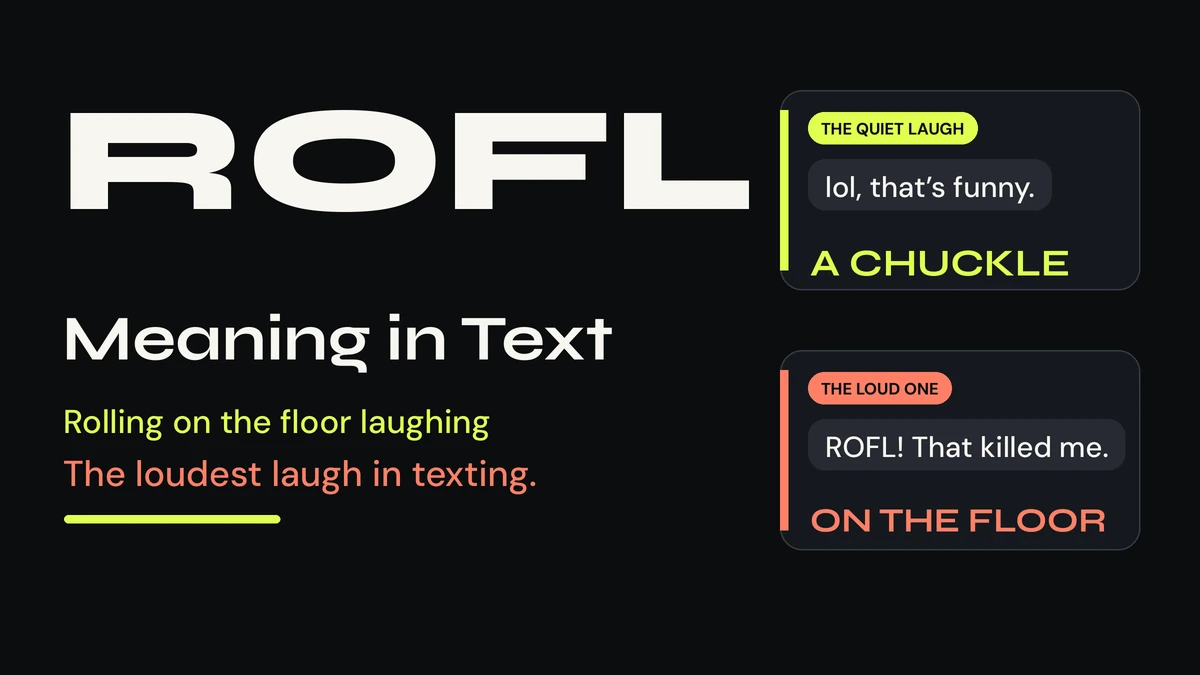
ROFL means rolling on the floor laughing. If someone texts you “ROFL, that video killed me,” they are telling you the joke hit so hard they are laughing like they fell off their chair — that is the rofl meaning in text in one sentence, and it is also the loudest laugh this series has covered so far. ROFL is not a chuckle and it is not a polite smile. It is the four-letter way of saying a joke was so funny your body gave up and your laughter took over.
ROFL sits at the top of a little ladder of laughs, and the ladder is the fastest way to understand it. At the bottom is LOL, laughing out loud, which people now throw at almost anything, even things that did not make them laugh at all. One rung up is LMAO, and the LMAO guide covers that louder, messier laugh in full. ROFL sits above both of them: it is the laugh you send when LOL would be an understatement and even LMAO does not quite carry the picture. The letters paint a scene — someone laughing so hard they are on the floor — and the scene is the whole point.
Almost nobody who sends ROFL is actually on the floor. That is the first thing a new reader needs to know, and the guides in this build are unusually honest about it. How-To Geek, the main guide this build was measured against, says the image is vivid on purpose: when you read ROFL, you are meant to picture someone cracking up while rolling on the ground. The letters are a stage direction, not a medical report. If the joke made you snort, grin, or laugh out loud at your screen, ROFL is a fair report of the feeling, even if your feet never left the ground.
The dictionary record, for once, agrees with the internet. Wiktionary lists ROFL plainly as internet slang and text messaging, an initialism of rolling on the floor, laughing, used to indicate great amusement — and Oxford Advanced Learner’s Dictionary lists it the same way, as an informal abbreviation used especially in text messages and on social media to show that you find something extremely funny. That agreement matters, because the last term in this series had a dictionary gap: the big dictionaries had not caught up with the slang. ROFL has no such gap. The slang meaning is the dictionary meaning, and this guide can spend its energy on how loud the laugh is instead of proving the letters mean anything at all.
The ROFL Floor Test
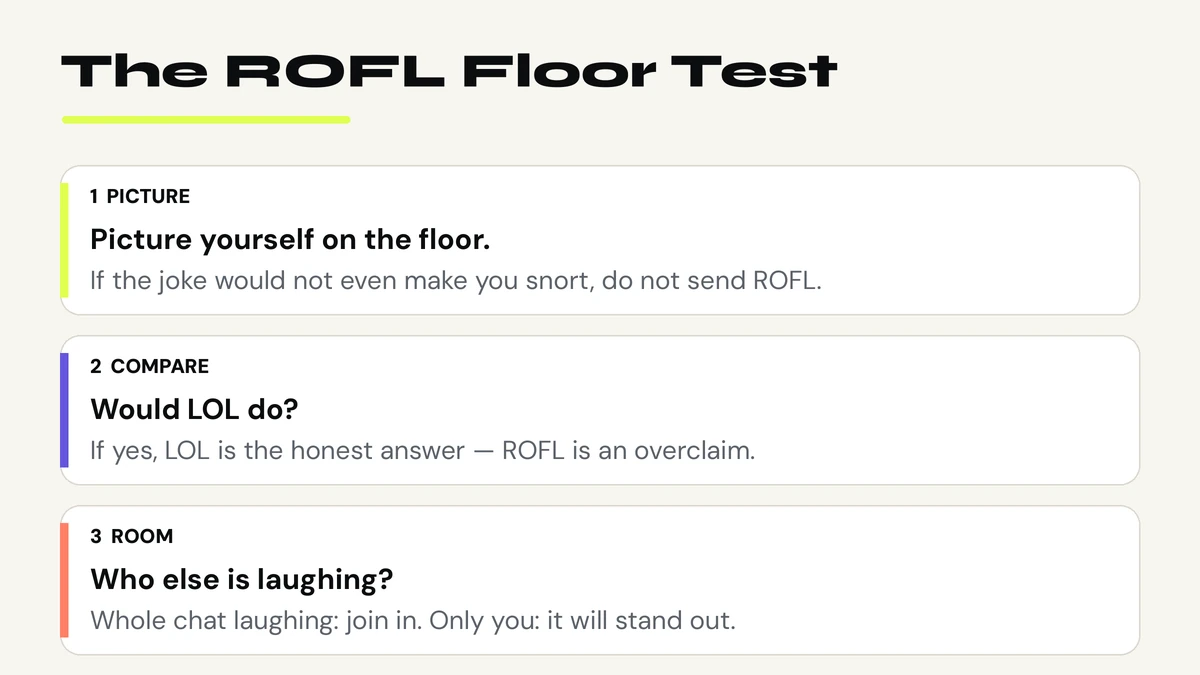
Most slang in this series is sorted by grammar or by room. ROFL is sorted by honesty — by whether you actually mean the letters, because ROFL is almost always an exaggeration and the exaggeration is the whole message. That is why this guide’s test is built differently from the last one. The RN Swap Test sorted by sentence mechanics; The ROFL Floor Test asks whether the laugh you are reporting is loud enough to earn the floor. It takes about five seconds, and it works on a text, a TikTok comment, and a group chat alike, because the test follows the feeling instead of the letters.
- Check 1 — Picture. Close your eyes for one second and picture yourself literally rolling on the floor. If the joke would not even make you snort — a mild smile, a polite “haha” — do not send ROFL. Send LOL, send a smile, or send nothing at all. ROFL is a picture, and if the picture does not fit, the letters will read as fake.
- Check 2 — Compare. Ask yourself whether LOL would do. If the joke was funny but ordinary, LOL is the honest answer, and ROFL is an overclaim that costs you credibility the next time you really do find something hilarious. Save ROFL for the joke that made you laugh out loud at your screen — the one you would have missed if you had been asked to stay quiet.
- Check 3 — Room. Ask who else is laughing. If the whole group chat is crying with laughter, ROFL joins the chorus and nobody will question it. If you are the only one laughing and everyone else sent a polite “lol,” a ROFL will stand out — and standing out is fine when the joke genuinely got you, but it is the wrong move when you are trying to fit in.
Run it on the hardest case in this guide: a joke that is funny, but only just. Your friend sends a decent pun, the kind that earns a grin. The Picture check fails — you did not snort, let alone roll. The Compare check points at LOL, which is exactly the right size for a decent pun. The Room check agrees, because everyone else sent “lol” too. The test says LOL, and the test is right: saving ROFL for the joke that truly floors you is what keeps the letters meaning anything at all.
What the test cannot do is measure someone else’s laughter, and it does not try. If your friend sends ROFL at a joke you found only mildly funny, do not correct them — humour is personal, and their floor is not your floor. The test is for your own messages, not for policing anyone else’s. Its job is to stop you from spending your loudest laugh on a quiet joke, not to tell anyone else how hard they are allowed to laugh.
“ROFL” in Real Chats
ROFL shows up wherever a joke lands hard, and the examples below are written for this guide from the documented uses — replies to jokes, reactions to videos, self-owns, and group-chat pile-ons — so you can recognise each job the moment you meet it. One thing ties them together: in every example, the letters are the reaction, not the message. The joke does the work; ROFL just reports how hard it hit.
- The reply to a joke. “ROFL! That is the funniest thing I have heard all week.” The classic job, and the one How-To Geek opens with: someone says something funny in the group chat, and ROFL is the whole reply. No explanation is needed, because the letters are the explanation.
- The video reaction. “I just watched that clip three times. ROFL.” A joke that arrives as a video instead of a sentence, and the letters say the video did its job. The reply is about the clip, not the letters — the clip is what was funny.
- The self-own. “I slipped on a banana rofl.” How-To Geek’s own example, and the funniest job in this guide: the sender is the joke, laughing at their own bad luck before anyone else can. The lowercase rofl keeps it casual, like a shrug with a laugh in it.
- The midnight laugh. “ROFLMAO, it is 3 in the morning, and I can’t stop laughing.” The stacked form, ROFL plus LMAO, for the laugh that will not stop — and the hour is doing half the work, because everything is funnier at 3 in the morning. The letters say the laugh is still going.
- The opener. “ROFL, I just saw the funniest thing outside my window!” The letters first, the story second. Leading with ROFL is a promise — what follows had better be funny — and it is the boldest way to open a message in this guide.
- The group-chat pile-on. One person sends the joke, three people send ROFL within seconds, and the chat becomes a wall of laughter. Nobody adds anything new, because nothing new is needed: the pile-on is the applause, and each ROFL is one more person clapping.
- The quiet one. “rofl.” Lowercase, no exclamation mark, one word alone. The same letters, sent flat — the joke was good, the sender is laughing, and they are not performing it. Capital ROFL with an exclamation mark is a shout; lowercase rofl is a nod.
Notice what nearly all of these examples do: they put ROFL where the laugh belongs, at the moment the joke lands. The letters are a reaction, not a conversation — nobody answers a ROFL with a question, because there is nothing to answer. If you read every ROFL as a small report from the floor — “this joke got me, hard” — you will read nearly all of them correctly, and the one that breaks the pattern, a ROFL at a joke nobody else found funny, will stand out precisely because the laughter has no company.
The ROFL Tone List
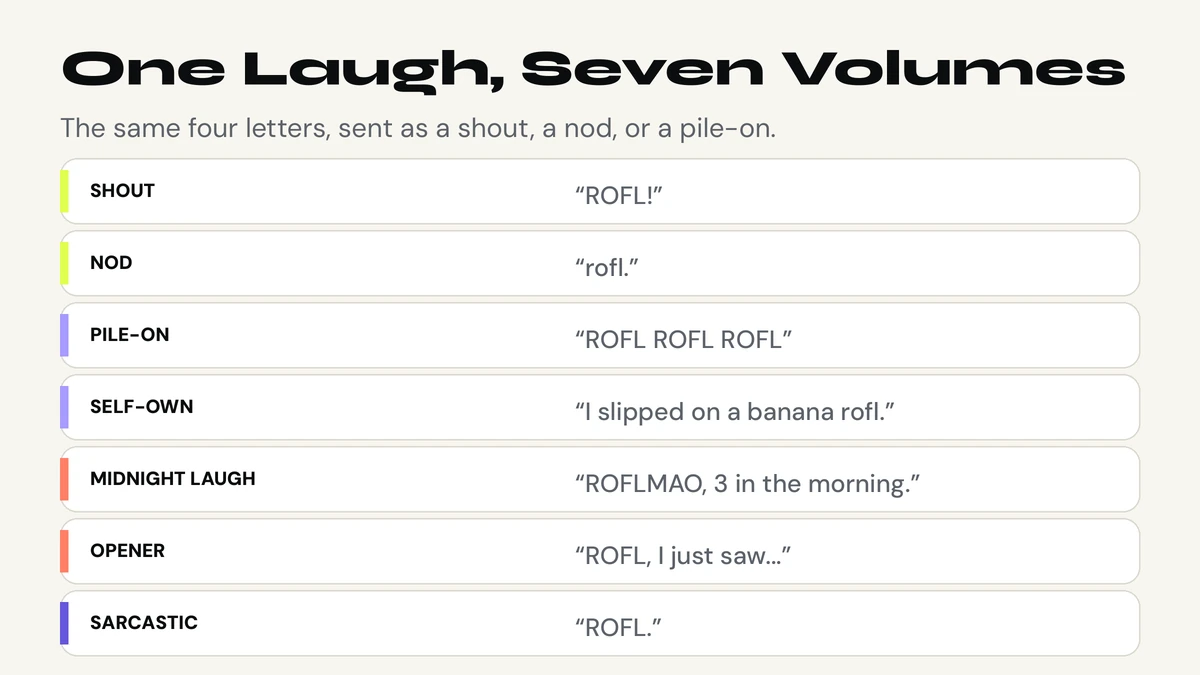
Seven readings, one abbreviation. Unlike the last term in the series, whose readings were seven volumes of the same moment, these are seven sizes of the same laugh — the same four letters, sent as a shout, a nod, a pile-on, or a performance. Read the list as a set of volumes, not as a set of meanings, because the meaning barely moves and the volume moves a lot.
- The shout. Loud, enthusiastic, all capitals with an exclamation mark. “ROFL!” The letters are doing the laughing out loud, and the tone is the tone of someone who just heard the funniest thing of the day. This is the default ROFL, and the one every guide in this build describes first.
- The nod. Quiet, subdued, lowercase. “rofl.” The same laugh, turned down to a murmur — the joke was good, the sender is amused, and they are not making a show of it. LiveAbout says both cases mean the same thing, and the case is a volume knob, not a different word.
- The pile-on. Social, contagious, one of many. “ROFL” in a chat where three other people just sent it too. The tone is applause, not a solo — the sender is joining a laugh that is already happening, and the letters are their ticket in.
- The self-own. Warm, self-deprecating, a little embarrassed. “I slipped on a banana rofl.” The sender is laughing at themselves before anyone else can, and the tone is a shrug: yes, that happened to me, and yes, it was funny. The laugh is aimed inward, and it disarms the room.
- The midnight laugh. Breathless, a little unhinged, stacked with extra letters. “ROFLMAO, it is 3 in the morning.” The tone is the tone of someone who should be asleep and is laughing instead — the hour makes everything funnier, and the stacked form says the laugh will not stop.
- The opener. Bold, promising, letters first. “ROFL, I just saw the funniest thing outside my window!” The tone is a drumroll: something hilarious is coming, and the sender is already laughing before the story starts. It only works if the story delivers.
- The sarcastic one. Flat, dry, almost a dare. “ROFL.” Sent after a joke that was not funny, or after a disaster that was not funny at all. This is the one reading where the letters mean the opposite of what they say — and it is rare, because How-To Geek notes that ROFL is almost never read as sarcastic, which is exactly what makes the sarcastic one land so hard when it appears.
Five of these are safe to send anywhere casual — the shout, the nod, the pile-on, the self-own, and the midnight laugh — because laughing at a joke offends nobody. The opener belongs to people who trust you to deliver, because a ROFL that promises a hilarious story and then tells a dull one spends your credibility. The sarcastic one belongs nowhere you need to be believed, because a ROFL that means “that was not funny” will be misread by half your audience. If you are unsure which tone you are hearing, answer the joke, not the letters — laugh along, or ask for the story — and the conversation will correct you gently if you picked wrong.
“ROFL” on TikTok
On TikTok, ROFL lives in comments, and the comment is its home ground. A video of a failed dance, a pet doing something absurd, or a perfectly timed fall gets a wall of “ROFL” and “ROFLMAO” underneath it, each comment a small vote that the video was genuinely funny. The meaning is the same as in texts — no source in this build documents a distinct TikTok-only meaning — but the platform changes the shape: on TikTok, ROFL points at a video instead of a sentence, and the video has to earn it.
The feed that surfaces these videos is the same one our FYP guide explains, and the ROFL comments riding on it are passengers, not drivers — nobody follows an account for the letters, they follow it for the fall, the joke, or the pet. The one TikTok habit worth naming is the comment trap: a creator captions a video “ROFL” themselves, and half the comments ask what is supposed to be funny, because the letters promised a laugh and the video did not deliver one. If you caption a video ROFL, make sure the video earns the floor.
Replying on TikTok rewards the same shortness the platform rewards everywhere else. A “what does rofl mean” comment under a video wants the one-sentence answer — rolling on the floor laughing — and nothing else. A longer explanation will be scrolled past, and a joke will be read as dodging the question. If you are the creator, pin the definition: it will save you answering the same comment fifty times.
“ROFL” on Snapchat
ROFL is at home on Snapchat, and the reason is simple: Snapchat is built for quick, disappearing messages between people who already know each other, and ROFL is built for exactly that kind of message — a reaction to a joke, a video, or a photo that made you laugh right now. A snap of a friend’s terrible haircut with a “ROFL” caption, or a chat message that just says “ROFL” after a funny story, both do the same job: they say the joke landed, and they say it fast.
The disappearing format suits ROFL better than it suits almost any other term in this series. A laugh is a moment, not a keepsake — a “ROFL” snap says “this made me laugh, here, now” and then vanishes, which is the honest lifespan of a reaction anyway. A streak snap with ROFL in it is not a message to save; it is a pulse check that says the friendship is still funny, and the next snap will replace it within the hour.
One habit makes Snapchatting ROFL painless: keep it in the chat, where it can be answered, rather than in a snap that disappears before the other person sees it. A “ROFL” sent as a snap can vanish before the joke’s author ever knows it landed; the same reaction sent as a chat message waits to be seen. Nothing about Snapchat changes the meaning; the app only changes how long your laughter lasts, so put the reaction where it can be read.
“ROFL” on Instagram
On Instagram, ROFL lives in two places that rarely meet: comments and DMs. In comments it is the public laugh — a reel of a dog stealing food, a meme about Monday, a friend’s failed cooking attempt, each one collecting “ROFL” and “ROFLMAO” underneath it like applause. In DMs it is the private laugh — a joke sent to one person, answered with a “ROFL” that nobody else sees. The public feed never sees the DM conversation, which is why a reader who only knows Instagram from the feed can miss half of what the letters do.
Our IG guide covers the shorthand itself; the point here is narrower — on Instagram, the room is decided by public versus private, and the same four letters do different jobs on either side of that line. A comment “ROFL” is a performance for an audience, a way of saying “I laughed, and I want everyone to know I laughed.” A DM “ROFL” is a message for one person, and it can be softer, longer, or followed by the actual story. Confusing the two is how a private joke ends up as a public comment.
The practical rule follows from that split. In a public comment, let the video or photo carry the joke and let the letters point at it — a bare “ROFL” under a genuinely funny reel is the whole review. In a private DM, laugh first and then say what got you, because the person who sent the joke wants to know which part landed. A bare “ROFL” in either place will be understood by nearly everyone, and on Instagram the half that might misread it is the half that did not see the joke.
“ROFL” in Text Messages
Text messages are the home ground for ROFL, which is why this section matters more than the three platform sections above it. The letters were born in chatrooms and grew up in SMS, and they still do their best work in a one-to-one text: a reply to a joke, a reaction to a story, a self-own, or a midnight laugh. No platform adds a meaning, and no platform takes one away — the text message is the original room, and every other room is a copy of it.
Capitalisation is a volume knob here, not a different word. LiveAbout says so plainly: use all uppercase ROFL or all lowercase rofl, and the meaning is identical. Capital “ROFL!” with an exclamation mark is the shout, the laugh you can hear through the screen. Lowercase “rofl” is the nod, the laugh you send when the joke was good but you are not performing it. Neither case is proof of anything on its own — the joke around the letters does the identifying, and the Floor Test still outranks the case every time.
One habit makes texting ROFL painless: keep the joke in the same message as the letters, or in the message right above them. “ROFL, that video killed me” cannot be misread, because the video names the room. “I slipped on a banana rofl” cannot be misread either, because the banana names the joke. It is the bare “ROFL” with no joke anywhere near it that causes every confusion in this guide, and it is also the easiest message in the world to fix — add one word about what was funny. If the conversation needs to move somewhere private or longer, that is what a DM guide move is for: take the joke out of the group chat and into a one-to-one thread, where a longer laugh and a longer story both belong.
Who Is Sending It: How “ROFL” Lands by Sender
The letters do not change with the sender. The weight you give them does, and so does the reply they deserve. A “ROFL” from a friend is applause; the same letters from a stranger are an opening move; from a boss, they are a surprise worth reading twice. Read the sender first, then the letters.
- Friend. Default, low stakes. A friend sending ROFL at your joke is the best review a joke can get, and a friend sending you a joke with a ROFL already attached is telling you it is worth opening. No performance required on either side — just laugh back.
- Crush. Overread territory, but gently. A crush sending ROFL at your joke is usually just laughing at your joke — do not turn a laugh into a confession. Answer with the next joke, or with a laugh of your own, and let the crush part happen somewhere else.
- Partner. Pattern rules. A partner who sends ROFL at your worst joke of the day is not grading the joke; they are saying they love hearing from you. A partner who sends “ROFL” and nothing else at a joke you worked hard on might just be busy — the history between you answers faster than the letters do.
- Parent. Usually literal and delighted. A parent sending ROFL means they genuinely found something funny, often a video you sent them, and the kind answer is the next funny thing, not a definition. A parent who writes “ROFL” in full capitals with three exclamation marks is not shouting — they just found the caps lock key, and they are having a wonderful time.
- Teacher or classmate. Homework room, mostly harmless. A classmate sending ROFL in a study group is laughing at a meme someone dropped between problem sets, and the reply that helps is a laugh and then the next problem. A teacher sending ROFL is rare, and when it happens it usually means the class joke genuinely landed — enjoy it, then get back to work.
- Coworker or boss. Read twice. A coworker sending ROFL at a work meme is normal, friendly, and safe. A boss sending ROFL is a surprise — it usually means the joke was good and the room is relaxed — but do not take it as an invitation to send jokes all day. The letters are casual here only because the moment is, and the moment will pass.
- Stranger. The opening move. A stranger sending ROFL at your post is usually just laughing at something public, and a short, warm reply is enough. A stranger sending ROFL in a DM you did not ask for is opening a conversation you did not agree to, and a stranger is owed a short, factual answer and nothing personal: no details about where you are, what your schedule is, or whether you are alone.
The sender rule that covers all seven is short: answer the laugh, not the letters. A friend wants the next joke, a crush wants a conversation, a partner wants presence, a parent wants the next funny video, a classmate wants the next problem, a boss wants the work to continue, and a stranger wants nothing you have not chosen to give. Get the job right and the letters take care of themselves.
When “ROFL” Is Too Much: Work, School, and Family
ROFL is welcome almost everywhere casual, because laughing at a joke offends nobody and the letters are the friendliest way to say a joke landed. A “ROFL” in a friends’ group, a “ROFL” under a meme, a “rofl” after your own bad luck — none of these will offend anyone, and none of them need a content warning. The risk in this article is not rudeness. It is timing: a laugh sent into a room that is not laughing.
At work, keep ROFL in the casual chat and out of the formal one. A “ROFL” in a team group chat after a good meme is normal, and a coworker will read it as friendly. A “ROFL” in a formal email, a report, or a message to a client reads as careless in a room where care is the job — and a ROFL sent during a serious meeting, about a mistake that cost someone their afternoon, will read as mockery even if you meant it as relief. At school, the letters are harmless in a class group, but a formal essay or an email to a teacher deserves plain words. In family chats, read the room person by person — a grandparent who sends ROFL is delighted, and nobody needs a lecture on texting slang at the dinner table.
The stop-when-asked rule applies here the way it applies to every term in this series. If someone says your “ROFL” felt like laughing at them rather than with them, believe them and soften it next time — “haha, that got me” costs nothing. And the swap menu is easy: say “that made me laugh” in any formal room, say “haha” when you want a smaller laugh, and say nothing at all when the room is grieving, angry, or serious — sometimes the kindest reply to a message is not a laugh but a pause. Plain language is never the wrong choice with a term this loud.
Checked Claims: Expansions That Do Not Hold Up
ROFL collects expansions and origin stories the way a joke collects retellings: most of them are real, a few are guesses, and the job is sorting which is which. The rule for this section is the series rule — grade every claim, fence the real-but-narrow ones, and reject the invented ones openly, with the reason stated. The literal-floor claim sits near the top of this list on purpose, because it is the misunderstanding every new reader arrives with, and it deserves a straight answer.
- FENCED — “ROTFL means the same thing as ROFL.” Real, but fading. Oxford lists ROTFL as an abbreviation for rolling on the floor laughing, with ROFL as the alternative form, and How-To Geek says the two can be used interchangeably — but ROTFL has fallen out of fashion in recent years, and ROFL is the form everyone actually sends now. Use ROFL; recognise ROTFL when an older message uses it.
- FENCED — “ROFLMAO is ROFL, turned up.” Real, and documented by Wiktionary, How-To Geek, and LiveAbout alike: rolling on the floor laughing, plus the extra letters, for a laugh that will not stop. It is the stacked form, sent at 3 in the morning or after the best joke of the day. The expansion is written with asterisks in this guide, and the plain form never appears — the letters do the work without it.
- FENCED — “‘That has me rolling’ means the same as ROFL.” Real, and documented by How-To Geek: the whole phrase has shortened to just “rolling,” so a sentence like “that has me rolling” conveys the same laugh as the four letters. The word “rolling” on its own is ROFL’s quiet cousin — same floor, no initials.
- FENCED — “ROFL is a verb too: ROFLing, ROFLed.” Real, and the first conjugation in this series. Wiktionary lists ROFL as a verb — to experience great amusement — with dated citations: a 2007 PC Zone piece writes “ROFLing at the absurd number of bugs,” a 2014 Guardian piece writes “Friends ROFLed and everybody at the party cheered,” and a 2015 anthology writes “I would be ROFLing if it were not so sad.” The verb is real, and it is rare: most people send ROFL, they do not conjugate it.
- FENCED — “ROFL means ‘ran out for lunch.'” Real, but vanishingly rare. Wiktionary lists it as a second, rare sense of the initialism. It lives in office in-jokes and nowhere else — nobody in a chat about a joke means they left for lunch, and no guide in this build reports meeting it in the wild.
- REJECTED — “ROFL means someone literally rolled on the floor.” No. The letters paint a picture, and the picture is an exaggeration on purpose — How-To Geek says the image is vivid because the laugh is strong, not because anyone fell down. A ROFL sent from a desk chair, a bus seat, or a bed is still an honest ROFL. The Floor Test’s Picture check exists precisely because the floor is figurative.
- REJECTED — “ROFL and LOL are identical.” No. How-To Geek draws the line plainly: the two can be used interchangeably, but ROFL is used in funnier situations where a different acronym will not do, and it is used deliberately, unlike LOL, which people throw around in sentences where it does not necessarily make sense. LOL has also lost power through overuse, while ROFL has kept its meaning — and people rarely read ROFL as sarcastic or passive-aggressive, which is more than can be said for LOL.
- REJECTED — “ROFL is Gen Z slang invented on TikTok.” No. How-To Geek traces ROFL to the very early days of the world wide web, used in IRC chatrooms as an alternative to LOL, with the first Urban Dictionary entry dated October 2002 and more popular entries in 2003, then internet forums and message boards, peaking in the early 2010s as it spread through memes — about fifteen years before TikTok existed. Gen Z uses ROFL constantly, and TikTok spreads it, but neither invented it, and the article says so instead of letting the newest platform claim the oldest laugh.
One more claim deserves a grade, and it does not fit neatly in the list: a 2026 guide reports that ROFL’s first documented use appeared on a Usenet group in 1989. That date is unverified in this build — no primary source here confirms 1989, and How-To Geek, the main competitor, dates the term to the early web and IRC without giving a year. The 1989 claim is reported as one guide’s account, not as a verified first use, and this article claims no first-use year at all. Two habits follow from this list. First, when someone offers you an expansion of ROFL, ask which room it lives in before you believe it — a real expansion always has a room, and an invented one never does. Second, when a claim arrives as an absolute — always, never, only — test it against the floor, because the absolute that survives “I slipped on a banana rofl” is the one worth keeping.
“ROFL” vs Its Closest Cousins
ROFL is a member of a family, not a lone invention, and meeting the relatives makes the term itself easier to hold. The cousins below sort into two groups: the laugh words, which say how hard you are laughing, and the joke words, which say what the message is doing. Four of them are linked; the rest are named only, because no TextsMeaning article exists for them yet — and one of them, JP, is named in passing here as the joke’s tag, without a link of its own.
- LOL — laughing out loud. The original, and the quietest cousin in the guide. LOL is the laugh you send at anything, which is exactly why it has lost its power — How-To Geek says people throw it around where it does not make sense, while ROFL is used deliberately. Name only — no TextsMeaning article exists.
- LMAO — the louder cousin. The louder cousin, and the linked one: our LMAO guide covers the laugh that sits one rung below ROFL on the ladder. LiveAbout says ROFL likely developed on the heels of LOL and its variant LMAO, and the two of them together are how chats grade a laugh without using a single number.
- LMFAO — the loudest cousin in the family. The loudest cousin, and the second linked one: our LMFAO guide covers the strongest laugh in the family. ROFL sits just below it — a floor laugh without the extra edge — and the pair shows how the family scales: LOL, then LMAO, then ROFL, then LMFAO, each one louder than the last.
- IMAO — in my arrogant opinion. The false friend, and the third linked one: our IMAO guide covers the abbreviation that looks like a laugh and is not one at all. IMAO is an opinion marker, not a reaction, and the pair is the trap this section exists to warn about — four letters, similar shape, completely different job.
- JK — just kidding. The joke’s tag, and the fourth linked one: our JK guide covers the abbreviation that marks a message as a joke, and “jk rofl” is the two of them stacked — the joke, then the laugh at it. JK says “I was kidding”; ROFL says “that was funny.” Together they are the smallest complete joke in texting.
- ROTFL — rolling on the floor laughing. The twin, and the fading one: Oxford lists it as the alternative form of ROFL, and How-To Geek says the two are interchangeable but ROTFL has fallen out of fashion. Same floor, same laugh, older spelling. Name only — no TextsMeaning article exists.
The pattern across the cousins is the point of the section: ROFL is not special because it is confusing, it is confusing because it is loud — four letters doing the work of a laugh, a volume knob, and a review of the joke at once, while sharing the family with quieter and louder relatives. Learn the ladder, and the cousins sort themselves.
Where “ROFL” Came From
ROFL is old by internet standards, older than the smartphone in your pocket and older than most of the people who send it daily. How-To Geek traces it to the very early days of the world wide web, when early adopters used it in IRC — internet relay chat — as an alternative to LOL, because LOL was already being worn out. The first Urban Dictionary entry dates to October 2002, with several other popular entries emerging in 2003, and the letters spread from chatrooms to internet forums and message boards, peaking in popularity in the early 2010s as they became widely used in internet memes. The letters were already a staple before the iPhone made texting universal.
The image inside the letters is older still. How-To Geek notes that ROFL is not the first time “rolling” has been used to describe someone laughing hysterically: the English idiom “rolling in the aisles” has been traced back to as far as the early 20th century, and it means laughing very loudly — the kind of laughter that fills a theatre. ROFL took that theatre image, shrank it to a living-room floor, and turned it into four keystrokes. The floor in the letters is the aisle in the idiom, and both of them are the same joke: a laugh too big for a chair.
The spread followed the apps, one by one. From IRC to forums, from forums to memes, from memes to SMS and instant messaging, from instant messaging to iMessage and WhatsApp and Snapchat and Instagram DMs and TikTok comments — each new app inherited the letters along with the habit of grading a laugh. How-To Geek reports that ROFL has even crossed from the screen into speech: most people pronounce it like “raw full,” similar to how you would say “waffle,” and you might hear someone say, “I am so screwed. I did not study for the test at all rofl.” When a term can be spoken out loud without spelling it, it has finished its journey from slang to ordinary language — and ROFL finished it years ago.
How to Reply When Someone Sends “ROFL”

The reply follows the test. Picture the floor, compare it with LOL, check the room — then answer the joke, not the letters. Six replies cover nearly every ROFL message you will ever receive, and each one names its moment out loud so the other person can correct you if you picked wrong.
- To a joke that landed. “ROFL, that got me. Send me the next one.” The laugh first, then the ask — the fastest honest reply in this guide, because it tells the joker the joke worked and that you want more of it.
- To a self-own. “ROFL, are you okay? That is the funniest thing today.” Laughs with the sender, not at them, and checks they are alright — the self-own is a joke the sender told on themselves, and the kind reply joins the laugh without piling on.
- To a video or meme. “ROFL, I have watched this four times.” Names the repeat, which is the highest praise a video can get — the joke was good enough to watch again, and the letters say so in one line.
- To a midnight laugh. “ROFLMAO, it is 3 in the morning, go to sleep.” Matches the stacked laugh with a stacked reply, and adds the one piece of advice the hour demands. Our HBU guide covers the return question — “hbu?” — for when the laugh ends and the conversation begins again.
- To a “ROFL” with no joke attached. “ROFL at what? I need the story.” The clarifying question, asked warmly, before you commit to a laugh you have not earned. It costs nothing and it saves the conversation from a laugh with no joke behind it.
- To a sarcastic “ROFL.” “Okay, that one did not land. Tell me the real one.” Names the miss without making it a fight — the sarcastic ROFL is a signal that the joke failed, and the kind reply offers a second chance instead of pretending the first one worked.
The reply to avoid is the empty echo: a bare “ROFL” back at a ROFL, with no joke and no story attached, which reads as a laugh with nothing behind it. Both mistakes in this guide come from skipping the Floor Test — laughing too loud at a quiet joke, or laughing at all when the room is serious — and both are fixed the same way: one honest sentence about what actually made you laugh, sent before you reach for the letters.
Frequently Asked Questions
What does ROFL mean in a text message?
In nearly every text it means rolling on the floor laughing — the sender found something extremely funny, much funnier than an ordinary LOL would cover. “ROFL, that video killed me” means the video made the sender laugh out loud. The floor is figurative: almost nobody who sends ROFL is actually on the floor.
What does ROFL mean on TikTok?
The same thing it means everywhere else: rolling on the floor laughing, usually in a comment under a video that was genuinely funny, or in a “ROFLMAO” under a clip that made the commenter laugh out loud. No source documents a distinct TikTok-only meaning. If a comment asks what rofl means under a video, the one-sentence answer is “rolling on the floor laughing.”
Is ROFL the same as LOL?
No, not quite. LOL means laughing out loud, and it is the quieter, more general laugh — people now send it at things that did not make them laugh at all. ROFL means rolling on the floor laughing, and it is used deliberately, for something genuinely hilarious. How-To Geek puts it plainly: use ROFL instead of LOL when you want to let someone know that something is absolutely hilarious. ROFL is also rarely read as sarcastic, while LOL often is.
Is ROFL rude?
No. ROFL is warm, not rude — a loud laugh at a joke, sent with affection. It can sting when it lands in the wrong room, like laughing during a serious conversation or at a mistake that hurt someone, but the sting lives in the timing, not in the letters. Nobody is offended by the abbreviation itself, and a ROFL at your own bad luck is the friendliest message in this guide.
Can I use ROFL at work?
In a quick internal chat with colleagues you know well, yes — a “ROFL” after a good work meme reads as normal and friendly. In a formal email, a report, or a message to someone senior, write “that made me laugh” in full; the abbreviation reads as careless in a formal room, and a ROFL during a serious meeting will read as mockery. When in doubt, spell it out.
What does ROFL mean on Snapchat?
Rolling on the floor laughing, in quick disappearing messages between people who know each other — reactions to jokes, funny snaps, and stories that made the sender laugh right now. Snapchat has no distinct meaning of its own for ROFL. Keep the reaction in the chat rather than in a snap, so the joke’s author can see it before it vanishes.
What does ROFLMAO mean?
Rolling on the floor laughing, plus the extra letters — the stacked, louder form of ROFL, sent when a joke was so funny the laugh will not stop. It is the laugh you send at 3 in the morning, or after the best joke of the day. This guide writes the expansion with asterisks, and the plain form never appears anywhere in it.
Does lowercase rofl mean something different from ROFL?
No, not by itself. LiveAbout says so plainly: use all uppercase ROFL or all lowercase rofl, and the meaning is identical. Capital ROFL with an exclamation mark is the shout, and lowercase rofl is the nod — the same laugh at a different volume. The joke around the letters decides how loud the laugh is, and the Floor Test outranks the capitalisation every time.
The Takeaway
ROFL is the loudest lesson in this series and the simplest one to carry: four letters that say a joke was so funny your body gave up. In nearly every message it means rolling on the floor laughing — a reaction to a joke, a video, a self-own, or a midnight laugh, sent at the exact moment the joke lands. Run the Floor Test: picture the floor, compare it with LOL, and check the room. The laugh that fits is the laugh you send.
Keep the two habits this guide is built on. Save ROFL for the joke that truly floors you, so the letters still mean something the next time you send them — a ROFL spent on a quiet joke is a ROFL you cannot spend twice. And when a ROFL message arrives bare — no joke, no story, no video — ask one question before you laugh along, because the cheapest reply in this whole guide is “ROFL at what?” and it is also the one that never laughs at nothing.