What “SM” Means in Text
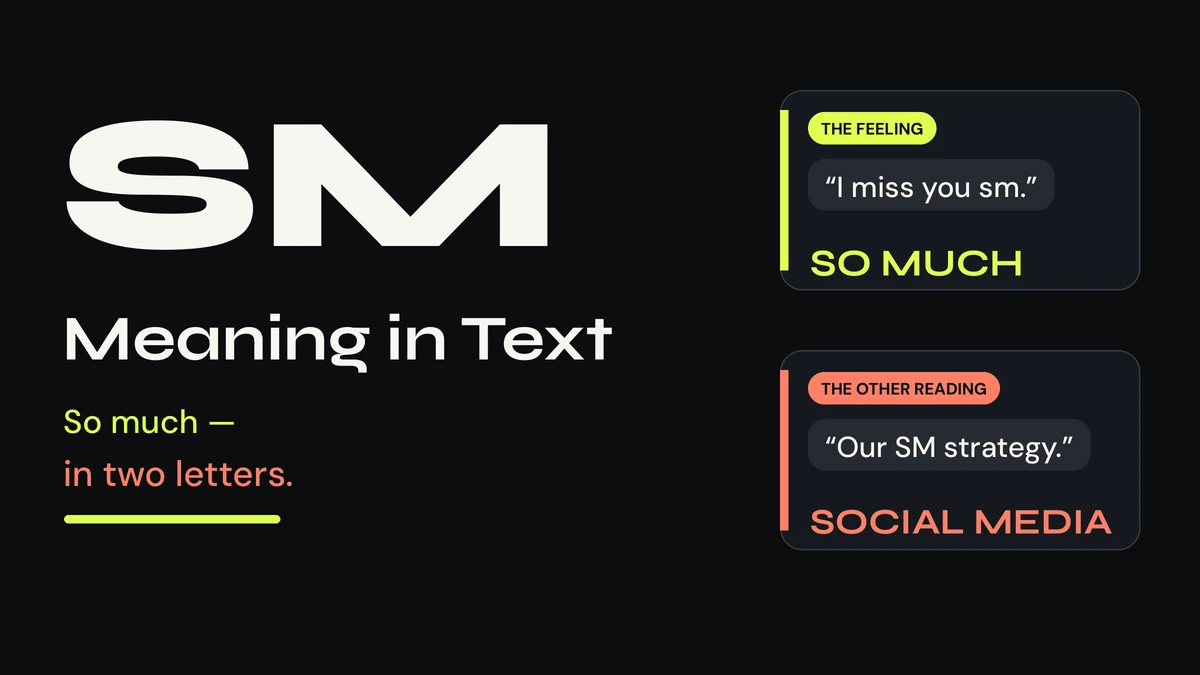
SM means “so much” in text. If someone writes “I miss you sm,” they mean “I miss you so much” — and that is the sm meaning in text in one sentence, and also the reason this guide starts with a test instead of a list, because the same two letters can mean something else entirely when the sentence around them changes. SM is an initialism, two letters standing in for two words, and in everyday personal texting it is almost always “so much.”
The strongest dictionary evidence agrees. Wiktionary lists English “sm” as an Internet slang and text messaging initialism of “so much,” and it backs the entry with dated citations from published books: “Omg, thank you. Thank you sm” in a 2019 short story, and “Miss you guys sm! XOXO” and “She used to hate when I texted her ILY SM!” in a 2020 novel. That is a dictionary entry with real printed usage behind it, not a guess from a slang site. Merriam-Webster, by contrast, has no texting sense for SM at all — its entry lists only small, samarium, master of science, sergeant major, service mark, stage manager, stationmaster, and sadomasochism. The gap is worth saying plainly: the biggest American dictionary has not caught up with the texting sense, and this guide reports the Wiktionary record rather than pretending the gap does not exist.
What SM does in a sentence is simpler than what it stands for. It is an intensifier. It takes a feeling that is already in the sentence — love, missing someone, thanks, annoyance, wanting something — and turns the volume up. “I love this sm” is “I love this” with the emphasis underlined. “This annoys me sm” is the same trick in the other direction: the abbreviation carries no feeling of its own, so it can strengthen affection in one message and irritation in the next. The verb supplies the emotion; SM supplies the degree. That is why the same two letters can sound warm, grateful, excited, or fed up, and why reading the rest of the sentence matters more than memorizing the expansion.
SM also has a favorite seat in the sentence, and the seat is a clue. In its “so much” reading it almost always sits at the end, right after a verb or a phrase that expresses a feeling: “miss you sm,” “thank you sm,” “love this sm,” “hate waiting sm.” It rarely opens a sentence, and it almost never stands in the middle of one as a subject. When SM shows up somewhere else — at the front of a sentence, in front of a noun, or inside a work discussion — that is the first sign that “so much” may not be the reading at all, and the Swap Test in the next section is built to catch exactly that.
Capitalization does not change the meaning. Lowercase “sm” is the most common form in casual messages, because it looks relaxed and matches the rest of a lowercase text. Uppercase “SM” means the same thing, and usually just looks more emphatic, the way “THANK YOU SM” reads louder than “thank you sm.” The spelling “s.m.” with periods shows up in some guides, but it is rare in real messages, and no dictionary lists it as a separate form. If the letters are S and M in that order, the reading comes from the sentence, never from the case.
The SM Swap Test
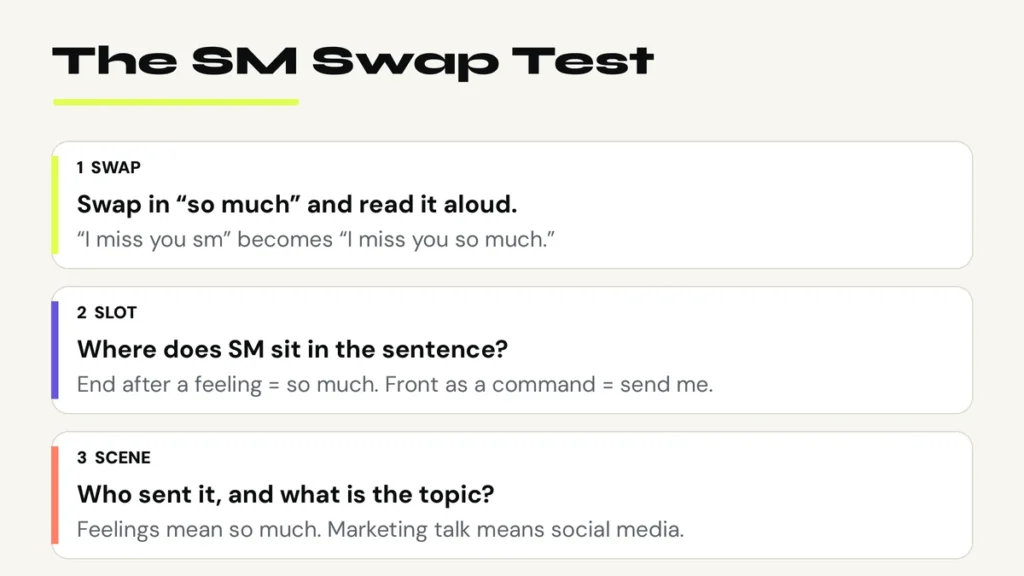
SM has more than one possible reading, so this guide does not ask you to memorize a list. It gives you a test with three checks — Swap, Slot, and Scene — and the three checks together settle almost every message in seconds. Run them in order, and stop at the first check that gives you a clear answer.
- Check 1 — Swap: replace SM with “so much” and read the sentence out loud. If the sentence still makes sense and sounds like something a person would say, SM means “so much.” “I miss you sm” becomes “I miss you so much,” which is perfect English. “Thank you sm” becomes “Thank you so much,” which is the phrase everyone already knows.
- Check 2 — Slot: look at where SM sits in the sentence. At the end, after a feeling verb, it is “so much.” At the front, before a noun, as a command — “SM the link,” “SM your address” — it is “send me,” because “so much the link” is not a sentence anyone would write. In a noun slot — “I need sm to eat” — it is “something,” because “I need so much to eat” means something different, and the writer needed a thing, not a degree.
- Check 3 — Scene: ask who sent the message and what the conversation is about. A friend, a crush, or a partner talking about feelings points to “so much.” A marketing chat, a work email, or a sentence full of words like strategy, team, post, or engagement points to “social media.” A conversation about sexuality or adult topics points to the sadomasochism reading, and only that conversation does.
Here is the test on the hardest ordinary case: “I love you sm.” Swap gives “I love you so much,” which is flawless. Slot agrees, because SM sits at the end after the feeling verb “love.” Scene agrees, because a partner or a close friend sent it. Three checks, one answer, no doubt left. Compare that with “Our SM strategy needs work.” Swap gives “Our so much strategy needs work,” which is nonsense, so Check 1 fails. Slot shows SM sitting before a noun, as a modifier, which “so much” never does. Scene finishes the job: a work conversation about strategy means “social media.” The test earns its keep precisely on messages like that one, where the letters are identical and only the sentence changes.
The one case where the test cannot decide is a bare “sm” on its own, with no sentence around it. “So much” needs a feeling to intensify, and a lone “sm” has none, so the Swap check has nothing to work on. In practice a bare “sm” is almost always a shortened reply to the message just above it — someone wrote “that was so fun” and the reply “sm” means “so much,” borrowing the feeling from the previous line. Read the message above it, run the Swap on that sentence, and if the meaning is still unclear, ask. One question beats a wrong guess, and nobody has ever been judged for asking what two letters mean.
When “SM” Does Not Mean “So Much”
“So much” is the default reading in personal texting, but it is not the only reading, and a guide that pretended otherwise would leave you stranded the first time SM showed up at work. Each of the other readings below is gated by its own context, and the gate is the point: none of them is a free-floating alternative you can pick at random. The sentence and the scene choose.
- Social media: in marketing, business, and professional conversations, SM commonly means “social media.” “Our SM team posts three times a day,” “Check the SM calendar before publishing,” “SM engagement dropped this week.” The topic words — strategy, team, post, engagement, calendar — are the giveaway, and the sender is usually a brand, a marketer, or a coworker, not a friend texting about feelings.
- Send me: in quick replies and gaming chats, SM can mean “send me,” as a command before a noun. “SM the link when you get it,” “SM your address for the delivery.” This reading only works when SM sits at the front of the sentence telling someone to do something; anywhere else, it does not fit. It is the least common of the everyday readings, and the Slot check is what catches it.
- Something: in very compressed casual writing, SM can stand for “something,” but only where “so much” fails the grammar test. “I need sm to eat” means “I need something to eat,” because “I need so much to eat” is a different sentence about quantity. This use is real but uncommon, and it needs a noun slot to work.
- Service mark, and small: Merriam-Webster lists both of these as standard senses of SM. A service mark is the legal cousin of a trademark, used in branding and legal writing: “This logo carries an SM, not a trademark.” Small is a clothing size, used in shopping and sizing contexts. Neither is texting slang, and neither will appear in a personal message unless the conversation is already about law or clothes.
- Sadomasochism: Merriam-Webster also lists sadomasochism as a sense of SM, and this is the one reading that needs handling with care. It belongs only to conversations that are already about sexuality or adult topics, and it should never be assumed from an ordinary message. “I love you sm” is “so much” — always, in a normal chat. Assuming the adult reading without contextual evidence is the single most common way to misread SM, and the Scene check exists to stop it.
- SM Entertainment: in K-pop conversation, SM can be the company SM Entertainment, behind groups like EXO, NCT, and Red Velvet. “SM just announced a new artist” is a proper noun, not an abbreviation, and it only reads that way inside a K-pop discussion. Outside one, it does not apply.
What ties these readings together is that SM is initials, and initials are reusable. The letters do not carry a meaning by themselves; the sentence lends them one. That is why this guide leads with a test instead of a list, and why the competitors that lead with a list — even the best of them — end up hedging every paragraph with “depending on context.” The context is not a footnote to the meaning. For SM, the context is the meaning.
“SM” in Real Chats
The examples below are illustrative, written for this guide to show how SM behaves in real conversations — not transcripts of real messages. Each one is followed by what it communicates, because the feeling is the part a dictionary cannot give you.
- “I miss you sm.” The classic SM message, and the one most people see first. It communicates longing, turned up. Without SM it is a fact; with SM it is a feeling that wants an answer.
- “Thank you sm for listening.” Gratitude with the emphasis on. The thanks is the message; SM is the underline. This is the sentence most likely to arrive after someone helped you through something, and it reads warmer than a bare “thanks” precisely because the writer took the extra two letters to mean it more.
- “I love this song sm.” Enthusiasm about a thing, not a person. SM turns a recommendation into a endorsement: not just “I like it,” but “I like it enough to tell you twice.”
- “You make me laugh sm.” Playful affection. The laugh is the feeling, SM is the volume, and the message lands as a compliment rather than a report.
- “I hate waiting sm.” The same intensifier in the other direction. Nothing about the letters is negative; the verb “hate” does that work. SM only makes the complaint louder, which is why the same abbreviation can sound loving in one chat and fed up in the next.
- “I want that jacket sm.” Desire, stated plainly. In a shopping chat this is a wish list in five words, and the SM is doing the work of an exclamation mark without the shouting.
- “ily sm, goodnight.” Two abbreviations stacked into one goodbye: “I love you so much.” The ILY guide covers the first half; SM is the second half, and together they are the most affectionate short message in this whole guide. Wiktionary lists the combined form ILYSM as its own entry, which is a good sign of how fixed this pairing has become.
Notice what the examples share: SM never carries the message alone. It always rides on a verb or a feeling that is already there. A message that is only “sm” has nothing to intensify, which is why it reads as a fragment, and a message where SM replaces a word it cannot replace — “SM the link” read as “so much” — reads as a mistake. The abbreviation is a volume knob, not a word of its own, and the chats above work because every one of them gives it something to turn up.
The SM Tone List
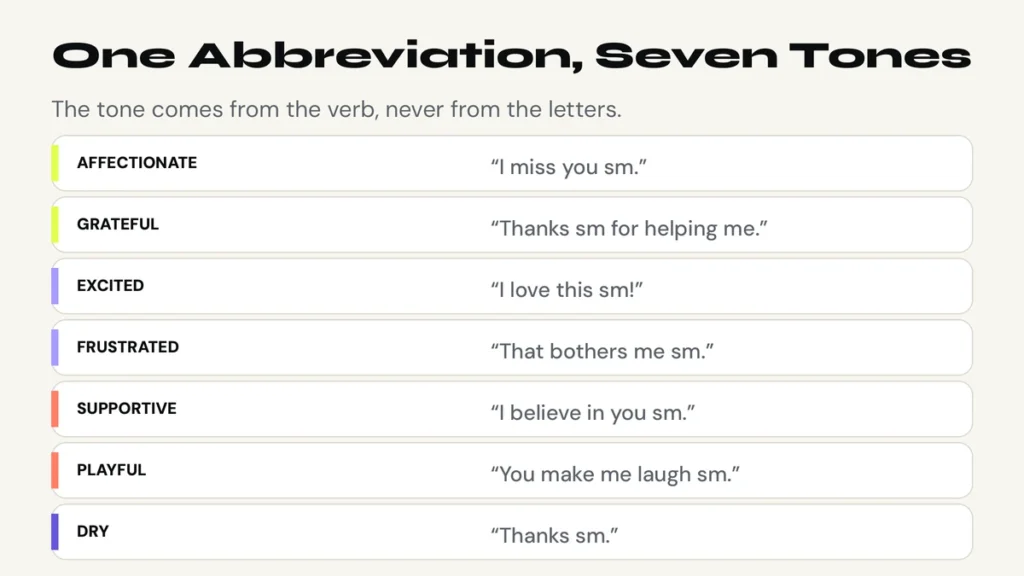
SM has one expansion in personal texting and seven tones, because the tone comes from the sentence, not the letters. Read the list as a decoder: find the feeling in the sentence, and you have found the tone of the SM attached to it.
- Affectionate: “I miss you sm.” Warm, close, and personal. The SM makes a short message feel like a longer one, because the feeling is doing the work that extra words would normally do.
- Grateful: “Thanks sm for helping me.” Appreciation with emphasis. This is the tone most likely to arrive after a favor, and it reads as sincere rather than formal — a thank-you note compressed into two letters.
- Excited: “I love this sm!” Desire or enthusiasm, turned up. The exclamation mark helps, but the SM is doing the same job on its own: this is not a mild like, it is a strong one.
- Frustrated: “That bothers me sm.” Annoyance, intensified. The same two letters that sound loving above sound irritated here, and the difference is entirely in the verb they follow.
- Supportive: “I believe in you sm.” Encouragement with weight behind it. This tone shows up before a test, a tryout, or a hard day, and the SM is the difference between a polite wish and a real one.
- Playful: “You make me laugh sm.” Light, teasing affection. The message is a joke and a compliment at the same time, and the SM keeps it casual enough that it never sounds heavy.
- Dry or rushed: “Thanks sm.” A quick, clipped reply. The meaning is still positive, but the lack of extra words can make it feel hurried or cool — and whether it actually sounds cold depends on the sender’s normal texting style, not on the abbreviation. A friend who always texts in fragments is not being distant; a friend who normally writes paragraphs might be.
Two habits make the tone list useful in real life. First, never read the tone off the abbreviation — read it off the verb, because “love sm” and “hate sm” are opposite messages wearing the same two letters. Second, remember that lowercase “sm” softens everything it touches, which is why even a frustrated “that bothers me sm” reads as a complaint between friends rather than a confrontation. The abbreviation is doing emotional work in every row of this list, and it is doing it quietly, which is the whole reason people reach for it.
“SM” on TikTok
On TikTok, SM means “so much,” and it shows up most often in comments, where the whole point is to react fast and publicly. “I love this creator sm,” “this song sm,” “need this sm” — the pattern is the same in every case: a strong reaction to a video, compressed into a comment that can be typed in two seconds. The FYP guide covers the feed where most of these comments land, and the connection is a practical one: the videos that collect “sm” comments are usually the ones the For You Page is pushing hardest, so the abbreviation travels with the platform’s fastest-moving content.
What TikTok changes is the frequency, not the meaning. Comments reward brevity, so SM appears more often here than in private messages, and it appears in front of strangers more often too — a commenter telling a creator they love a video “sm” is using the same warm intensifier a friend uses in a text, just in public. The “social media” reading does not apply here even though the platform is social media: a comment that says “love this sm” is about a feeling, not about marketing, and the Swap Test settles it instantly, because “love this so much” is a perfect sentence and “love this social media” is not.
“SM” on Snapchat
On Snapchat, SM means “so much,” usually in a private reply to a snap or a story. The trigger is almost always something visual: a photo, an outfit, a face, a place. “I love your hair sm,” “this place sm,” “miss this sm” — the snap supplies the thing being reacted to, and SM supplies the intensity, so the reply can stay short while still sounding warm. Because snaps disappear, the replies tend to be quick and unpolished, and lowercase “sm” fits that rhythm better than a full sentence would.
Snapchat is also the platform where the “send me” reading is most likely to appear, because snaps are things people ask each other to send. “SM the pic” in a Snapchat chat is a request, not an intensifier, and the Slot check is the only thing standing between the two readings: SM at the front of the sentence, before a noun, telling someone to do something. In a reply to a snap, though, the default is “so much,” and a reader who assumes “send me” from a compliment is making the rarer reading the default, which is the mistake the test exists to prevent.
“SM” on Instagram
On Instagram, SM means “so much,” most often in comments, captions, and story replies. “Love this photo sm,” “miss you sm,” “this outfit sm” — the post or the story provides the context, so the commenter can communicate strong approval with almost no words at all. The IG guide covers the shorthand the platform runs on, and SM sits comfortably inside it: a two-letter intensifier for a platform built on quick public reactions.
Instagram is the platform where the “social media” reading causes the most confusion, because the conversation is literally about social media. But the confusion dissolves on the Swap Test. A comment that says “love this sm” becomes “love this so much,” which is exactly what the commenter means. The “social media” reading only applies when the topic is marketing or the business of the platform itself — “our SM strategy,” “the SM team” — and those sentences look nothing like a comment under a photo. The platform does not choose the meaning; the sentence does, and on Instagram the sentence is almost always a feeling.
“SM” in Text Messages
In private text messages, SM means “so much,” and this is the clearest environment for that reading in the whole guide. There is no audience, no algorithm, and no marketing team — just two people, and usually two people who know each other well. “Thank you sm for listening,” “miss you sm already,” “I appreciate you sm” — the pattern is affection, gratitude, or longing, intensified by two letters, sent to someone who will understand it without thinking. The DM guide covers the one-to-one thread where these messages live, and the fit is natural: SM is a private abbreviation for private feelings, and it sounds most at home exactly here.
Texting is also where SM’s role as a relationship signal is easiest to see. A person who writes out “so much” in full to a client will write “sm” to a close friend, and the choice itself says something about the relationship: we are close enough that I can shorten this. That is why SM shows up most in messages between friends, partners, and family, and least in messages to strangers, bosses, or anyone the writer is trying to impress. The abbreviation is not only saving keystrokes. It is saying “we are casual with each other,” and that message is part of the meaning.
Who Is Sending It: How “SM” Lands by Sender
SM means “so much” whoever sends it, but it does not land the same way from everyone, because the relationship changes what the intensifier is intensifying. The sentence is the same; the weight is not.
- A close friend: “Miss you sm” reads as warmth and habit. Friends use SM the way they use any shorthand — as a sign that the conversation is easy and the understanding is mutual. The intensifier is doing emotional work, but it is low-stakes emotional work, and the right answer is usually a matching “miss you too” rather than a big response.
- A crush: “I like talking to you sm” reads as interest, turned up one notch. SM alone does not prove attraction — friends say the same sentence — but in a flirty conversation it is a small signal that the feeling is strong, and the safest reading is “they enjoy this a lot,” not “they are in love.”
- A partner: “I love you sm” reads as routine affection, and that is a compliment, not a criticism. In a long relationship, SM is the abbreviated form of a sentence that has been said a hundred times, and its brevity is the point: the feeling is so established that it fits in two letters.
- A parent or family member: “Thank you sm for today” from a parent reads as genuine gratitude in a casual register. Older relatives use SM less often, so when they do, it usually means they picked it up from the family group chat — and it is worth answering warmly rather than correcting.
- A coworker or boss: “Thanks sm” from a coworker is friendly but still casual, and it is a small signal about the working relationship: this person treats you as a colleague they are comfortable with, not as a formal contact. In a work thread, though, the same letters could mean “social media,” so the Scene check matters more here than anywhere else — read the topic before you read the abbreviation.
- A stranger or a creator: “Love this sm” from a stranger in a comment is a public compliment, not a personal one. The feeling is real, but it is aimed at the content, not at you, and it needs nothing more than a like or a brief thanks in return.
- A group chat: “You guys make me laugh sm” is a broadcast of good feeling to the whole room. SM works well here because it is fast, and group chats reward fast: the intensifier lets one message do the work of a paragraph, and nobody has to slow down to read it.
Checked Claims: Expansions That Do Not Hold Up
SM attracts invented expansions, because any two letters can stand for many phrases, and a guide that lists them all without grading them is not helping anyone. Each claim below was checked against Wiktionary, Merriam-Webster, and the full competitor guides, and graded on that evidence.
- “SM means smiling” — REJECTED. One low-quality guide claims SM stands for “smiling” or “so much,” as if the two were equals. No dictionary lists a “smiling” sense for SM, no major competitor repeats it, and no dated citation supports it. “Smiling” does not even fit the sentences SM appears in: “I miss you smiling” is not what anyone means. The claim fails every check, and this guide does not repeat it as a real reading.
- “SM means same” — REJECTED. One competitor lists “same” as a loose chat meaning, with no example and no source behind it. No dictionary lists it, no other guide repeats it, and “same” is already spelled out in full in every message where it appears. A single unsupported assertion is not evidence, and this guide treats it as a guess, not a meaning.
- “SM means sad moment” — REJECTED. One guide offers “sad moment” as a niche community reading, again with no citation and no example. The phrase “sad moment” has no documented abbreviation history, and the sentence test kills it: “I miss you sad moment” is not a sentence. Unsupported, and not carried forward.
- “SM means so much 90% of the time” — REJECTED as a number. One guide states, twice, that “so much” accounts for 90% or more of SM uses. No study, survey, or corpus is cited for the figure, and no other source repeats it. The qualitative claim — that “so much” is the most common reading in casual texting — is supported by every source in this guide. The number is invented, and this guide does not repeat it.
- “SM always means so much” — REJECTED. The opposite error. “So much” is the default in personal texting, but the work, marketing, legal, and adult readings above are real, documented senses of the same letters. A reader who assumes “so much” in a marketing email will misread “our SM strategy” completely. The Swap Test exists because “always” is wrong.
- “SM means social media on Instagram” — REJECTED. One competitor assigns meanings by platform, putting “social media” on some platforms and “so much” on others, as if the app chose the definition. The evidence points the other way: Instagram comments saying “love this sm” are “so much” by the Swap Test, and the “social media” reading follows the topic — marketing and business — not the app. Platforms change how often SM appears, not what it means.
- “SM has a documented first use” — UNVERIFIED. No source in this guide gives a first-use date, a first user, or an invention story for SM, and the most careful competitor says plainly that it has no single documented invention point. Wiktionary’s earliest dated citations are from published books in 2019 and 2020, which show the abbreviation was already natural by then — they do not show when it started. This guide claims no origin date, because none exists to claim.
- “SM is Gen Z slang” — UNGRADED, not claimed. Several guides call SM Gen Z slang, and it is certainly used by young people, but no source in this guide ties the abbreviation to one generation with evidence, and Wiktionary’s citations come from adult novelists writing about ordinary texting. SM belongs to the wider culture of compressed digital English, used across ages wherever people text quickly, and this guide does not fence it into one generation without proof.
“SM” vs Its Closest Cousins
SM is an intensifier, and its cousins are the other short forms that do emphasis work in a message. The differences are small, but they decide which abbreviation fits a sentence, and mixing them up is the most common small mistake readers make with SM.
- TYSM — “thank you so much.” TYSM is SM with the gratitude built in: it is a fixed phrase, and it only ever says thank you. SM is the flexible half of the same idea — it can intensify thanks, love, missing someone, or annoyance, while TYSM can only do the first one. Use TYSM when gratitude is the whole message; use SM when the feeling could be anything. No TextsMeaning article on TYSM exists yet, so it is named here, not linked.
- ILY and ILYSM — “I love you,” and “I love you so much.” ILYSM is the compound this guide keeps coming back to: ILY plus SM, love plus degree. The ILY guide covers the first half, and the difference between the two forms is the difference between saying you love someone and saying how much. Wiktionary lists ILYSM as its own entry, which is a good measure of how fixed the pairing is.
- FR — “for real.” The FR guide covers the cousin that stresses truth where SM stresses amount. “I love this fr” says “I really mean it”; “I love this sm” says “I mean it a lot.” They often appear in the same sentence for exactly that reason — one for sincerity, one for degree — and they stack neatly because they are doing different jobs.
- ISTG — “I swear to God.” The ISTG guide covers the cousin that stresses sincerity with an oath where SM stresses degree with two letters. “I miss you istg” is a promise; “I miss you sm” is a measurement. Both make a feeling louder, and the choice between them is the choice between swearing it is true and saying how much of it there is.
- RN — “right now.” The RN guide covers the cousin that answers a different question entirely. “I miss you sm” says how much; “I miss you rn” says when. One measures the feeling, the other times it, and the two stack easily in the same message because they never compete for the same job.
- VM — “very much.” VM is the nearest synonym SM has: “thank you very much” against “thank you sm.” The difference is currency — SM is the form people actually type in casual texting, while VM is rare enough that many readers would not recognize it. SM won the abbreviation, and VM is mostly a reminder that the same idea can be shortened two ways, only one of which caught on. No TextsMeaning article on VM exists yet, so it is named here, not linked.
- SMH — the look-alike, not a cousin. SMH is three letters, not two, and it means “shaking my head” — disappointment or disbelief, the opposite of what SM usually does. The two get confused because they share the first two letters and the same texting world, but they do opposite emotional work: SM turns a feeling up, SMH shakes its head at one. If the message has an H on the end, it is a different abbreviation entirely. No TextsMeaning article on SMH exists yet, so it is named here, not linked.
Where “SM” Came From
SM has no single documented invention point, and that is not a gap in this guide — it is the honest answer, and the most careful competitor in this guide says the same. SM was not coined, launched, or named by anyone. It emerged the way most texting abbreviations did: from the habit of shortening a common phrase by its initials, in a medium where typing was slow and space was short.
The medium that made it necessary was SMS, where early phones had numeric keypads and messages had character limits, and “so much” was a natural candidate for compression because it is one of the most repeated phrases in emotional conversation. “I miss you so much,” “thank you so much,” “I love this so much” — these are sentences people write every day, and a two-letter shortcut for the repeated ending saved effort on every one of them. Internet chatrooms and instant messaging kept the habit alive after the technical pressure eased, and smartphones finished the change: by the time the abbreviation was common, people were no longer shortening to save characters, they were shortening because the short form felt casual, fast, and right for the conversation.
The dated evidence fits that story without fixing a birthday. Wiktionary’s earliest citations for the slang sense come from published books in 2019 and 2020, where characters text “Thank you sm” and “Miss you guys sm” without any explanation — the writers expected their readers to already know what the letters meant. That tells us SM was already natural, unremarkable texting language by 2019. It does not tell us when it started, and no source in this guide claims to know. What the record does show is the abbreviation spreading the usual way: from fast private texting into comments, captions, and group chats, carried by the same platforms that carried every other abbreviation in this series, until “sm” stopped looking like a shortcut at all and started looking like a word.
How to Reply When Someone Sends “SM”
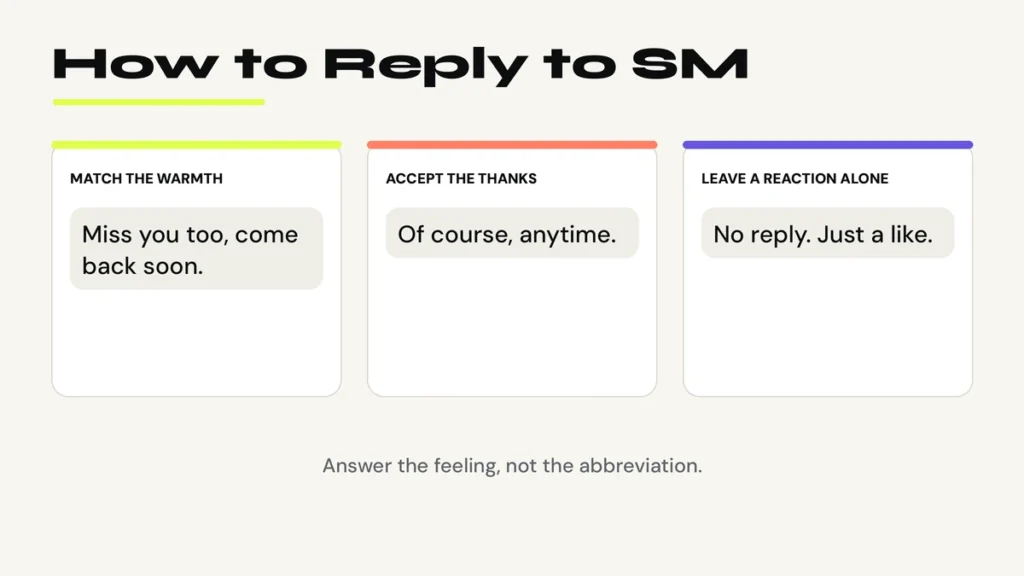
Reply to the feeling, not the abbreviation. SM is a volume knob on a sentence that already says what it means, so the right reply answers the sentence — the thanks, the missing, the love, the complaint — and lets the SM take care of itself.
- Match the warmth: “I miss you sm” deserves a warm answer, not a definition. “Miss you too, come back soon” answers the feeling and returns it, and it is the reply most senders were hoping for.
- Accept the thanks simply: “Thank you sm for helping” needs nothing grand. “Of course, anytime” or “You got it” accepts the gratitude and closes the exchange cleanly, without making a small thanks into a big production.
- Return the enthusiasm: “I love this song sm” is an invitation to agree. “Same, it has been on repeat all day” joins the feeling instead of commenting on it, and that is usually the point of sending it.
- Take a complaint seriously, briefly: “I hate waiting sm” is a frustration, not a joke. “I know, it is the worst” acknowledges it without escalating it, and the sender feels heard without the conversation turning into an argument.
- Ask a question back: when the conversation needs to keep going, a return question does the work. The HBU guide covers the classic version — “hbu?” — and it fits here because SM usually ends a statement rather than opening a discussion, so a question is the natural way to restart one.
- Leave it alone when it is a reaction: “love this sm” under a photo or a video often needs no reply at all beyond a like. Not every intensifier is a question, and answering a reaction with a paragraph is the one reply that can make a light message feel heavy.
The one reply to avoid is correcting the abbreviation. Nobody who writes “sm” needs to be told it stands for “so much,” and answering “you mean so much” reads as condescension, not helpfulness. The writer knows what they wrote. Answer the message they sent, and the abbreviation will have done its job.
Frequently Asked Questions
What does sm mean in a text message?
In a text message, sm almost always means “so much.” “I miss you sm” means “I miss you so much,” “thank you sm” means “thank you so much,” and the abbreviation is an intensifier: it makes the feeling in the sentence stronger. Wiktionary lists this as the English slang sense, with dated citations from published books in 2019 and 2020.
What does sm mean on TikTok?
On TikTok, sm means “so much,” usually in comments reacting to a video or a creator. “I love this creator sm” and “this song sm” are strong public reactions, typed fast. The meaning does not change by platform — the Swap Test settles it, because “love this so much” is a perfect sentence and “love this social media” is not.
Does sm mean “something”?
It can, but only where “so much” fails the grammar test. “I need sm to eat” most likely means “I need something to eat,” because the writer needed a thing, not a degree, and “I need so much to eat” means something different. This use is real but uncommon, and it needs a noun slot — SM standing where a thing would stand — to work.
Is sm rude or a bad word?
No. In its “so much” reading, SM is harmless and polite enough for any casual conversation, including messages to parents and family. The one sensitive reading is sadomasochism, which Merriam-Webster lists as a standard sense of SM, but that reading belongs only to conversations that are already about sexuality or adult topics. In an ordinary message, “I love you sm” is “so much,” and nothing else.
What does “ily sm” mean?
“Ily sm” means “I love you so much.” It stacks two abbreviations: ILY, “I love you,” and SM, “so much.” Wiktionary lists the combined form ILYSM as its own entry. It is one of the most affectionate short messages in texting, and it usually appears between partners or very close friends.
What does sm mean on Instagram?
On Instagram, sm means “so much,” most often in comments, captions, and story replies. “Love this photo sm” is strong approval of a post, expressed in two letters. The “social media” reading does not apply to comments like that, even though Instagram is social media — that reading belongs to marketing and business talk about the platform, not to reactions under a photo.
Does capital SM mean something different from lowercase sm?
No. Capitalization does not change what SM means. Lowercase “sm” is more common and looks more casual; uppercase “SM” can look more emphatic, especially in a fully capitalized message like “THANK YOU SM.” The reading always comes from the sentence around the letters, never from the case.
What does sm mean in a work email?
In a work email, SM most likely means “social media” or a job title such as “sales manager,” not “so much.” “Our SM strategy needs work” is about social media, and “Ask the SM before changing the schedule” is about a manager. The Scene check is what decides it: a professional topic and a professional sender point away from the texting sense. In formal writing, it is better to write the full phrase — “so much,” “social media,” or “sales manager” — than to use the abbreviation at all.
The Takeaway
SM is a small abbreviation with a simple job and a long list of impostors. In personal texting it means “so much” — an intensifier that takes a feeling already in the sentence and turns it up, so “I miss you sm” lands warmer than “I miss you” and “thank you sm” lands more grateful than “thanks.” The other readings are real, but each one is gated by its own context: a work conversation for “social media,” a command before a noun for “send me,” a noun slot for “something,” and an adult conversation for the one sensitive sense. The sentence chooses, every time.
Keep one habit from this guide, and it is the test, not the list. Swap “so much” into the sentence: if it fits, you have your answer. Check the slot SM sits in, and check the scene it arrived in, and the three checks together will settle almost every message in seconds. The abbreviation is only two letters, and the skill is only three questions — but a reader who can run them will never have to guess what “sm” means again.