What “SMH” Means in Text
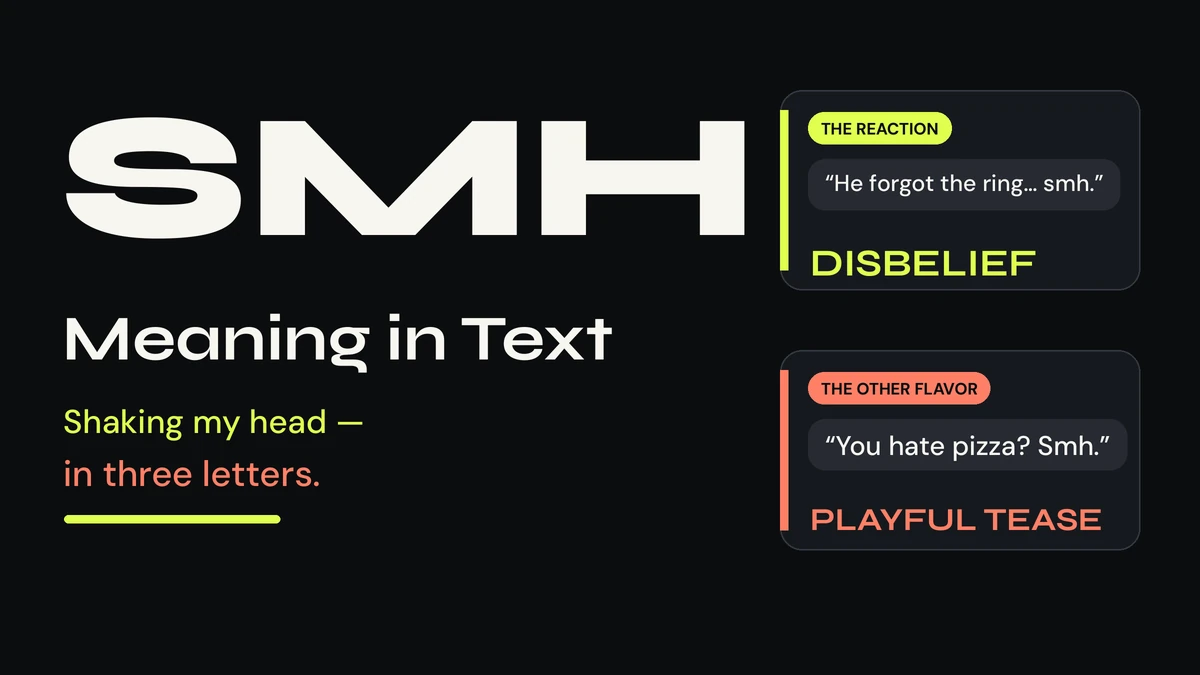
SMH means “shaking my head” in text. If someone writes “He forgot the ring at the wedding… smh,” they are shaking their head at him without typing out a whole lecture — and that is the smh meaning in text in one sentence: a typed head-shake for something disappointing, unbelievable, or just plain foolish. SMH is an initialism, three letters standing in for three words, and it is one of the oldest texting shortcuts still in daily use, older than most of the slang in this series and still going strong because the gesture behind it never goes out of style.
The dictionaries agree on SMH, which is itself worth noting, because the last article in this series found a real gap: Wiktionary lists the slang sense of SM while Merriam-Webster had none. For SMH there is no gap at all. Wiktionary lists SMH as an Internet slang initialism of “shaking my head,” used to convey disapproval. Merriam-Webster lists it as informal, “shaking my head — used to express disapproval, dismay, or disbelief,” and backs the entry with real citations from X, Reddit, and BlueSky, including one user writing “SMH $.25 tip? Nope.” Dictionary.com calls it an internet slang initialism “variously used to convey disappointment, disapproval, frustration, or impatience.” Three dictionaries, one meaning, no disagreement on the core. That is the first time in this series all three have lined up, and it means the opening answer above is not a guess from a slang site but the recorded definition.
What SMH does in a sentence is different from what most abbreviations in this series do. It is a reaction, not a piece of information. It points at something — something someone else did, something someone else said, or a situation that went wrong — and judges it with a gesture. The gesture is the whole meaning. Picture the real head-shake: slow, side to side, eyes half closed, the look of someone watching avoidable nonsense happen in real time. SMH types that look. It is not yelling, it is not laughing, and it is not a full opinion. It is the shortest possible way to say “I cannot believe this is happening” and leave it there.
SMH can also stand alone as a complete reply. A friend tells you the landlord said to wear a jacket because the heater has been broken for two weeks, and a single “SMH.” carries the whole response. It can sit at the end of a sentence, at the start of one, or in front of the news itself: “smh… My flight got cancelled and can’t be rebooked.” It can even work as a verb, as in “I’m smh because of his antics,” a use Dictionary.com records. Few abbreviations in this series bend that far grammatically, and the bending is a sign of how settled SMH is: people do not think about its letters anymore, they just reach for it the way they would reach for the gesture itself.
One small thing about capital letters, because every guide mentions it and most of them overstate it. Lowercase “smh” often reads softer and more playful, and ALL-CAPS “SMH” often reads heavier and more annoyed. That is a real tendency, not a rule. A lowercase “smh.” with a period after bad news is still disappointed, and an uppercase “SMH” between friends who roast each other is still a joke. Punctuation, emojis, and the history between the two people decide the temperature far more than the shift key does, and this guide grades the hard capitalization rule as an overclaim in the checked-claims section below.
The SMH Head-Shake Test
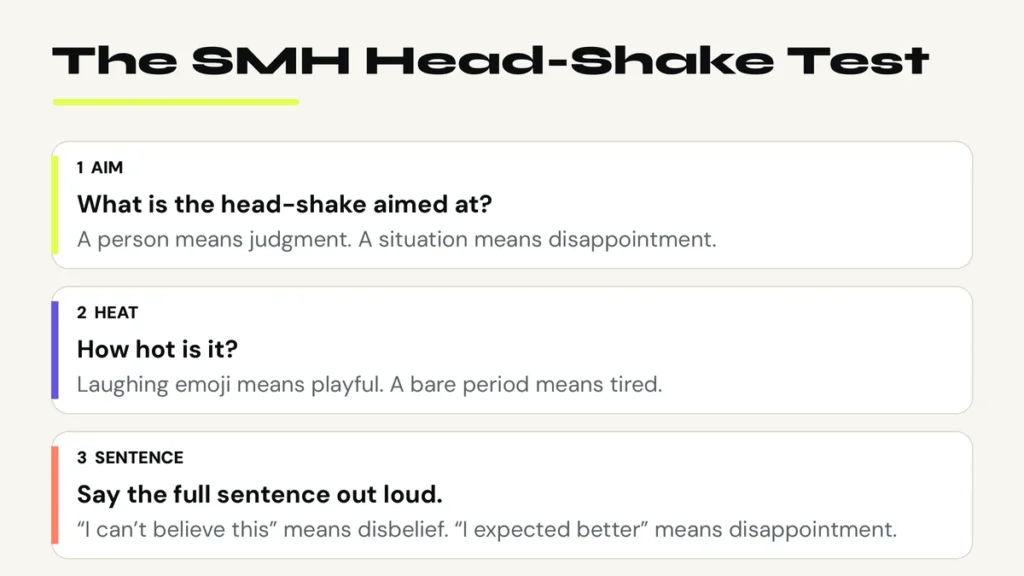
SMH is easy to define and hard to read, because the same three letters can mean “I am genuinely upset with you,” “I am disappointed in the world,” or “that was funny, you idiot, I love you.” The SMH Head-Shake Test sorts those out with three questions, asked in order. Stop at the first question that gives a clear answer, and if two questions disagree, trust the second one, because heat beats aim: a joke aimed at a person is still a joke, and a furious message aimed at a situation is still furious.
- Question 1 — AIM: what is the head-shake aimed at? A person who did something, a situation that went wrong, or the sender themselves. Aimed at a person, SMH is usually judgment. Aimed at a situation, it is usually disappointment. Aimed at the sender’s own mistake, it is usually self-directed frustration.
- Question 2 — HEAT: how hot is it? Lowercase with a laughing emoji, a joke threat, or an obvious roast means playful. A bare “smh.” with a period, no emoji, and no follow-up means tired or genuinely annoyed. ALL-CAPS with an exclamation means heated. Read the punctuation and the emoji before you read the letters.
- Question 3 — SENTENCE: say the full sentence out loud. Replace SMH with the sentence it stands in for. “I can’t believe this happened” means disbelief. “I expected better” means disappointment. “You’re joking, right?” means playful teasing. If none of those sentences fits, you are probably looking at one of the rare alternate readings in the next section.
Run it on a real example. “He really paid $500 for that broken phone smh.” Aim: the person who paid. Heat: lowercase, no emoji, no exclamation — flat, not playful. Sentence: “I can’t believe he paid $500 for a broken phone.” All three questions agree, and the answer is disbelief. The test earns its keep on the messages where the questions disagree, so here is one of those: “You put ketchup on steak?? smh we’re done here.” Aim: a friend’s taste, which sounds like judgment. Heat: lowercase, a joke threat (“we’re done here”), and a situation nobody ends a friendship over — playful. Sentence: “You’re joking, right?” The heat and the sentence overrule the aim, and the answer is playful exasperation between friends who roast each other.
One more, because disappointment is the flavor readers miss most often. “Team had a 20-point lead and lost in overtime. smh.” Aim: the situation, not a person — nobody on the team is being judged by name. Heat: a period, no emoji, no caps — flat and tired. Sentence: “I expected better.” That is disappointment, the sad flavor of SMH rather than the angry one, and answering it with a joke would land wrong while answering it with sympathy would land right. The test is the difference between those two replies.
The hardest case for the test is a bare “smh” alone, sent as a whole reply with nothing else attached. The test cannot decide it, because there is no sentence to run the questions on — the aim, the heat, and the full sentence all live in the message above it, the one SMH is answering. Read that message, run the three questions on it, and if it is still unclear, ask. “That smh — are you mad at me or just tired of today?” is a better move than guessing, because a wrong guess about SMH is a wrong guess about someone’s feelings.
When “SMH” Does Not Mean “Shaking My Head”
Almost always, SMH means shaking my head. Almost is doing real work in that sentence, because the dictionaries record a small set of alternate readings, and a few more show up in guides without dictionary backing. This section lists the documented ones first, then the ones that only exist in guides, so the reader can tell them apart.
- Scratching my head. Wiktionary lists this as a second sense, used to convey confusion or incredulity, and backs it with a 2015 citation from the book srsly Hamlet: “SMH. Who is going to be BURIED here?” It is rare, and it only fits when the sentence is a puzzle rather than a judgment — a mystery, not a mistake.
- So much hate. Wiktionary lists this too, marked usually hyperbolic, and Dictionary.com records it as a less common reading, showing or commenting on disdain. It lives almost entirely in fandom drama and comment-section arguments, and it is never the default reading of a bare SMH.
- The Sydney Morning Herald. Wiktionary lists SMH as the initialism of the Australian newspaper, and Dictionary.com warns readers not to confuse the internet slang with it. If the sentence is about Australian news, it is the newspaper, not the head-shake.
- The Society for Military History. Wiktionary lists this as well. Same rule as the newspaper: if the sentence is about historians, it is the society, not the slang.
- “Shake my head” instead of “shaking my head.” Some guides give the expansion as “shake my head” rather than “shaking my head.” That is not a different meaning, it is the same gesture in a different verb form, and the dictionaries standardize on “shaking my head.” Treat the two forms as one reading.
The practical rule is simple. Read the sentence first. If it describes something disappointing, unbelievable, or foolish, SMH means shaking my head, and no further thought is needed. Only if that reading makes no sense at all should the alternates come out — confusion points to scratching my head, fandom venom points to so much hate, and Australian news points to the newspaper. The next section shows the default reading doing its work in real chats.
“SMH” in Real Chats
The examples below are written for this guide, in the shape of real messages, so the reader can see the Head-Shake Test working instead of just reading about it. Each one names its flavor, because the flavor is the lesson.
- “Failed my test after studying 6 hours. SMH.” Disappointment, aimed at the situation. The sender did everything right and it still went wrong, and the head-shake is aimed at the unfairness of it, not at a person.
- “He really paid $500 for that broken phone smh.” Disbelief. The price is the giveaway: nobody in their right mind pays that, and the SMH is doing the work of a whole paragraph that starts “I cannot believe this.”
- “You don’t like pizza? Smh I can’t be friends with you.” Playful teasing. The threat is obviously a joke, the topic is obviously trivial, and the lowercase spelling is the tell that nobody is actually ending a friendship over pizza.
- “smh… My flight got cancelled and can’t be rebooked.” Disappointment that prefaces the news. SMH comes first here, setting the tone before the facts arrive, a pattern Dictionary.com records with this exact shape of sentence.
- “I’m smh because of his antics.” SMH used as a verb. The sender is not quoting a gesture, they are performing it grammatically, and the sentence only makes sense if SMH means the head-shake and nothing else.
- “She said the meeting was at 9 and showed up at 11 like nothing happened. smh.” Disbelief aimed at a person. The detail does the work — the lateness, the casualness — and SMH just stamps it.
- “You put ketchup on steak?? smh we’re done here.” Playful exasperation. The double question mark is excitement, not anger, and “we’re done here” is a roast, not a resignation.
Notice what the examples share. In every one of them, the message around SMH does the heavy lifting, and SMH itself adds only the temperature. Remove SMH from “He really paid $500 for that broken phone” and the sentence is still surprising. Remove it from “You don’t like pizza?” and the joke is still a joke. SMH is a seasoning, not the meal, which is why the Head-Shake Test starts with the aim and the heat instead of the letters.
The SMH Tone List
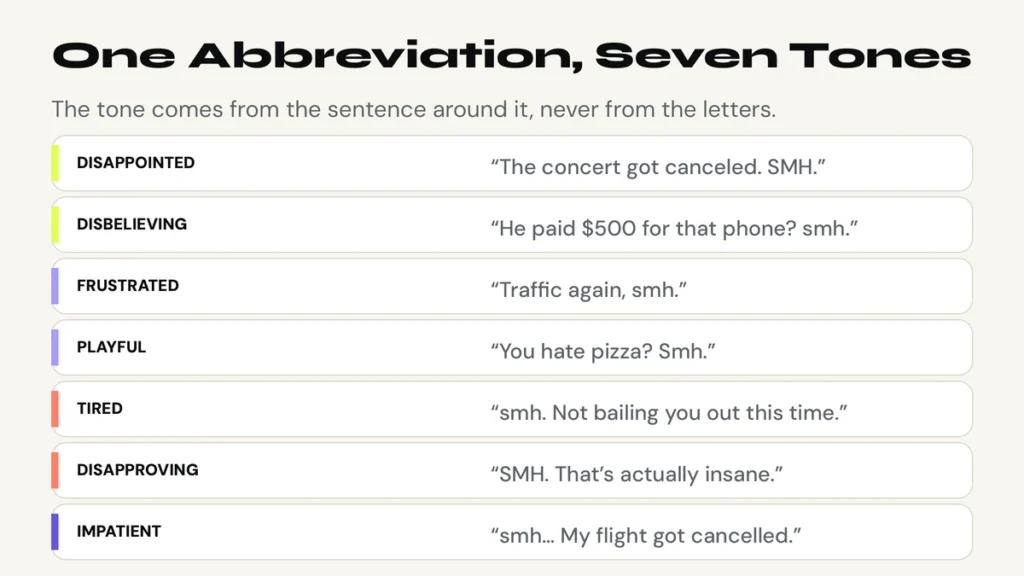
SMH wears seven tones, and the letters never change between them. Read the tone off the sentence around SMH, the punctuation, and the relationship — never off the three letters alone, because the same “smh” can be a laugh or a warning depending on what sits next to it.
- Disappointed. “I saved up for months and the concert got canceled. SMH.” Sad more than angry. Something had potential, someone had a chance, and it went sideways.
- Disbelieving. “Bro really argued with the GPS and got lost. SMH.” The “there is no way that just happened” version, for something so absurd the brain needs a second to process it.
- Frustrated. “Traffic added 40 minutes to my commute, smh.” Aimed at a situation that keeps happening, with the emphasis on “again” even when the word “again” is not there.
- Playful. “You brought store-bought cookies to the bake sale. SMH. Amateur.” A roast between friends, where the teasing is the point and nobody is actually in trouble.
- Tired. “smh. I’m not bailing you out this time, call the restaurant yourself.” The weary flavor, for the second time this month, when the sender has run out of patience but not out of affection.
- Disapproving. “SMH. That’s actually insane. Please tell me you’re reporting him.” The firm flavor, aimed at someone’s behavior rather than at bad luck, with the head-shake doing the judging.
- Impatient. “smh… My flight got cancelled and can’t be rebooked.” The “I have no words left for this” flavor, where SMH stands in for a rant the sender is too tired to type.
The tones overlap, and that is the point of listing them separately from the test: the test sorts disbelief from disappointment from playfulness, and the tone list gives the reader the vocabulary for the in-between cases, the tired SMH and the impatient SMH that are neither jokes nor fights. Two signals help more than any other. An emoji next to SMH almost always softens it, and a period after a bare SMH almost always hardens it. Everything else is context, and context is the message above it.
“SMH” on TikTok
On TikTok, SMH lives mostly in comments and captions, reacting to clips rather than to people the commenter knows. “POV: he texts ‘wyd’ at 2am smh” is the shape of it: a staged situation, a punchline, and a head-shake as the applause. The meaning is the same as everywhere else — shaking my head — but the stage makes it louder. A comment is a public performance of disapproval in front of strangers, where a text is a private reaction in front of one person, and TikTok comments reward the loudest version of the reaction.
That public stage is also why TikTok is the likeliest home of the playful flavor. A creator posts a video of a foolish decision, the comments fill with lowercase “smh” and laughing emojis, and nobody involved is actually angry. The FYP guide covers the feed those comments collect on, and the same rule applies there as here: the clip supplies the context, the comment supplies the temperature, and the platform supplies neither the meaning nor the feeling. SMH does not gain a TikTok-only definition, and no source in this guide claims one.
“SMH” on Snapchat
On Snapchat, SMH is usually a quick reply to a friend’s snap or story, and it is usually the softest version of itself. The setting is private, the audience is one person, and the message is often a reaction to something visual — a photo of a bad decision, a story about a long day — where the snap itself supplies the thing being reacted to. “Smh you and your 47-step routine, see you Sunday then” is the shape of it: a tease, a lowercase spelling, and a plan to meet anyway.
The disappearing context matters more on Snapchat than anywhere else. A snap vanishes, and with it goes the evidence of what SMH was answering, which is why a Snapchat SMH read days later can feel colder than it felt at the time. The meaning never changes — it is still shaking my head — but the reader loses the message above it, and the Head-Shake Test needs that message. If a Snapchat SMH feels harsh out of context, it is usually the missing snap, not the sender, that makes it feel that way.
“SMH” on Instagram
On Instagram, SMH shows up in comments on posts, in replies to stories, and in captions, often paired with the face-palm or eye-roll emoji. A post about a disappointing result collects “smh” comments the way a good photo collects hearts, and the comments are public in a way text messages never are. The hashtags “#smh” and “#smdh” are popular ways to tag exasperation on social media, according to Dictionary.com, and they turn the head-shake into a label other people can find and join.
Instagram is also where SMH is most likely to be aimed at a stranger. A celebrity does something foolish, a brand posts something tone-deaf, and the comments fill with head-shakes from people who have never met the person they are judging. That is still the same meaning — disappointment, disbelief, disapproval — aimed further away. The distance changes the stakes, not the definition: a stranger’s SMH is easier to ignore than a friend’s, and a public SMH is harder to take back than a private one, but neither one means anything different.
“SMH” in Text Messages
Private texting is the clearest home SMH has. There is no audience, no algorithm, and no performance, just one person reacting to another, and the relationship between the two does more work than the platform ever could. In a one-to-one thread, SMH is usually the whole reply — a friend tells you what happened, you send “smh,” and the conversation moves on with the understanding intact. The DM guide covers the thread itself, the private room where most texting SMH lives, and the same logic applies: the fewer people watching, the more honest the head-shake.
Texting is also where the two grammatical tricks from the opening section show up most. SMH prefaces the news, as in “smh… My flight got cancelled,” and SMH works as a verb, as in “I’m smh because of his antics.” Both patterns need a private thread to feel natural, because both assume the reader already knows the sender well enough to fill in the blanks. In a group chat the same patterns still work, but the audience is bigger and the risk of misreading is higher, which is why the sender section below matters: the same “smh” from a best friend and from a coworker is not the same message.
Who Is Sending It: How “SMH” Lands by Sender
The meaning of SMH does not change with the sender. What changes is how it lands, how much it stings, and how much room the reader has to laugh it off. The sender is the second question of the Head-Shake Test for a reason: the aim tells you what is being judged, and the sender tells you how seriously to take the judgment.
- Close friend. The safest SMH there is. Usually playful or tired, almost never a real threat to the friendship, and the lowercase spelling is doing the work of saying “I’m teasing you.” A friend’s “smh” after your bad decision is closer to a hug than a lecture.
- Crush. The most over-read SMH in texting. A crush’s “smh” after your joke is usually flirtation wearing a head-shake — the teasing tone is doing the real talking — but a dry “smh.” after you cancel plans is annoyance, and the period is the tell. Decode the conversation around it, not the acronym.
- Partner. Usually tired rather than angry, and usually about something small: a forgotten chore, a repeated habit, a plan gone sideways. A partner’s SMH is shorthand built on shared history, and it rarely needs a reply longer than an apology or a joke.
- Parent or family. Genuine disappointment in a casual register, and rarer than a friend’s, which is why it lands heavier. A parent’s SMH means “I expected better from you,” and it deserves a real answer rather than a deflection.
- Coworker. Friendly but risky, because work threads keep receipts. A coworker you are actually friends with can send a playful SMH in a private message; the same SMH in a group channel reads as dismissive, and in writing that might get forwarded it reads as unprofessional.
- Stranger or creator. Public judgment aimed at content, not at the reader, and the easiest SMH to ignore. A stranger’s head-shake about a post says more about the stranger’s taste than about the post, and it costs nothing to scroll past.
- Group chat. Broadcast disapproval, aimed at whoever just spoke, and performed for the rest of the room. A group-chat SMH is the loudest version of the reaction, because the sender knows everyone is watching, and it is also the version most likely to be bait rather than a real feeling.
Gender does not change the meaning. Whether SMH comes from a girl, a guy, or a group chat, it still signals disappointment or disbelief about something said or done, and the real difference is tone and context. If a close friend sends “smh” with a laughing emoji, they are probably teasing. If someone sends a cold “SMH.” after an argument, they are probably showing real frustration. That is the same answer every careful guide gives, and it is the answer this guide gives too: don’t decode the acronym, decode the conversation around it.
Checked Claims: Expansions That Do Not Hold Up
SMH attracts confident claims, and several of them fall apart when checked against the dictionaries. Eight claims are graded here against Wiktionary, Merriam-Webster, and Dictionary.com, plus the two full competitor reads. A claim graded REJECTED is not repeated anywhere else in this article as if it were true.
- “SMH lives in text 99% of the time” — REJECTED as a number. One competitor states this flatly, with no study, survey, or corpus behind it. SMH is certainly mostly a typed thing, but “99%” is a made-up precision, and this guide does not repeat it.
- “The apology reply works 70% of the time” — REJECTED as a number. The same competitor claims the apology is the correct answer “about 70% of the time.” No study supports the number. The advice itself — own it when you earned it — is sound; the percentage is invented and is not repeated.
- “SMH dates to the early 1990s” — UNVERIFIED, and the conflict resolves against it. One guide attributes early-1990s origins to Merriam-Webster’s citation records, but Merriam-Webster’s own SMH entry gives no date at all. Dictionary.com, the more careful source on dating, says the initialism emerges by the 2000s, was first entered on Urban Dictionary in 2004, and spread on Twitter by 2007. This guide reports the documented milestones and claims no 1990s origin.
- “SMH means so much hype” — REJECTED. One guide lists “so much hype” as a less common alternate reading. No dictionary lists it, no other guide corroborates it, and no example sentence supports it. It is not repeated as a real reading anywhere in this article.
- “SMH is Gen Z slang” — UNGRADED, not claimed. No source ties SMH to one generation with evidence. The documented timeline — a 2004 Urban Dictionary entry, a 2007 Twitter spread, 2010s explainer articles — predates Gen Z’s texting years, and the guides that discuss generations agree the same SMH can be teasing between friends or genuinely annoyed depending on who sent it, not on how old they are.
- “Capital SMH always means real anger, and lowercase smh always means playful” — REJECTED as a rule. Capitalization is a tendency, not a rule, and the guides that state it as a rule admit in the next sentence that it only “holds up surprisingly often.” Punctuation, emojis, and the history between the two people decide the temperature, and a lowercase “smh.” after bad news is still disappointed.
- “SMH always means shaking my head” — REJECTED. The default reading is shaking my head, and it is the right guess almost every time, but Wiktionary documents “scratching my head” for confusion and “so much hate” for disdain, and Dictionary.com records both. “Always” is the word that fails, not the meaning.
- “SMH means shake my head, not shaking my head” — GRADED as a variant, not wrong. One competitor gives the expansion as “Shake My Head.” The dictionaries standardize on “shaking my head,” and this guide uses that form, but the two forms name the same gesture with the same meaning, and correcting one to the other is pedantry, not fact-checking.
No frequency or dominance claim in this guide is stated as a percentage, because no frequency study of SMH exists in the sources read for this article. “Most common,” “rare,” and “almost always” are qualitative judgments backed by dictionary agreement and competitor consensus, and they are labeled as such wherever they appear.
“SMH” vs Its Closest Cousins
SMH is a reaction to someone or something else, and that direction is the key to telling it apart from its cousins. If the feeling is aimed outward at a letdown, it is SMH. If it points anywhere else — inward, at the truth, at a joke — it is something else, and this section names the difference for each one.
- SM — “so much.” Two letters, an intensifier on a feeling: “I miss you sm” means “I miss you so much.” SM turns the volume up on a feeling that is already in the sentence; SMH reacts to a letdown with a gesture. The two are the easiest pair in the series to confuse, because they share two letters and a texting home, and the last article in this series named SMH exactly once, unlinked, as a confusion warning — this guide returns the favor properly, with the SM guide linked, because SM is published and the link is now correct.
- FML — “f*** my life.” Self-directed misery: something bad happened to the sender. SMH is other-directed: something foolish happened around the sender. Failed your own test, FML. Watched your friend fail after not studying, SMH. The FML guide covers the self-directed side.
- ICK — “ick.” Disgust and repulsion at something gross, creepy, or off-putting. SMH is disappointment at something foolish or unbelievable, not disgust at something revolting. A bad date gives you the ick; a date who argues with the GPS gives you SMH. The ICK guide covers the disgust reaction.
- FR — “for real.” A truth flag: it confirms that something is true or serious. SMH judges what is true rather than confirming it. “FR, he really did that” says it happened; “He really did that, smh” says it should not have. The FR guide covers the confirmation.
- ISTG — “I swear to God.” An oath about sincerity: the sender swears the claim is true. SMH reacts without swearing anything, and the two do different jobs in the same conversation — ISTG insists, SMH judges. The ISTG guide covers the oath.
- SMDH — “shaking my damn head.” The same head-shake with the volume turned up. The extra word adds genuine irritation, and it is pulled out when SMH feels too soft for what just happened. Someone double-parks you, SMH. Someone double-parks you and then flips you off, SMDH. Not a different meaning, a louder one.
- SMFH — “shaking my f***ing head.” The same head-shake at full volume, fully fed up, and the one cousin that needs a warning attached: close friends only, never at work, never to a stranger. It hits hard because it breaks the casual rhythm of normal texting, and when someone drops it, they are actually upset.
The short version, borrowed from the main competitor’s cleanest line and credited here in plain text because it is theirs: FML is about your pain, TBH and NGL are about your honesty, and SMH is about everyone else’s nonsense. The direction of the feeling is the test that never fails: inward is FML, outward is SMH.
Where “SMH” Came From
As with a lot of internet slang, the exact origins of SMH are unclear, and this guide does not pretend otherwise. Dictionary.com, the most careful source on dating, says the initialism emerges by the 2000s as a way of marking tone in text messages and online, and gives the documented milestones: SMH was first entered on Urban Dictionary in 2004, and it spread on Twitter by 2007. During the 2010s, publications like Vice and Bustle dedicated articles to deciphering SMH for readers, evidence of its rise into popular use, and a now-defunct website, SMHMeansWhat, was launched in 2015 giving examples in text form and in GIFs of people shaking their heads. Since then SMH has become common enough for publications to use it unexplained in headlines.
Dictionary.com also records that the slang may have been an innovation of Black internet users, as early and notable uses are prevalent among Black speech communities, and that SMH is very frequently used in diverse forms of digital communication, especially in Black internet communities. That origin note is reported here because the dictionary records it, not as a claim this guide can independently verify, and it is part of why SMH reads as older and more settled than most slang in this series: it did not arrive with a single app or a single generation, it spread through forums, chatrooms, and early Twitter before most current platforms existed.
Why did it survive for two decades while most early-2000s slang died off? Because the gesture is universal. Every culture has a head-shake for disbelief, and the acronym gave that gesture a keyboard. Chat rooms and instant messaging rewarded shortening a constantly repeated reaction, SMS kept the habit, and Twitter turned it into a public reaction in front of strangers. The head-shake never needed an update, so the abbreviation never needed one either. No first-use date is claimed anywhere in this article beyond the documented milestones above, and the early-1990s claim is graded in the checked-claims section rather than repeated.
How to Reply When Someone Sends “SMH”
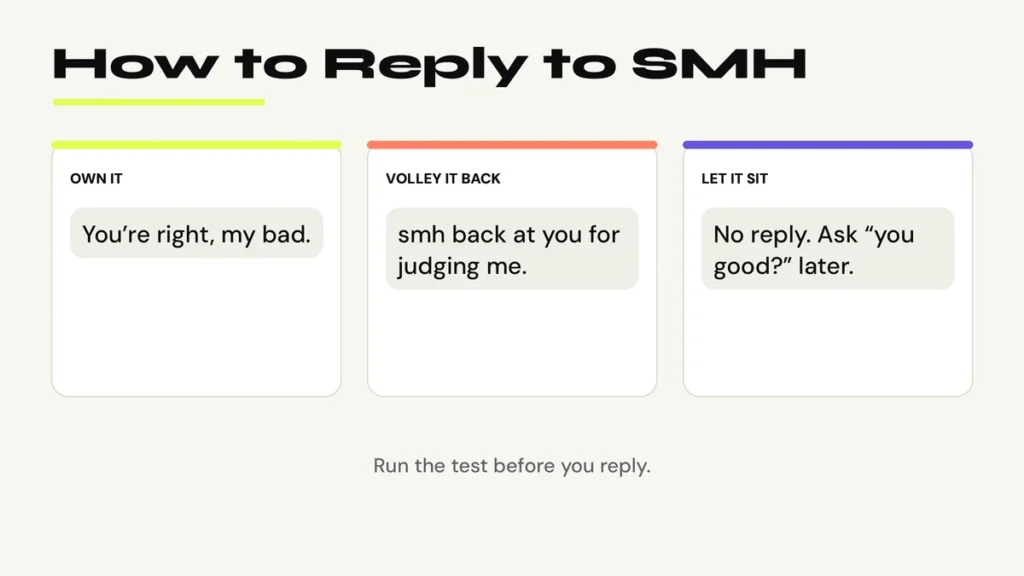
Getting hit with an SMH puts the reader in an odd spot. It is not quite an insult and not quite a joke — it is a judgment with the volume left ambiguous. The reply depends on two things: whether the SMH was earned, and how hot it is. Four strategies cover basically every situation, and the reply bank below them gives the exact words.
Own it, when you earned it. The SMH was fair, you know it, and the sender is waiting for acknowledgment rather than a defense. A quick “you’re right, my bad” or “yeah fair, I messed up” defuses it instantly, because people send SMH hoping to be heard, not hoping for a courtroom argument. Do not over-explain and do not get defensive; the moment passes faster when it is owned.
Volley it back, when it was playful. The SMH was a roast, everyone is laughing, and the right move is to keep the bit going. “Smh back at you for judging me” or “wow, shaking YOUR head at ME? Bold” matches the energy. If they sent lowercase “smh” with an emoji, you are almost certainly in joke territory — stay there, because nothing kills a fun group chat faster than answering a roast with a sincere paragraph.
Push back calmly, when it was unfair. Sometimes the SMH is not earned: the sender does not have the full story, or they are being dramatic about something minor. A calm “okay, that’s a bit much — here’s what actually happened” is completely fair. Keep it light but firm; the goal is correcting the record, not starting a fight. If they double down with another SMH instead of engaging, that is information too: they are not looking for a discussion, they are looking for a reaction, and the best move is not to give them one.
Let it sit, when it is bait or already over. If someone drops an SMH in a group chat about something trivial, or the conversation has already moved on, silence reads as confidence. Not every head-shake needs a response. The one exception is someone you actually care about, where the SMH felt heavy: a quick “you good?” later goes a long way, and it costs nothing.
- “You’re right, my bad.” The earned SMH, owned in five words. The single most useful reply in this guide.
- “Yeah fair, I messed up.” The earned SMH, owned warmly. Use it when the relationship matters more than the point.
- “smh back at you for judging me.” The playful volley, for the roast that was never serious.
- “Okay, that’s a bit much — here’s what actually happened.” The calm pushback, for the SMH that was not earned.
- “You good?” The later check-in, for the SMH that felt heavy and the person who matters.
- “mhm.” The flat acknowledgment, for the SMH that needs no fixing and no joke — just a sign that the message was read. The MHM guide covers the sound of agreement itself.
The mistake to avoid is answering the wrong flavor. A joke answered with a sincere paragraph kills the fun, and a real complaint answered with a joke reads as dismissal. Run the Head-Shake Test before replying: aim, heat, sentence. Ten seconds of reading saves a conversation.
Frequently Asked Questions
What does SMH mean in a text message?
SMH means “shaking my head” in a text message. People use it to show disbelief, disappointment, disapproval, or frustration about something someone said or did, without writing out a full reaction. It can stand alone as a whole reply, sit at the end of a sentence, or come first to set the tone before the news arrives.
What does SMH mean on TikTok?
The same thing it means everywhere: “shaking my head.” On TikTok it usually appears in comments and captions reacting to a clip, often with a humorous edge, because the platform rewards the loudest version of the reaction. The platform changes the packaging, not the meaning.
Is SMH rude or a bad word?
SMH itself is not a bad word, and it is not automatically rude. Playful SMH between friends is about as rude as a friendly eye-roll, which is to say not rude at all. But SMH can sting when it is aimed at someone with real frustration behind it, especially from a stranger or in a heated argument, where it reads as dismissive. Its stronger cousins are a different story: SMDH adds “damn,” and SMFH adds a fully profane word, so both read as more intense and belong only with close friends.
What does “smh” mean from a girl?
It means the same thing it means from anyone: shaking my head. The letters do not change based on who is typing them. What changes is the context. If she sends “smh you’re so dumb” after you say something goofy, that is flirty, and the teasing tone is doing the real talking. If she sends a dry “smh.” with a period after you cancel plans for the second time, she is annoyed, and the SMH is the polite version of what she is actually thinking. Decode the conversation around it, not the acronym.
Can I use SMH in a work email?
No. SMH is far too informal for anything work-related — it reads as flippant at best and disrespectful at worst, and email strips away the tonal cues that make it playful in texts. If the same energy is needed in a professional setting, “That’s disappointing to hear,” “I’m surprised by this outcome,” or “This is concerning” carry the head-shake sentiment without the risk. Save SMH for private messages with coworkers who are actually friends, and even then think twice before putting it in writing anywhere a manager might see it.
What is the difference between SMH and SMDH?
SMH means “shaking my head” and SMDH means “shaking my damn head.” They are used the same way, with the same gesture and the same range of flavors, but SMDH signals stronger frustration. Use SMH in almost any casual setting and save SMDH for moments when SMH feels too soft for what just happened.
Does SMH mean “so much hate”?
Rarely, and never by default. Wiktionary lists “so much hate” as a sense of SMH, marked usually hyperbolic, and Dictionary.com records it as a less common reading, showing or commenting on disdain. It lives almost entirely in fandom drama and comment-section arguments. If you see SMH without other context, assume “shaking my head” unless the sentence clearly does not fit.
Does capital SMH mean something different from lowercase smh?
No, not as a rule. Capital letters can add emphasis, but they do not create a separate definition, and lowercase “smh” and uppercase “SMH” normally mean the same thing. Lowercase tends to read softer and more playful, and ALL-CAPS tends to read more annoyed, but punctuation, emojis, and the relationship between the two people decide the temperature far more than the shift key does.
The Takeaway
SMH means “shaking my head,” and it is the internet’s shorthand for the oldest reaction there is: watching something foolish happen and shaking your head at it. It has been around since the early days of forums and chatrooms, it survived the move from SMS to Twitter to every platform since, and it settled into dictionaries with all three major references agreeing on the definition — the first time in this series that has happened. It means disbelief when something makes no sense, disappointment when something had potential and went sideways, and playful exasperation when a friend does something silly enough to deserve a roast.
The next time SMH lands in your messages, run the Head-Shake Test before you answer it. Ask what the head-shake is aimed at, how hot it is, and what the full sentence would be if it were written out. Disbelief gets a “wait, really?” and a question. Disappointment gets sympathy or an apology. Playfulness gets the joke volleyed straight back. The three letters never change, but the temperature always does, and reading the temperature is the whole skill. That is the smh meaning in text, and it is the only reading you will need almost every time you see it.