What “TTYL” Means in Text
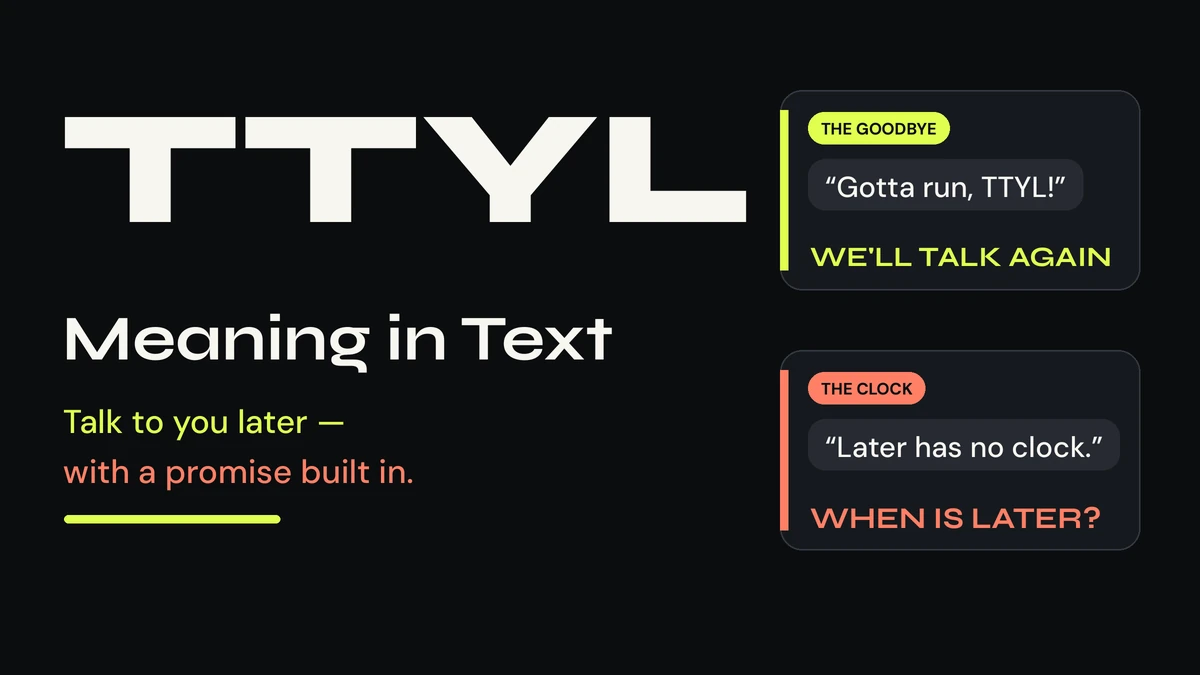
TTYL means “talk to you later” in text. When a friend ends a chat with “Gotta run, TTYL!” they are saying one thing: we will talk again, just not right now — and that is the ttyl meaning in text in one sentence: four letters that close a conversation without closing the door on it. TTYL is an initialism, four letters standing in for four words, and it is one of the oldest abbreviations in texting, because it does a job almost no other abbreviation does: it says goodbye and promises a hello at the same time, with the timing left deliberately loose.
The dictionaries agree about TTYL in a way they did not agree about every term in this series. Wiktionary has a page for “TTYL,” and it lists the reading directly: “(Internet slang, text messaging) Initialism of talk to you later,” with TTY, TTYS, and TTYA named beside it as related terms. The Oxford Advanced Learner’s Dictionary lists TTYL as an informal abbreviation meaning “talk to you later,” used when ending a message to somebody on social media, with the example “OK, I’ve gotta fly. Bye. TTYL.” Merriam-Webster says TTYL was “popularized in Internet chat forums” and is “one of a host of abbreviations that sprang into widespread use in the 1980s and 1990s.” And the Oxford English Dictionary added TTYL in 2016, alongside other internet initialisms including SMH and TBH — a dictionary milestone this series has now seen twice, and one TTY never got at all, because no major dictionary dates the texting sense of TTY the way the OED dates TTYL.
What TTYL does in a sentence is different from what most abbreviations in this series do. It is not a request aimed at the other person, like a nudge for a reply, and it is not a label on the sentence itself, like an honesty marker. It is a sign-off with a clock built in — except the clock is broken on purpose. “Later” is the whole point of the abbreviation and also its whole problem: it promises a next conversation without promising when. TTY, its three-letter parent, promises to talk again with no time word at all. TTYL adds exactly one word, “later,” and that one word is doing all the work: it tells the reader the conversation is pausing, not ending, and it refuses to say whether the pause lasts an hour or a week.
That refusal is why TTYL survives. A goodbye that named a time would be a plan, and a plan can be broken. TTYL is not a plan. It is a wave with a promise attached, and the promise is vague enough that nobody has to keep it on a schedule. The reader’s real question is almost never “what do the letters stand for” — that takes four seconds to learn — it is “how long is ‘later,’ and do they actually mean it?” This guide answers the second question, not just the first, and the tool for it is the Later Test in the next section.
The TTYL Later Test
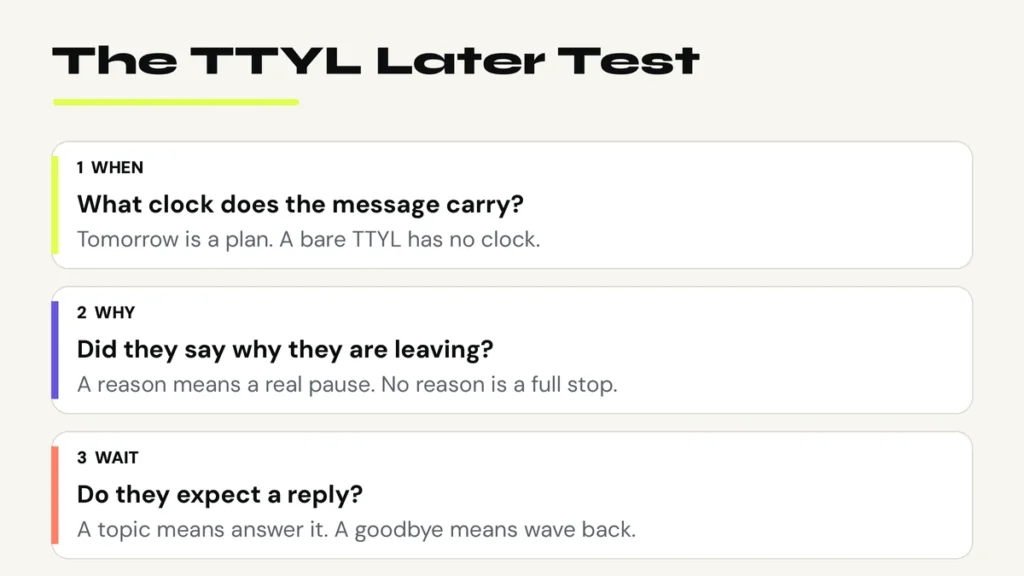
TTYL is easy to decode and hard to read. The letters always mean “talk to you later,” but “later” can mean tonight, tomorrow, next week, or never — and the difference between those four is the difference between a pause and a polite ending. The TTYL Later Test pins the “later” down with three questions, asked in order, stopping at the first clear answer. If two questions disagree, trust Question 1, because the clock the sender put on the message beats the reason they gave for leaving.
- Question 1 — WHEN: what clock does the message carry? Look for the time word. A bare “TTYL” carries no clock at all. “TTYL later” is the default, vague by design. “TTYL tonight” or “TTYL tomorrow” names the day. TTYS tightens the clock to “soon,” and TTYT names the day outright. The tighter the clock, the more real the promise.
- Question 2 — WHY: did they say why they are leaving? A reason means a real pause: “Gotta run, the kids are calling. TTYL!” is a person with somewhere to be. No reason at all — a bare “TTYL” after a long silence — is the shape a polite ending takes. A reason is evidence; its absence is also evidence.
- Question 3 — WAIT: do they expect a reply, or is the chat over until they come back? TTYL usually closes the conversation for now, and no reply is expected. But “I’ll ttyl about it” is not a goodbye at all — it is a promise about a topic, and it does expect a next message, just later. If the sentence has a topic in it, the test answers differently.
Worked case one: “Gotta run, the kids are calling. TTYL!” All three questions agree. The clock is vague (“later”), the reason is real (the kids are calling), and no reply is expected. That is a pause, not an end — the conversation will pick up when the sender is free, and the honest reply is a wave back: “No worries, ttyl!”
Worked case two: “Sure, I’ll ttyl about it.” Question 3 overrules the first two. There is no clock and no reason, but the sentence has a topic — “about it” — and that turns TTYL from a goodbye into a promise about something specific. Reply to the topic, not to the goodbye: “Sounds good, let me know what they say.” If you answer it like a goodbye, the conversation stalls on a question nobody asked.
Worked case three: a bare “ttyl” alone, after you sent a long message that got no real answer. Question 1 finds no clock. Question 2 finds no reason. Question 3 finds no topic. The test can narrow it to a sign-off, but it cannot tell you when the sender will be back, because there is nothing to run the questions on. That is a wave with no date attached, and the honest reading is the cautious one: the conversation is over for now, and the next message, if there is one, will come from them. Do not chase a bare “ttyl” with three more messages. The hardest case in this guide is also the most common one, and the test is honest about what it cannot do: it sorts the promise from the ending, but it cannot invent a clock the sender never gave you.
“TTYL” in Real Chats
The examples below are written for this guide, in the shape of real messages, so you can see how TTYL actually lands in a thread. Each one shows a different job the abbreviation does — a pause, a plan, a topic promise, a warm close, a brush-off — and the reply each one earns. Read them as a set, and the pattern appears: TTYL almost always arrives with a reason, a time word, or a topic, and whichever of the three it carries is the part that decides the reply.
- The errand pause: “Gotta run, the kids are calling. TTYL!” — The classic TTYL. A real reason, a vague clock, no reply expected. Reply: “No worries, ttyl!”
- The bedtime close: “I have to get to sleep early for my morning meeting. TTYL!” — The clock is hidden in the reason: “later” means tomorrow. Reply: “Sleep well, ttyl tomorrow!”
- The topic promise: “Sure, I’ll ttyl about it.” — Not a goodbye. A promise to come back to a subject. Reply to the subject: “Sounds good, let me know.”
- The warm close: “TTYL, miss you!” — The abbreviation carries feeling, not just logistics. “Later” here is soon, and the reply should carry feeling back: “Miss you too, ttyl!”
- The travel goodbye: “I’ll have to ttyl, the plane’s about to board.” — The reason is a hard stop, and the clock is however long the flight is. Reply: “Safe flight, ttyl!”
- The phone-dying exit: “My phone’s about to die. I’ll TTYL.” — A practical TTYL, and one of the few where the sender is telling you why they cannot keep talking. Reply: “Go charge it, ttyl!”
- The bare wave: “Okay, ttyl.” — No reason, no clock, no topic. The shortest TTYL is also the coldest, and the reply is the shortest one that still works: “Okay, ttyl.”
The TTYL Tone Scale
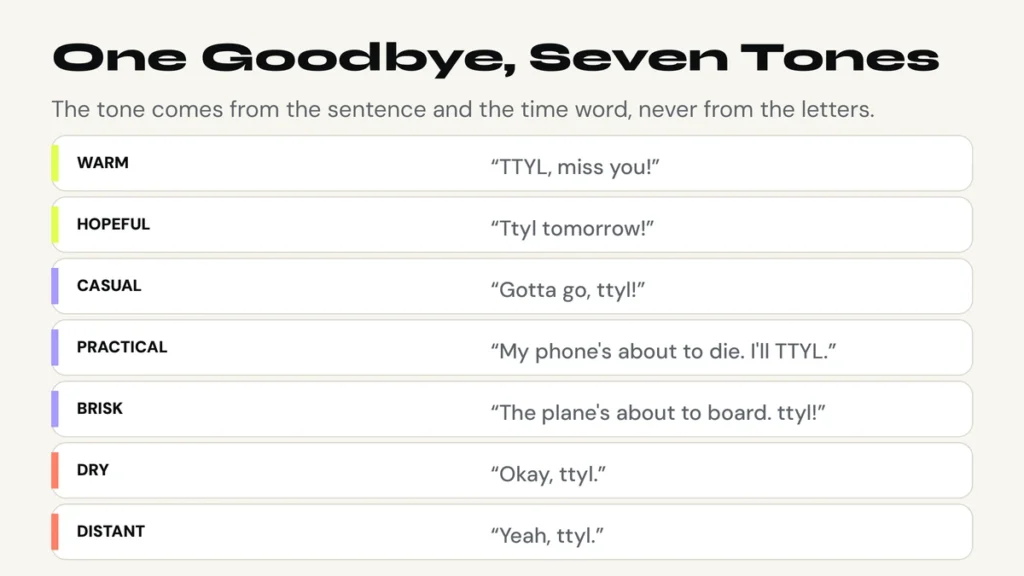
TTYL has one meaning and seven tones, and the tone never comes from the letters. It comes from the sentence around TTYL, the time word attached to it, and the relationship — the same three signals the Later Test reads, turned into a scale. The tones below are ordered by how warm the goodbye feels, from the warmest to the coldest, and the time word is a tone signal all by itself: a “tomorrow” is warmer than a “later,” and a “later” is warmer than nothing.
- Warm: “TTYL, miss you!” — A goodbye wrapped in a feeling. The “later” is soon, and the sender wants you to know it.
- Hopeful: “Ttyl tomorrow!” — A goodbye that is really a plan. The clock is named, and the promise is dated.
- Casual: “Gotta go, ttyl!” — The default. A goodbye with no edge, the way most TTYLs are sent and most are received.
- Practical: “My phone’s about to die. I’ll TTYL.” — A goodbye sent on logistics, not feelings. Warmth is beside the point; the battery is the point.
- Brisk: “I’ll have to ttyl, the plane’s about to board.” — A goodbye sent on the move. Short, real, and gone in a sentence.
- Dry: “Okay, ttyl.” — Flat, and the hardest to read. Shortness alone proves neither coldness nor warmth, but it proves nothing warm either.
- Distant: “Yeah, ttyl.” — A cooling goodbye. Short words, no time word, no reason, and the reader is left to guess whether “later” means anything at all.
The tones overlap by design. A real TTYL can be practical and warm at the same time (“Gotta run, ttyl tomorrow, miss you!”), and the scale gives you vocabulary for the in-between cases the three-question test sorts more coarsely. The one rule that holds across the whole scale is the clock rule: the more specific the time word, the warmer the goodbye reads, because a named time is a promise with a date on it, and a vague “later” is a promise with no date at all.
When “TTYL” Does Not Mean “Talk to You Later”
TTYL has one dictionary meaning, but it does more than one job, and three of its jobs are not the dictionary meaning at all. The first is the polite full stop: a TTYL sent to end a conversation the sender does not want to continue, where “later” means “not now, and probably not soon.” How-To Geek says this openly — sometimes you use TTYL even if you have no immediate plans of talking to someone again, and then you are using it as a polite goodbye rather than as its literal definition. The letters are the same; the promise is not. The Later Test catches this one in Question 2: a TTYL with no reason, no clock, and no topic, sent after a conversation that was already cooling, is a full stop wearing a promise’s clothes.
- The polite full stop: a bare “ttyl” that ends a conversation the sender does not plan to restart. The promise is the politeness, not the plan.
- The topic promise: “I’ll ttyl about it” — not a goodbye at all, but a promise to return to a subject. The “later” attaches to the topic, not to the conversation.
- The “ta-ta, you all” folk claim: some guides say TTYL may have come from “ta-ta, you all,” a British goodbye from the 1980s. No dictionary supports this, and it is graded UNVERIFIED in the checked-claims section — a nice story, not a fact.
- The book title: in 2004, Lauren Myracle published a young adult novel called “ttyl,” written entirely as text conversations between teenagers, and it became a New York Times bestseller. The title is a pop-culture use of the abbreviation, not a second meaning.
- The work misread: in a work thread, TTYL can be read as a dismissal — the sender is leaving the conversation, and the reader cannot tell whether “later” means after lunch or after the project. The abbreviation is not wrong there, but the setting is.
- The stranger’s wave: from a stranger or a creator, TTYL is a promise of a private conversation from someone who owes nothing. It is the easiest TTYL to leave unanswered, and the one most likely to mean nothing at all.
- The mid-message TTYL: “TTYL, my tea is boiling over” puts the abbreviation at the start of the message, not the end. Position does not change the meaning here — it is still a goodbye — but it changes the shape: the sender is leaving mid-thought, and the reason is the whole message.
The rule across all seven is simple: TTYL always stands for “talk to you later,” but it does not always promise a later. The letters are fixed; the promise is not. That is the one thing the dictionaries cannot tell you, because no dictionary grades a promise. The Later Test exists for exactly this gap — it reads the clock, the reason, and the topic, and tells you which of the seven jobs this particular TTYL is doing.
Who Is Sending It: How “TTYL” Lands by Sender
The meaning stays “talk to you later” for every sender. What changes is how the promise lands, and how long “later” is allowed to be before it starts to feel like a brush-off. A close friend gets the longest “later” of anyone, because the friendship already carries the promise. A stranger gets the shortest, because there is no history to hold it up. The list below is about the landing, not the definition — no sender changes what the letters stand for.
- Close friend: the safest TTYL. Usually warm and practical, a plan rather than a formality, and the “later” can stretch for days without anyone worrying.
- Crush: the most over-read TTYL. A goodbye that can feel loaded with meaning it may not actually have, because every vague word gets weighed. The Later Test is worth running here more than anywhere else.
- Partner: usually comfortable shorthand built on shared history. A fast goodbye for the night or the day, and the “later” is understood without being named.
- Parent or family: plain and practical, and rarer, so warmer. Usually “I have to go, but I will check in” — a TTYL with a reason attached, which is the warmest shape it takes.
- Coworker: friendly but risky, because work threads keep receipts. A TTYL in a work chat can read as a dismissal if the conversation was not finished, and “later” has no clock on it when a deadline does.
- Stranger or creator: the easiest TTYL to leave unanswered. A promise of a private conversation from someone who owes nothing, and the one most likely to be a polite full stop.
- Group chat: the hardest TTYL to place. It can be aimed at one person in the room or at the whole room, and the reply it gets depends on who thinks it was meant for them.
Gender does not change the meaning. The guides that address it agree in substance — the same letters from a girl and from a guy, with the tone coming from the relationship and the rest of the message, not from who typed it. What changes the reading is the history between the two people, and the history is the one thing the abbreviation never carries. That is why the sender section and the Later Test belong together: the test reads the message, and the sender list reads the relationship, and the honest answer needs both.
“TTYL” on TikTok
On TikTok, TTYL lives in the comments, and the comments are the most public place the abbreviation ever appears. A creator ends a live or a reply thread with TTYL, and the goodbye is performed for strangers as much as for the person it is aimed at. That publicity loosens the promise: a TTYL in a TikTok comment is the likeliest home of the loosest TTYL in this guide — a bare “ttyl!” with no time word, no reason, and no topic, sent where hundreds of people can see it and nobody can tell who it was for. The FYP guide covers the feed whose comments collect these goodbyes, and the pattern there is the same one this guide describes everywhere: the core meaning stays “talk to you later,” and only the looseness changes.
TTYL also shows up in TikTok captions and video text, usually as a sign-off on a storytime or a reply video — “storytime part 2, ttyl!” — where it is doing the same job it does in a chat, closing one installment and promising the next. The promise is thinner here than in a private message, because the audience is a crowd and the “later” is whenever the next video appears, but it is still a promise, and viewers read it that way. No source supports a distinct TikTok meaning for TTYL, and this guide claims none: the platform changes the publicity, not the definition.
“TTYL” on Snapchat
Snapchat is the most natural home TTYL has. The chats are fast and disappearing, the rhythm is send-reply-send-reply, and a goodbye that promises a next conversation fits that rhythm exactly. A TTYL on Snapchat usually arrives at the end of a streak of snaps, when one person has to go — to class, to work, to bed — and the other person knows the conversation will pick up the next time either of them opens the app. The opened-read receipt makes a repeated TTYL sharper here than anywhere else: a TTYL you have already read, followed by another TTYL the next day, reads as a pattern, and patterns are how readers decide whether “later” is real.
The disappearing messages change the stakes, not the meaning. Because the chat vanishes, a TTYL on Snapchat carries no receipt to check later — nobody can scroll back and count how many “laters” never happened. That makes the abbreviation lighter here than in text messages, where the thread keeps score. The tone is usually the casual or practical one from the tone scale, and the warmest Snapchat TTYLs are the ones with a time word attached: “ttyl after school” is a plan, and a plan survives disappearing messages better than a vague “later” does.
“TTYL” on Instagram
Instagram splits TTYL by place, and the place decides how much the promise weighs. In DMs, TTYL carries the real promise — a one-to-one goodbye at the end of a private conversation, with a history behind it and a next message expected. In comments, TTYL is the polite wave: a creator or a follower closing a public exchange, where “later” means “the next time we happen to cross paths on here.” The IG guide covers the app where both the DM promise and the comment wave live, and the split there is the same one this guide draws for every platform: same letters, different weight.
TTYL also appears in Instagram stories and reels, usually as a caption sign-off — “more tomorrow, ttyl!” — where it is promising a next post rather than a next conversation. The job is the same, the audience is a crowd, and the clock is the posting schedule. No source supports a distinct Instagram meaning, and none is claimed here. What Instagram adds is the clearest version of the platform rule in this guide: the more private the place, the heavier the promise; the more public the place, the lighter it gets.
“TTYL” in Text Messages
Private texting is where TTYL is at its fullest, because the thread keeps score. A text message thread remembers every “later” that never arrived, and that memory is what makes a texted TTYL heavier than a commented one. In text messages, TTYL carries the widest range in this guide: classic sign-offs (“Gotta go, ttyl!”), promises with times (“ttyl tomorrow!”), warm closes (“TTYL, miss you!”), overnight goodbyes (“I have to get to sleep early, TTYL!”), and pauses rather than ends (“I’ll ttyl about it”). The DM guide covers the one-to-one thread where TTYL lives most of its life, and the pattern there matches the one in this guide: the abbreviation is a pause with a promise, and the thread is the record of whether the promise was kept.
Texting is also where the bare TTYL is coldest. In a private thread, a bare “ttyl” after a long message is not a casual sign-off — it is a door closing, and the reader knows it, because the thread shows exactly how much was left unanswered. The same bare “ttyl” in a TikTok comment means almost nothing; in a text thread, it means the conversation is over for now, and the next message, if there is one, will come from the sender. That difference is not a difference in meaning. It is a difference in evidence, and the evidence is the thread itself.
“TTYL” vs Its Closest Cousins
TTYL belongs to a family of goodbye abbreviations, and the family differs by the clock, not by the job. Every cousin below is a sign-off that promises a next conversation; what changes is how much of the “when” each one carries. TTY leaves the clock out entirely. TTYL adds “later” and leaves it vague. TTYS tightens it to “soon.” TTYT names the day. That is the whole family tree, and the Later Test is built on it: Question 1, the clock question, is the question that sorts the cousins from each other.
- TTY (“talk to you”): the parent and the closest cousin. TTY promises to talk again with no time word at all; TTYL is TTY with the clock added back in. Read the TTY guide for the three-question Sign-Off Test that sorts a goodbye from a teletypewriter.
- TTYS (“talk to you soon”): the cousin that tightens the promise. “Soon” is a shorter “later,” and a TTYS reads warmer than a TTYL for exactly that reason. Named, not linked — no TextsMeaning article exists yet.
- TTYT (“talk to you tomorrow”): the cousin that names the day. The most specific promise in the family, and the warmest, because a named day is a promise with a date on it. Named, not linked — no TextsMeaning article exists yet.
- BRB (“be right back”): the opposite move in the same conversation. BRB promises a return in minutes, where TTYL promises a talk again sometime. Read the BRB guide for the quick return.
- GTG (“got to go”): the exit to TTYL’s entrance. GTG closes a conversation; TTYL closes it with a promise attached. Read the GTG guide for the exit without the promise.
- GN (“good night”): the sign-off to TTYL’s sign-off. GN ends a conversation for the day, where TTYL promises it will continue. Read the GN guide for the sign-off that names the night.
- CYA (“see you”): the cousin that promises a meeting, not a message. TTYL promises words; CYA promises a face. Read the CYA guide for the meeting versus the message.
- CUL8R (“see you later”): the cousin that spells the promise out loud, letter by letter, and means almost exactly what TTYL means — a goodbye with “later” built in. Named, not linked — no TextsMeaning article exists yet.
Checked Claims: Expansions That Do Not Hold Up
Eight claims about TTYL, graded against Wiktionary, the Oxford Advanced Learner’s Dictionary, Merriam-Webster, the Oxford English Dictionary record, and the two full competitor reads. A claim is graded REJECTED when the sources contradict it, UNVERIFIED when no source supports it and none contradicts it, and CONFIRMED when the sources agree. The grading is the point of this section: TTYL is so familiar that people repeat things about it that nobody has ever checked.
- “TTYL means talk to you later” — CONFIRMED. Wiktionary lists it directly, the Oxford Advanced Learner’s Dictionary lists it directly, Merriam-Webster describes it directly, and every competitor read agrees. This is the strongest grading in the section, and the only one that is unanimous.
- “TTYL comes from ‘ta-ta, you all'” — UNVERIFIED. Reader’s Digest and Parade both repeat this as a possibility — “some think” and “others say” — and no dictionary supports it. A British goodbye from the 1980s with the same meaning is a nice story, and it is presented here as a story, not a fact.
- “Merriam-Webster added TTYL in 2016” — REJECTED as stated. One guide claims Merriam-Webster added TTYL in 2016. The 2016 addition that is actually documented is the Oxford English Dictionary’s, reported by How-To Geek and repeated by other guides. The dictionary is right; the name attached to it is wrong.
- “TTYL has no other meaning” — CONFIRMED with a note. One guide states that TTYL has no other meanings other than “talk to you later,” and the dictionaries agree: unlike TTY, which also names a teletypewriter, TTYL has no device reading, no computing reading, and no second life anywhere. The note is that the same letters do more than one job — a polite full stop, a topic promise — but those are jobs, not meanings.
- “TTYL is only for teenagers” — REJECTED as a generational claim. The first Urban Dictionary definition was posted in June 2002, the abbreviation was in use long before then, and the guides that describe its users describe people of all ages — parents texting about kids, coworkers boarding planes, friends going to bed early for morning meetings. No first-use date ties it to a generation, and no study does either.
- “TTYL works in professional settings” — REJECTED. One guide claims TTYL can be used in a variety of contexts, including social and professional settings. The first half is right and the second half is not: TTYL is a casual sign-off that does not belong in work email, and in a work thread it can read as a dismissal, because “later” has no clock on it when a deadline does. The appropriateness section below gives the substitutes.
- “TTYL always promises a later conversation” — REJECTED. How-To Geek says it openly: sometimes you use TTYL even if you have no immediate plans of talking to someone again, and then you are using it as a polite goodbye rather than as its literal definition. A promise the sender does not plan to keep is still a goodbye, but it is not a promise.
- “TTYL is brand-new internet slang with no history” — REJECTED. The abbreviation is four decades old in spirit: Merriam-Webster traces it to abbreviations that sprang into widespread use in the 1980s and 1990s, it was in use in IRC chatrooms and on AIM, MSN, and Yahoo Messenger before SMS made it universal, its first Urban Dictionary definition dates to June 2002, and the Oxford English Dictionary added it in 2016. The phrase “talk to you later” predates the internet by many years, and the letters are younger than the words, not younger than the habit.
Where “TTYL” Came From
TTYL came from the same place most of the abbreviations in this series came from: the early internet, where people typed fast, on small keyboards, in rooms full of strangers, and cut phrases down to their first letters to save time. How-To Geek traces it to the early days of internet chatrooms like IRC, where shorthand acronyms replaced full phrases, and says it gained traction with instant messaging apps like AIM, MSN, and Yahoo Messenger, where it was commonly used prior to logging off. That last detail matters, because it explains the shape of the abbreviation: when portable internet devices were uncommon, telling others you were shutting down your computer was standard online etiquette, and TTYL was the way you said it.
In the late 1990s and early 2000s, as SMS became the most common form of digital communication besides email, TTYL moved from the chatroom to the phone. Reader’s Digest gives the practical reason: SMS messages limited how many characters you could send in one text, typically to 160, and abbreviations saved time and space. TTYL was the way most people said goodbye to a texting partner, and it stayed the way people said goodbye long after the character limit stopped mattering, because the habit had already formed. The abbreviation outlived the constraint that created it, which is the usual story of internet slang.
The paper trail is unusually good for a slang term, and this guide reports it exactly. The first definition of TTYL on Urban Dictionary was posted in June 2002, three years after the website was founded, and the term was in use a long time before then. In 2004, Lauren Myracle published “ttyl,” a young adult novel written entirely as text conversations between teenagers, and it became a New York Times bestseller, cementing the abbreviation in pop culture. In 2016, the Oxford English Dictionary added TTYL, alongside other internet initialisms including SMH and TBH. Merriam-Webster describes TTYL as one of a host of abbreviations that sprang into widespread use in the 1980s and 1990s, popularized in Internet chat forums. No first-use date is claimed beyond those milestones, because no source read for this build can put a year on the very first TTYL — the shift happened gradually, in millions of private chats, and nobody was keeping score.
The “ta-ta, you all” story deserves its own paragraph, because it is the one origin claim in this guide that cannot be verified. Reader’s Digest says some think TTYL originally stemmed from “ta-ta, you all,” a popular British saying of the same meaning in the 1980s, and Parade repeats it in the same hedged form. No dictionary lists it, no dated source supports it, and the two guides that repeat it both present it as a possibility, not a fact. It is graded UNVERIFIED in the checked-claims section, and it is repeated here only so the reader knows it exists and knows it is unproven. The documented history — IRC, instant messaging, SMS, Urban Dictionary in 2002, the novel in 2004, the OED in 2016 — needs no folk etymology to stand on.
How to Reply When Someone Sends “TTYL”
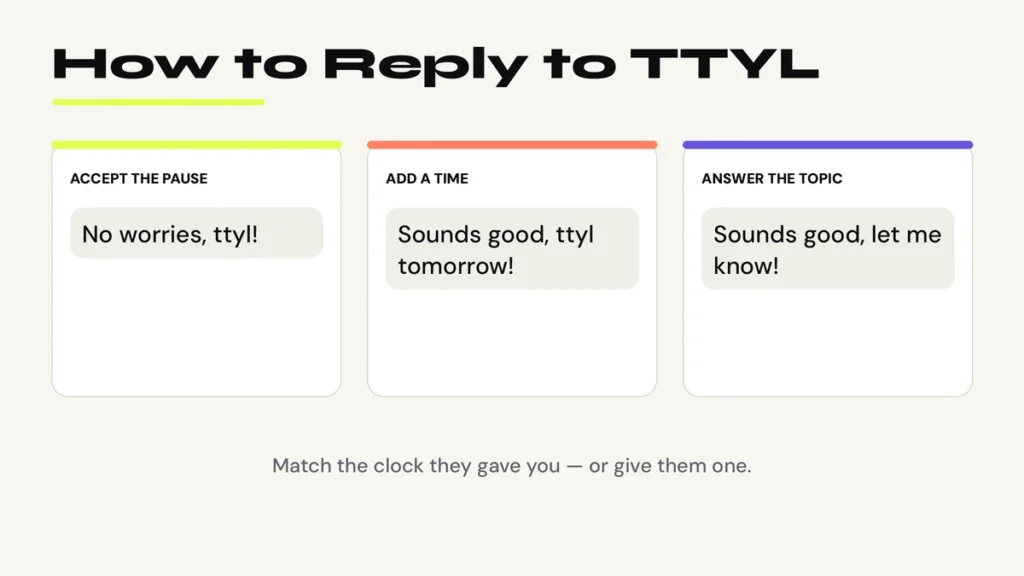
Replying to TTYL is easy once the Later Test has done its work, because the test tells you which job the TTYL is doing, and the job tells you the reply. A pause gets a wave back. A topic promise gets an answer about the topic. A warm close gets warmth back. A bare wave gets a short wave back, and nothing more. The reply bank below is ordered the same way the tone scale is ordered — warmest first — and the rule underneath it is the clock rule: match the clock they gave you, and if they gave you none, give them one of your own.
- Accept the pause: “No worries, ttyl!” — For the errand pause and the bedtime close. Accepts the reason and returns the wave.
- Add a time: “Sounds good, ttyl tomorrow!” — For any TTYL with a vague clock. You supply the date the sender left out, and the promise gets a schedule.
- Answer the topic: “Sounds good, let me know what they say.” — For “I’ll ttyl about it.” The reply is about the subject, not the goodbye.
- Return the warmth: “Miss you too, ttyl!” — For the warm close. A TTYL with feeling in it earns feeling back.
- Wish them well: “Safe flight, ttyl!” — For the travel goodbye and the phone-dying exit. The reason is real, so the reply names it.
- Match the bare wave: “Okay, ttyl.” — For the bare “ttyl” with no reason, no clock, and no topic. Short, polite, and nothing more. Do not chase it with three more messages.
The one reply that never works is the one that ignores the test. Answering a topic promise like a goodbye stalls the conversation on a question nobody asked. Answering a bare wave with a paragraph proves the sender right to leave. And answering a warm close with a bare “ok” spends goodwill the sender just offered. Run the three questions — when, why, wait — and the reply writes itself: a wave for a pause, a date for a vague clock, an answer for a topic, warmth for warmth, and a short wave for a short wave.
Frequently Asked Questions
What does TTYL mean in a text message?
TTYL means “talk to you later.” It is a casual way of saying goodbye in a text while promising to talk again, and it is used when the sender has to stop chatting for now — to go to sleep, to run an errand, to board a plane — but expects the conversation to continue later. The “later” is deliberately vague: it can mean tonight, tomorrow, or next week.
What is the difference between TTY and TTYL?
TTY means “talk to you” and TTYL means “talk to you later.” The difference is the clock: TTY promises to talk again with no time word at all, and TTYL adds “later,” which is vague but still a time word. TTYL is also the safer of the two, because TTY can mean a teletypewriter on a contact page, while TTYL has no second meaning anywhere. The Later Test in this guide sorts the cousins by the clock each one carries.
Is TTYL rude?
A single TTYL between friends is about as rude as a wave — not rude at all. It only feels rude when it cuts a conversation off: sent in the middle of a conversation that is not finished, or to a person who was clearly still talking, the goodbye reads as a door closing rather than a promise. A bare “ttyl” with no reason, no clock, and no topic is the coldest shape it takes, and the reply it gets will be shaped by the cutting-off as much as by the goodbye.
What does “ttyl” mean from a girl?
It means “talk to you later” — the same as from anyone else. The letters do not change with the sender, and the guides that address the question agree in substance: the tone comes from the relationship and the rest of the message, not from who typed it. From a crush, a TTYL can feel loaded, because every vague word gets weighed, but the honest reading still runs the Later Test on the message itself: the clock, the reason, and the topic, not the sender.
Can I use TTYL at work?
Not in work email, and carefully in work chats. TTYL is a casual sign-off that does not belong in resumes, cover letters, formal documents, or customer-facing business communication, and in a work thread it can read as a dismissal, because “later” has no clock on it when a deadline does. Professional substitutes are “I will follow up with you tomorrow” and “I will be in touch soon.” Between close coworkers in a casual chat, a TTYL is fine — the relationship, not the abbreviation, decides.
Does TTYL mean goodbye forever?
No. TTYL means the conversation is pausing, not ending. It promises a next conversation, even when the “later” is vague. The exception is the polite full stop — a TTYL sent to end a conversation the sender does not plan to restart — and the Later Test catches that one: no reason, no clock, no topic, after a conversation that was already cooling. The letters are the same in both cases; the promise is not.
When was TTYL added to the dictionary?
The Oxford English Dictionary added TTYL in 2016, alongside other internet initialisms including SMH and TBH. The first Urban Dictionary definition was posted in June 2002, and the term was in use long before then — in IRC chatrooms, on AIM, MSN, and Yahoo Messenger, and then in SMS. Merriam-Webster describes it as one of a host of abbreviations that sprang into widespread use in the 1980s and 1990s.
What does TTYS mean, and how is it different from TTYL?
TTYS means “talk to you soon.” It is TTYL with a tighter clock: “soon” is a shorter “later,” so a TTYS reads warmer and more definite than a TTYL. TTYT means “talk to you tomorrow” and names the day outright, which makes it the most specific promise in the family. The family differs by the clock, not by the job — every cousin is a sign-off that promises a next conversation.
The Takeaway
TTYL means “talk to you later,” and that is the easy part. The hard part is the “later,” and the hard part is the whole guide: a goodbye with a promise built in, where the promise has no clock on it. The dictionaries agree on the letters — Wiktionary lists the reading directly, the Oxford Advanced Learner’s Dictionary lists it directly, Merriam-Webster traces it to the chat forums of the 1980s and 1990s, and the Oxford English Dictionary added it in 2016 — and the guides agree on the job, a sign-off that closes a conversation without closing the door. What none of them can tell you is how long your particular “later” is, and that is what the Later Test is for: ask when, ask why, ask whether a reply is expected, and trust the clock over the reason when they disagree.
If you remember one thing from this guide, remember the clock rule. A TTYL with a named time is a plan. A TTYL with a reason is a pause. A TTYL with a topic is a promise about something specific. And a bare TTYL with none of the three is a wave with no date attached — polite, honest, and not worth chasing. Run the test, match the clock they gave you, and when they gave you none, give them one of your own: “Sounds good, ttyl tomorrow!” That is the whole guide in one reply.