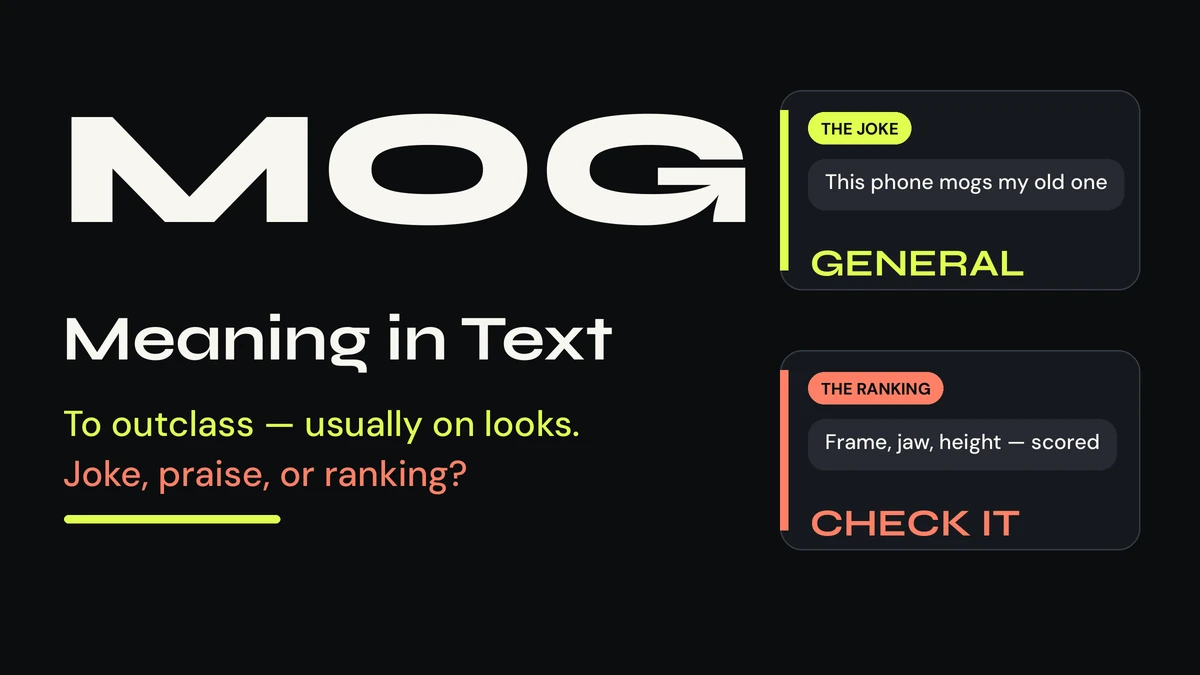
What does mog mean in text? To mog someone is to outclass them — to look or perform so much better than them, side by side, that they fade a little by comparison. This guide to mog meaning in text gives you the MOG Outclass Test, so you can tell in seconds whether the mog you just saw was a joke, praise, or a ranking with a sting.
This guide covers the two dictionary-backed senses, the three-check test, seven tones, MOG on TikTok, Snapchat, Instagram, and in texts, how it lands by sender, when it crosses a line at work, school, and home, graded claims, cousins, a dated history from AMOG to Collins Dictionary’s 2026 Word of the Year, and a reply bank keyed to the reading you just identified.
What “MOG” Means in Text
MOG is a verb, not an initialism of a phrase — the first thing that sets it apart from most terms in this series. It has three forms you will actually see: mog (the base verb), mogged (the past tense, usually about yourself: “I got mogged”), and mogging (the ongoing act). Two more words travel with it: a mogger is the person doing the outclassing, and a moggee is the person on the losing end, both used with a wink. The core meaning is comparison: one person or thing is put next to another, and the gap between them is the whole point.
The dictionary record is unusually strong for a slang term, and this guide leans on all of it. , read directly for this article, calls mog “a humorous Internet slang term meaning ‘to outclass,’ used especially to describe one person as appearing far more attractive than another,” and notes it was originally used to praise one man as taller, more muscular, or more stereotypically handsome in direct comparison to another man. Wiktionary, also read directly, lists the slang sense as “to manifest effortless dominance through self-evident superior handsomeness, especially with composure and by quiet comparison,” and adds the wider second sense, “to be superior to (something); to beat, outclass.” Dictionary.com agrees in its own words: “to be noticeably superior to someone, in everything from physical appearance to performance on a sports team,” and it carries the same informal-word-summary note as its MBN page, so this guide treats it as an established reference’s usage summary, not a formal definition.
Two senses, then, and the difference between them is the first thing to learn. Sense one is the looks sense: faces, height, build, jawlines, hair — one person looks better than another in a photo or a room. Sense two is the general sense: a team, a phone, a film, a city can mog another, with no face involved at all. The looks sense came first and still carries the sting; the general sense is newer, wider, and almost always a joke. And the word is having a moment: Collins Dictionary named “mogging” its 2026 Word of the Year on 2026-11-03, two days before this article was built, after a 210% rise in usage during 2026. A term that started in niche forums is now, officially, the year’s word.
The MOG Outclass Test
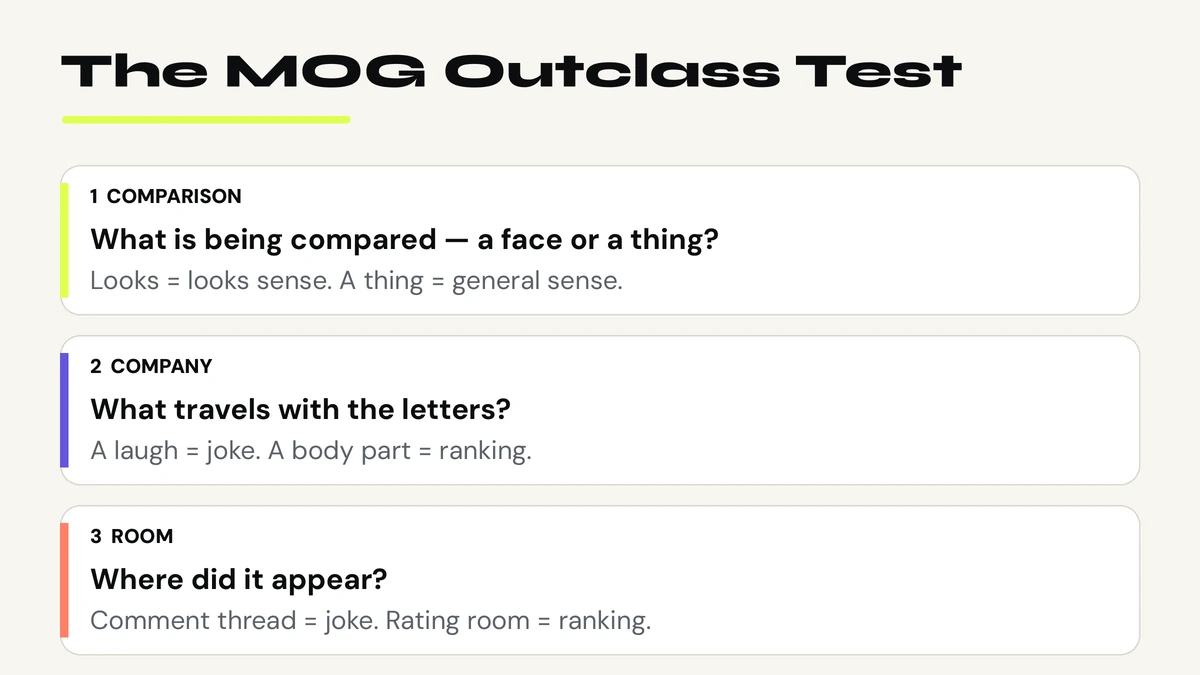
Before you answer a mog — or send one — run three checks. They take about five seconds, and they beat every shortcut the competitors offer, because the competitors all say “it depends on context” without giving you a procedure for reading it:
- Check 1 — The Comparison Check. What is being compared, and on what? A face, a height, a build in a photo means the looks sense. A game, a gadget, a film, a city means the general sense. If you cannot point to the thing being compared, there is no mog at all — just a word being waved around. Name the comparison first, and half the readings disappear.
- Check 2 — The Company Check. What travels with the letters? A laugh, a “lol,” a self-mocking follow-up (“got mogged by my cat”) points to a joke. Ranking language, a side-by-side photo, a named body part (frame, jaw, hair) points to a ranking. Jokes bring company; rankings bring evidence. The company is the fastest single clue, because the sender chooses it on purpose.
- Check 3 — The Room Check. Where did it appear? A public comment thread stages a joke for an audience. A private DM can carry either reading, so the first two checks do the work there. A classroom, a looks-rating forum, or a chat that scores faces is where the ranking sense lives — and where the word stops being funny. If the room ranks people, read it as a ranking, whatever the emoji says.
Worked trio. “This new phone mogs my old one”: comparison a gadget, company plain, room a tech thread. General sense, pure joke, no person ranked. “He mogged everyone in that photo”: comparison looks, company admiring, room a public comment thread. Praise with a competitive edge, and the test says enjoy it, do not fear it. “You just got mogged lol, look at that jawline”: comparison a face, company a jab plus a body part, room a group chat that rates looks. Ranking, aimed at a person — and the reply it deserves is completely different from the first two. Three messages, one verb, three readings — and the test, not the spelling, sorted them.
“MOG” in Real Chats
Illustrative examples written for this guide, not real transcripts:
- The photo comment. “He mogged everyone in that photo”: admiration with a competitive edge. The photo is the evidence, and the comment is the applause.
- The self-mock. “I got mogged by my cat”: the sender aims the verb at themselves and loses on purpose. The joke is that a cat outshone a human, and nobody is ranked.
- The sports boast. “He mogged everyone on his football team!”: the general sense at full volume. No face is being judged; a performance is.
- The gadget comparison. “This new phone mogs my old one”: a thing outclassing a thing. The looks sense never enters the room, and the sentence proves how far the general sense has travelled.
- The gym frame-mog. “He is frame mogging everyone in the gym”: a bigger build doing the outclassing, named by body part. Closer to the looks sense, and the one to watch for the ranking edge.
- The group-chat pile-on. One friend posts a selfie; three replies in a row read “mogged,” “you just got mogged lol,” “jawmogged”: the crowd turns a comparison into a verdict. Answer the group, not the coldest single reply.
- The ironic rollercoaster. A rider sits perfectly still while everyone around them screams, captioned “mogging the whole row”: composure as the outclassing. The calm is the point, and the joke lands because nobody is being ranked.
“MOG” on TikTok
On TikTok, MOG lives in comments and captions, and the comment thread is its natural habitat: a creator posts a photo, a clip, or a glow-up, and the comments fill with “he mogged everyone in this video” or “I got mogged by a cat.” The public stage suits the playful and admiring readings best, because a comment thread is an audience, not a private conversation — nobody there is owed a sentence, and the joke lands precisely because everyone in the thread knows the feeling of being outshone.
TikTok is also where the word went mainstream in 2026. In February 2026 a clip of looksmaxxing creator Clavicular being “frame-mogged” by a bigger man at Arizona State spread across the platform, and the rollercoaster trend — sitting perfectly still while the row screams, to mog the riders around you — turned composure into a punchline. Olympic figure skater Alysa Liu even joked that her competition strategy was “to mog.” If a MOG arrives in a TikTok DM, though, run the test as usual — a DM is private again, and the ranking reading returns with it.
“MOG” on Snapchat
On Snapchat, MOG fits the fast, private, disappearing DM: “bro just mogged us all in that pic” as a story reply, or a bare “mogged” on a streak snap between close friends. The disappearing format suits the playful readings — a joke that lands lightly and is gone. But disappearance also removes your evidence: if a MOG felt like a ranking, you cannot re-read it, so judge from memory what rode with it — a laugh, a body part, or nothing at all.
Snapchat is also where the photo does half the work. A picture of two friends side by side plus “mogged” needs no explanation: the image names the comparison, and the letters only say who won it. That is the Comparison Check working in real life — remove the MOG and the snap still shows two people, one of whom the camera likes more, which is how you know the job was comparison, not information.
The MOG Tone List
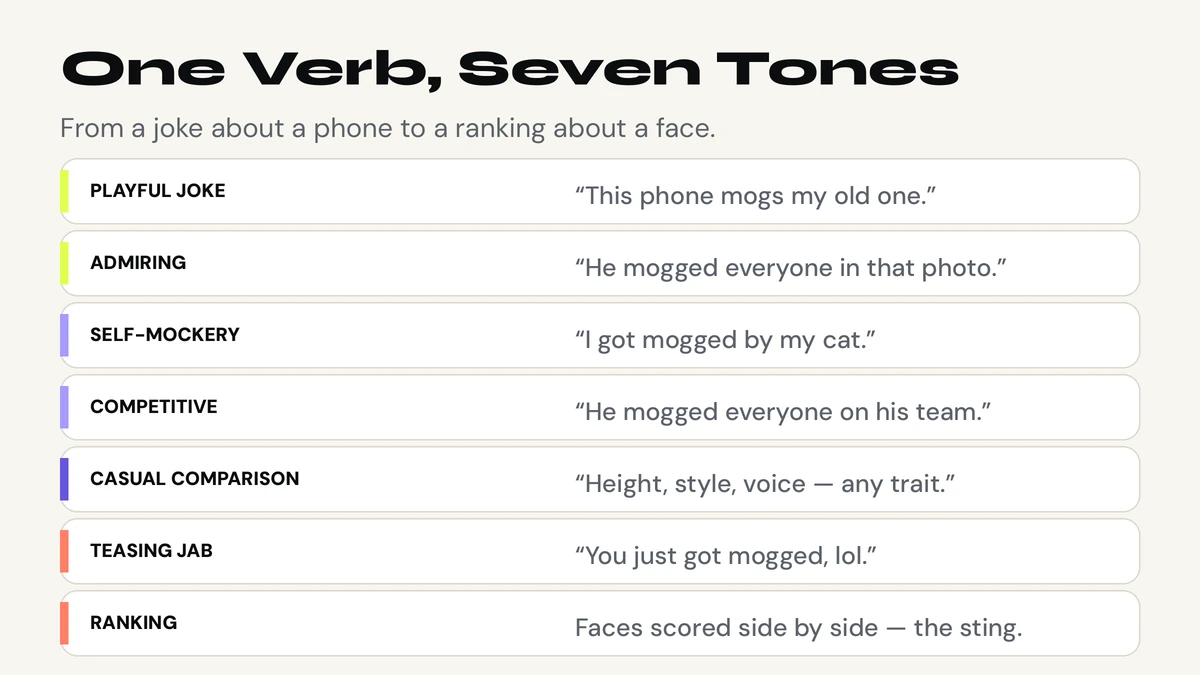
MOG’s verb never changes; its feeling slides across seven readings, lightest to riskiest. The first four are safe to send; the last one is safe only as a joke nobody believes:
- Playful joke: “This phone mogs my old one” — a thing beating a thing. The comparison is the joke, and no person is in it.
- Admiring: “He mogged everyone in that photo” — praise with a competitive edge. The gap is real, and naming it is the compliment.
- Ironic self-mockery: “Got mogged by my little sister at her graduation” — the sender loses on purpose, proudly. The joke is aimed inward.
- Competitive: “He mogged everyone on his football team” — a performance gap, stated plainly. The scoreboard does the talking, not a face.
- Casual comparison: Height, style, voice, walk — the compound family (heightmog, stylemog, voicemog, walk-mogging) turns any trait into a comparison. Light as long as it stays casual.
- Teasing jab: “You just got mogged lol” — aimed at a person, in front of people. Funny between friends who tease each other; a jab anywhere else.
- Ranking: The looksmaxxing sense: faces and bodies scored side by side, with the lower person meant to feel inferior. This is the reading the dictionaries warn about, and the only one with a real cost.
What moves a reading between these tones is never the letters alone: it is the comparison (a thing or a face), the company (a laugh or a body part), and the room (a comment thread or a rating forum). The same “mogged” that is a joke about a phone on Saturday can be a ranking about a jawline on Monday — and the test, not the spelling, tells you which day you are on.
“MOG” on Instagram
On Instagram, MOG shows up in comments, captions, story replies, and DMs, and the stage decides the tone the way it does for every comparison term. Comments lean public and playful: “he mogged the whole shoot” under a friend’s photos is applause the whole thread can join. Captions lean ironic: “mogging my own feed today” under an ordinary photo is a joke about outshining yourself. DMs carry the full range, exactly like texts — a friend’s admiring comment and a stranger’s ranking jab live in the same inbox, and only the test tells them apart.
Instagram is also where MOG meets its closest platform trap: reading a public comment as a private verdict. A stranger’s “mogged” under your post is a reaction to a photo, not a rating of your face, and answering it with a life story embarrasses both sides. A thank-you, a matching laugh, or silence all end it cleanly; the comment was never asking for more. The exception is a DM that names a body part and keeps score — that is a ranking, and the reply section below covers it.
“MOG” in Text Messages
Plain texts are MOG’s home ground for the general sense, and the one-to-one setting makes the distinction sharpest. A playful text wants a witness: “This game mogs the old one, no contest.” A ranking text wants a decision from you: is this a joke between friends, or is someone keeping score about looks? The reply each one deserves is completely different, which is why the Room Check comes before the reply — answering a ranking with a laugh you do not feel, or a joke with suspicion, is the classic MOG misfire.
Texts are also where a MOG debate turns into a longer conversation, and the conversation usually moves somewhere private. A friend who replies “you got mogged lol” and means it as a joke often follows up with the photo itself — our DM guide covers that move in full, because the channel changes what the next message can say. And texts are MOG’s work limit in miniature: never send MOG in a professional message. A client, a manager, or a first contact deserves plain language, not three letters that presume an intimacy and a casualness you do not have — and never one that ranks anyone’s looks.
Who Is Sending It: How “MOG” Lands by Sender
No source documents a different meaning of MOG per sender — the verb stays fixed; what changes is which reading you should expect, and therefore what you owe back:
- Friend: the default. A friend’s MOG is a playful joke or admiration at face value; run the test and answer that, not the letters.
- Crush: overread territory. A crush’s MOG feels bigger than it is — usually “I notice you look good,” not a confession about you. Answer the comparison, not a romance you invented.
- Partner: pattern rules. A partner’s MOG is usually routine teasing; judge the pattern across days, not one message — but a sudden run of ranking MOGs after warm ones is worth one plain question, not a fight.
- Parent: usually literal and plain. A parent who writes MOG has usually learned it from you and means the comparison plainly; do not read a parent’s MOG as a ranking unless the sentence around it names a body part.
- Coworker or boss: context decides. In a friendly team chat a colleague’s MOG about a game is a joke; in any formal thread it is out of place, and never send one upward to a manager or client — and never one that compares people’s looks.
- Group chat: both habitats at scale. A group’s “mogged!!” cheers for everyone; a group’s single “jawmogged” after your selfie still stings, but answer briefly in the group either way, and do not single one sender out for a private reading of a public comparison.
- Stranger or creator: the applause habitat. A stranger’s MOG under your post, or a creator’s MOG in a caption, is a public reaction, not a verdict on you personally. A thank-you or a matching laugh is enough; never answer a public reaction with a private confession about how you look.
When “MOG” Is Too Much: Work, School, and Family
This section is mandatory for MOG in a way it is not for most terms in this series, because MOG’s risk is not vulgarity — the word is clean — but ranking: it turns people into scores, and scores into feelings about faces and bodies. Four rooms, four rules. At work: never send MOG in a professional message, a client thread, or a formal channel. A game joke among close peers in a casual chat is one thing; the same letters comparing two colleagues’ looks read as a ranking, and a ranking at work is a problem, not a joke. If the room would want a compliment, give one that names no loser.
At school: the same rule, with a younger audience, and a sharper edge. Teachers have turned to TikTok to explain the term because it is already in middle-school classrooms and chatrooms, and the comparison habit it carries is exactly what worries the adults watching it. A child psychiatrist quoted in the Guardian warned about the “constant sense of competition” the word fosters in teenagers, and the Cleveland Clinic warns that looksmaxxing can harm teen boys’ physical and mental health and, in extreme cases, contribute to body dysmorphic disorder. Teachers, school groups, and class chats are not MOG rooms, and a student who sends a ranking MOG about a classmate’s face has sent a judgment whether they meant to or not. The clean swap is a full sentence: “you look great in that photo.” In family chats, read the room person by person: a sibling group may love the joke, a grandparent group may not know the letters, and a parent who dislikes ranking people will dislike the abbreviation exactly as much as the verb, once they learn what it stands for. Abbreviation is not permission.
The general rule covers every room at once: if someone tells you MOG bothers them, simply stop. Switching words is easy, and it shows respect. The swap menu is free and it loses nothing: “you outshone everyone” for admiration, “that was unreal” for a performance, “you look great” for a photo. And one boundary worth stating plainly: never use MOG to rank someone’s face or body, even as a joke, because you cannot control who reads it or how it lands — and never use it to dress up cruelty. A comparison aimed at making someone feel inferior is not teasing; it is a ranking wearing a joke’s clothes, and the Room Check catches it, because the room that receives repeated rankings is not a joking room at all.
Checked Claims: Expansions That Do Not Hold Up
Three letters attract folklore, and a word this new attracts more than most. Each claim below was graded against the dictionaries read in full and the competitors read in full; nothing is repeated here as fact on a single blog’s say-so:
- “MOG comes from ‘mogul’” — rejected. One competitor derives mog from “mogul,” meaning a powerful person. No dictionary supports it: Merriam-Webster, Wiktionary, and Dictionary.com all trace mog to AMOG, “alpha male of group,” and none mentions mogul. A plausible-sounding word is not a derivation.
- “MOG is only about looks” — rejected as a full account. The looks sense is the original and the famous one, but every dictionary read for this article also documents the general sense: a team, a phone, a film, a city can mog another. Reducing the word to faces deletes half its job.
- “MOG is always a joke” — rejected. Most use today is playful or ironic — Merriam-Webster says so directly — but the same page notes the judgments behind mogging “have been criticized as harmful,” and Dictionary.com notes the word is still used in manosphere contexts. A joke with a ranking inside it is still a ranking.
- “TikTok invented mogging” — rejected. TikTok spread the word; it did not invent it. Merriam-Webster dates mog to 2016 in male internet forums, Wiktionary to fitness forums and imageboards around 2016, and a Know Your Meme explainer already existed in November 2023. TikTok is the stage, not the author.
- “Clavicular invented mogging” — rejected. The streamer Clavicular helped make the word mainstream in 2026, when a February clip of him being frame-mogged spread widely, but the word predates him by a decade. Popularizing a word and inventing it are different jobs.
- “Getting mogged means you are ugly” — rejected. A mog is a comparison, not a verdict. Being outshone in one photo, one game, or one moment says nothing durable about how you look — and the general sense proves it, because a phone can be mogged without being ugly at all.
- “Mogging is the same as looksmaxxing” — rejected. Looksmaxxing is the work of improving your own appearance; mogging is the act of outshining someone else. One is a project, the other is a comparison. They travel together, and they are not the same word.
- “MOG is a British word for a cat, so it means cat in texts” — fenced, not a texting meaning. Mog is genuinely an old British word for a cat, short for moggy, and Dictionary.com still lists it — but that noun lives in British pet talk, not in chats. Nobody replying “mogged” to a photo is naming a cat.
What SURVIVES: to mog is to outclass, usually on looks and sometimes on anything at all, with the seven tones above as feelings of the same verb — not different meanings; AMOG as the source, dated to the early 2000s; mog itself to 2016, popularized around 2021, mainstream in 2026; and Collins Dictionary naming “mogging” its 2026 Word of the Year, announced 2026-11-03. A Word of the Year is a usage award, not a formality ruling: the word stays informal slang, and this guide treats it that way.
“MOG” vs Its Closest Cousins
MOG belongs to the comparison family — words that put one thing next to another and score the gap. Its closest cousins split by what they compare:
- ICK (looks-judgment cousin). Our ICK guide covers the sudden turn-off: one small moment that flips attraction off. ICK judges a feeling about a person; MOG judges a person against another person. One reports a reaction, the other runs a contest.
- FR (co-sign cousin). Our FR guide covers the sincerity stamp that certifies a claim. A comment that reads “fr, he mogged everyone” uses FR to certify the MOG: one word makes the claim, the other swears it is true.
- IKR (agreement cousin). Our IKR guide covers the echo that agrees with a feeling. A reply of “ikr, totally mogged” agrees with the comparison; MOG makes it. One shares the judgment, the other delivers it.
- LFG (opposite-direction cousin). Our LFG guide covers a cheer that fires a group up. LFG celebrates with everyone; MOG picks a winner and leaves a loser. The direction is opposite, even when both sound loud.
- “Chopped” (looks-ranking cousin). The other side of the same coin: where MOG names the winner of a looks comparison, “chopped” names the loser. Both come from the same ranking rooms, and both carry the same cost when aimed at a real person.
- “Slay” (compliment cousin). The clean alternative: praise without a loser. “Slay” says someone looks great; MOG says someone looks better than someone else. When the comparison adds nothing, the compliment alone is the kinder word.
- MBN (envy cousin). Our MBN guide covers “must be nice” — the reaction to someone else’s good fortune, genuine or sarcastic. MBN envies the winner; MOG names them. One looks sideways at the prize, the other runs the contest.
Where “MOG” Came From
The trail is unusually well dated for a slang term, because four different kinds of evidence converge on it. The acronym came first: AMOG, “alpha male of group,” emerged in online manosphere and pickup-artist communities in the early 2000s, naming the supposedly dominant man in a social setting — a pseudoscientific archetype, as Merriam-Webster puts it plainly, from a subculture it describes as associated with misogynist beliefs and extremist ideologies. By the 2010s, users on those forums had shortened AMOG to mog and turned it into a verb: to outclass someone so thoroughly they appear inferior by comparison, particularly on looks.
The short form’s own dates are agreed across the dictionaries: Merriam-Webster finds mog in male internet forums by 2016, and Wiktionary dates its first appearance to fitness forums and imageboards around 2016, popularized around 2021. In the early 2020s it attached itself to looksmaxxing, the online push to maximize appearance, and the compound family grew — frame, jaw, hair, height, style, voice, walk — each naming one trait to be compared. It spread from forums to Instagram and TikTok, a Know Your Meme explainer arrived in November 2023, a February 2026 clip carried frame-mogging into the mainstream, and on 2026-11-03 Collins Dictionary named “mogging” its 2026 Word of the Year after a 210% usage rise. No inventor is claimed, because there is none: the word was shortened by a community, not coined by a person, and its history is a dated spine — early 2000s, 2016, 2021, 2026 — not a single birth year.
How to Reply When Someone Sends “MOG”

Golden rule: answer the reading the test found, not the letters. A reply bank keyed to the reading:
- Playful joke — laugh back: “Haha, fair, that phone is unreal” or “Okay, that one wins.” The joke is the bond; answer the joke.
- Admiring — accept it: “Right? That photo is unreal” or “He really did.” Admiration answered with agreement keeps the thread warm.
- Self-mockery — join it: “Your cat mogs us all, honestly” or “Same, I get mogged by my own dog daily.” A joke aimed inward deserves a joke back, not comfort.
- Teasing jab — laugh, or deflect: “Okay okay, I will take the L on this one” matches the energy; silence ends it. Never answer a jab with a longer jab unless the friendship runs on that.
- Ranking sting — name the boundary, do not engage: “Not really into ranking people’s faces, honestly” ends it cleanly. You owe no defense of how you look, and no debate about a score nobody asked for.
- You want them included — turn the comparison into a plan: A playful MOG is an opening, not just a verdict — our HMU guide covers the open invitation in full, because “next time, you are coming too” turns a comparison into a plan, and plans beat rankings every time.
Frequently Asked Questions
What does MOG mean in a text message?
MOG means to outclass someone — to look or perform noticeably better than them, side by side. In a text it is usually a joke or praise about a comparison (“this phone mogs my old one”), and sometimes a ranking about looks. Run the Outclass Test before you decide which one you just got.
What does mogged mean?
Mogged is the past tense. If you got mogged, someone next to you looked or performed noticeably better — in a photo, a game, or a room. It is usually said about yourself, as a joke or a shrug: “I got mogged by my cat.” A mogger is the one who did the outclassing; a moggee is the one who got outclassed.
What does MOG mean on TikTok?
On TikTok, MOG usually means to outclass someone in comments or captions, most often on looks: “he mogged everyone in this video.” The public stage suits the playful and admiring readings best. In February 2026 a frame-mogging clip went viral there, and the rollercoaster trend turned sitting still into a MOG joke.
What does MOG mean on Instagram?
On Instagram, MOG usually means to outclass someone in comments, captions, story replies, and DMs. Comments lean public and playful, captions lean ironic, and DMs carry the full range exactly like texts. A stranger’s MOG under your post is a public reaction to a photo, not a rating of your face.
Is mogging rude or harmful?
It depends on the reading. The joke and general senses are not rude. The ranking sense — scoring faces and bodies side by side — is where the harm lives: Merriam-Webster notes the judgments behind mogging have been criticized as harmful, and clinicians warn the comparison habit can damage teenagers’ body image. Never use MOG to rank someone’s looks.
Can I use MOG at work or school?
Generally, no. MOG belongs in casual digital conversations. In work messages, formal chats, or school messages it can sound unprofessional, and a ranking MOG about a classmate’s looks is a judgment, not a joke. In a casual peer chat about a game or a gadget, it is fine; anywhere formal, or anywhere faces are compared, spell it out instead.
What should I reply when someone says I got mogged?
Answer the reading the test found. A playful joke gets a laugh back (“Haha, fair”); admiration gets agreement (“Right? That photo is unreal”); a teasing jab gets a laugh or a deflect; a ranking sting gets a boundary, not a debate (“Not really into ranking people’s faces”). The full reply bank is in the section above.
Does lowercase mog mean something different from MOG?
No. Capitalization changes volume, not meaning: capital MOG reads a touch louder, lowercase mog reads softer and faster, but both mean to outclass. What changes the reading is the comparison, the company, and the room — never the case alone.
The Takeaway
MOG means to outclass: one person or thing put next to another, and the gap between them is the whole point. The verb never changes; the feeling does — joke, praise, competition, or ranking. When a MOG lands, run the Outclass Test: check the comparison, check the company, check the room. And when you send one, remember the only rule that matters: a joke compares things, a ranking compares people — so if you mean it playfully, keep the people out of the score, and if you mean it warmly, prove it with a follow-up sentence, because Collins Dictionary just named this the word of the year, and the whole internet is watching how it gets used.